
Sweden Crypto Tax 2026 : K4, Skatteverket, and DAC8
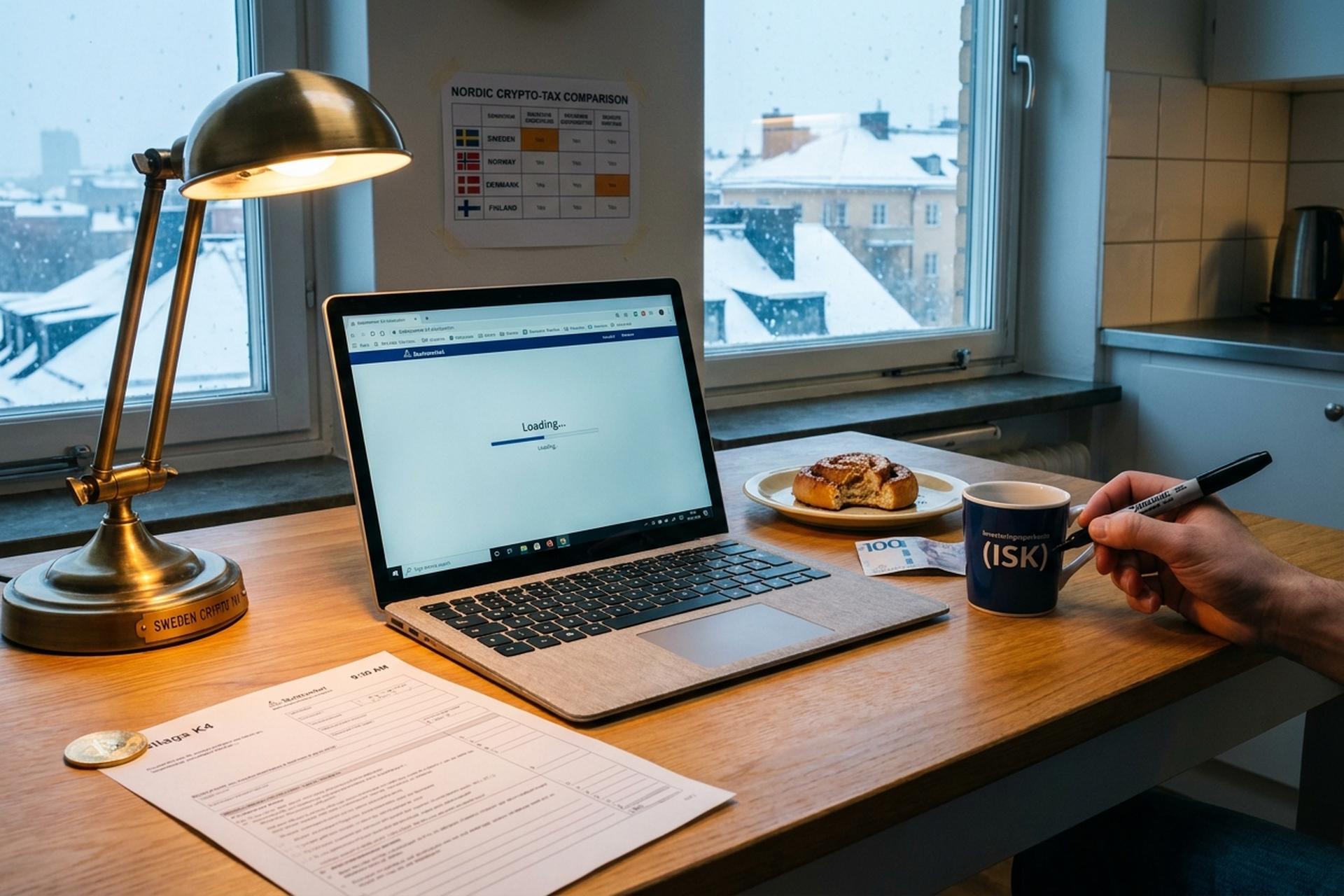
A first-time Swedish crypto declarant arriving at Skatteverket usually meets the Sweden crypto tax regime through one assumption that turns out to be wrong. The ISK tax-shelter account, the one most Swedes already use for listed shares, also covers Bitcoin. It does not. Crypto sits outside ISK, outside kapitalförsäkring, and outside the schablonintäkt regime that quietly underpins the whole Swedish retail-investing experience. The first surprise is finding the K4 form. The second surprise is the 70% rule on losses. The third surprise is that, starting in 2026, the exchanges report you to Skatteverket whether you file or not.
Roughly 400,000 to 600,000 Swedes hold crypto by Finansinspektionen and industry estimates. About 10 percent of in-store payments in Sweden were still made in cash in 2023, by the Riksbank's Payments Report, the lowest figure in the EU. That cashless baseline is the macro frame for crypto tax in Sweden today. Sweden does not have a crypto-specific tax law on the books. It has a general capital-income chapter, a strict declaration system, and a Swedish tax agency that has spent three years building the data infrastructure to enforce them — a workmanlike approach with consequences. The Swedish tax rules treat crypto assets as ordinary capital, with the cross-border automatic exchange of information set to land in 2026.
How Cryptocurrency Is Taxed in Sweden
Cryptocurrency is treated as kapital income under chapter 52 of Inkomstskattelagen (1999:1229), the umbrella statute for personal taxation in Sweden. Crypto fits the "annan tillgång" classification (other asset), which means it is not a security, not a delägarrätt, and notably not eligible for the ISK or kapitalförsäkring tax shelters. Anyone who has ever bought a fund inside ISK and benefited from the deemed-income schablonintäkt rate (typically well below 30 percent) discovers that crypto pays the full flat rate.
That flat tax rate is 30 percent on net kapitalvinst, the rate of 30 percent that Swedish residents already know from listed-share gains. Tax on gains follows the same income tax rate logic as any other capital position. It has applied to capital income in Sweden since the 1990 tax reform that simplified the dual-income system, and the rate has held through the 1999 IL rewrite and every revision since. There is no progressive band on crypto gains and no annual exemption like the Finnish €1,000 capital-gains allowance. Every taxable event, however small, lands inside the same 30 percent line.
Skatteverket's list of taxable events is short and unambiguous: when you sell your crypto for SEK, swap one crypto transaction for another, settle goods or services with a crypto payment, receipt of mining, staking and airdrop rewards, and certain lending or LP deposit events. Wallet-to-wallet transfers between accounts you control are not taxable. The intra-portfolio bookkeeping that retail investors usually skip is exactly where Skatteverket starts asking questions.
Capital Gains Tax on Crypto and the K4 Form
The mechanical tax return is straightforward to file. Crypto disposals go on bilaga K4, avsnitt D, the section labelled "Övriga värdepapper och andra tillgångar" on the Inkomstdeklaration 1 annual return. Each asset line gets four numbers on the tax report: sales price, omkostnadsbelopp (cost basis), and a gain or loss column. The form sums them and the result flows into the kapital income block. Filing is digital through the Skatteverket e-tjänst portal with BankID. The deadline for tax year 2025 is 2 May 2026.
What looks simple becomes painful in practice for one specific reason: cost basis must be calculated under genomsnittsmetoden, the average-cost method, applied per fungible asset and per the IL 48 kap. 7 § rule referenced through 52 kap. 3 §. Every acquisition rolls into the running average for that asset. Every disposal triggers a new calculation against the average. Schablonmetoden, the 20 percent shortcut used for listed shares, is not available for crypto because crypto fails the marketable-security test. The genomsnittsmetoden quietly forces full transaction histories to be reconstructed every spring.
The second source of pain is SEK conversion. Every taxable event must be valued in SEK at fair market value on the transaction date. Skatteverket accepts reasonable reference rates (Riksbank, major-exchange spot, a defensible source), but it expects the rate to be applied consistently across the year. A user with 800 trades across major crypto exchanges has 800 separate currency-conversion touchpoints, and crypto reporting through software can collapse them. Crypto-to-crypto trades count: trading ETH for SOL is treated as a sale of ETH at SEK FMV and a fresh acquisition of SOL at the same SEK figure. The IRS-style "like-kind exchange" idea does not apply.
For practical execution, almost every active Swedish trader uses tax software. Divly, Koinly, Kryptos and CoinLedger all export K4-compatible files. Divly and Koinly hold the most reliable position for Sweden-native filings because they auto-format the bilaga and the SRU upload that Skatteverket actually consumes. The right workflow for a retail filer is to import the entire year's history from each exchange and self-custody address, reconcile transfers, mark airdrops and staking receipts separately, and let the software output the bilaga rather than build it by hand.
Crypto Losses and the 70% Deductibility Rule
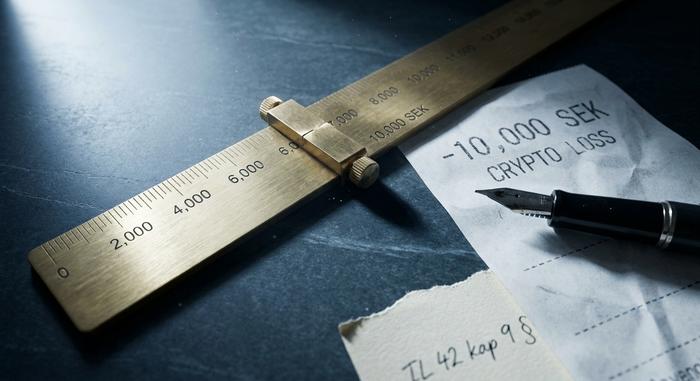
The 70 percent rule is the single most under-appreciated provision in Swedish crypto tax. It sits in IL 42 kap. 9 § and quietly turns symmetric-looking gains and losses into an asymmetric outcome.
The basic mechanic: a kapitalförlust on "andra tillgångar", which includes crypto, is fully deductible against gains on the same asset class within the same tax year. So if you have a SEK 50,000 gain on Bitcoin and a SEK 30,000 loss on Ethereum in 2025, the two net inside the asset class at 100 percent, and you pay 30 percent on the SEK 20,000 net gain. That part is intuitive.
The asymmetry kicks in when the loss flows out of the asset class. Only 70 percent of the crypto kapitalförlust is allowed to offset other capital income such as dividends, interest, and listed-share gains. The remaining 30 percent vanishes. A pure SEK 10,000 crypto loss that has nothing to net against inside the asset class reduces the taxable kapital base by SEK 7,000, not SEK 10,000. At the 30 percent rate that is SEK 2,100 of relief, not SEK 3,000.
The deepest cut comes when the loss creates a general kapital deficit (underskott av kapital) and converts to a skattereduktion against income tax. Sweden gives 30 percent of the deficit up to SEK 100,000 and 21 percent on the portion above. A loss that runs all the way through that pipeline can land at an effective recovery of roughly 14.7 percent. The 30 percent paid on gains is symmetric on the way in and stochastic on the way out.
| Scenario | Tax on gain | Recovery on loss | Asymmetry |
|---|---|---|---|
| Gain SEK 10,000, no other position | 30% = 3,000 | — | — |
| Loss SEK 10,000, netted intra-class (same year) | — | 30% of 10,000 = 3,000 | None |
| Loss SEK 10,000, offsetting other capital income | — | 30% × 70% × 10,000 = 2,100 | 30% lost |
| Loss SEK 10,000 → kapital deficit, top band | — | 21% × 70% × 10,000 = 1,470 | 50%+ lost |
The practical move retail Swedes miss is to separate profit and loss lines per asset on the K4 so the 100 percent intra-class netting actually works before the 70 percent haircut bites. Tax software handles capital gains and losses correctly; manual filers often do not. Annual tax return preparation in Sweden depends on getting this split right before any tax payments are computed.
Mining, Staking, Airdrops and DeFi
Most retail crypto income in Sweden stays in kapital. The exception is when activity becomes systematic enough that Skatteverket reclassifies it as näringsverksamhet, or business income, taxed progressively at 30 to 57 percent depending on the municipality plus egenavgifter or sociala avgifter at roughly 28.97 percent. Hobby mining filed on bilaga T2 sits in inkomst av tjänst with a five-year carry-forward of hobby losses. Industrial mining lands in näringsverksamhet, where the rate jumps and social contributions stack on top.
The threshold is not a single number. Skatteverket weighs scale, professionalism, equipment, and the expectation of durable surplus. The 2018-2019 ställningstagande on mining still in force points to roughly 25 BTC per year as the rough scale at which the agency considers the activity industrial. Below that, hobby treatment usually holds. Above it, the agency expects näringsverksamhet.
Staking rewards are taxed as kapital at SEK FMV on receipt for ordinary delegators. The act of locking ETH to stake is not, by itself, a disposal. Skatteverket clarified this after the Merge. The reward issuance is the taxable moment. The cost basis of the received tokens is the SEK FMV at that moment, which then carries forward into the genomsnittsmetoden running average for that asset.
Airdrops are taxable kapital income at SEK FMV when they arrive in your wallet, and that FMV becomes their cost basis. Hard forks follow the same logic, with receipt at FMV setting a fresh basis. Lending interest is generally ränta and falls into kapital. DeFi liquidity provision is the corner of the regime with the least clean guidance: depositing tokens into an LP is generally treated as a disposal of the deposited assets at SEK FMV, with the LP tokens acquired at the same SEK value, and the withdrawal reverses the logic. That doubles the bookkeeping load relative to a simple swap.
MiCA and DAC8: What Changes for 2026
The two EU rules that matter for Swedish crypto holders this year are MiCA and DAC8. MiCA, Regulation (EU) 2023/1114, applied in full from 30 December 2024. Stablecoin titles (ART and EMT) kicked in earlier, on 30 June 2024. In Sweden the national competent authority for CASP authorisation and ART/EMT supervision is Finansinspektionen. Pre-MiCA Swedish VASPs operate under a transitional period of generally up to eighteen months from the start date, meaning they must be MiCA-authorised by mid-2026 to keep serving Swedish retail customers.
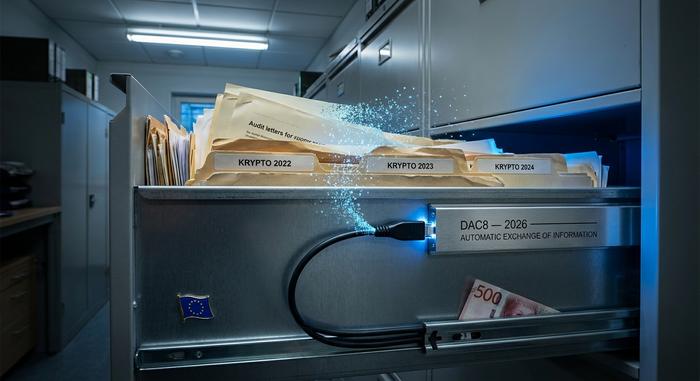
DAC8, Council Directive (EU) 2023/2226, is the directly relevant reporting framework for tax obligations. Member states had until 31 December 2025 to transpose. The first reporting period is calendar year 2026. The first reports flow to tax authorities by 31 January 2027 and the first automatic exchange between member states is due by 30 September 2027. The scope is broad: EU-resident CASPs and, importantly, non-EU CASPs that serve EU customers. From the perspective of a Swedish crypto holder, the practical effect is that Skatteverket's existing audit-letter pipeline, already large enough to have produced thousands of correction notices since 2022, turns into a structured data feed. The argument that an exchange "is not really visible" to the Swedish tax authorities stops working in 2026.
Riksbank, e-krona and Cryptocurrency in Sweden
Discussions of Swedish crypto tax often slide into talk about the e-krona, which is a category error. The e-krona is a central bank digital currency project, not a crypto asset. The Riksbank ran a four-phase technical pilot between February 2020 and March 2024, when phase 4, focused on offline payments resilience, became the final report. There is no phase 5. There is no go or no-go decision in 2026. The Riksbank has explicitly shifted attention toward following the ECB's digital euro work while keeping its own design and legal preparation alive.
If the e-krona ever launches, it sits outside the chapter 52 IL regime that governs cryptocurrency taxes. A non-remunerated retail CBDC, the design the Riksbank has consistently described, would generate no interest income and no capital gains at all, effectively tax free at the holding level. The reason the e-krona matters to a crypto-tax discussion is rhetorical rather than legal: in a country where roughly 10 percent of in-store payments were cash in 2023 and Swish handles the bulk of digital retail flow, sovereign digital money is the default. Crypto in Sweden competes with that backdrop. That partly explains why Chainalysis's Global Crypto Adoption Index consistently ranks Sweden outside the top thirty despite its world-leading digital-payments penetration. Adoption here is investment-driven, not payments-driven.
Sweden vs Norway, Denmark, Finland
Sweden's headline tax treatment is middle-of-the-pack by Nordic standards. The Swedish income tax framework around crypto becomes punitive at the corners, on losses specifically, rather than at the centre.
| Country | Crypto rate | Loss treatment | Other |
|---|---|---|---|
| Sweden | 30% flat | 70% deductible against other capital (IL 42:9) | K4 bilaga D; ISK excluded |
| Norway | 22% flat | Fully deductible at 22% | Formuesskatt (wealth tax) on holdings |
| Denmark | 27% to DKK 61,000; 42% above | Speculation losses deductible only at 27% vs gains at up to 42% | Skattestyrelsen treats most crypto as speculation |
| Finland | 30% up to €30,000; 34% above | Fully deductible against capital gains | €1,000 annual exemption; hankintameno-olettama option |
Norway is the cleanest for active traders by rate, but it offsets the rate advantage with formuesskatt, an annual wealth tax that values crypto holdings on 31 December of each year. Denmark's brackets are the most punitive on losses and have triggered an ongoing reform debate in Folketinget. Finland's hankintameno-olettama lets a holder substitute a deemed acquisition cost (20 percent of sale price for assets held less than ten years, 40 percent for longer holds) in place of the actual basis. That option does not exist in Sweden and partly explains why Finnish retail investors with messy old wallets prefer the Finnish rule set.
EU-wide, MiCA and DAC8 apply to all four; Norway implements MiCA via the EEA agreement on a slightly delayed timeline and follows the OECD's CARF rather than DAC8 for cross-border reporting.
Filing and Penalties: Skatteverket in Practice
The Swedish tax agency runs the same enforcement playbook for crypto as for any other capital income, with one upgrade. Inkomstdeklaration 1 is due 2 May for the previous tax year, filed via the Skatteverket e-tjänst with BankID. K4 attaches as bilaga D for crypto. Documentation must cover the seven-year retention window: exchange CSVs, on-chain records, SEK conversion notes, wallet inventories.
Skattetillägg is the formal name for the surcharge applied to undeclared or incorrectly declared income, and it is 40 percent of the unpaid tax. Self-correction via självrättelse, filed on SKV 6891 or as a structured letter, drops the surcharge to 10 percent provided the correction lands before the agency opens an audit. The number of crypto-related självrättelse filings has climbed from roughly 3,000 in 2020 to about 9,000 in 2024 — a threefold rise — by Divly's tracking, directly linked to the audit-letter wave the agency started sending in 2022 after pulling exchange data.
Is Crypto in Sweden Heading Toward MiCA-Only Custody?
The likely 2026 outcome is consolidation. Pre-MiCA Swedish VASPs that do not complete Finansinspektionen authorisation by mid-2026 lose the right to serve domestic retail customers. Most retail flow already concentrates on the large pan-EU CASPs that have either already obtained authorisation or are in the FI pipeline. For a Swedish crypto holder, that means cleaner reporting on the upstream side, fewer questions on tax refunds, and tighter coupling with Skatteverket via DAC8 on the downstream side. Anyone planning to file crypto income in 2026 should treat the new crypto tax rules as already binding rather than aspirational. The flexibility of the past decade compresses into a single regulated pipe.



