Recurring Payments: Definition, Types, and How They Work
Netflix charges you every month without you lifting a finger. So does Spotify, your gym, your cloud storage, and probably a dozen other services you use weekly but haven't thought about in months. That's recurring payments at work, and they're the backbone of a subscription economy now forecast to hit $2,419 billion by 2028.
This guide covers what a recurring payment actually is, the main types of recurring payments, how the billing cycle works under the hood, and why crypto is emerging as a serious alternative payment method for subscription businesses.
What Are Recurring Payments?
You entered your card number into Netflix once. Maybe in 2019. Since then, $15.99 has left your account every single month without you doing a thing. No login required, no checkout, no confirmation email asking if you still want to subscribe. That's a recurring payment working exactly as designed.
A recurring payment is an automatic charge your billing system runs on a defined schedule — monthly, annual, weekly, whatever the product demands — using credentials the customer provided at signup. One authorization, then the system takes over.
Four parties are involved whenever one of these charges runs:
- Customer — authorizes the initial charge and provides payment credentials
- Merchant — sets the billing schedule and amount, initiates charges each cycle
- Payment gateway — tokenizes credentials, manages retry logic, processes each transaction
- Bank or card network — authorizes the charge and transfers funds
The key word is "tokenized." The gateway doesn't store your actual card number — it stores a surrogate token that maps to your real credentials in a secure vault. That's what makes it legal to charge you again next month without asking.
Where does this show up? Streaming services, SaaS tools, gym memberships, cloud hosting, utility bills, subscription boxes, news paywalls, professional retainers. Slack ($15.99/month), HelloFresh (weekly box), AWS (usage-based monthly) — different products, different billing cycles, same underlying recurring payment structure.
Types of Recurring Payments
The four main types of recurring payments differ in two dimensions: whether the charge amount stays the same each cycle, and whether the subscription has a defined end date.
The simplest model is fixed billing — same charge, same day, every cycle. Netflix at $15.99/month. Spotify. Any SaaS flat-rate plan. There's no calculation involved; the gateway just runs the same transaction on schedule. Predictable for both sides.
Variable billing works differently. The amount charged each cycle reflects actual consumption. Your electricity bill is the obvious example; AWS and usage-based tools like Twilio follow the same logic. You need metered infrastructure to track what was actually used before each billing cycle closes.
Installment payments look like subscriptions but aren't, technically. A phone contract spreading $800 over 24 months is a fixed number of recurring payments with a guaranteed end point. Buy-now-pay-later (BNPL) products use the same structure. Once the term finishes, billing stops automatically.
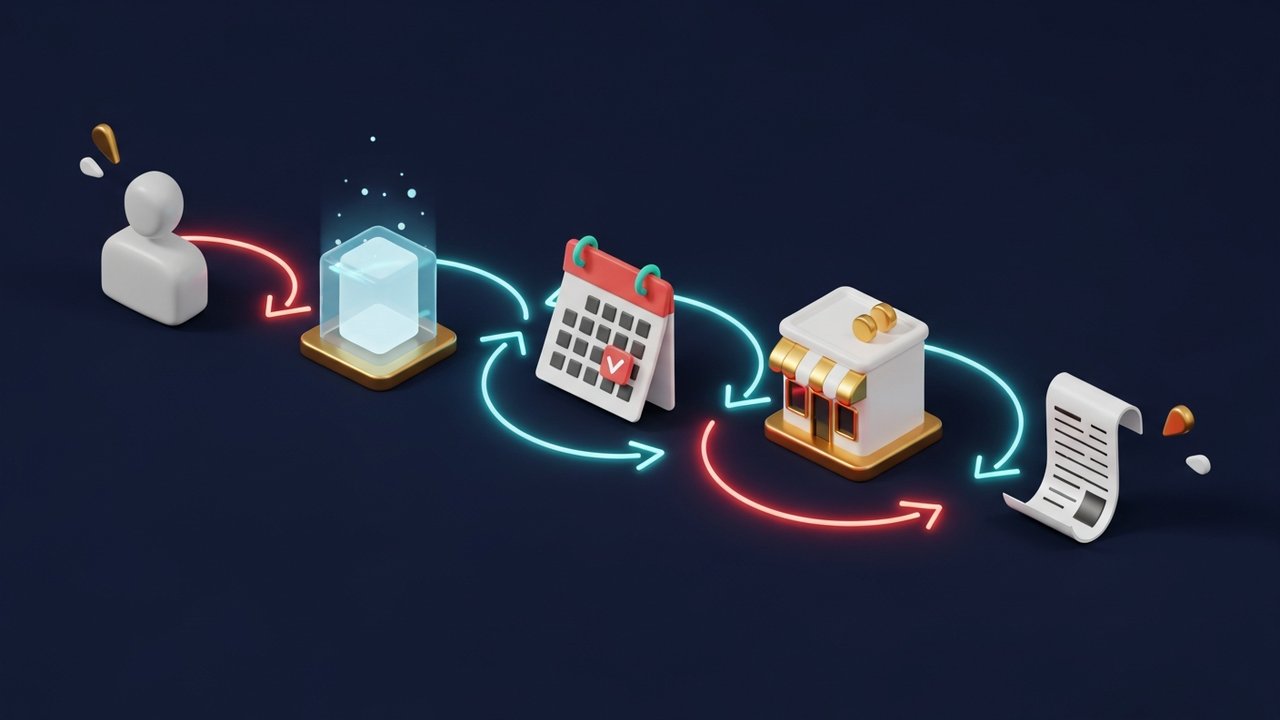
Trial-to-paid is the conversion model. Dropbox, HubSpot, and most freemium SaaS products offer a free tier, then flip it to a paid subscription after a trial period. The recurring billing kicks in automatically unless the user cancels first. Getting the timing and communication right on that conversion is where most companies lose users who would otherwise have stayed.
| Type | Amount | Term | Example |
|---|---|---|---|
| Fixed | Same each cycle | Ongoing | Netflix, Spotify |
| Variable | Changes by usage | Ongoing | AWS, utilities |
| Installment | Fixed split | Finite | Phone plan, BNPL |
| Trial-to-paid | Free then paid | Ongoing | Dropbox, HubSpot |
How Do Recurring Payments Work?
The mechanics behind a recurring payment are more involved than they appear to the customer. Here's the full billing cycle, step by step:
- Customer signs up — provides card or bank account details through a secure checkout form
- Gateway tokenizes credentials — the payment gateway stores a token representing the payment method, never the raw card data itself (PCI DSS compliance requires this)
- Billing cycle starts — at the renewal date, the gateway automatically initiates the charge using the stored token
- Charge routes through the network — the transaction goes through the card network (Visa, Mastercard) or banking rails (ACH for domestic direct debit, SEPA in Europe)
- Authorization received — the bank approves or declines the charge
- Funds transfer — approved funds move to the merchant account
- Receipt sent — customer gets an invoice or email confirmation
- Failed charge triggers dunning — if the transaction fails (expired card, insufficient funds), automated retry logic kicks in with a defined schedule and customer notification
- Cycle repeats — the process restarts at the next billing interval
Tokenization is what makes the whole thing tick. When a customer enters their card number, the gateway swaps it for a unique token — a random string that maps back to the real credentials in a secure vault. Merchants never see raw card data.
Monthly is the most common billing cycle, followed by annual. Annual plans typically go for 15–30% less than the monthly equivalent, which explains why so many products push them at checkout.
Which Businesses Use Recurring Payments?
Subscription businesses exist in nearly every industry. The model works wherever customers want ongoing access to something, and that turns out to be almost everywhere.
- SaaS companies — monthly or annual per-seat plans (Slack, Zoom, HubSpot, Salesforce)
- Streaming services — fixed monthly fee for content access (Netflix, Spotify, Disney+)
- E-commerce subscription boxes — physical products shipped on a schedule (HelloFresh, Dollar Shave Club, Birchbox)
- Utilities and telecoms — variable billing based on consumption (electricity, phone plans, internet)
- Fitness and health — gym memberships, wellness app subscriptions (Peloton, Calm, Headspace)
- Professional services — retainer agreements, monthly legal or accounting plans
- News and media — digital subscriptions (NYT, WSJ, Substack creators)
- Cloud and hosting providers — usage-based or flat hosting fees (AWS, Cloudflare, DigitalOcean)
80% of historical vendors now offer subscription-based recurring billing models, according to Gartner. Software and media are the most visible examples, but the logic applies to any business with repeat customers.
Benefits of Recurring Payments
Subscription billing keeps growing because it solves real problems for cash flow, customer retention, and long-term unit economics on both sides of the transaction.
For businesses:
- Predictable revenue — monthly recurring revenue (MRR) is measurable and forecastable, which makes financial planning and fundraising significantly easier
- Cash flow stability — subscription billing delivers consistent incoming funds across every billing cycle, rather than lumpy one-off payments
- Customer retention — an active subscription keeps customers in the product longer, raising lifetime value and reducing pressure to re-acquire lapsed buyers
- Reduced admin overhead — automatic billing eliminates manual invoicing; you can automate the process from charge to receipt without touching it
- Amortized acquisition cost — upfront CAC pays back over a subscription lifetime, improving unit economics at scale
- Upsell opportunities — ongoing relationships create natural moments to upgrade customers to higher tiers
For customers:
- Convenience — no manual payments to remember; uninterrupted service without friction
- Budget predictability — fixed monthly or annual costs are easy to plan around
- Better pricing — annual subscription payments typically run 15–30% cheaper than month-to-month equivalents
46% of Americans have at least one streaming service subscription. Subscription e-commerce grew more than 100% year-over-year for five consecutive years running.
Challenges of Recurring Payments
Recurring billing has real operational friction. Every subscription business runs into the same problems eventually — the question is whether you've built systems to handle them before they hurt revenue.
Failed payments are the most common issue, and the most recoverable. Cards expire. Bank fraud filters block unfamiliar charge patterns. Customers run low on funds mid-cycle. A proper dunning setup — automated retries on day 1, day 3, day 7, notification emails at each step — recovers 20–40% of initially failed charges. Without it, those transactions just disappear as lost revenue.
Subscription fatigue is harder to fight. Customers accumulate recurring bills over time, stop noticing value, and cancel on impulse during the next billing cycle. This is the leading threat to customer retention in subscription businesses. One fix that consistently works: a pause option. 55% of consumers rank pause-not-cancel as a top subscription priority, and it keeps users who'd otherwise be gone.
Chargebacks happen when customers don't recognize a transaction on their statement. Two things prevent most of them: a clear billing descriptor (your actual brand name, not some truncated processing code) and a renewal reminder email sent 3–5 days before each charge. Neither requires complex infrastructure.
Card expiry quietly kills subscriptions at scale. Visa and Mastercard both run card updater services that push new card numbers to merchants automatically, but you need to be enrolled. Without it, expired cards just fail silently and churn adds up.
Selling internationally introduces another layer of complexity — SEPA direct debit in the EU, PIX in Brazil, UPI in India. Each market has a preferred payment method, and card-only billing misses significant portions of those audiences. A payment gateway with multi-method routing handles the complexity, but setup takes time.
On the compliance side: PCI DSS applies whenever you store customer payment information. The practical answer is to use a payment gateway that maintains its own PCI certification and handles tokenization, so your servers never touch raw card data at all.
Crypto Recurring Payments: The New Option
Most recurring billing guides stop at credit cards and ACH. Cryptocurrency barely gets a mention — and when it does, it's usually dismissed as too volatile or too complicated for subscriptions. That dismissal misses what's actually happening.
Crypto fixes three specific problems that card-based billing can't.
The first is chargebacks. Blockchain transactions are irreversible. When a customer pays with a card and then disputes the charge — claiming they didn't authorize it, even though they did — the merchant loses the money and pays a dispute fee. This "friendly fraud" runs at about 1–2% of subscription revenue for many businesses. With crypto, there's no dispute mechanism. The transaction settles and stays settled.
The second is card expiry. Wallets don't expire. A subscriber who signed up two years ago still has the same wallet address. No silent churn, no card updater service needed, no failed renewal because someone got a new card.
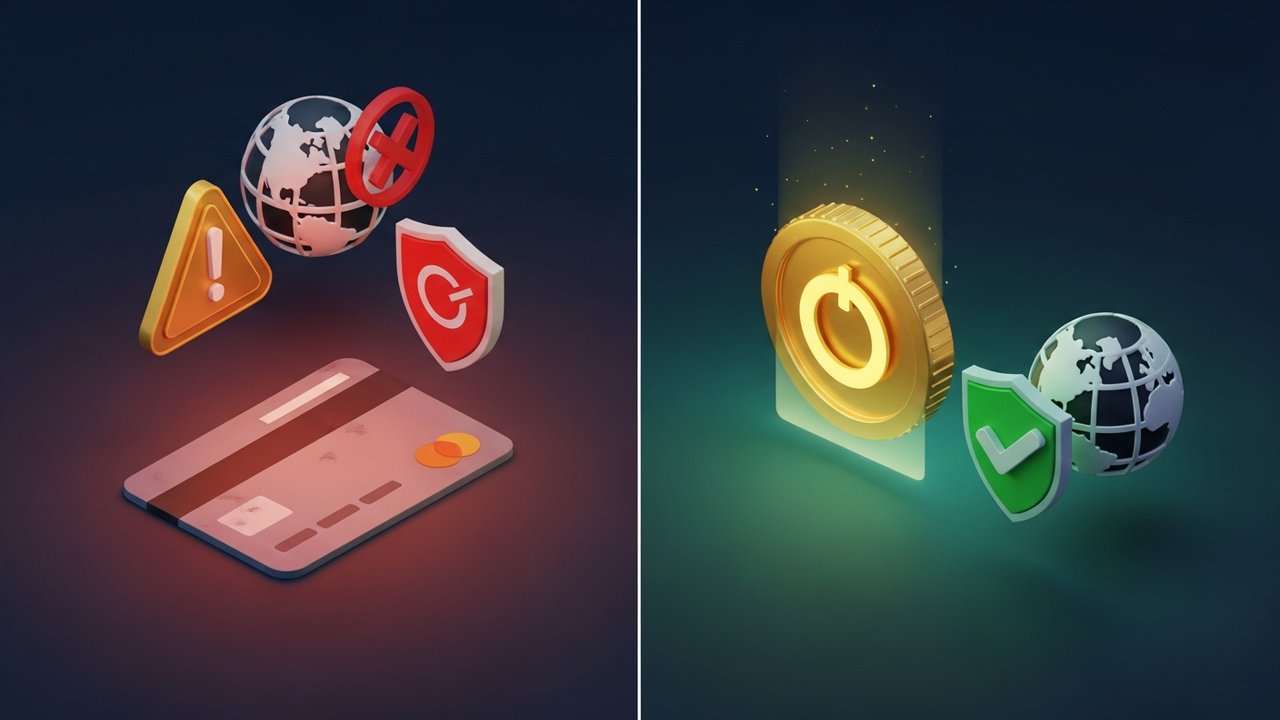
The third is cross-border cost. Sending a subscription payment from Singapore to a US-based SaaS via traditional rails means currency conversion, SWIFT routing fees, and 2–3 business days of settlement. With stablecoins — USDC or USDT, both pegged 1:1 to the US dollar — it costs near nothing and settles in minutes. The merchant gets exactly $9.99 regardless of where the customer is.
Smart contracts add a layer of programmable subscription logic on top: enforcing trial periods, pausing billing, handling upgrades — all without manual management on the merchant side.
The real challenge is that most blockchains use a "push" model. Users initiate transactions; merchants can't pull funds on a schedule the way card networks do. Crypto payment gateways solve this through pre-authorized sessions and signed transaction logic, enabling recurring charges without requiring customers to manually approve each billing cycle.
| Factor | Card subscription | Crypto subscription |
|---|---|---|
| Chargeback risk | High | Zero |
| Cross-border fees | 2–5% FX | Near zero |
| Card expiry | Yes | No |
| Settlement time | 2–3 days | Minutes |
| Global reach | Limited by card networks | Borderless |
Plisio is a crypto payment gateway built for businesses that want to accept recurring payments in stablecoins or other cryptocurrencies without building custom blockchain infrastructure. It supports multiple currencies, handles the recurring charge logic, and integrates into existing billing workflows.
How to Set Up Recurring Payments
Getting recurring billing live is a technical project, but the steps are consistent regardless of which platform you pick.
- Choose a payment gateway that supports recurring billing — it must offer tokenization, automated retry logic for failed charges, and a subscription management API
- Define your billing model — fixed, variable, or hybrid; monthly vs. annual; trial period length and conversion logic
- Build the signup flow — collect payment details through a hosted form or direct API integration; never store raw card data on your own servers
- Configure dunning rules — set the retry schedule for failed payments (a common pattern: retry on day 1, day 3, and day 7 after the initial failure) and the customer notification emails that accompany each retry
- Connect your accounting system — link billing events to invoicing and revenue recognition so every charge automatically generates a record
- Test the full cycle — including failed payments, cancellations, plan upgrades and downgrades, refunds, and trial conversions
- Add crypto as an alternative payment method — particularly valuable for international subscribers or tech-forward audiences who prefer crypto rails over card networks
Most payment gateways offer sandbox environments. Run every failure mode through them before going live. A broken dunning sequence or a cancellation flow that doesn't work costs real customers — you want to find that in testing, not in production.