Fastest Crypto Transactions: TPS, Finality, Fees
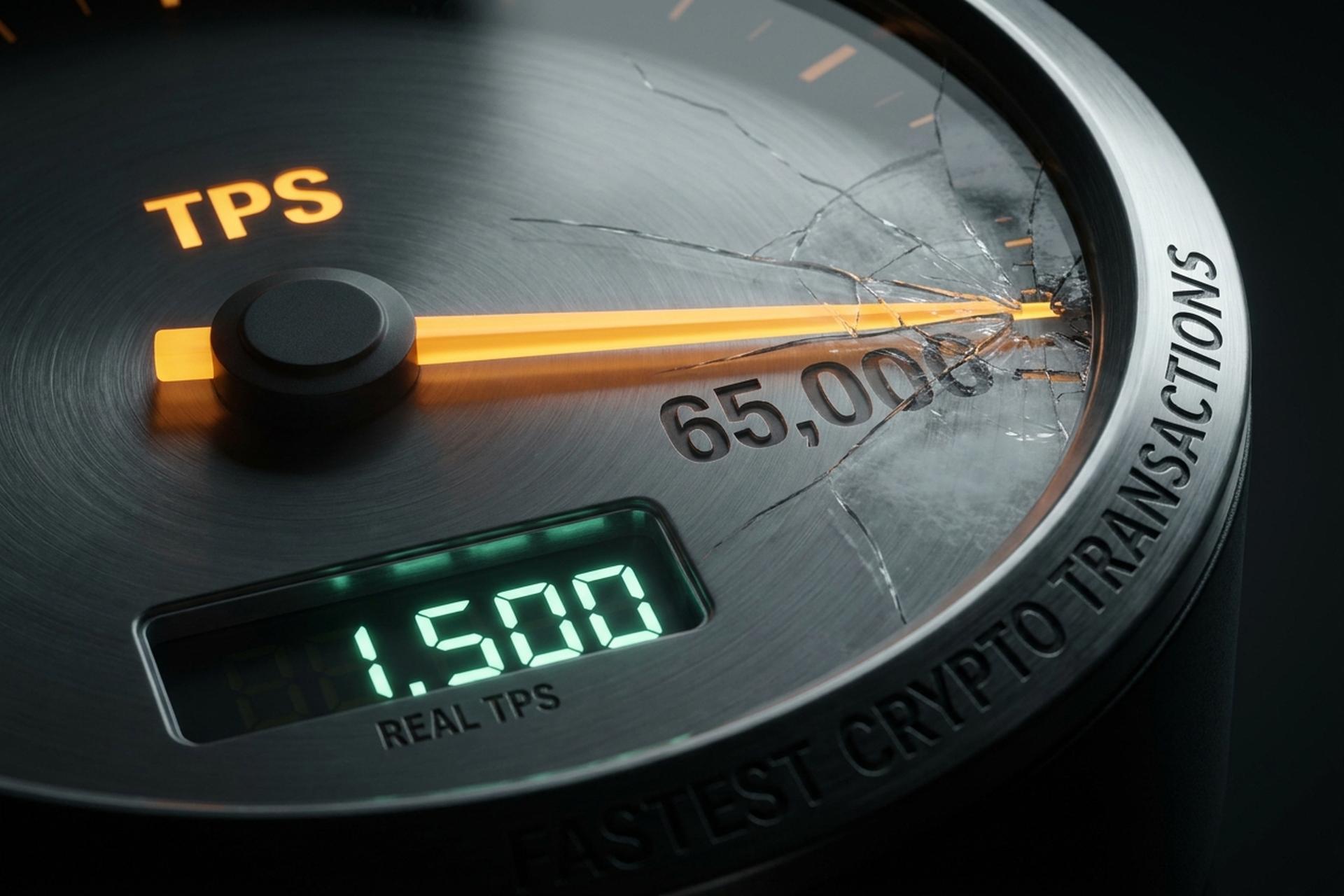
The "65,000 transactions per second" you keep seeing next to Solana is mostly fiction. Not a lie exactly, but a lab number that almost never happens. CoinGecko measured the real figure and found Solana has touched only about 1.6% of that ceiling. So when an article ranks the fastest crypto transactions by headline TPS, it is ranking marketing brochures, not actual speed.
Here is the thing nobody selling you a blockchain wants to spell out: the number that decides how fast your payment clears is not TPS at all. It's finality. This guide untangles the three metrics that get mashed together, ranks the networks on real measured data, and tells you which crypto actually moves money fastest in 2026.
TPS vs Finality vs Fees: What Fast Means
Three different things hide behind the phrase transaction speed, and mixing them up is where most confusion about cryptocurrencies starts.
TPS, transactions per second, is throughput. It measures the number of transactions the whole network can handle at once. It matters when millions of people use a chain at the same time, the way a highway's lane count matters at rush hour. Most of the time, for one payment, it tells you almost nothing.
Finality is the moment your specific transaction becomes irreversible, when nobody can claw it back. This is the number you actually wait on, your real transaction time. Send money and stare at the screen, and you are waiting for finality, not TPS. A coffee shop deciding whether to hand over the latte cares about one thing only, whether the payment can still be reversed. That is finality in a sentence.
The fee is simply what the transfer costs. On fast modern chains it ranges from a fraction of a cent to a few cents. In plain terms, a fast transaction needs both: quick finality and low transaction costs.
Keep these apart and the rankings for fast crypto change completely. A network that processes huge volume can still make you wait, and a modest blockchain network can settle your payment instantly. Throughput is the brochure. Finality is the experience.
The Theoretical TPS Myth in Crypto
Almost every "fastest blockchain" list quotes a maximum TPS. Treat those numbers with suspicion, because they are ceilings measured under perfect lab conditions that real networks rarely meet.
Why "65,000 TPS" is mostly marketing
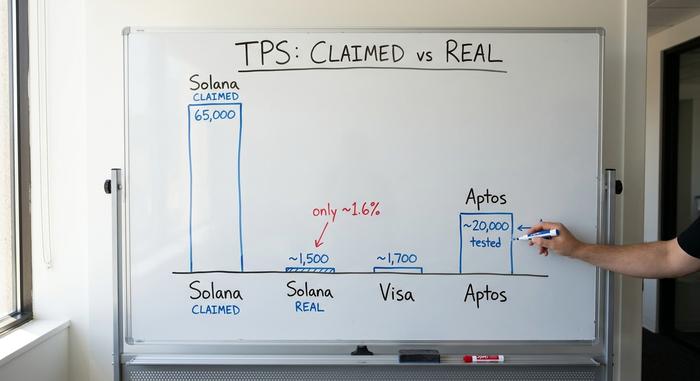
Solana is the textbook case. Its 65,000 TPS figure is real in the sense that the code can theoretically do it. In practice, CoinGecko's research found it has reached only around 1.6% of that, with a real peak closer to 1,500 transactions per second. The pattern holds across the board: most chains run at 2% to 10% of their advertised maximum. The lab number sells. The live number ships. The gap is not really dishonest, it's physical: real networks face uneven demand, ordinary validator hardware, and global latency that a controlled benchmark quietly strips away.
How crypto really compares to Visa
The classic comparison is Visa, usually quoted at 24,000 TPS. That figure is disputed too. As Bitcoin.com has pointed out, Visa's real average is closer to 1,700 transactions per second, even though it processed 293 billion transactions in 2024. So the honest framing is not "crypto crushes Visa." It's that several chains now finalize a single payment far faster than a card network, even if neither side is really running at its theoretical top speed.
The Fastest Blockchains by Real TPS
Strip out the brochures and rank on measured data for the fastest blockchain networks, and the picture sharpens. The table below pairs real or peak throughput with the metric that actually matters, finality, plus typical fees.
| Network | Real / peak TPS | Theoretical max | Finality | Typical fee |
|---|---|---|---|---|
| Solana | ~1,500 real | 65,000 | ~12.8 s | ~$0.0002 |
| Aptos | 20,000+ tested | very high | ~0.4 s | sub-cent |
| Sui | 100,000+ in stress test | very high | sub-second | sub-cent |
| XRP Ledger | ~1,500 capacity | 1,500 | 3-5 s | ~$0.0002 |
| Algorand | hundreds real | ~10,000 | instant (~3 s block) | ~$0.001 |
| TON | ~175 real | ~1,500 | under 1 s | low |
| Stellar | ~150 real | ~1,000+ | instant | ~$0.00001 |
| Avalanche | ~90 real | ~4,500 | ~2 s | ~$0.01 |
The current real-TPS leaders
Per Chainspect's live dashboard, Solana leads most days on sustained real throughput, but the Move-based newcomers are rewriting the ceiling. Aptos confirmed more than 20,000 TPS on mainnet with sub-second finality, and Sui pushed past 100,000 transactions per second in a December 2025 stress test. One quiet pattern from CoinGecko's data is worth noting: non-EVM chains run roughly four times faster on average than EVM chains. The architecture, not the marketing, decides the speed.
Solana is still the one to beat on raw, sustained throughput, and it is getting faster. Its Firedancer client, live on a fifth of validators since late 2025, and the coming Alpenglow upgrade are aimed straight at closing the gap between its lab number and its live one. Even now its real peak sits above 6,000 TPS in bursts, which is seriously fast, outages aside.
The Move-based pair, Aptos and Sui, are the real 2025-2026 story. Both were built to process transactions in parallel rather than one after another, which is how Aptos cleared 20,000 TPS on mainnet and Sui blew past 100,000 in testing. The older EVM crowd, Ethereum included, mostly leans on Layer-2 rollups to keep up, which is why their base-layer numbers look modest next to the newcomers.
The quieter winners are the payment-first chains. The XRP Ledger has done one job since 2012: settle value in three to five seconds for a fixed sliver of a cent. Stellar runs on the same idea and is pushing toward 5,000 TPS while keeping fees near $0.00001. Algorand finalizes every block with no fork risk, so a confirmed payment is simply done. None of these win a TPS drag race. None of them need to.
Why Finality Beats TPS for Your Payment
Now the part that flips the usual ranking on its head. For sending money, finality is the real speed in any fastest cryptocurrency comparison, and a high TPS number can hide a slow payment.
Instant-finality networks
Some chains make your transaction irreversible almost the instant you send it. Algorand, Stellar, Aptos, and Sui all reach finality in well under a few seconds, with no rollback risk by design. On these, "sent" and "settled" are basically the same moment. That is what fast feels like to a human.
The Layer-2 finality trap
Then there is the catch buried in a lot of "fast" chains. Layer-2 networks show you a snappy transaction confirmation, but true finality, the point where the transaction is locked into the base layer, can take far longer. Optimistic rollups like Base and Arbitrum can need 12 to 14 minutes to reach full Ethereum finality. Even Tron, with a three-second block time, carries an economic finality closer to 57 seconds. Solana's economic finality sits around 12.8 seconds today, though its upcoming Alpenglow upgrade targets a startling 100 to 150 milliseconds. The practical lesson is blunt: a merchant who treats a Layer-2 soft-confirmation as final is taking a risk the marketing never mentions.
| Finality tier | Networks | Time to irreversible |
|---|---|---|
| Instant | Algorand, Stellar, Aptos, Sui | under ~1 s |
| Seconds | TON, Avalanche, BNB Chain, Solana, XRP Ledger | 1-13 s |
| Minutes to hours | Base, Arbitrum, Ethereum, Bitcoin | 13 min to ~1 h |
Crypto Fees and the Speed-Cost Trade-off
Fast usually means cheap in crypto, but not always, and the exceptions matter. Stellar transfers cost around $0.00001. Nano is feeless by design. Solana and the XRP Ledger sit near $0.0002 a transaction, Algorand around $0.001, and Avalanche closer to a cent. Hedera prices its transfers at a fixed tenth of a cent, which businesses like precisely because the cost never surprises them.
The wrinkle is congestion. A chain's fee is only "low" until everyone shows up at once. Solana fees have spiked during popular token mints, and busy periods can turn a sub-cent transfer into something you actually notice. When you compare networks, look at the fee on a normal day and the fee on a chaotic one, because you will eventually meet both. As a rule, the instant-finality payment chains that power the fastest crypto transactions stay cheap even when they are busy, which is half of why they suit everyday spending.

Lightning Network: Fast Bitcoin Transactions
Here is the irony at the center of crypto. The biggest coin is one of the slowest on its base layer. Bitcoin handles roughly seven transactions per second, with ten-minute blocks and finality that can take about an hour to feel safe.
The fix is the Lightning Network, Bitcoin's Layer-2. It moves payments through pre-funded channels that settle in under half a second for a fraction of a cent, and according to CoinLaw, its payment volume grew about 266% in 2025 on more than 5,600 BTC of capacity. Lightning is proof of where fast crypto transactions are heading: less about the base chain's raw numbers, more about the layer you transact on. The same logic now drives Ethereum's rollups. The trade-off is setup, since channels need funding and a little management, which a plain on-chain send does not. For repeat payments, though, the speed is hard to argue with.
How to Send the Fastest Crypto Transactions
Practical advice, because the chain is often not your real bottleneck. Your exchange is.
When a withdrawal feels slow, it is usually the platform sitting on it for security review or batching it with others, not the blockchain crawling. So three habits help. First, pick a network that finalizes fast and cheap, an instant-finality chain like Stellar, Algorand, or the XRP Ledger, or Solana when it is healthy. Second, choose the right network at withdrawal time. Sending USDT over Tron or Solana clears in seconds for pennies, while the same transfer over Ethereum can cost dollars and drag. Third, mind the small print: a missing destination tag or memo can freeze a transfer that the chain itself handled in seconds. The fastest crypto transactions still die on a forgotten memo. And if speed is the whole point, skip the exchange step where you can. A direct on-chain transfer from a self-custody wallet avoids the withdrawal queue entirely, which is often the single biggest delay between you and a finalized payment.
The Trade-offs of Ultra-Fast Blockchains
Speed is never free, and the bill usually comes due in decentralization. Pushing a network to handle huge throughput tends to mean fewer, heavier, more expensive validators, which concentrates control. The old triangle still holds: speed, security, decentralization, pick two.
Reliability is the other cost. Solana, the headline speed champion, also has the longest outage record among the majors, with several full or partial halts over the years. A chain that is blisteringly fast except for the afternoons it stops entirely is not actually fast where it counts. As these blockchain technologies mature, the newer high-speed networks show cleaner uptime so far, but most are also young, and a few quiet years is not the same as a decade of stress-tested reliability. I would take boring and final over fast and flaky any day, and for moving real money, so should you. The fastest blockchains are impressive engineering. That does not make all of them safe places to park value.
The Real Answer on Fastest Crypto Transactions
So ignore the 65,000 TPS billboards. For actually moving money, the fastest crypto transactions come from chains that finalize in seconds for a fraction of a cent, and several already clear that bar: Stellar, Algorand, the XRP Ledger, Solana on a good day, and Bitcoin once it borrows Lightning. The throughput arms race is real and getting wild, but it is mostly a story about scale, not about your next payment. The better question to carry into any "fastest crypto" list is simple: how long until my transaction cannot be reversed, and what does it cost? Answer that, and you already know which coin to send. And if a list cannot tell you a network's finality, only its theoretical TPS, treat the whole ranking as decoration.