Lightning Network: What It Is and How It Works
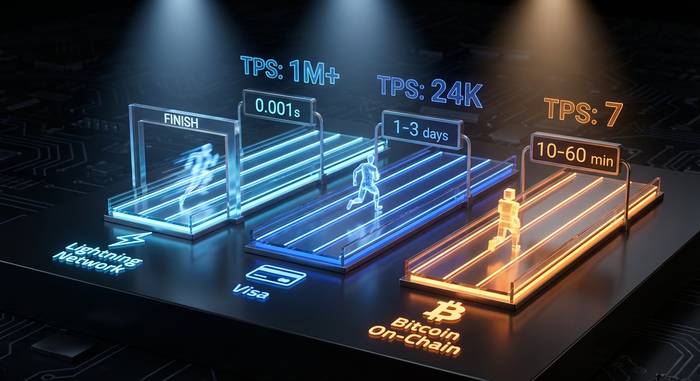
Bitcoin can handle about 7 transactions per second. Visa does 24,000. For a cryptocurrency that was supposed to replace cash, that gap is embarrassing. It is the reason your coffee shop does not accept BTC, the reason a $5 transfer can cost $50 in fees when the Bitcoin network is busy, and the reason someone had to build a fix.
That fix is the Lightning Network. A layer-2 scaling solution that sits on top of the Bitcoin blockchain and moves payments off-chain, settling them in milliseconds for less than a penny. In November 2025, Lightning crossed $1 billion in monthly transaction volume for the first time. Coinbase, Binance, Kraken, and Cash App all support it. And in March 2026, Tether launched USDT on Lightning, turning Bitcoin's payment layer into a stablecoin highway.
This is how it works, why it matters, and what it can actually do in 2026.
How the Lightning Network works
Here is the problem. The Bitcoin network's base layer is slow because it has to be. Every single Bitcoin transaction gets broadcast to thousands of nodes, verified by miners, packed into a block, and carved into the ledger forever. Ten minutes per block. Real fees. During the 2021 bull run, a basic Bitcoin transaction cost $50 at peak. You are not buying a sandwich with that.
The Lightning Network works around this with a dead simple trick. Two people open a payment channel between them, kind of like running a tab at a bar. You put down a deposit, you transact back and forth all day, and you settle up when you are done. Only the opening and the closing hit the Bitcoin blockchain. Everything in between? Off-chain. Instant. Basically free.
Here is the actual flow:
1. Alice and Bob each lock some BTC into a 2-of-2 multisig address on the Bitcoin blockchain. That is the channel opening. It is an on-chain transaction.
2. Once the channel is open, Alice and Bob can send BTC back and forth as many times as they want. Each transaction updates the balance between them but never touches the blockchain.
3. When they are done, either one can close the channel. A single on-chain transaction settles the final balances.
Now what if Alice needs to pay Carol but they do not have a direct channel? Lightning routes the payment through nodes in between. Alice pays Bob. Bob passes it to Carol. HTLCs (Hashed Time-Locked Contracts) are the smart contracts that keep everyone honest. Bob only gets his tiny routing fee when Carol confirms the payment landed. If anything goes wrong, the funds return to Alice. Nobody can pocket money in transit.
The math is wild. Lightning can theoretically push over 1 million transactions per second. In reality, the network handles about 12 million per month and growing. That is still orders of magnitude more scalable than the 7 TPS Bitcoin manages on its own.
Lightning Network in numbers
| Metric | Value | Period |
|---|---|---|
| Network capacity (public channels) | ~5,000 BTC (~$500M) | March 2026 |
| Peak capacity | 5,637 BTC | December 2025 |
| Active public nodes | ~12,600-17,000 | Early 2026 |
| Active channels | ~40,000-43,700 | Early 2026 |
| Monthly transaction volume | $1.1 billion (peak) | November 2025 |
| Monthly transactions | 12+ million | 2025-2026 |
| Average transaction size | $223 | November 2025 |
| Share of all Bitcoin orders | 16%+ | 2025 |
| Average fee | <$0.01 | 2026 |
| Theoretical max TPS | 1,000,000+ | -- |
One thing worth explaining: the public capacity number (5,000 BTC) looks like it has been flat or even declining. It dropped about 20% in mid-2025 before bouncing back. That worried some people. But most of the decline came from liquidity moving into private channels, which do not show up on public trackers. When you include private channels, the real capacity is probably double the public figure. The network is not shrinking. It is just getting harder to measure from the outside.
Lightning Network use cases in 2026
Pay for things
Strike operates in 100+ countries and lets you send Lightning payments that arrive as local currency on the other end. Cash App gave 70 million users access to Lightning. In late 2025, Block announced Bitcoin payments through Square for businesses, turning every Square terminal into a potential Lightning point of sale.
Coinbase added Lightning in April 2024 through Lightspark. Within a year, 15% of all Bitcoin transactions on Coinbase were already going through Lightning. That is fast adoption for a platform that waited years to add the feature.
Send stablecoins
This is the big new one. In March 2026, Tether launched USDT on the Lightning Network using Taproot Assets. That means you can now send dollars (as USDT) through Lightning with the same speed and near-zero fees as sending BTC. The implications for remittances and cross-border payments are hard to overstate. USDT moved $13.3 trillion in transfers in 2025. Even capturing a small slice of that through Lightning would be massive.
Speed, a Lightning-native payments company that Tether invested $8 million in, already processes $1.5 billion per year with 1.2 million users.
Tip and stream payments on Nostr
Nostr, the decentralized social protocol, built Lightning payments directly into its DNA through Zaps. You see a post you like, you Zap the author a few sats (fractions of a Bitcoin). By May 2025, the network had processed over 5 million Zaps. Fountain.fm lets you stream sats to podcasters per second of listening. It is a pay-for-what-you-actually-consume model that makes Patreon look clunky.
Run a node and earn routing fees
Anyone can run a Lightning node and earn fees for routing payments through their channels. The fees are tiny (median base fee: 1 satoshi, median fee rate: 0.0029%), but operators with well-connected, high-liquidity nodes generate meaningful income. The barrier to entry is a computer, an internet connection, and some BTC for channel liquidity.
Lightning Network fees vs Visa
| Lightning Network | Visa/Mastercard | Bitcoin on-chain | |
|---|---|---|---|
| Speed | Milliseconds to seconds, final | 1-3 business days to settle | 10-60 minutes |
| Cost per transaction | Less than $0.01 | 1.5-3.5% interchange fee | $1-50+ depending on congestion |
| Availability | 24/7 globally | Bank hours for settlement | 24/7 globally |
| Theoretical throughput | 1,000,000+ TPS | 24,000 TPS | ~7 TPS |
| Settlement finality | Instant and final | T+2 or T+3 days | After block confirmation |
Lightning is over 1,000 times cheaper than card networks per transaction. More importantly, the settlement is final. When a Lightning payment goes through, it is done. No chargebacks, no pending period, no waiting for your bank to clear it. For merchants, that is a real difference.
Who supports Lightning in 2026
| Exchange / Service | Lightning support | Notes |
|---|---|---|
| Coinbase | Since April 2024 | Via Lightspark; 15% of BTC transactions use LN |
| Binance | Since July 2023 | Deposits and withdrawals |
| Kraken | Since 2022 | Zero fees on LN deposits/withdrawals |
| Cash App | Yes | 70M+ users; auto-converts USD to BTC for LN payments |
| Strike | Yes | 100+ countries; remittances in local currency |
| OKX | Since 2021 | Deposits and withdrawals |
| Bitfinex | Since 2019 | First major exchange to add LN |
| BitPay | Yes | Merchant payment processing |
Over 26 exchanges now support Lightning. The holdouts are running out of excuses.
The Taproot Assets shift
Taproot Assets is what turns Lightning from a Bitcoin-only payment rail into a multi-asset crypto network. Developed by Lightning Labs, it lets anyone issue tokens (stablecoins, synthetic assets, whatever) directly on Bitcoin and send them through Lightning channels.
Version 0.6 launched on mainnet in June 2025. Version 0.7 followed in December with production-grade features: reusable static addresses and auditable supply commitments. These were the final pieces needed for USDT integration.
Why does this matter? Because Tron currently handles the majority of USDT transfers, mostly because it is cheap. If Lightning can offer the same cost with Bitcoin's security model underneath, the payment flow shifts. It is too early to say Lightning will eat Tron's USDT market share. But the infrastructure to do so is now live.
Risks and security
Lightning works. But I would not call it bulletproof.
Offline risk is real. Your node needs to be watching the blockchain. If you go offline and your channel partner tries to close with an old state (one where they had more money), you have a limited time window to contest it. Miss it, and you lose funds. Watchtowers exist for this — third-party services that monitor on your behalf — but the watchtower ecosystem is still immature. Most operate on a volunteer basis with no economic incentive.
Replacement cycling attacks surfaced in 2023 and spooked some people. They exploit HTLC timeouts to steal from routing nodes. All major implementations (LND, Eclair, C-Lightning) deployed patches, and nobody has pulled off a real attack since. But the fact that it was found at all reminds you: this is still young software.
The network is centralizing. A handful of fat nodes run by exchanges and infrastructure companies handle most of the routing. That is great for speed and reliability. It is less great for the "decentralize everything" crowd. I think this is how payment networks work in practice, but it is worth watching.
Big payments can fail. No layer-2 solution like the Lightning Network is perfect for every scenario. You cannot push more through a channel than its capacity. Multi-path payments (splitting across routes) help, but the experience gets clunky for large amounts. Lightning is built for speed and small to medium payments. For moving $100K in one shot, the base chain is still more reliable.
Getting started with the Lightning Network
You do not need to understand cryptography or run a server to use Lightning. The easiest on-ramp is a mobile wallet like Phoenix or Breez. Download one, fund it with a small amount of BTC, and you can send your first Lightning payment in under a minute. Both wallets handle channel management automatically, so you never have to think about payment channel logistics.
If you already hold Bitcoin on an exchange like Coinbase, Kraken, or Binance, you can withdraw directly to a Lightning wallet. Kraken charges zero fees on Lightning withdrawals, which makes it a good starting point. For anyone deeper in the crypto space who wants more control, running your own node with software like Umbrel gives you full sovereignty over your Bitcoin transactions and lets you earn routing fees on the side.
The barrier to entry keeps dropping. Two years ago, getting started with the Lightning Network meant hours of setup and a decent understanding of how nodes work. Today it is closer to downloading Venmo.