
How Meme Coins Captured Billion-Dollar Crypto Gains in 2024

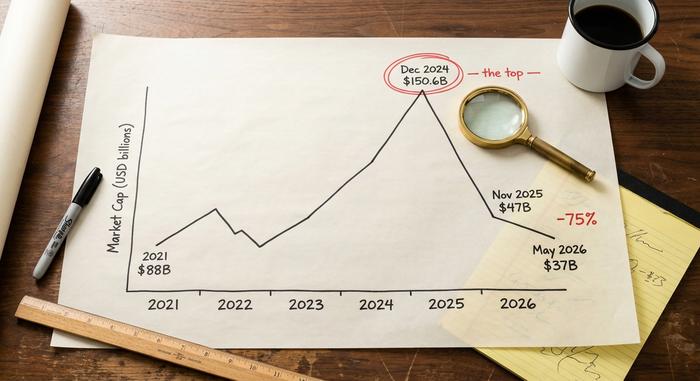
For about three weeks in December 2024, meme coins as a category were worth more than the entire crypto market had been five years earlier. The total sat at $150.6 billion at the peak, almost double the previous high from October 2021. Then the air came out. By the spring of 2026 the same category trades at roughly a quarter of that peak. The story of how meme coins captured billion-dollar gains, and then gave most of them back, has four parts that almost no single piece of coverage tries to hold together: the trajectory of the market cap itself, the cultural mechanics that made it possible, the structural scam economy underneath the boom, and a mortality study of which coins are actually still alive. This article tries to fit all four into one frame.
Meme Coins' Trajectory: From Joke to $150 Billion
The numbers are larger than most casual observers remember. According to CoinGecko's State of Memecoins 2025 report, total meme coin market capitalisation reached $150.6 billion in December 2024, comfortably above the prior peak of $88 billion set on 29 October 2021. The 2024 cycle was driven by three things at once: Solana's launchpad infrastructure (mainly pump.fun), the wave of political and celebrity tokens led by TRUMP and MELANIA in January 2025, and a generational rally in PEPE, which reached an all-time high of roughly $11 billion in market cap on 9 December 2024, up more than 1,500 percent on the year.
Trading volume scaled with it. Daily meme coin volume averaged $9.7 billion in 2024 against $1.1 billion in 2023, a 767 percent year-on-year increase per CoinGecko. The single-day record sat at $87.4 billion after the WIF and PEPE major-exchange listings. The trough between cycles was severe but short. After the 2021 high, the category collapsed through the FTX implosion of November 2022 to a fraction of its peak, then ground sideways through 2023 before the Solana launchpad infrastructure brought it back. By early January 2025, with the TRUMP launch driving record retail engagement, launchpads across Solana, Ethereum, and Base together facilitated over 73,000 new token launches per day at the absolute peak of the frenzy.
| Date | Total meme coin market cap | Top component | Note |
|---|---|---|---|
| Oct 29, 2021 | $88B | DOGE $88.8B ATH (May 8, 2021) | Prior cycle peak |
| Apr 17, 2023 | — | PEPE launches; hits $1.6B in three weeks | New entrant |
| Dec 9, 2024 | $150.6B (peak) | DOGE $59.76B, SHIB $15.26B, PEPE $11B | 71% above 2021 peak |
| Jan 17, 2025 | — | TRUMP launch; ATH ~$14.5B in 48 hours | Political-coin wave |
| Nov 2025 | $47.2B | DOGE 47.3% of category | -69% from peak |
| May 2026 | ~$37.3B | DOGE dominance still ~47% | -75% from peak |
The drawdown matters as much as the peak. The category has shed roughly three-quarters of its top valuation in eighteen months, and the composition has narrowed sharply. DOGE alone accounts for almost half of what is left, which means the category is more concentrated now than it was at the peak. PEPE has lost the bulk of its 2024 gains. WIF, BONK, FLOKI, BRETT, and POPCAT, all stars of the 2024 cycle, trade well below their highs. The longest-tail tokens, the seven-million-strong cohort spun out of pump.fun and other launchpads, are largely gone.
Why Memes Work as Money: The Cultural Mechanics
Most coverage of meme coins treats the cultural element as decoration, as if the real story were the asset class and the memes were a marketing layer on top. The opposite is closer to the truth. Meme coins are culture first, and assets only because culture happens to be tradable on a settlement layer that runs 24/7. The clearest articulation of this thesis came in September 2024 at Token2049 Singapore, where analyst Murad Mahmudov delivered a talk titled "The Memecoin Supercycle." His framing: meme coins are not financial instruments at all, but "digital cults" unified by shared belief, and in an attention-scarce economy the assets that capture attention will eventually capture value.
That framing explains a lot. It explains why DOGE has now been alive for thirteen years even though it has never had a roadmap. It explains why a single social media post from Elon Musk in November 2024 could push PNUT, a coin themed on a euthanised squirrel, from obscurity to a $1 billion market cap in eleven days, 135 times faster than DOGE's original 1,487-day climb to the same milestone. It also explains why political coins worked: TRUMP and MELANIA were not new ideas in tokenomics, they were tokenised tribal identity at the most concentrated moment of attention in the 2024 election cycle. By the day after Trump's inauguration the combined market value of the two coins briefly sat near $9.5 billion.
The most coherent critique from inside Ethereum is Vitalik Buterin's blog post of 29 March 2024, in which he argued the category was not inherently bad but was overwhelmingly dominated by what he called attention-extraction vehicles that produced no public good and carried serious financial risk for retail participants. He went so far as to donate roughly $2.5 million of meme coins he had been gifted to public-good causes, including a $532,000 donation in August 2024 to an effective-altruism animal welfare fund. The position is consistent: meme coins are real, the category is here to stay, the typical instance is parasitic.
The promoter economy that grew on top of the cycle is its own story. The most documented case is Sahil Arora, a token-launch promoter who earned roughly $30 million during 2024 by representing celebrities including Caitlyn Jenner, Jason Derulo, Lil Pump, and Rich the Kid in their meme coin launches. The Jenner tokens fell more than 99 percent from their early highs. The Decrypt year-in-review for 2024 called the celebrity meme coin wave the single most defining cultural-financial pattern of the year, and the pattern was structurally consistent: an audience of millions, a token controlled by a small group of insiders, a launch event that produced a spike, and a fast decay curve.
The Scam Economy Underneath the Boom
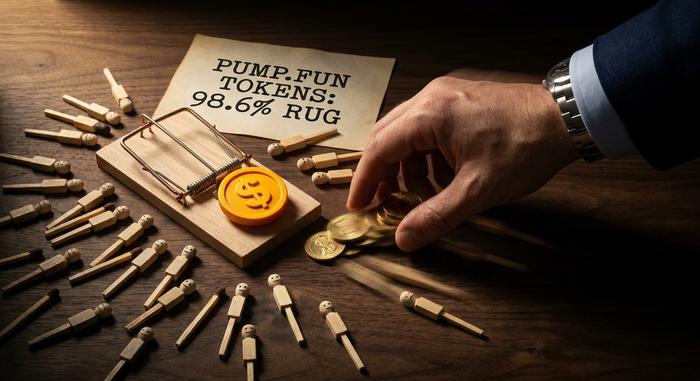
The cultural story sits on top of a structural scam economy, and the numbers there are uglier than most retail buyers realise. Solidus Labs published its 2025 Rug Pull Report covering tokens deployed on pump.fun between January 2024 and March 2025. Of more than seven million tokens with at least five trades, 98.6 percent met the definition of a rug pull or pump-and-dump scheme. Only around 97,000 of them ever held more than $1,000 in liquidity. A separate cut of the same data found that 93 percent of Raydium liquidity pools showed rug-pull characteristics; the median rug-pull value was $2,832, meaning the typical scam is small and high-volume rather than the occasional headline disaster.
The headline disasters do exist. The clearest 2024 case is the HAWK token, launched by viral internet personality Hailey Welch on 4 December 2024. According to Halborn's post-mortem, HAWK reached a market cap of roughly $490 million within fifteen minutes of launch and then lost more than 93 percent of its value almost as quickly. Bubblemaps' on-chain analysis showed that about 96 percent of the supply was held by ten insider wallets before launch, with only a 3-4 percent public float; insiders pocketed roughly $3.3 million as retail bought the top. A class-action lawsuit followed within weeks.
| Token | Date | Peak mcap | Subsequent crash | Insider supply | Source |
|---|---|---|---|---|---|
| HAWK | Dec 4, 2024 | ~$490M (in 15 min) | -93% within hours | ~96% | Halborn / Bubblemaps |
| TRUMP | Jan 17, 2025 | ~$14.5B ATH | -97% by May 2026 (mcap ~$493M) | — | CoinMarketCap |
| MELANIA | Jan 19, 2025 | combined w/ TRUMP ~$9.5B Jan 20 | -90% by Feb 6, 2025 | — | NPR / CNBC |
| JENNER (Caitlyn Jenner) | 2024 | high single digits | -99%+ | promoter $30M | Decrypt SCENE 2024 |
| pump.fun typical token | rolling | minimal liquidity | — | scam-pattern | Solidus Labs |
Aggregate retail losses from meme coin rug pulls reached at least $500 million in 2024 alone, according to Merkle Science figures reported by CoinDesk in February 2025 — a figure that does not capture the broader investment losses from coins that declined 90 percent or more without technically meeting the rug-pull definition. The structural pattern is consistent across the category: a small cohort of insider wallets controls the supply at launch, the influencer or celebrity face provides the audience, and the retail buyer is the exit liquidity. That pattern is not incidental to the asset class; it is roughly how the asset class works on average.
pump.fun's own economics tell a parallel story. At peak, the platform was generating monthly revenue of roughly $138 million from launch fees and trading cuts alone. By October 2025 daily revenue had fallen approximately 80 percent from the peak, settling near $1 million per day. Cumulative DEX volume across all pump.fun-launched tokens passed $150 billion. Yet only about 1.15 percent of new launches ever graduate to a Raydium listing, according to Cryptopolitan figures from February 2026 — and that figure is itself a seven-month high.
Survival Study: Who Lived, Who Died
The headline number on mortality comes from a Chainplay study published in August 2024, which examined more than 30,000 meme coin projects and found a 97 percent failure rate, with an average of about 2,020 tokens dying per month. The same study broke mortality out by chain: Base 66.91 percent, Solana 54.03 percent, Ethereum 36.59 percent. Higher launch velocity correlates with higher death rate, which is not surprising in retrospect.
What looks like the asset class is, in practice, a very small group of survivors. Bitcoin proved that a cryptocurrency without cash flows could hold value across cycles; DOGE, launched in December 2013, and SHIB, launched in August 2020, are the only meme coins that have come close to demonstrating the same thing. DOGE accounted for 47.3 percent of total meme coin market capitalisation as of November 2025. The 2024 cohort, PEPE, WIF, BONK, FLOKI, BRETT, POPCAT, has demonstrated short-cycle visibility but the same fragility: most are down 70 to 95 percent from their highs, and the durable winners of that cohort will not be obvious until at least one more drawdown cycle has passed.
The features that predict survival, where data exists, are roughly what would be expected: depth of liquidity on a major DEX, tier-one centralised exchange listings, an active development team beyond the initial token drop, and a holder base measured in actual addresses rather than social media follower counts. The features that do not predict survival include celebrity endorsement, news coverage, and short-term price performance.
The mortality also varies by chain in a way worth noting. Chainplay's data put Base at the worst survival rate at 66.91 percent of projects dead within the study window, followed by Solana at 54.03 percent, with Ethereum at the lowest mortality of 36.59 percent. The order tracks the same ranking as launch velocity: the easier and cheaper it is to spin up a token, the higher the death rate. The takeaway is that a meme coin's chain of issuance carries genuine information about its expected lifespan, even before any specific tokenomics enter the picture.
Where the Meme Coin Category Sits Now
As of May 2026 the category sits at roughly $37.3 billion in aggregate market cap. The SEC settled the legal question on 27 February 2025 by issuing a Staff Statement declaring that meme coins are not securities under federal law, describing their value as derived from "speculative trading and collective sentiment, like a collectible." That ruling removed the largest single tail risk for the category in the United States. MiCA in the European Union has no meme-coin-specific carve-out; the standard whitepaper regime applies unless the small-issuance exemptions are met.
The category is not going to disappear. DOGE has been alive longer than most VC-backed crypto projects, and pump.fun continues to generate roughly $1 million in daily revenue from new launches even at the post-peak baseline. What the data does not yet answer is whether the survivors of the 2024 cohort are a durable second tier or a temporary rotation of attention carriers. The honest read, after looking at the trajectory and the mortality numbers together, is that meme coins captured tens of billions in real value and returned most of it. Whether the next cycle's peak is above or below $150 billion will tell us which kind of asset class this actually is, and how much of the gain from this cycle was real value capture versus a brief redistribution of retail capital into insider wallets.



