Solana Payment Gateway: Merchant’s 2026 Guide
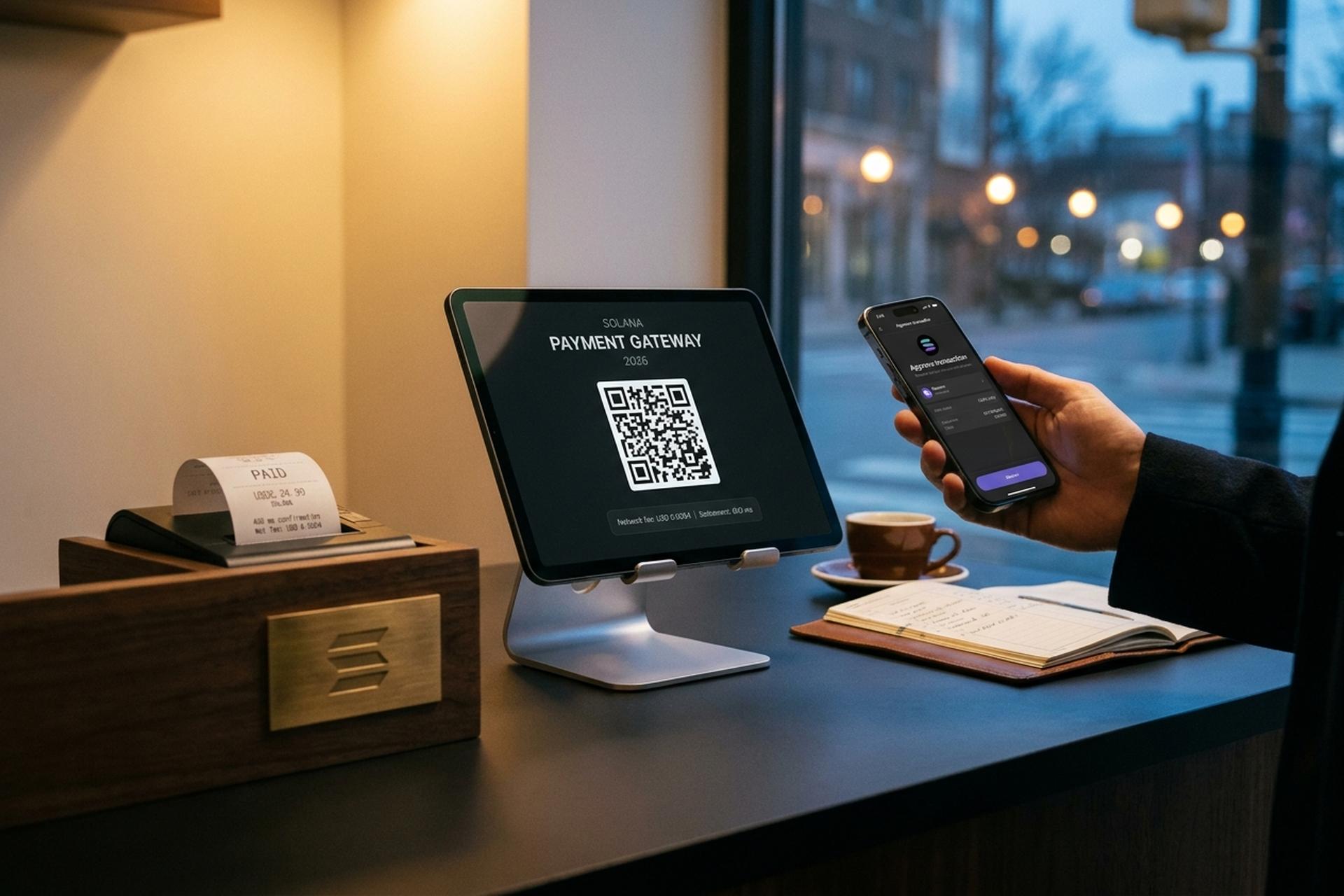
A Solana payment gateway is a serious business decision in 2026 rather than a curiosity. In February 2026, Solana cleared a record $650 billion in monthly stablecoin transfer volume, the first month it surpassed Ethereum and Tron combined. USDC volume on Solana overtook Ethereum on December 29, 2025 and has held the lead since. Coinbase Commerce shut down on March 31, 2026, leaving a real gap in the gateway market. BitPay added Solana on August 13, 2025, four years after Solana Pay launched. This guide explains what a modern Solana payment gateway actually does, compares the providers that matter (Solana Pay, Helio, Plisio, NOWPayments, BitPay, CoinPayments, CoinGate, 0xProcessing), and lays out which one fits which kind of merchant.
The short answer on Solana payment gateways
Solana has the lowest base-layer fees and the fastest finality of any major payment rail. The base fee is 0.000005 SOL per signature (a fraction of a cent at current prices) and the slot time is 400ms. Solana is a decentralized blockchain built on Solana's proof-of-stake design, with near-zero fees and high throughput and low fees relative to Ethereum L1. A modern crypto payment gateway built on Solana lets you accept SOL payments and SOL tokens (USDC-SPL, USDT-SPL, PYUSD) without intermediaries and lets you accept payments in cryptocurrency alongside fiat. Gateway fees on top of the on-chain transaction fees range from Solana Pay's zero platform fee to Helio's 2 percent flat. The choice depends on three things: whether you want a custodial or non-custodial setup, how much KYC you can tolerate, and whether you need multi-chain support alongside the Solana blockchain. Plisio anchors the cheap, no-KYC, multi-chain end of the market at 0.5 percent. Helio anchors the Shopify-native end with custodial settlement. Solana Pay sits in between for technically capable merchants who want zero platform fee.
Why Solana for payments: throughput, low fees, instant settlement
The numerical case for Solana is short. The base fee per signature is 5,000 lamports, which works out to about $0.00042 at an $84 SOL price. For an online store running sub-thousand-dollar checkouts, that is a fraction of a cent per order. Token Terminal's volume-weighted average transaction fee on Solana for early 2026 is roughly $0.002, with priority transactions ranging from $0.00044 to $0.013. Slot time is 400ms and four-slot leader rotation means real settlement in well under two seconds. Finality (the point at which a transaction is irreversible) lands around 12.8 seconds in current mainnet configuration. The forthcoming Alpenglow upgrade targets 100 to 150 milliseconds.
Throughput numbers are even more skewed. The protocol cites a theoretical ceiling of thousands of transactions per second — around 65,000 — with real-world scalability evidenced on mainnet. Real-world sustained throughput runs about 5,500 TPS in early 2026, with typical days settling between 1,000 and 4,000 TPS. Jump Trading's Firedancer client, which phased into mainnet in December 2025 as Frankendancer, has demonstrated a million TPS in lab testing. Scalability used to be Solana's biggest bottleneck; in 2026 it is the network's strongest selling point. For comparison, a Visa transaction costs 1.5-3 percent plus chargeback risk; Bitcoin's high fees ($2-$8 plus a ten-minute block) put it out of reach for most retail flows.
The stablecoin picture matters more than the SOL-denominated one. Circle minted $3.25 billion in USDC on Solana in a single week of April 2026. PYUSD launched on Solana on May 29, 2024 and now holds about 60 percent of total PYUSD supply. Visa expanded its USDC settlement rails to Solana on September 5, 2023 through Worldpay and Nuvei. Facts of the 2026 payments stack, not forecasts.
How a Solana payment gateway actually works
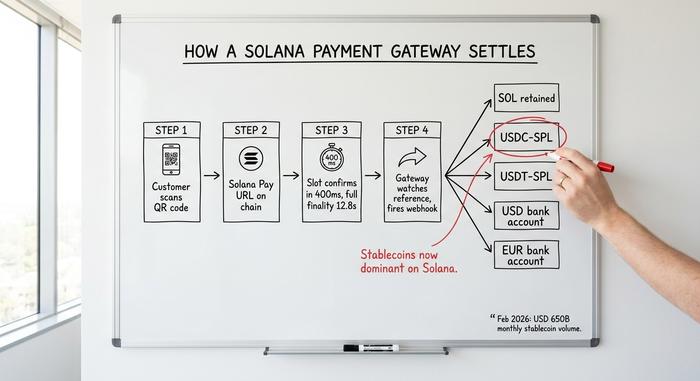
The mechanics of a Solana payment gateway are straightforward enough that a small merchant can integrate one in an afternoon, configure the supported coins, and start to directly accept SOL or USDC on the same day. At checkout, the gateway generates a transaction request, a small payload that includes the merchant's public key, the requested amount, optionally an SPL token mint address (USDC, USDT, PYUSD), and a unique reference identifier. The reference is what lets the gateway find the transaction later on chain. The request is encoded into a Solana Pay URL, which the storefront displays as a QR code or a clickable payment link. The whole payment flow runs as a programmable workflow that an engineering team can extend if needed.
The customer opens a Solana wallet (Phantom, Solflare, Backpack, or any compatible app), scans the QR or follows the link, and approves the transaction. The Solana network confirms the transaction in about 400 milliseconds for the slot and around 12.8 seconds for full finality, well under the thirty-minute waits that on-chain Bitcoin payments can require. The gateway watches for the reference via `findReference`, validates the destination and amount via `validateTransfer`, and then notifies the merchant's storefront through a webhook. The order moves to "paid" and accounting sees a clean line item.
Settlement is the part that differs between providers. A non-custodial gateway like Plisio routes the SOL or SPL token straight to the merchant's wallet at the moment of confirmation, with no intermediate custody. A custodial gateway like Helio holds funds in a business account on the merchant's behalf and pays out on a schedule, optionally converting to fiat currency via MoonPay rails so the merchant can withdraw to your bank account in USD or EUR rather than holding SOL. Many merchants configure auto-conversion to convert SOL to other cryptocurrencies (USDC, USDT) to avoid volatility; the rails are programmable enough that a scalable payment system can be tuned to a cash-flow shape. Solana Pay itself has no platform layer at all; the merchant either runs the verification themselves through a Helius RPC endpoint at the backend or uses a thin SDK like the Solana web3.js library.
| Payment rail | Base fee | Finality | Stablecoin support | Outage risk profile |
|---|---|---|---|---|
| Solana | ~$0.0004 | ~12.8 s (Alpenglow 100-150 ms) | USDC, USDT, PYUSD | No outage since Feb 6, 2024 |
| Ethereum L1 | $1–$10 | ~13 min | USDC, USDT, PYUSD | Highly stable, fee-volatile |
| Litecoin | ~$0.005 | ~2.5 min | None native | 14+ years 100% uptime |
| Bitcoin | $2–$8 | ~60 min | None native | Mempool congestion |
Solana's position is the fee-finality corner.
Gateway comparison: Solana Pay, Helio, Plisio, NOWPayments, BitPay
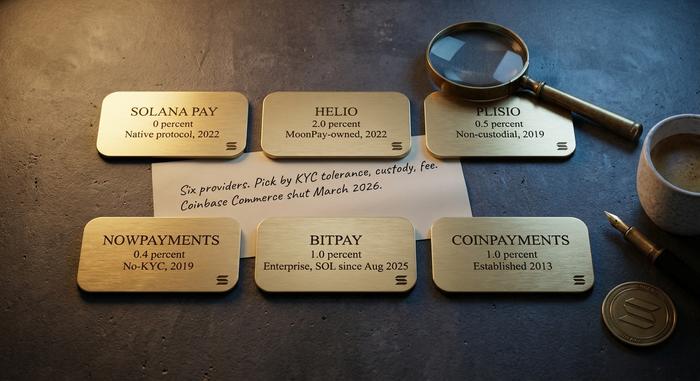
The Solana payment gateway market in 2026 has six providers that any serious merchant considers and a long tail of niche players.
Solana Pay is the native protocol, open-sourced by Solana Labs in collaboration with Circle, Checkout.com, Citcon, Phantom, and others on February 1, 2022. There is no platform fee. The merchant pays only the on-chain transaction cost. The trade-off is that Solana Pay is a protocol, not a product; somebody has to build the verification layer, webhooks, and dashboard. The Shopify app integration on Shopify, delivered through Helio on August 23, 2023, made the protocol available to millions of businesses in one stroke.
Helio is the Solana-native processor that won the Shopify integration. Founded in 2022 in London by Jim Walker and Stijn Paumen, it raised $3.3 million in a seed round in April 2023, and was acquired by MoonPay for $175 million on January 9, 2025 — the largest deal in MoonPay's history. At acquisition Helio was processing $1.5 billion across 6,000+ merchants. The headline fee is 2 percent flat, dropping to 1 percent for users holding the HelioX Pass NFT. The dedicated Shopify plugin has been cited at 0.75 percent in some marketing, but the docs and review sites consistently quote 2 percent for general use.
Plisio is the cheapest non-custodial way to accept USDC, USDT, and SOL on Solana alongside 30+ other chains, with no merchant KYC on the standard tier. Founded in 2019 in Manchester (UK PLISIO LTD #12374919), it charges 0.5 percent on its Gateway API and cash-out tier, with a free personal wallet plan and a 1.5 percent white-label option. SPL token support covers native SOL, USDC-SPL, and USDT-SPL. Settlement is non-custodial — funds route directly from customer to merchant wallet, never through a Plisio custody account. For a merchant who wants the fee gap of Solana without giving up custody or going through MoonPay-tier identity verification, Plisio is the price-aggressive option in the category.
NOWPayments supports SOL, USDT-SOL, and USDC-SOL with fees starting at 0.4 percent (POS terminal tier) and no mandatory merchant KYC.
BitPay added Solana on August 13, 2025, four years after Solana Pay launched. SOL, USDC-SOL, and USDT-SOL are all supported for pay-ins, and BitPay's own data shows stablecoins were roughly 40 percent of 2025 processing volume. Fees are about 1 percent with full enterprise KYC.
CoinPayments supports SOL at 1 percent (the rate for non-native coins on its platform; native coins get 0.5 percent). USDT-SOL routes through the 0.5 percent SPL tier.
Coinbase Commerce shut down on March 31, 2026, replaced by the more limited custodial Coinbase Business product, which is available only in the US and Singapore. Merchants who were on Commerce had to migrate, and the gap created in the market is part of why Plisio, NOWPayments, and BitPay all see organic 2026 inflows.
| Gateway | Founded | Fee | Merchant KYC | Custody | SPL tokens supported |
|---|---|---|---|---|---|
| Solana Pay | 2022 | 0% platform (chain only) | None at protocol level | Non-custodial | SOL + any SPL via integration |
| Helio (MoonPay) | 2022 | 2% (1% HelioX) | Full MoonPay KYC | Custodial | SOL, USDC-SPL, USDT-SPL |
| Plisio | 2019 | 0.5% | None on standard tier | Non-custodial | SOL, USDC-SPL, USDT-SPL |
| NOWPayments | 2019 | 0.4–1% | None | Mixed | SOL, USDC-SPL, USDT-SPL |
| BitPay | 2011 (SOL Aug 2025) | ~1% | Full enterprise KYC | Custodial | SOL, USDC-SPL, USDT-SPL |
| CoinPayments | 2013 | 0.5–1% | Tiered | Custodial | SOL, USDT-SPL |
Integration paths: Solana Pay, plugins, API, payment links
Three integration paths cover almost every merchant.
The Solana Pay protocol path is for engineers who want the lowest fees and full control. Generate a transaction request via the Solana web3.js library, encode the URL, render the QR, watch for the reference on chain through a Helius RPC endpoint, and fire your own webhook. The fee is the base 0.000005 SOL per signature and nothing more.
The plugin path is for storefronts running WooCommerce, Magento, PrestaShop, or OpenCart. Every major gateway listed above ships at least the WooCommerce and Magento plugins; CoinGate, Plisio, and 0xProcessing also ship PrestaShop and OpenCart builds. The dedicated Shopify path goes through Helio's official app, the result of the August 23, 2023 integration that made Solana Pay available to millions of Shopify merchants.
The API path covers custom storefronts, marketplaces, subscription products, and high-risk verticals (gambling, forex, SaaS). Every gateway exposes the same three-step flow: create invoice, listen for webhook, mark paid. Plisio, Helio, NOWPayments, and 0xProcessing all publish sandbox keys and OpenAPI-style docs. The no-code path — hosted payment links and QR codes — is the simplest entry point for freelancers, donation buttons, and one-off B2B remittances.
Network reliability: what changed after Feb 2024
The threat model for accepting Solana payments has changed since 2022. The chain itself is no longer the failure point. The wallet layer is.
Solana had three notable network incidents. The September 14, 2021 outage lasted seventeen hours after bot spam during the Grape Protocol IDO pushed 300,000-plus TPS of synthetic traffic. The February 25, 2023 outage degraded performance for hours after a malformed block propagated through Turbine. The February 6, 2024 outage was the last full halt, lasting about five hours from a `LoadedPrograms` bug.
As of mid-2026, Solana has gone more than 16 consecutive months without an acknowledged outage. Uptime references for 2025 NFT and DeFi activity cite 99.99 percent, in line with mature payment rails. The Firedancer rollout from December 2025 onward has hardened the network further.
The risk surface that grew in the same period is the user-side wallet. The August 2-3, 2022 Slope wallet incident exposed about 9,229 wallets and roughly $4.1 million in losses, traced to Slope's Sentry logging that captured private keys. Q2 2025 saw an Insikt-tracked $87 million in phishing drains across roughly 50 unique drainer landing pages targeting Solana users. Backpack's integration with Blockaid blocked $26.6 million in losses across 71,000 malicious transactions between June and September 2024 alone. The implication for merchants: pick a gateway whose wallet recommendations include a drainer-defense layer, and never present a payment URL through any channel that an attacker could spoof.
Compliance: MiCA, MSB, and what shuts down after July 1, 2026
The 2026 compliance picture has three jurisdictions worth understanding.
In the European Union, MiCA's hard cutoff for unlicensed crypto-asset service providers is July 1, 2026. Any CASP serving EU customers after that date without a MiCA licence is in breach. Most major Solana payment gateways have either applied for or completed MiCA registration; merchants serving EU customers should confirm before signing.
In the United States, FinCEN's 2013 money-services-business guidance still controls. A payment processor that settles directly to a seller under a written agreement is generally exempt from MSB registration. A processor that custodies customer funds outside that exemption needs to file FinCEN Form 107 and run a written AML program.
Outside those two jurisdictions, the picture is fragmented but trending the same way: KYC obligations are tightening, no-KYC merchant tiers still exist at Plisio and NOWPayments but the runway is shorter than it was two years ago. The Coinbase Commerce shutdown on March 31, 2026 was driven in part by the cost of maintaining compliance across jurisdictions, and the gap is being filled by the no-KYC and tiered-KYC providers. Gateway-side troubleshooting in 2026 is almost entirely about KYC paperwork and payout configuration rather than chain mechanics.
Which Solana payment gateway should you choose?
Decision framework, by merchant profile.
For Shopify and other mainstream e-commerce stores, Helio is the default path because of the native Shopify integration since August 2023, with the caveat that the 2 percent fee is the highest in the table and full MoonPay KYC applies. If 2 percent is unworkable, the WooCommerce or Magento plugin from Plisio at 0.5 percent is the obvious alternative.
For non-custodial settlement with multi-chain support, Plisio is the price-aggressive choice at 0.5 percent. As a SOL payment gateway, it accepts SOL, USDC-SPL, and USDT-SPL alongside 30+ other chains, with no merchant KYC on the standard tier. This is the segment where Plisio wins on price and onboarding for crypto payments at SMB scale.
For enterprise and regulated industries — large e-commerce, regulated card programs — BitPay is the default, even with the 1 percent fee and full KYC, because of the named-customer reference list and the four-year audit trail of stablecoin volume.
For high-risk verticals (gambling, forex, adult, gray-area SaaS) where mainstream Visa and Mastercard rails are restrictive, 0xProcessing and Plisio's no-KYC tier are the two most-mentioned options. The Coinbase Commerce shutdown removed a competitor in this space; the slot is now contested by NOWPayments and Plisio.
For engineering-led builds where every basis point matters, Solana Pay directly with a custom verification layer is the cheapest possible setup. The fee is just the chain cost. The cost is engineering time.