Advantages of Receiving Payments in Cryptocurrency
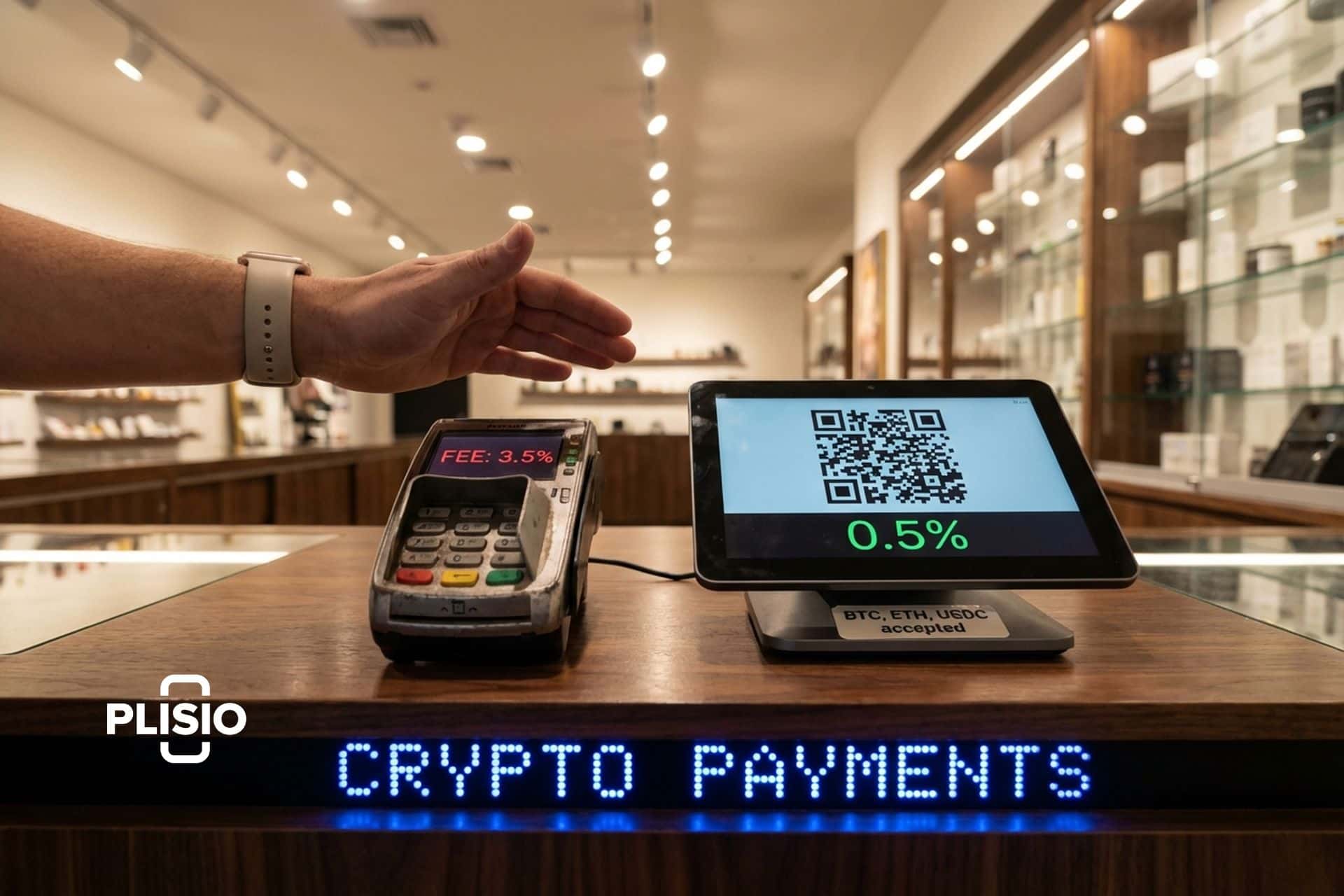
Every time someone swipes a credit card at your store, Visa or Mastercard takes 1.5-3.5%. Add up a year of those charges and it hurts. Chargebacks -- where a customer disputes a charge and the bank rips the money right back out of your account -- cost merchants $28.1 billion a year. Wire a payment overseas? Three to five business days, $25-50 flat, plus a 2-7% sting from currency conversion and intermediary banks.
Now think about crypto. A customer pays you in USDC or bitcoin. The transaction costs you under 1%. It settles in minutes. Nobody can reverse it. And it works the same way whether the buyer is in Ohio or Osaka. No bank in the middle. No FX markup. No waiting.
I know how that sounds. Too clean. There are catches -- volatility, taxes, low consumer adoption -- and we will get to all of them. But the numbers are real. In early 2026, 39% of US merchants accept cryptocurrency in some form. Stablecoin volume blew past $33 trillion in 2025. Payment gateways like Plisio let you accept 15+ cryptocurrencies at just 0.5% per transaction -- less than a third of what Visa charges. These are not pilot numbers anymore.
Here is what you actually get when you start accepting payments in cryptocurrencies and digital wallets -- and what might bite you if you are not careful.
Lower fees: the single biggest advantage
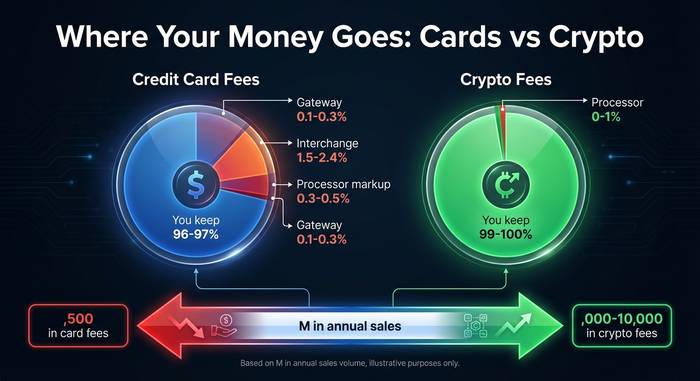
The math is simple. Accept a $100 payment through Visa, and you keep $97-98 after interchange fees, processor markups, and gateway charges. Accept the same payment through a crypto payment processor and the picture changes fast.
Plisio charges 0.5% per transaction. No monthly fees. No setup fees. No hidden charges. That is it. On a $100 sale you keep $99.50 instead of $97. On $1 million in annual revenue, you save over $18,000 compared to the average credit card processing rate of 2.35%. BitPay charges 1% -- double Plisio's rate. Coinbase Commerce takes 0% if you settle in crypto, but charges 1% for fiat conversion, which is what most merchants actually need. NOWPayments matches Plisio at 0.5% but lacks the same breadth of eCommerce integrations.
BTCPay Server is the only option cheaper than Plisio: zero fees, but you run your own server, handle your own keys, and get zero support if something breaks. For most businesses that want a managed solution without the tech overhead, Plisio's 0.5% is the best deal in the market.
| Payment method | Merchant fee | Settlement time | Chargebacks | Plugins/integrations | Best for |
|---|---|---|---|---|---|
| Visa/Mastercard | 1.5-3.5% | 1-3 business days | Yes | Universal | Everyone (default) |
| PayPal | 2.9% + $0.30 | 1-2 business days | Yes | Universal | Online retail |
| Wire transfer | $25-50 + 2-7% FX | 3-5 business days | No | N/A | Large B2B payments |
| Plisio | 0.5% | Minutes | No | WooCommerce, Magento, PrestaShop, OpenCart, 13+ more | Best managed solution |
| BitPay | 1% | Next business day | No | Shopify, WooCommerce | Established brands |
| NOWPayments | 0.5-1% | Minutes to hours | No | Shopify, WooCommerce | SMBs |
| Coinbase Commerce | 0-1% | Minutes | No | Shopify, custom | Coinbase ecosystem users |
| BTCPay Server | 0% | Minutes | No | WooCommerce, custom | Tech-savvy, self-hosted |
No chargebacks: $28 billion in fraud you do not have to deal with
If you sell anything online, you have dealt with chargebacks. Customer buys a thing. Gets the thing. Then calls their bank and says they never got it. Bank yanks the money from your account. You lose the product, the payment, and a $20-50 chargeback fee on top. Fun.
This is called "friendly fraud" and it is insane. 72% of consumers now treat chargebacks like a normal refund button. In 2026, merchants will eat an estimated 337 million chargeback transactions worth $28.1 billion. Every dollar of fraud costs you $4.61 once you add up the fees, the lost inventory, and the time your team spends fighting it.
Crypto kills this entire problem. A bitcoin or stablecoin payment that confirms on the blockchain is done. Over. Nobody pulls it back. There is no dispute button. No bank sitting between you and your money. For anyone selling digital goods, consulting services, or high-ticket items to international buyers, this is not a feature. It is freedom from one of the worst parts of running a business online.
Instant global reach without currency conversion
A traditional payment from a customer in Japan to a merchant in Germany involves yen-to-euro conversion, correspondent banking fees, and multi-day settlement. Crypto skips all of that. A stablecoin like USDC or USDT transfers the same way whether it goes across the street or across the planet. The transaction costs stay flat. Settlement happens in minutes.
Cross-border crypto transfers typically cost 0.5-2% of the transaction value. Traditional international transfers run 2-7% when you add wire fees, FX markups, and intermediary bank charges. That is up to an 80% reduction in costs. For businesses with a global customer base, this is real money.
In 2025, stablecoins moved $33 trillion in total transfer volume. USDC alone handled $18.3 trillion. These are not speculative trades. A growing share of stablecoin volume is commercial: businesses paying suppliers, freelancers receiving international invoices, and eCommerce merchants settling cross-border sales. The use of digital currencies for real commerce is growing fast.
Lightning Network adds another layer for Bitcoin-specific payments. Monthly volume hit $1.17 billion in November 2025, with 5.22 million transactions. Average transaction size: $223. For merchants who want to accept bitcoin with near-instant settlement and fees below a penny, Lightning is the answer.
New customers who spend more
BitPay's merchant data shows that 40% of customers who pay with crypto are new to the business. They found the merchant specifically because it accepts cryptocurrency payments. These customers also spend more per transaction than credit card users.
The demographics lean young and affluent. Gen Z consumers are 44% more likely to make crypto purchases than other age groups. Sixty-five percent of consumers in a Capital One survey said they want to pay with cryptocurrency for daily purchases. The actual usage is still low (under 2% of all US consumer payments), but the gap between willingness and adoption is closing as more merchants add crypto payment options.
For businesses in tech, gaming, luxury goods, travel, and digital services, accepting crypto is a marketing play as much as a payment play. It signals that your brand is forward-thinking and gets you in front of a demographic that actively seeks out crypto-friendly merchants.
Companies already in the game: Microsoft accepts bitcoin for Xbox credit. PayPal built crypto checkout into its entire merchant network. Shopify merchants can plug in crypto via third-party apps. Tesla takes Dogecoin for merch. Gucci, TAG Heuer, and Balenciaga accept crypto at select stores. AMC Theatres, Travala, CheapAir, AT&T -- the list keeps growing. In Japan, 35,000 retail locations accept cryptocurrency as payment. Brazil has 110,000 active crypto POS terminals. Over 250 companies globally are documented as accepting crypto payments by Tangem.
The regulatory picture is getting clearer too, which helps merchants feel safer about adopting crypto. The EU's MiCA framework went into full effect in January 2025 -- the first comprehensive crypto regulation anywhere. In the US, the GENIUS Act for stablecoins and the CLARITY Act are moving through Congress. Japan issued its first stablecoin licenses in 2025. Hong Kong passed a Stablecoin Ordinance in August 2025. El Salvador still treats Bitcoin as legal tender. The direction everywhere is toward clear rules, not bans. That removes one of the biggest fears businesses had about accepting cryptocurrency payments.
Transparency and control
Every crypto transaction lives on a public blockchain ledger. You can verify any payment in real time. No waiting for bank confirmations. No reconciliation headaches. The transparency of the blockchain makes auditing easier and fraud detection simpler.
You also keep control over your money. With traditional payment methods, banks can freeze accounts, delay settlements, or reverse transactions. With crypto, funds go to your digital wallet. You decide when and whether to convert to fiat. Some businesses hold a portion in stablecoins or bitcoin as a treasury strategy. Others convert everything to fiat instantly through their payment processor.
BTCPay Server gives you total control: you run the server, you hold the keys, no third party touches your crypto wallet. For businesses that care about financial autonomy -- or run in countries where the banking system is not reliable -- this is a big deal.
And unlike a bank account, nobody can freeze your crypto wallet because they do not like your industry. Adult content, cannabis (where legal), political organizations, gun shops -- plenty of legal businesses get cut off by traditional payment processors. Crypto does not care what you sell as long as the transaction is valid. That is not just ideology. For some merchants, it is the only way to accept digital payments at all.
The downsides you need to know about
Alright, the downsides. I promised I would be honest.
Price swings will scare you. Accept a bitcoin payment at $95,000 and by the time you get around to converting, it could be $92,000. Or $98,000. You do not know. Stablecoins mostly fix this -- USDT and USDC hold their dollar peg -- but if you want to hold BTC or ETH or other crypto assets instead of cashing out right away, you are betting on the market.
Taxes are a pain. The IRS treats crypto as property. Every single cryptocurrency payment you receive is a taxable event at fair market value the moment it lands. Hold it and sell later for more? Capital gains tax. The EU added reporting rules under DAC8 starting January 2026. You will need accounting tools that handle digital asset tracking, or an accountant who does.
People say they want to pay with crypto. They mostly do not. Surveys show 65% of consumers want the option. Actual usage in the US? Under 2%. That gap is closing slowly, but right now most of your customers will still use a card. Crypto is an added payment option, not a replacement.
Setup depends on your platform. If you run WooCommerce, Magento, or PrestaShop, Plisio has ready-made plugins that take minutes to install. Same for BitPay and NOWPayments on Shopify. But if you are on a custom stack, you will need some API work and a developer who understands how crypto transactions settle. Not hard, but not a checkbox either.
| Advantage | Disadvantage |
|---|---|
| Fees 50-100% lower than cards | Volatility risk (non-stablecoin) |
| Zero chargebacks | Tax complexity (property treatment) |
| Instant global settlement | Low consumer usage (<2%) |
| New customer demographics | Integration effort for custom setups |
| Financial autonomy | Regulatory uncertainty in some markets |
| Blockchain transparency | Learning curve for staff |
How to start accepting crypto payments
If you want the best balance of low cost, easy setup, and full features, start with Plisio. Here is why.
Plisio charges 0.5% -- the lowest fee among managed crypto payment gateways. No monthly subscription. No setup cost. It supports 15+ cryptocurrencies including Bitcoin, Ethereum, USDT, USDC, Litecoin, Dogecoin, Monero, Tron, BNB, and Shiba Inu. It converts crypto to 160+ fiat currencies, so you do not have to worry about holding volatile assets.
The integration is where Plisio stands out for most businesses. Ready-made plugins for WooCommerce, Magento, PrestaShop, OpenCart, BigCommerce, Shopware, and over 13 other platforms. If you run a custom stack, the API is well-documented with PHP libraries on GitHub. You can send crypto invoices by email, SMS, or messenger. Mass payouts let you batch up to 1,000 transactions at once, saving up to 80% on fees compared to sending them individually.
Plisio also offers white-label solutions (1.5% fee) for businesses that want custom branding without redirects. A free built-in crypto wallet. 24/7 live support. 90% of funds stored in cold wallets. 2FA protection and SSL encryption. No identity verification required for basic accounts, which matters for merchants who value privacy.
The alternative paths still exist. BTCPay Server is free and fully self-hosted, but you manage everything yourself. BitPay is the biggest name in the space (130,000 merchants) but charges 1% -- twice what Plisio does. Coinbase Commerce has the backing of a public company but limits you to the Coinbase ecosystem and charges 1% for fiat conversion.
Whichever processor you pick, start with stablecoins. They kill volatility risk, work on cheap chains like Tron and Solana, and make up 60-76% of all crypto payment volume. Once you are set up, add Bitcoin and Ethereum based on what your customers actually use.
You do not need to understand blockchain to accept crypto. Plisio and other processors handle the hard parts -- exchange rates, wallet management, settlement. Your job is to decide whether the lower fees, zero chargebacks, and instant global reach make sense for your margins. For a growing number of merchants in 2026, the answer is obvious.
Adopting crypto for payments is not all-or-nothing. Most businesses add it as one more payment option next to cards and bank transfers. You do not have to replace anything. Just add a button.
The businesses that gain the most? International sellers tired of FX fees. Digital goods merchants who get hammered by chargebacks. Anyone with margins thin enough that shaving 2% off processing costs makes the difference between profit and loss. If that sounds like you, it is worth trying. The worst case is you remove the option later. The best case is you keep more of what you earn.