What to Own When the Dollar Collapses: Hedge Your Wealth

US federal debt crossed $38.86 trillion in Q4 2025. Debt-to-GDP is near 122 percent. The fiscal 2026 deficit is on track for $1.9 trillion. Meanwhile the dollar's share of global FX reserves slid to 56.77 percent, a multi-decade low per the IMF COFER survey. Gold set a fresh all-time high of $5,589 per ounce on January 28, 2026 and finished 2025 up 65 percent. Bitcoin printed $126,000 in October 2025. The sentence "what if the dollar collapses" stopped being a hypothetical somewhere along the way, and became an allocation question.
This guide is about that allocation. Not doom. A mostly boring, mostly diversified portfolio that holds purchasing power across more than one scenario.
What "dollar collapse" actually means
A real "dollar collapse" sits at the extreme end of a continuum. The mild end is what the DXY actually delivered from January 2025 through April 2026: a 5-10 percent annual decline against major currencies. Annoying but routine.
The middle is currency-crisis territory. The dollar loses 30-50 percent over a year or two. Inflation spikes into the teens. Argentina, Turkey and post-2018 Lebanon live there now.
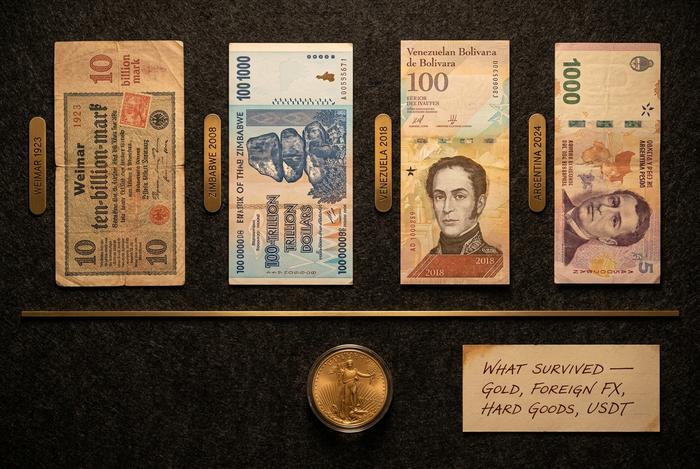
The far end is hyperinflation: Weimar 1923, Zimbabwe 2008, Venezuela 2018. Different problems and very different hedges.
The US dollar has been a fiat currency since 1971, when the Nixon Shock ended convertibility into gold and the world's other major fiat currencies followed within a few years. The dollar has lost about 96 percent of its purchasing power against a 1913 baseline. Mostly through quiet, year-by-year inflation rather than a single break. The Federal Reserve grew M2 money supply from $15.4 trillion in January 2020 to $22.44 trillion in January 2026. That is a 46 percent expansion across six years.
The dollar's reserve-currency role is sticky. It is not permanent. Sterling lost its reserve crown after roughly three decades of gradual depreciation. The Roman denarius slid for two centuries before the monetary system gave up. Slow erosion is the more common form.
Why diversification beats single bets
No single asset wins under every dollar-stress scenario. Gold underperforms when inflation is mild and equities rally. Bitcoin sells off in correlated risk-off panics. Foreign currencies struggle if every developed-market central bank devalues at once. Real estate is illiquid when you need cash. The instinct to pick "the one trade that wins" is exactly the instinct that produced the worst 60/40 portfolio outcome since 1937, when balanced funds fell 17 percent in 2022 and 10-year Treasuries fell 17.8 percent. The same balanced portfolio also outperformed cash across the 1970s inflation. Spread your bets is not exciting writing. It is durable advice.
Diversification works because mixed asset classes lose value at different times. What matters is the slice sizes. A defensive allocation in 2026 typically pushes precious metals to 10-20 percent (against the traditional 5), keeps 1-5 percent in crypto, holds 30-40 percent in productive equities with an international tilt, and reserves 5-10 percent for foreign FX and TIPS. Real estate sits at 5-15 percent depending on where you live. The point is the mix, not the pick.
Gold and silver: physical precious metals as the base layer
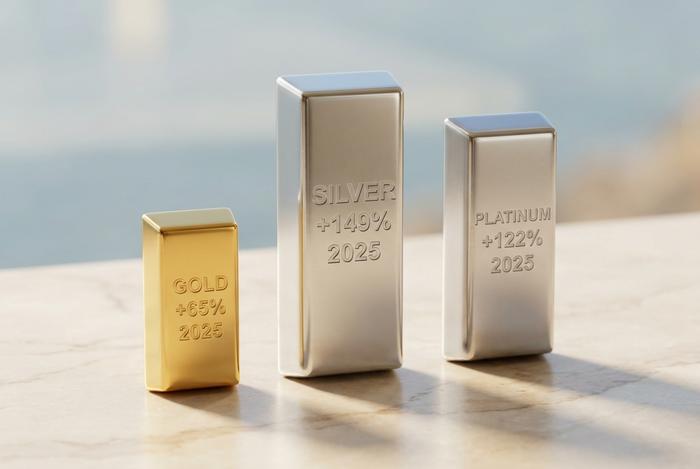
Precious metals are the oldest hedge in finance. The past three years have rewarded that staleness. Gold gained 65 percent in 2025. Silver gained 149 percent. Platinum gained 122 percent. Not subtle.
Central banks did most of the heavy lifting on the demand side. The World Gold Council recorded 1,045 tonnes of central-bank gold purchases in 2024. Then another 863 tonnes in 2025. Poland alone added 102 tonnes in 2025, the top sovereign buyer two years running. China extended a 13-month buying streak through November 2025.
How to own gold matters as much as how much you own. Physical gold (1 oz coins, 1 kilo gold bars from LBMA-accredited refiners) gives you the cleanest hedge. Gold IRAs offer tax-deferred exposure through approved custodians. ETFs like GLD and IAU give cheap liquid exposure, but you do not own physical gold and silver in your own name. Mining stocks add leverage at the price of equity-market correlation.
Silver carries a different profile. Six consecutive years of supply deficit. More than 160 million ounces a year. The gold-silver ratio sat near 85 to 1 in early 2025 and compressed sharply through the year. Platinum and palladium are industrial-demand stories with smaller monetary roles. Side hedges, not core holdings.
Zimbabwe's ZiG, launched in April 2024 as a gold-backed currency, illustrates the limit of the gold story. The ZiG has lost roughly 94 percent of its launch value despite the gold backing. Hard-asset reserves do not save a currency whose underlying fiscal and political problems remain. Owning physical precious metals yourself is the version with the longest track record across financial crisis cycles. That is what global markets reward.
| Form | Premium over spot | Liquidity | Best for |
|---|---|---|---|
| 1 oz gold coins (Eagle, Maple) | 3-7% | High retail | First-time buyers |
| 1 kg cast gold bar | 2-3% | Dealer / vault | Core holdings |
| Gold ETF (GLD, IAU) | 0.4% expense | Highest | Tax-advantaged accounts |
| Gold IRA | 1-3% custody | Medium | US retirement |
| 1 oz silver round | 8-15% | Medium | Tactical, divisible |
| Platinum bar (1 oz) | 4-8% | Lower | Diversifier only |
Foreign currencies and TIPS: paper hedges that still work
If you cannot leave the paper system, the right paper assets still help. The Swiss franc, Japanese yen and Singapore dollar are the classic safe-haven trio. The franc in particular has appreciated significantly against the dollar across most multi-year windows. Holding foreign currency directly through TIAA, Interactive Brokers or Wise gives you exposure to the FX leg without needing to time markets.
US Treasury Inflation-Protected Securities are the unloved sibling here. The 10-year TIPS real yield sat at 1.98 percent on 13 May 2026 — not exciting nominally, but the principal adjusts with CPI. In an inflationary path TIPS deliver what cash and conventional bonds cannot.
Sovereign bonds of Norway, Switzerland, Singapore work for the institutional-minded, though yields are usually thin. Foreign-currency CDs at TIAA and Everbank are simpler options for retail buyers who want USD-alternative cash exposure with FDIC-equivalent protections.
Bitcoin and crypto: the fastest-moving 1-5 percent slice
Bitcoin is the newest and most polarising entry on this list. The asset broke $126,000 in October 2025 and held near that level into 2026. The US Strategic Bitcoin Reserve was authorised on March 6, 2025, with the federal government formalising holdings near 207,000 BTC. Bhutan holds roughly 12,062 BTC, equal to about 40 percent of GDP. El Salvador sits near 7,500 BTC. Bitcoin has become a sovereign-balance-sheet asset, not just a retail bet.
That matters for individuals too. If treasuries with reserve mandates now hold Bitcoin alongside gold and FX, the asset deserves the same evaluation framework retail buyers already use for gold IRAs and FX deposits. Not the same allocation. The same framework.
Three crypto buckets matter for someone hedging dollar risk. First, Bitcoin as digital hard money, with a 21-million fixed supply. Second, stablecoins. USDT runs $189.6 billion outstanding. USDC sits at $77.6 billion. Combined, the stablecoin market touches roughly $319 billion in 2026. They let you hold a dollar-denominated balance outside the US banking system. The 2025 GENIUS Act created the first federal framework for compliant US stablecoin issuance. Third, tokenised gold (PAXG, XAUT), which gives you on-chain physical gold without storage friction.
Crypto's risk is volatility, not theoretical zero. Sizing is the discipline. A 1-5 percent allocation captures most of the asymmetric upside without putting the rest of the portfolio at risk. Push above 10 percent and Bitcoin becomes the dominant factor in your overall return, which is a different bet altogether.
Real estate, commodities and productive assets
Real estate moves slowly and pays you to wait. US home prices rose roughly 50 percent on a Case-Shiller measurement basis from January 2020 to early 2026, dwarfing the 23 percent CPI gain over the same window. Direct ownership comes with leverage, mortgage payments and maintenance. REITs (VNQ, IYR) give liquid exposure without those frictions, though they correlate more with equities than direct property does.
Farmland is the hedge inside the hedge. The NCREIF Farmland index has delivered roughly 10.15 percent annualised since 1992 with 6.82 percent volatility — outperforming the S&P 500 with less than half the drawdown. Retail access has improved through AcreTrader, FarmTogether and a handful of farmland REITs.
Commodity exposure through DBC or USCI gives an inflation-correlated basket of oil, agriculture and metals — a productive tangible asset class with embedded demand for goods and services across cycles. International stocks with hard-asset earnings (Brazilian mining, Australian miners, Norwegian energy majors) act as productive hedges against any local-currency story. The Buffett line about owning the company that owns the asset still applies: a profitable miner usually beats the metal it digs, over decades.
Historical lessons from real currency collapses
What survived in past collapses tells you what is likely to survive the next one. The list is shorter than people expect. It is also strikingly consistent across cases.
Take Weimar Germany. The mark went 1 USD = 49 marks in 1919, then 1 USD = 4.2 trillion marks by November 1923. Whoever held gold kept wealth. Foreign currencies too. Real estate, machinery, art, jewellery. Mark-denominated bonds went to zero in real terms.
Zimbabwe, 2008-2009. The reserve bank printed a 100-trillion-dollar note that famously bought one loaf of bread. The locals who survived held physical USD cash, gold or productive land. Zimbabwe has tried gold-backed money twice since (ZiG, April 2024). Both attempts are failing. Hard-asset backing alone never fixes a broken issuer.
Venezuela, 2016-2019. Inflation past 1,000 percent. Locals went to USD cash, then USDT once stablecoins hit liquid local markets.
Argentina has lived in this regime almost continuously. December 2023 CPI clocked 211 percent year-on-year. Half of all crypto purchases on Bitso, the biggest local exchange, now clear in USDT.
Turkey is the parallel story. Lira down 80-plus percent against the dollar between 2022 and 2025. Binance's USDT-TRY pair has done $22 billion-plus in cumulative volume. Gold and stablecoins did the heavy lifting.
| Collapse | Years | Peak inflation | Assets that worked |
|---|---|---|---|
| Weimar Germany | 1921-1923 | 4.2T marks per USD | Gold, foreign FX, RE |
| Zimbabwe | 2008-2009 | 89.7 sextillion % | USD cash, gold, livestock |
| Venezuela | 2016-2019 | 1,000%+ | USD cash, USDT, gold |
| Argentina | 2018-2025 | 211% (Dec 2023) | USDT, USD, RE |
| Turkey | 2022-2025 | TRY −80%+ vs USD | Gold, USDT, USD CDs |
Putting it together: a sample protective allocation
The textbook 2026 defensive allocation is not exotic. Roughly 30-40 percent productive equities, with 10 percent international exposure. 10-20 percent precious metals, split 70/30 gold/silver and mostly physical. 5-15 percent real estate, direct or REIT. 5-10 percent foreign FX and TIPS. 1-5 percent crypto, predominantly Bitcoin with small ETH or Solana. 5 percent cash and short-term Treasuries for liquidity. Re-balance annually. Adjust the mix to age and risk tolerance, not to headlines.
Conclusion: build the allocation, then ignore the noise
A genuine dollar collapse rarely arrives as a single televised event. The more common path is a 5-10 percent yearly loss of purchasing power compounded across a decade, with sharp drawdowns mixed in. The allocation that hedges that slow path is the same allocation that hedges a sudden break. Build it once, rebalance annually, ignore the doom feed. The dollar may or may not collapse on a timeline anyone can predict. Your portfolio either survives the path or it does not, and the wiring you put in place this year is what decides. A defensive mix of hard assets, productive equities and a measured crypto sleeve is a sensible hedge against any financial crisis scenario the next decade hands you.