Pros and Cons of PayPal: Is It Still Worth Using?
PayPal has been around long enough that most people just assume it's the default. Over 426 million active accounts and 36 million merchants — but that scale also masks some real problems. The pros and cons of PayPal look very different depending on whether you're a buyer, a domestic seller, or a business taking international payments. This article breaks down both sides so you can make an informed decision rather than defaulting to habit.
What Is PayPal and How It Works
PayPal launched in 1998 and was acquired by eBay before spinning off as an independent public company in 2015. It now processes $1.53 trillion in payment volume annually across 25 billion transactions, making it one of the largest payment platforms in the world.
The basic mechanic is straightforward:
- Link a bank account, debit card, or credit card to your PayPal account
- At checkout, select PayPal and authenticate — no need to enter card details with the merchant
- PayPal processes the payment and transfers funds to the seller's PayPal balance
- The seller withdraws to their bank account (free in 1–3 business days, or 1% for instant transfer)
This flow adds a privacy layer — merchants never see your card details — and enables PayPal's buyer protection policies.
PayPal offers three account types: Personal (for individuals), Business (for merchants accepting payments), and Premier (a middle tier for frequent sellers). Setup takes minutes, and the platform is available in 200+ countries across 25 supported currencies. That geographic reach is one of its strongest selling points — and also the source of some of its worst fee structures.
The Main Pros of Using PayPal
PayPal's longevity is no accident. The pros of using PayPal are real, particularly for consumers and small domestic sellers:
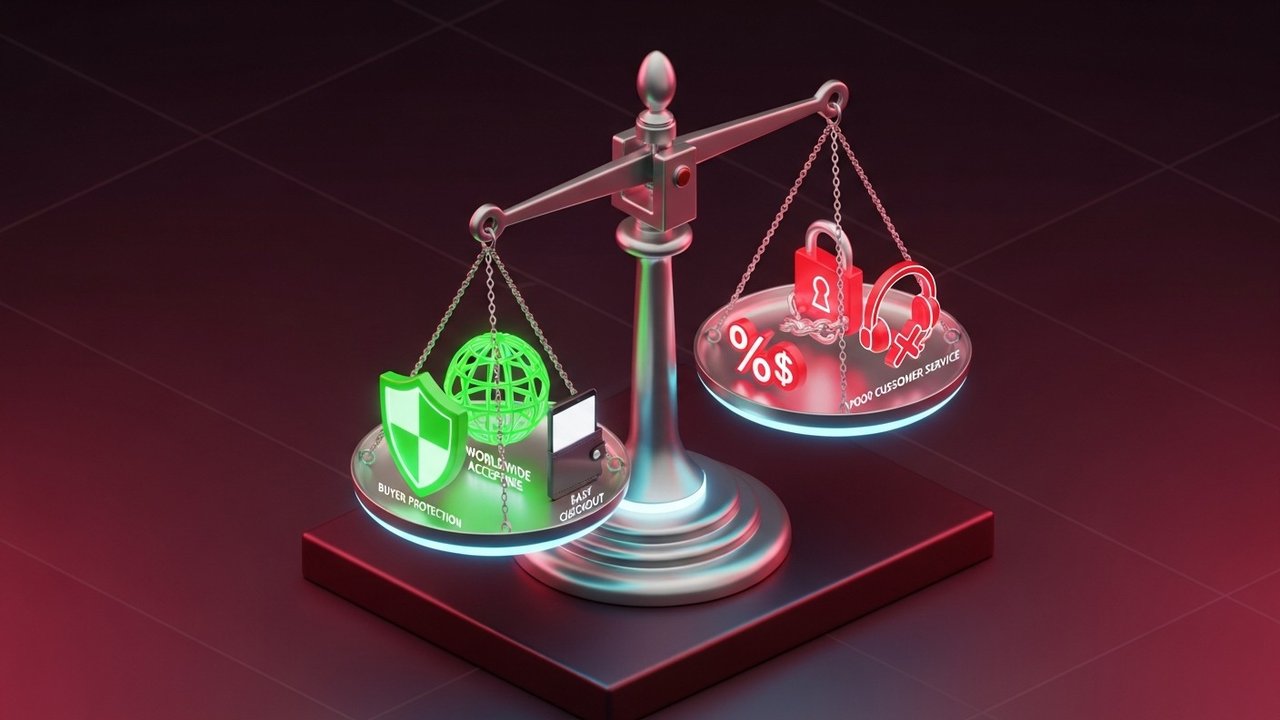
- Widespread acceptance — 36 million merchants accept PayPal. Most major e-commerce platforms (Shopify, WooCommerce, BigCommerce) offer PayPal checkout by default, so adding it rarely requires custom development.
- Buyer protection — PayPal Purchase Protection covers eligible transactions if an item doesn't arrive or significantly differs from the listing. The dispute process is straightforward and often resolves quickly.
- One-click checkout — stored payment details mean buyers don't re-enter card information on every purchase. This reduces friction and increases conversion for merchants who offer PayPal as an option.
- Free for personal transfers — sending money domestically to friends and family in the same currency costs nothing. This makes it competitive with Venmo and other peer-to-peer apps for casual use.
- Brand trust — 54% of consumers trust PayPal more than other checkout options. For merchants, that trust translates directly into conversion: offering PayPal at checkout demonstrably increases completed purchases.
- Seller protection — for eligible physical goods shipped with tracking, PayPal covers chargeback liability. This is meaningful protection for small merchants who sell tangible products.
- Crypto access — since 2020, PayPal lets users buy, sell, and hold cryptocurrency directly in their account. It's a convenient entry point for people new to crypto, though with significant limitations (covered below).
- Mobile experience — the PayPal app is well-rated and supports Venmo integration for US users, making it functional as a daily-use payment tool.
The buyer protection and brand trust arguments are especially strong. For consumers, the pros of using PayPal — protection, convenience, and brand recognition — provide a level of recourse that paying directly by card doesn't always match in practice.
Cons of Using PayPal: The Drawbacks
The cons of using PayPal are real, and for certain users — particularly high-volume merchants and international sellers — the disadvantages of PayPal become a serious cost:
- Account freezing — PayPal can freeze or permanently limit accounts with minimal warning, holding funds for up to 180 days. This is by far the most common complaint: Consumer Affairs rates PayPal 1.2 out of 5 stars, with account limitation as the dominant issue. Sellers who depend on PayPal as their primary payment channel face an existential risk if their account is flagged.
- High merchant fees — standard card processing runs 2.99% plus a fixed fee per transaction. That's before any surcharges. At volume, this is materially more expensive than Stripe's 2.9% + $0.30 or Square's equivalent rates.
- International surcharge — cross-border payments incur an additional 1.50% fee on top of the standard rate. For merchants with significant international sales, this stacks up fast.
- Currency conversion markup — PayPal applies a 4% markup above the base exchange rate on currency conversions. This is one of the worst conversion rates among major payment platforms.
- Chargeback and dispute fees — each disputed transaction triggers a $20 fee. Even if the merchant wins the dispute, the fee isn't automatically refunded. High-dispute businesses pay a significant premium.
- No seller protection for digital goods — services, software, e-books, and other intangible products are explicitly excluded from PayPal's seller protection. Digital-only merchants have no chargeback defence.
- Customer service — phone support is limited, and resolution often routes through a community forum or automated systems. When account issues occur, getting a human response quickly is genuinely difficult.
- Balance is not bank-insured — funds held in a PayPal account are not protected by FDIC insurance in the US or equivalent schemes in most other countries. PayPal holds your money, not a bank.
The cons of using PayPal are manageable for low-volume domestic sellers and consumers. For international merchants or businesses processing significant volume, they become a meaningful cost and operational risk.
How Much Does PayPal Charge in Fees
PayPal fees are where the advantages and disadvantages become most concrete. Understanding the full cost structure matters because PayPal fees stack — standard rate, international surcharge, and currency conversion fee can all apply to the same transaction. Here's the breakdown:
| Transaction Type | Fee |
|---|---|
| Personal transfer (domestic, same currency) | Free |
| Standard card payment (merchant) | 2.99% + fixed fee |
| International transaction surcharge | +1.50% |
| Currency conversion markup | +4% above base rate |
| Instant withdrawal to bank | 1% (min $0.25, max $25) |
| Standard withdrawal (1–3 business days) | Free |
| Chargeback / dispute fee | $20 per disputed transaction |
To put this in concrete terms: a merchant receiving a $100 payment from an international customer pays approximately $2.99 in standard fees, plus $1.50 in international surcharge. If a currency conversion is also involved, add another $4.00 on top. The total cost on a $100 cross-border transaction can reach $8–$9 — 8–9% of the transaction value, significantly higher than most alternatives.
PayPal fees for domestic, same-currency transactions are reasonable and competitive with similar payment service providers. The international stacking is the real problem: standard fee, surcharge, and currency conversion fee applied to the same payment add up to something that's genuinely hard to justify when alternatives exist.
PayPal for International Payments
PayPal's geographic reach is genuinely broad — 200+ countries and 25 currencies — but its international payment costs are among the highest of any major payment service. Businesses that regularly send or accept international payments need to look at the numbers carefully before defaulting to it.
The 4% currency conversion markup is the core problem. Platforms like Wise use the mid-market exchange rate with a small transparent fee. PayPal's 4% markup above the base rate gets applied without clear disclosure at the point of transaction. On a $5,000 international invoice, that's $200 buried in the exchange rate — invisible unless you know to check.
Settlement timing causes separate problems for new or flagged accounts. PayPal routinely places international transactions on hold for 21 days when an account is new or has triggered risk signals. Three weeks is a long time to wait on receivables when you're managing cash flow.
Some countries have restricted functionality too. In parts of Africa and Southeast Asia, PayPal accounts can receive funds but cannot withdraw to local banks. The money sits inaccessible unless recipients have an alternative withdrawal method — and this is rarely disclosed clearly upfront.
For domestic US, UK, or European transactions, PayPal works well. For consistent international payment flows, its fee structure and settlement behaviour make it worth comparing seriously against paypal alternatives that offer better rates and faster settlement.
PayPal Alternatives Worth Considering
The growth in payment platforms over the last decade means PayPal is no longer the obvious default. Businesses that accept PayPal alongside other options tend to perform better than those locked into a single payment platform. The right paypal alternative depends on what you're actually trying to solve:
| Alternative | Best for | Key advantage over PayPal |
|---|---|---|
| Stripe | Developers, online businesses | Better API, lower dispute fees, more customisable |
| Square | In-person retail | Free card reader, integrated POS, clear pricing |
| Wise | International personal transfers | Mid-market rate, low flat fees, transparent |
| Venmo | US peer-to-peer payments | Social features, instant transfers between users |
| Apple Pay / Google Pay | Mobile and contactless checkout | No account needed for buyers, fast checkout |
| Crypto gateways | Cross-border merchant payments | No chargebacks, flat fees, no FX markup |
Each alternative has its own limitations. Stripe requires more technical setup. Wise isn't a full merchant payment solution. Square's international coverage is limited. No single alternative replaces PayPal in every use case — but for specific pain points like international fees or chargeback risk, the alternatives are often materially better.
Crypto as a PayPal Alternative for Merchants
PayPal has a crypto feature. What it doesn't have is a real crypto payment solution.
Since 2020, PayPal lets users buy and hold Bitcoin, Ethereum, Litecoin, and a handful of other assets inside the PayPal wallet. The problem: in most markets, you can't transfer that crypto to an external wallet or use it to pay at non-PayPal merchants. It's a walled garden — crypto in name, but without the properties that make crypto useful for commerce.
For merchants who actually want to accept cryptocurrency as payment, a dedicated crypto payment gateway is a different category of tool. There are no chargebacks, because blockchain transactions are irreversible. The fee is flat regardless of what currency the buyer holds. Settlement goes directly to the merchant's wallet, without a payment processor holding funds overnight.
This matters most for merchants where PayPal's international surcharge and conversion fees are a real cost. A seller taking payments from customers in five countries pays a different effective rate depending on currency and location. A crypto gateway charges the same flat rate every time, regardless of origin.
Plisio accepts Bitcoin, Ethereum, Litecoin, USDT, and over a dozen other assets at a flat 0.5% per transaction. No monthly fees, no chargeback exposure, no currency conversion markup. For cross-border merchants where PayPal's fee stacking adds up to something worth fixing, it's a meaningful option to evaluate.
Conclusion
The pros and cons of PayPal break down along fairly predictable lines. For consumers and small domestic sellers, the advantages — buyer protection, easy checkout, brand trust — outweigh the drawbacks. For international merchants dealing with cross-border transactions, the disadvantages of PayPal become a real cost: fee stacking, a 4% currency conversion markup, and the ever-present risk of account limitation add up to something worth actively managing.
PayPal remains a useful payment platform for most checkout flows, and no merchant should remove it without understanding the conversion rate impact. But treating it as the only or best option for cross-border payments ignores alternatives that are materially cheaper and less risky. The right move is evaluating the pros and cons of PayPal honestly — fees, protection, risk, and alternatives included — before locking it in as the default.