Propy Crypto: PRO Token, Price & Blockchain Future

Propy sold the world's first house on a blockchain in 2017. Almost a decade later, its token trades around 93% below its all-time high, even as the company quietly runs billions of dollars in property deals through its software. That gap is the whole story.
Most pages you find for "Propy crypto" are price widgets. They tell you the number and nothing else. This guide does the opposite. It explains what Propy actually is, what the PRO token does, the real on-chain deals it pioneered, and the awkward truth that the company and the coin have started drifting apart. By the end you should be able to answer the only question that matters: which Propy are you actually looking at, the business or the token.
What Propy is and the problem it attacks
Propy is a company first and a token second. Founded in 2017 by CEO Natalia Karayaneva, a former property developer, it set out to fix something almost everyone who has bought a home complains about: the closing process is slow, paper-heavy, and stuffed with middlemen. In the United States a typical real estate transaction still drags on for around a month.
Propy's pitch is to move that process onto the blockchain. Offers, documents, title, and escrow are handled in software, and property records are written on-chain so they are harder to forge and easier to verify. A smart contract can hold funds and release them when conditions are met, in theory cutting out some of the manual back-and-forth between real estate agents, lawyers, and escrow officers. Karayaneva's argument has always been that the blockchain technology to streamline a home purchase already exists — the real estate industry simply has no incentive to adopt it, because every middleman in the chain earns a fee from the friction.
The PRO token sits inside this ecosystem, but it is not the product. The product is the transaction platform and, increasingly, the title and escrow service behind it. That distinction matters more than any price chart, because it is the reason the company can grow while the token does not. Keep it in mind for everything that follows.
Propy's real on-chain real estate firsts
Whatever you make of the token, the deals were real. Propy owns a genuine list of blockchain real-estate firsts, and that history is the strongest part of its story.
| Date | Milestone |
|---|---|
| Sep 2017 | World's first blockchain property sale, Kyiv (~$60K in ETH) |
| Jun 2021 | World's first real-estate NFT, the same Kyiv flat (~36 ETH, ~$94K) |
| Mar 2022 | First US home sold as an NFT, St. Petersburg, Florida ($653K) |
| Mar 2024 | PropyKeys launches on Base, 150K+ on-chain addresses minted |
The 2017 sale set the template. TechCrunch founder Michael Arrington bought a Kyiv apartment through an Ethereum smart contract, paying in crypto, with the transaction recorded on-chain. In 2021 the same apartment was auctioned as the first real-estate NFT, fetching roughly 36 ETH, about $94,000 at the time. The following year Propy ran the first NFT-linked home sale in the United States, a St. Petersburg, Florida property that went for around $653,000, paid in 210 ETH.
PropyKeys, launched in March 2024 on Coinbase's Base chain, took a different angle: minting real-world home addresses as on-chain tokens, a kind of digital-address registry that Propy pitched as a new asset class. It pulled in more than 150,000 addresses within weeks. None of this is vaporware. The honest caveat is that pure crypto-native property sales remain rare and boutique, more proof-of-concept than mass market. The firsts are real; the volume behind them is small.
What the Propy crypto token actually does
PRO is an ERC-20 token on Ethereum — a digital asset with a bridge to Base. Its utility is real but thin, and being clear-eyed about that is the point.
The token is used to pay for some services on the platform, to reward activity like referrals, agent signups, and property listings, and to participate in PropyKeys. Governance and staking have featured on the roadmap, with staking framed as a way to earn rewards for holding. Supply is capped at 100 million PRO, of which roughly 57.9 million circulate.
The token first appeared in Propy's 2017 ICO, raised to fund the platform, and its job has always been to lubricate the ecosystem rather than to settle the actual property payments, which have run in cryptocurrency and increasingly in fiat. What PRO is not is a fee that every Propy transaction must burn. A family closing on a house through Propy's title service is not buying PRO to do it. That is the central weakness in the token's design: the business can scale on dollars and stablecoins while demand for the token stays flat. Useful, yes. Essential, not really.
Propy price, market cap and the brutal chart
Here the price-tracker pages give you a number without the context. The context is unkind. PRO is a micro-cap trading far below the hype peak it hit during the last cycle.
| Metric | Value (May 2026) |
|---|---|
| Price | ~$0.33 |
| All-time high | $5.15 (Jan 2018) |
| All-time low | ~$0.03 (Mar 2020) |
| Market cap | ~$19.1 million |
| Market rank | ~#899 |
| 24h volume | ~$7.9 million |
| Circulating / max | 57.9M / 100M PRO |
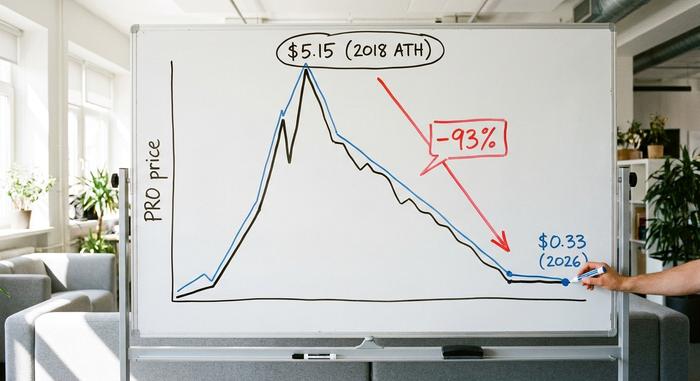
Read that top to bottom and the shape is clear. PRO launched in a September 2017 ICO at about $1 and raised roughly $15.1 million. It spiked to an all-time high of $5.15 in January 2018, during the broad crypto mania, then collapsed. Today, near $0.33, it sits about 93% under that peak. CoinMarketCap lists the all-time high slightly higher at $6.15, a common discrepancy between data providers, but either way the drawdown is brutal.
A roughly $19 million market cap puts Propy well outside the top 800 tokens by value. Liquidity is modest, with daily trading volume around $8 million. For a project this old with genuine product milestones, that is a striking gap, and it points straight at the disconnect between what the company does and what the market pays for its coin.
Propy's 2025-26 pivot to an AI title company
This is the development almost no price page mentions, and it is the most important one. Over 2025 and into 2026, Propy stopped acting like a crypto-native platform and started behaving like a technology-enabled title company.
The clearest signal was money. In October 2025 Propy lined up a $100 million credit facility from Metropolitan Partners Group to buy up traditional title and escrow firms and fold them into an AI-driven operation. By that point Propy said it had processed more than $4 billion in transactions through its systems, a figure it put above $5 billion by early 2026. It built an AI agent, Agent Avery, trained on more than $5 billion of closing data over four years, to automate the routine follow-ups and paperwork that make closings slow. Propy has framed the goal as saving agents hours per deal and cutting manual work sharply. It also began rolling out crypto-backed home loans in early 2025, letting holders borrow against their crypto to buy property without selling it — a neat bridge between digital wealth and physical real estate, and another service that does not require touching the PRO token at all.
| Propy the company | PRO the token | |
|---|---|---|
| Scale | $5B+ processed | ~$19M market cap |
| Direction | Acquiring title firms | ~93% below ATH |
| Engine | AI + fiat closings | Fees, rewards, staking |
Look at that contrast. The company is consolidating an old, fragmented industry with credit and AI, and most of those closings settle in dollars or stablecoins, not PRO. The token bears the name and the history, but the growth is happening on a track the token does not directly ride. A buyer hoping the token simply tracks the company's success is making an assumption the business model no longer guarantees.

Where Propy fits in RWA tokenization
Step back and Propy is a bet on a bigger idea: real-world asset tokenization, the movement to put assets like bonds, funds, and property on-chain. The macro numbers are large. On-chain RWA value sat around $33.65 billion in May 2026, and a widely cited BCG projection sees real-estate tokenization growing from roughly $120 billion in 2023 to about $3.2 trillion by 2030.
The reality on the ground is humbler. Tokenized treasuries and private credit lead the RWA charts, while tokenized real estate remains a rounding error, with leading projects measured in the tens of millions, not billions. Property is simply hard to tokenize cleanly: every parcel is unique, illiquid, tied to local law, and governed by a county registry that does not care what a blockchain says. Those frictions are exactly why real estate has lagged behind easier assets like bonds. Propy is early to a market that may be huge later, which is a flattering way of saying it has been waiting for the wave for years. Being right eventually and being early are not the same thing for a token holder who has to live through the gap.
Is Propy a good investment? The honest read
Separate the company from the coin, because in 2026 they are not the same bet. None of this is investment advice, but the honest framing is straightforward.
The company looks like it is executing. It has real milestones, real revenue from title services, fresh credit, and a concrete AI strategy. The token is the harder case. Its value capture is the open question: if Propy's billions in closings settle in fiat and stablecoins, what exactly drives sustained demand for PRO? On top of that sits a legal reality the marketing tends to skip. An on-chain deed or NFT does not by itself override the county recorder; the blockchain record still has to line up with the local property registry, and in most places paper law wins ties.
Add thin liquidity, a 93% drawdown, execution risk, and shifting crypto regulation, and the picture is a project with a credible business wrapped around a token whose role is uncertain. There is also concentration to consider — with only about 57.9 million of 100 million tokens circulating, future unlocks could weigh on the price regardless of how the company performs. My read is simple: Propy-the-company looks more durable than PRO-the-token, and anyone buying the coin is really betting that the two reconnect.
Where to buy the Propy (PRO) token
PRO is listed on several major venues, including Coinbase, Kraken, and KuCoin, and it trades on decentralized exchanges such as Uniswap. As an ERC-20 token it can be held in standard wallets like MetaMask, and the Base version works with that ecosystem too. Because it is a small-cap asset, liquidity and spreads vary between platforms, and it is not available everywhere. Always confirm the correct contract address before buying, since low-cap tokens are common targets for fake listings. For a thinly traded asset like this, it is also worth using limit orders rather than market orders, because a single large trade can move the price more than you expect.
The bottom line on Propy crypto
Propy is two things sharing one name: a real, executing real-estate technology company, and a battered micro-cap token. The pioneer history is genuine, the 2025-26 pivot into AI-driven title services is the real growth engine, and the PRO token is the piece with the least clear future.
So before you act on anything labeled "Propy crypto," decide which Propy you mean. If you admire the business, that is a company story about dragging a slow industry on-chain, and you would watch acquisitions and transaction volume. If you are eyeing the token, you are taking a separate, riskier position that the coin will eventually capture the value the company creates, and you would watch utility and demand instead. In 2026, those are two different bets, and pretending they are one is how people get surprised.