JOBY Stock: Is Joby Aviation Inc a Buy Now?
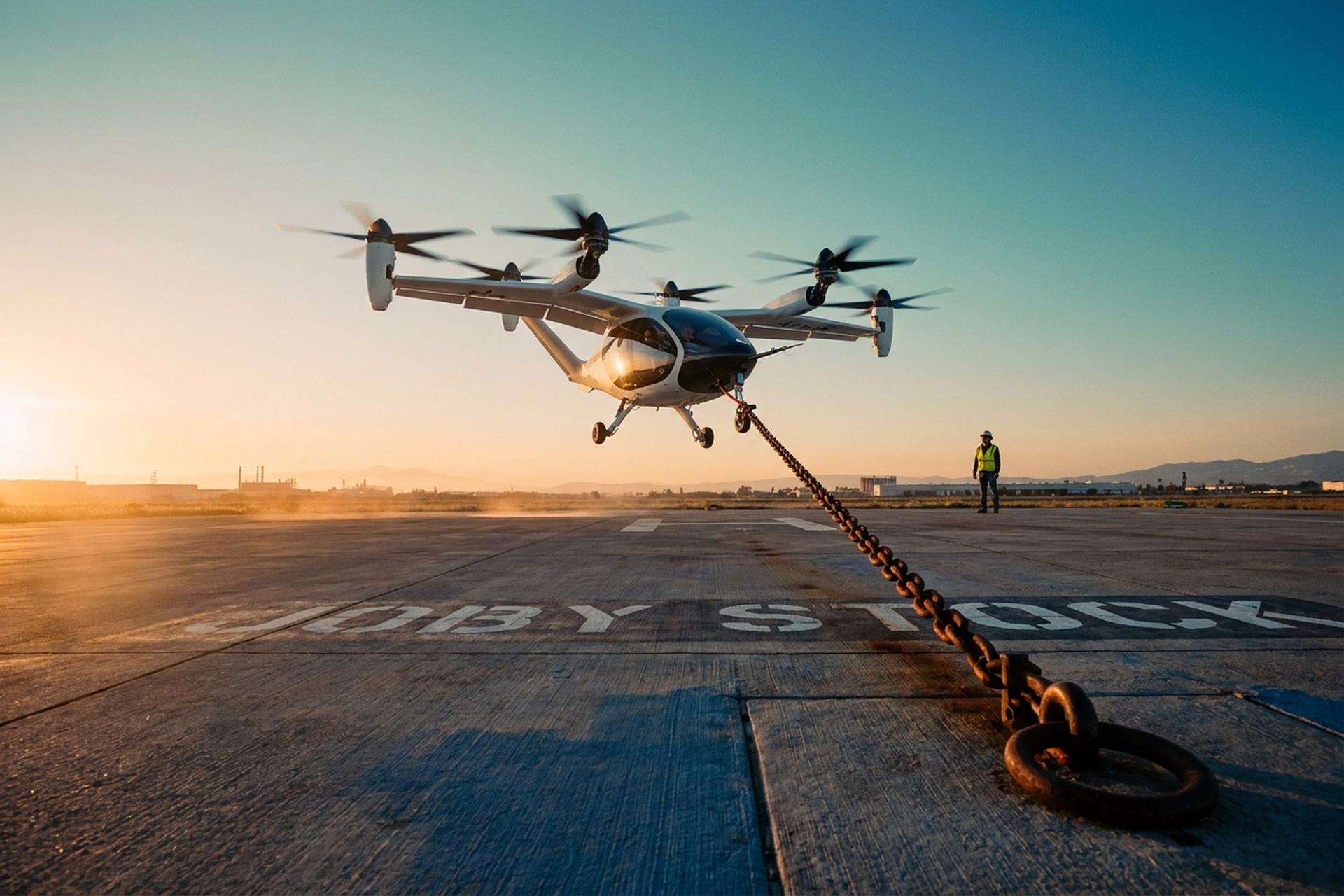
Here is a company worth roughly $12 billion that sold almost no real product last year and lost close to a billion dollars doing it. The stock is up anyway. That single fact tells you most of what you need to know about JOBY stock: this is not a bet on what Joby Aviation earns today. It is a bet on a date in the future.
The real question is not whether the company is impressive. It is. The question is what you are actually paying for at $12 a share. Strip away the flying-taxi headlines and you are buying a timeline: the date Joby's aircraft start carrying paying passengers. Everything else is noise around that one number.
What JOBY Stock Is and What Joby Aviation Builds
When you buy JOBY stock, you are buying equity in Joby Aviation, a company developing an all-electric vertical takeoff and landing aircraft, the kind of vehicle the industry calls an eVTOL. The aircraft is designed to carry a pilot and up to four passengers, travel about 100 miles on a charge, and hit speeds near 200 mph. Think of it as a quiet electric helicopter built for short city hops.
Pull up a JOBY stock quote and you will see Joby Aviation stock listed on the NYSE under the ticker JOBY. The company was founded in 2009, is headquartered in Santa Cruz, California, and is run by founder JoeBen Bevirt. It went public in August 2021 through a SPAC merger with Reinvent Technology Partners, the deal vehicle backed by Reid Hoffman and Mark Pincus.
This is the part beginners miss. Joby is not a transportation company in any normal sense yet. It does not run a fleet. It barely sells anything to passengers. It is a developer, a well-funded science project that must clear regulators before it can charge for a ride. That gap between the vision and the cash register is the whole story.
How Joby Aviation Plans to Make Money
Let me be blunt about the revenue line, because it is the most misread number on the page. Joby Aviation reported about $53.4 million in revenue for fiscal 2025. That sounds like a real business taking off. It is not what it looks like.
Almost all of that revenue came from Blade, the helicopter and air-mobility business Joby acquired in August 2025. It is existing helicopter and charter activity, not money from electric air taxis. The eVTOL aircraft that the entire investment thesis rests on has generated essentially nothing in passenger revenue, because it cannot legally fly paying customers yet.
| Revenue reality | Figure | What it actually is |
|---|---|---|
| FY2025 revenue | $53.4M | Mostly the acquired Blade business |
| Q1 2026 revenue | $24.2M | Helicopter and charter, not eVTOL |
| FY2026 guidance | $105–115M | Still Blade-driven |
| eVTOL passenger revenue | ~$0 | Waiting on certification |
So how is this supposed to become a real business? The plan for JOBY stock holders to ever see a return is to manufacture eVTOL aircraft at scale, operate air-taxi routes in cities, and sell rides at prices that fall toward ride-share levels over time. Joby also earns smaller amounts today from US Department of Defense flight contracts and pilot-training work. None of that is the prize. The prize is millions of short urban flights a year, and not one of them counts until the regulator says yes.
JOBY Stock Price: A $7-to-$21 Rollercoaster
If you want proof that this is a sentiment stock rather than a fundamentals stock, look at the chart. Over the past year JOBY stock has swung from a low of $7.34 to an all-time high of $20.95, reached on August 4, 2025. It now trades back near $12. That is not how a stock behaves when it is being valued on earnings. It is how a stock behaves when it is being valued on belief.
The numbers underneath confirm it. Joby carries a beta around 2.6, meaning it tends to move more than twice as hard as the broad market in either direction. Short interest sits near 13.5% of the float, so a meaningful crowd is betting against it. Daily volume runs into the tens of millions of shares. This is a battleground.
| Price and volatility | Value |
|---|---|
| Recent price | ~$12 |
| 52-week range | $7.34 – $20.95 |
| All-time high | $20.95 (Aug 4, 2025) |
| Market cap | ~$11.3–12B |
| Beta | ~2.6 |
| Short interest | ~13.5% of float |
The lesson is simple. JOBY stock price reacts to news, not to quarterly results, because the quarterly results are all spending and no product. Every certification update, every partner headline, every Dubai photo moves the tape more than any income statement will for years.
FAA Certification and the Path to First Flight
This is the only clock that matters, so spend a minute on it. Every dollar of Joby's valuation is a wager on a single regulatory date: when the Federal Aviation Administration lets these aircraft fly paying passengers in the United States.
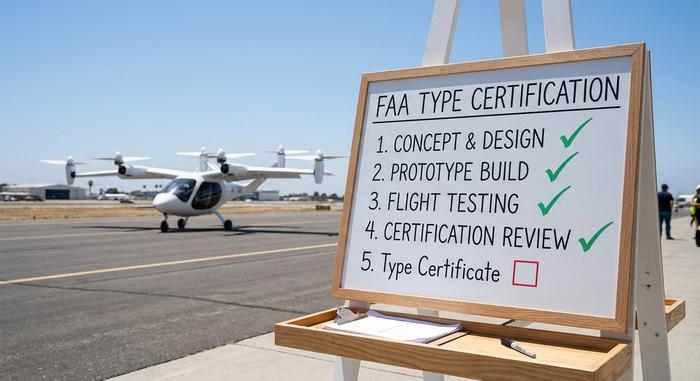
The FAA runs type certification in five stages. Joby cleared Stage 4 in late March 2026, covering things like hardware conformity, propulsion reliability, and the redundancy of its fly-by-wire controls. That is real progress, and it makes Joby the most advanced eVTOL company in the US certification pipeline. Credit where it is due.
But read what comes next carefully. After Stage 4, the aircraft still has to complete Type Inspection Authorization flight testing, which is underway, then earn the Type Certificate itself, and finally an Air Carrier Certificate to operate commercially. Joby tells investors it is aiming for late 2026. Several independent analysts who follow the program think mid-to-late 2027 is more realistic.
That gap, between the company's timeline and the skeptics', is the entire risk in JOBY stock in one sentence. A year of slippage on a pre-revenue company that burns cash every quarter is not a rounding error. It is another year of losses, another possible share sale, and another year before the first dollar of real revenue arrives. Aviation certification has a long history of taking longer than anyone promises. So when you see "late 2026," treat it as the optimistic end of a range, not a delivery date.
Toyota, Delta and the Dubai Air-Taxi Launch
If the bull case has a foundation, it is the quality of Joby's partners, and this is where the recent news matters. Start with Toyota. The automaker has committed about $894 million in total, including a $394 million stake from 2020 and a fresh $500 million pledged in two $250 million tranches, the first of which closed on May 27, 2025. More important than the cash is what Toyota brings to the factory floor: the Toyota Production System, engineers embedded on site, and powertrain supply. Anyone can write a check. Almost no one can hand a startup the world's best manufacturing playbook.
Delta Air Lines is in too, with $60 million upfront and up to $200 million tied to milestones, a roughly 2% equity stake, and plans for home-to-airport service at JFK and LAX. And then there is Dubai, which may be the most underrated piece. Joby holds a six-year exclusive agreement with Dubai's Road and Transport Authority and completed the first piloted point-to-point eVTOL flight in the UAE on November 9, 2025. Commercial service there is targeted for 2026, potentially well ahead of the US.
Why does Dubai matter so much for JOBY stock? Because it could let Joby start earning real air-taxi revenue and gathering operating data before the FAA finishes its work. A live market is worth more than a hundred press releases.
Joby Financials and Earnings: Cash and Burn
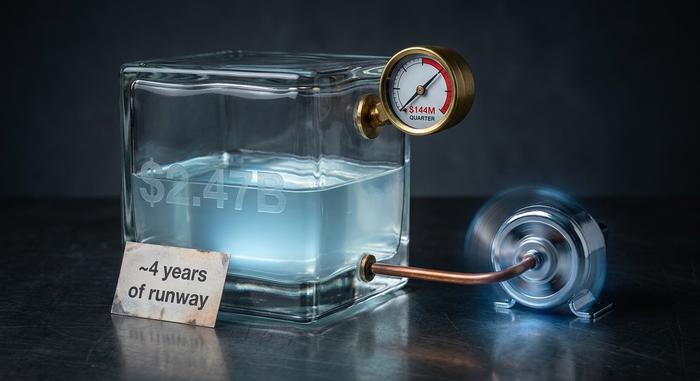
The bull case lives or dies on the balance sheet, so here is the real picture. The good news first: Joby is not about to run out of money. As of March 31, 2026, the company held about $2.47 billion in cash and short-term investments, boosted by a $1.3 billion raise made up of $600 million in equity and $690 million in convertible notes.
Now the uncomfortable part. Joby is spending fast. Operating cash burn was $144.4 million in the first quarter of 2026, and the full-year 2025 net loss came in near $929.8 million. At the current rate the cash buys roughly four years of runway, but that burn will climb as the company tools up factories in California and Ohio.
| Joby financials | Figure (as of Q1 2026) |
|---|---|
| Cash + investments | ~$2.47B |
| Q1 2026 operating burn | $144.4M |
| FY2025 net loss | ~$929.8M |
| Shares outstanding | ~984M |
| Estimated runway | ~4 years |
Notice the share count: roughly 984 million shares, and rising — a figure that matters to anyone sizing a position in JOBY stock. Joby has funded this dream the way pre-revenue companies usually do, by selling more stock. Every raise keeps the lights on and quietly shrinks your slice of the pie. For a company that will not turn a profit for years, dilution is not a footnote. It is a recurring cost of staying alive, and it lands on existing shareholders.
JOBY vs Archer: The eVTOL Two-Horse Race
You cannot evaluate JOBY stock without looking at Archer Aviation, ticker ACHR, the rival the market constantly weighs it against. The two are running the same race from different lanes. Joby leads on FAA certification stage and on the depth of the Toyota relationship. Archer counters with a lower market cap, a conditional United Airlines order for up to 300 aircraft, and a manufacturing tie-up with Stellantis.
| Factor | Joby (JOBY) | Archer (ACHR) |
|---|---|---|
| Market cap | ~$11.3–12B | ~$5B |
| Liquidity | ~$2.47B | ~$1.78B |
| FAA progress | Stage 4 cleared | Phase II complete |
| Marquee partners | Toyota, Delta | United, Stellantis |
| Lead order book | Smaller | 300-aircraft United deal |
The fair read is that there is no clean winner yet. Joby looks like the safer, better-capitalized leader; Archer looks like the cheaper option with a bigger named order book. If you believe urban air mobility happens at all, owning the category beats guessing the single winner. If you do not believe it happens, neither one is cheap.
Latest JOBY News, Analyst Ratings and Targets
Wall Street's verdict on JOBY stock is unusually honest: it does not know. The consensus rating across roughly 11 analysts is a Hold, and the average price target sits near $11 to $12, basically where the stock already trades. The most recent forecast moves only widened the split rather than settling it.
| Analyst view | Figure |
|---|---|
| Consensus rating | Hold (~11 analysts) |
| Average price target | ~$11–12 |
| Target range | $6 – $18 |
| Bull example | H.C. Wainwright, Buy, $18 |
| Bear example | Goldman Sachs, Sell, $9 |
Look at that spread. One bank rates it a Sell with a $9 target while another rates it a Buy at $18, on the very same company. That is not a forecast you can lean on; it is a coin flip with a research report attached. When the professionals are that divided, it tells you the outcome hinges on events nobody can model, mainly the certification date.
The Bull and Bear Case for JOBY Stock
Time to take a position. The two sides of JOBY stock are not balanced, and the imbalance is about time, not direction.
The bull case is real and large. Joby is the most FAA-advanced eVTOL maker, it has Toyota's manufacturing muscle behind it, it has a live launch market in Dubai, and it sits on $2.47 billion in cash. If urban air mobility becomes a normal way to cross a city, the addressable market is enormous and Joby is positioned near the front. That is a genuine prize, and it is why the stock can spike on a single headline.
The bear case is quieter and, to me, harder to dismiss. A pre-revenue story stock with a beta of 2.6 does not need anything to go wrong to fall. It just needs the crowd to get bored while it waits. Real revenue is years away, the company burns more than $140 million a quarter, the share count keeps climbing, and certification could slip to 2027 or beyond. On a price-to-sales basis the stock trades at well over 100 times sales, a multiple that only makes sense if you are pricing 2030, not 2026.
| Bull case | Bear case |
|---|---|
| Most FAA-advanced eVTOL | Real revenue years away |
| Toyota manufacturing depth | $144M/quarter cash burn |
| Dubai launch market | Ongoing share dilution |
| $2.47B cash runway | Certification could slip to 2027+ |
| Huge market if UAM works | P/S above 100x, sentiment-driven |
My read is that the bull case needs years of nearly flawless execution to pay off, while the bear case only needs patience to run out. That asymmetry is the thing to sit with before you buy.
Conclusion: Is JOBY Stock Worth the Risk?
Joby Aviation is the clear technical leader in a category that might change how cities move. It is also a company priced as if certification and a paying market both arrive on schedule, when aviation history says one of them usually slips. At around $12, JOBY stock is valuing not the business it has but the business it hopes to be in 2030.
JOBY stock can still be a smart buy, but only for a specific kind of investor. So ask yourself one question before you click: are you prepared to hold a volatile, money-losing story stock for three to five years while it tries to turn a flying prototype into a profitable airline? If yes, size it small and be honest that it is a venture bet in public-market clothing. If the answer is no, the chart will keep tempting you, and that is exactly when it pays to stay out.