Mistral AI: A Frontier AI Lab Meets Crypto in 2026

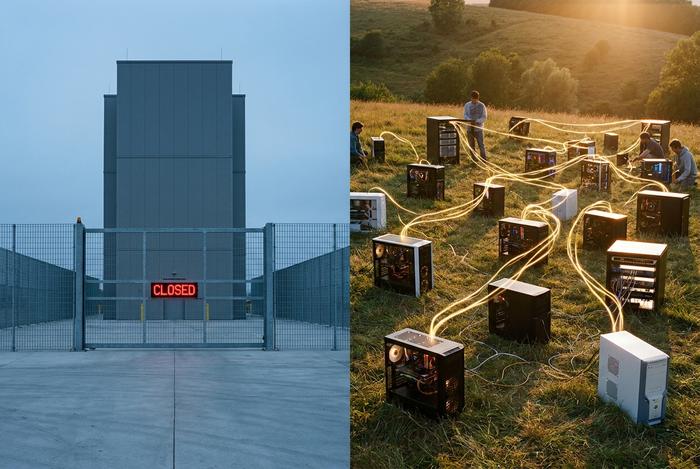
Most AI labs guard their models like trade secrets. Mistral AI does the opposite. It builds frontier models and then gives the weights away for anyone to download, run, and modify. That single choice is why a Paris startup most crypto users have never heard of may end up running on the same decentralized rails as their wallets.
This article does two things. First, it explains what Mistral AI actually is: the founders, the funding, the models, and the open-weight bet that defines it. Then it looks at the part nobody else writes about, where Mistral and crypto actually overlap, and, just as important, where the connection is hype rather than substance. If you care about owning your own infrastructure, the link is more real than it sounds.
What is Mistral AI, the open model lab
Calling Mistral "Europe's OpenAI" is lazy. The open-weight strategy is the whole identity, and it is exactly what makes the company interesting to anyone who values self-custody.
The founders and the funding
Mistral AI was founded on 28 April 2023 in Paris. Its three founders came straight from the labs that built modern AI: Arthur Mensch, the CEO, worked at Google DeepMind, while Guillaume Lample and Timothee Lacroix came from Meta's FAIR research group. They started with pedigree and almost no product, and investors did not wait. The company raised a roughly 385 million euro Series A in December 2023 at about a 2 billion dollar valuation, led by Andreessen Horowitz. A 600 million euro Series B followed in June 2024 at a 5.8 billion euro valuation. By September 2025 it closed a 1.7 billion euro round led by the chip-equipment giant ASML, valuing Mistral at around 11.7 billion euros, close to 14 billion dollars. For a company barely two years old, that is a remarkable climb, and it made Mistral Europe's most valuable AI startup by a wide margin.
Le Chat and La Plateforme
Mistral is not only a research lab. Le Chat is its consumer assistant, a direct answer to ChatGPT, and it had a breakout moment of its own. In February 2025 the app crossed one million downloads in just 14 days and briefly topped the iOS chart in France. That spike rode a wave of national pride in a homegrown alternative, but it also put Le Chat on the map next to ChatGPT and Gemini. Developers reach the same models through La Plateforme, Mistral's API, where you pay per token instead of hosting anything yourself. Both front the same engine.
Why "open weight" is the headline
Here is the part that matters. Many of Mistral's models are released as open weights under the permissive Apache 2.0 license. You can download the actual model file, run it on your own hardware, fine-tune it, and ship it inside a product without asking permission. Most rivals only rent you access through an API. That difference sounds technical, but it is the hinge the entire crypto story turns on. No other lab at Mistral's funding level ships frontier-class weights this freely, and that scarcity is part of why it draws attention well beyond Europe.
The Mistral AI models and what they do
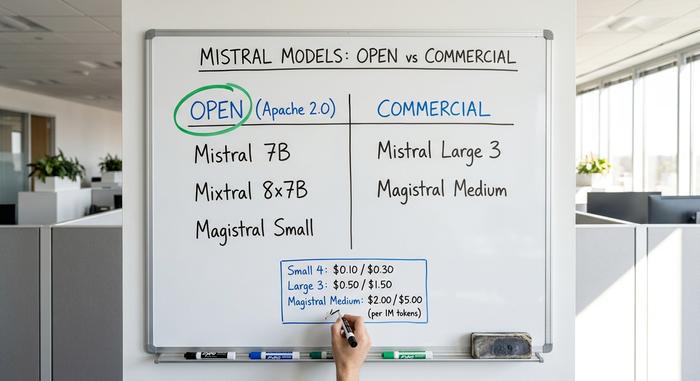
The Mistral AI models split cleanly into two camps: open models you can take and run, and commercial models you pay to access. That split is what makes every crypto use case later in this article possible.
Open-weight models (Apache 2.0)
The open line started with Mistral 7B in September 2023, a small model that punched far above its size. Mixtral 8x7B followed in December 2023, using a mixture-of-experts design that activates only part of the network per query, which keeps inference cheap. A larger Mixtral 8x22B arrived in 2024 for heavier workloads. That trick matters for self-hosting, because it delivers strong output without paying to run every parameter on every token. Since then the family has grown to include Mistral Small, the coding-focused Codestral, the multimodal Pixtral, and in June 2025 the Magistral reasoning models, whose 24-billion-parameter Small version ships under Apache 2.0.
Commercial frontier models
At the top sit the paid models, led by the Mistral Large series through Large 3, plus the commercial Magistral Medium, which scored 73.6% on the AIME 2024 math benchmark. These compete on raw capability and stay closed. The pattern is deliberate: give away the smaller and mid-tier model versions to win developers, charge for the frontier. It is the open-source playbook applied to AI, building a developer base with free tools, then earning from the customers who need the absolute best or who want managed hosting.
What it costs
API pricing is low enough that cost is rarely the blocker. The table below shows representative rates, charged per million tokens of input and output.
| Model | Type | Best for | Price (in / out per 1M tokens) |
|---|---|---|---|
| Mistral Small 4 | Open weight | Cheap, fast tasks | $0.10 / $0.30 |
| Mistral Large 3 | Commercial | General frontier work | $0.50 / $1.50 |
| Magistral Medium | Commercial | Hard reasoning | $2.00 / $5.00 |
For self-hosting, you skip these fees entirely and pay only for the hardware, which is where decentralized compute enters the picture.
Why Mistral AI matters for crypto and Web3
Open weights are crypto-native almost by accident. The same instinct that makes someone hold their own keys makes them want to run their own model. This is the actual plumbing, not the marketing.
Self-hosting on decentralized GPUs
Because Mistral's open models are downloadable, they can run anywhere there is a GPU, including decentralized compute marketplaces. In November 2025, the Akash Network launched AkashML, a managed inference service that serves open models like Mistral on a network of independent GPU providers rather than a single cloud. The pitch is cost and neutrality: an H100 chip on these networks has been quoted around $2.50 to $3.50 per hour, against roughly $4.10 on AWS. You rent compute from strangers, pay in tokens, and no single company can cut you off. That neutrality is the real selling point for crypto teams. A centralized API can suspend an account, change its terms overnight, or log every prompt. A model you downloaded and run on rented, permissionless GPUs answers to nobody but you, the same guarantee a self-custodied wallet gives over your funds.
AI agents that pay with crypto
The more interesting overlap is payments. Autonomous AI agents need to pay for things, including their own model calls, and they cannot hold a bank account. Stablecoins fit the gap neatly. According to a Keyrock report, AI agents settled around $73 million across 176 million on-chain transactions between May 2025 and April 2026, with 98.6% of that volume in USDC. Coinbase expanded its x402 stablecoin payment standard for agents in December 2025. An agent running an open Mistral model can pay per inference in USDC without a human in the loop. Zoom out and the whole AI-crypto token sector was worth about $22.1 billion in mid-2026, by CoinGecko's count, still small but no longer a rounding error. This is why the agent economy keeps drifting toward crypto rails rather than cards. Card networks were built for people with billing addresses; a program calling a model a thousand times an hour needs machine-speed, account-free settlement, and stablecoins provide it.
The honest caveat
Now the part the hype skips. There is no official partnership between Mistral AI and any blockchain. Mistral has not launched a token, a chain, or a crypto product. The connection is infrastructural, because Akash and similar networks happen to host open models, and thematic, because agent-payment rails work with any open model, not just Mistral's. Treat anyone selling a "Mistral coin" as a scammer. The overlap is real, but it is plumbing, not a press release.
Real use cases for Mistral AI in crypto
So where does an open Mistral AI model actually slot into a Web3 product today? A few cases are already practical rather than theoretical.
A self-hosted support agent built on an open model never sends user data or API keys to an outside provider, which matters when your users are protective of their on-chain activity. An autonomous trading or research agent can call a self-run model and settle its compute costs in USDC, keeping the whole loop on-chain. Developers use Codestral, the coding model, to draft and review smart-contract code, though every line still needs a human audit. Analytics teams run a local model to summarize messy on-chain data into plain language. A DAO can run a shared model for proposal summaries that no single member controls, mirroring how its treasury is already governed. And any project with compliance constraints can deploy a private model inside its own environment, so sensitive prompts never leave the building. Some teams wire a self-hosted model to an oracle so an agent can read live on-chain data and act on it, without trusting any outside AI provider. None of this requires Mistral's blessing, which is the entire point of open weights.
Mistral AI vs the closed AI model giants
Against OpenAI, Anthropic, and Google, Mistral rarely wins the raw benchmark crown. Its edge is different: you can own the model. For a Web3 builder who distrusts single points of control, that can outweigh a few benchmark points. The comparison below focuses on what a self-hosting, crypto-minded developer cares about.
| Lab | Flagship | Open weights? | Self-hostable? | Crypto-compute friendly? |
|---|---|---|---|---|
| OpenAI | GPT series | No | No | No |
| Anthropic | Claude | No | No | No |
| Gemini | No | No | No | |
| Meta | Llama | Partial (custom license) | Yes | Yes |
| DeepSeek | DeepSeek series | Yes | Yes | Yes |
| Mistral AI | Mistral Large / open tier | Yes (Apache 2.0 on open models) | Yes | Yes |
The generative AI market is not a single race. The closed labs compete on capability; Mistral, Meta, and DeepSeek compete on freedom. Crypto naturally leans toward the second group. Meta's Llama license is the catch: it is open enough to self-host but carries usage restrictions that pure Apache 2.0 models like Mistral's avoid, which makes Mistral and DeepSeek the cleaner fit for permissionless deployment.
Limits and risks of the Mistral crypto link
A reality check before you get excited. There is still no official Mistral-blockchain tie, so the story rests on infrastructure others built. Decentralized compute remains tiny next to AWS and Azure, and uptime can be patchy. The agent-payment economy is early, with that $73 million figure small against traditional rails. Open weights cut both ways: the same freedom that protects you lets bad actors run an unfiltered model. And self-hosting is not free in practice. It demands real GPU budgets and engineering skill that most teams underestimate. The promise is genuine, but it is a frontier, not a finished road. Anyone who tells you Mistral AI is a crypto play today is selling something it is not. The honest framing is that open AI and open money are converging slowly, and Mistral happens to sit on the AI side of that bridge.
The bottom line on Mistral AI and crypto
Mistral AI makes intelligence ownable, and that is the same instinct that built crypto self-custody. You hold the keys; now you can hold the model too. Today the practical link is narrow: decentralized networks like Akash hosting open Mistral models, and agents paying for inference in stablecoins. Neither is a partnership, and neither is huge yet. But the direction is hard to miss. As AI agents start transacting on their own, they will need models nobody can switch off and money nobody can freeze. Open weights and crypto answer the same question from two sides. So the real thing to watch is not whether Mistral launches a token. It is whether owning your AI becomes as normal as owning your coins.