What Is DeepSeek AI? The Open Model Shaking Crypto
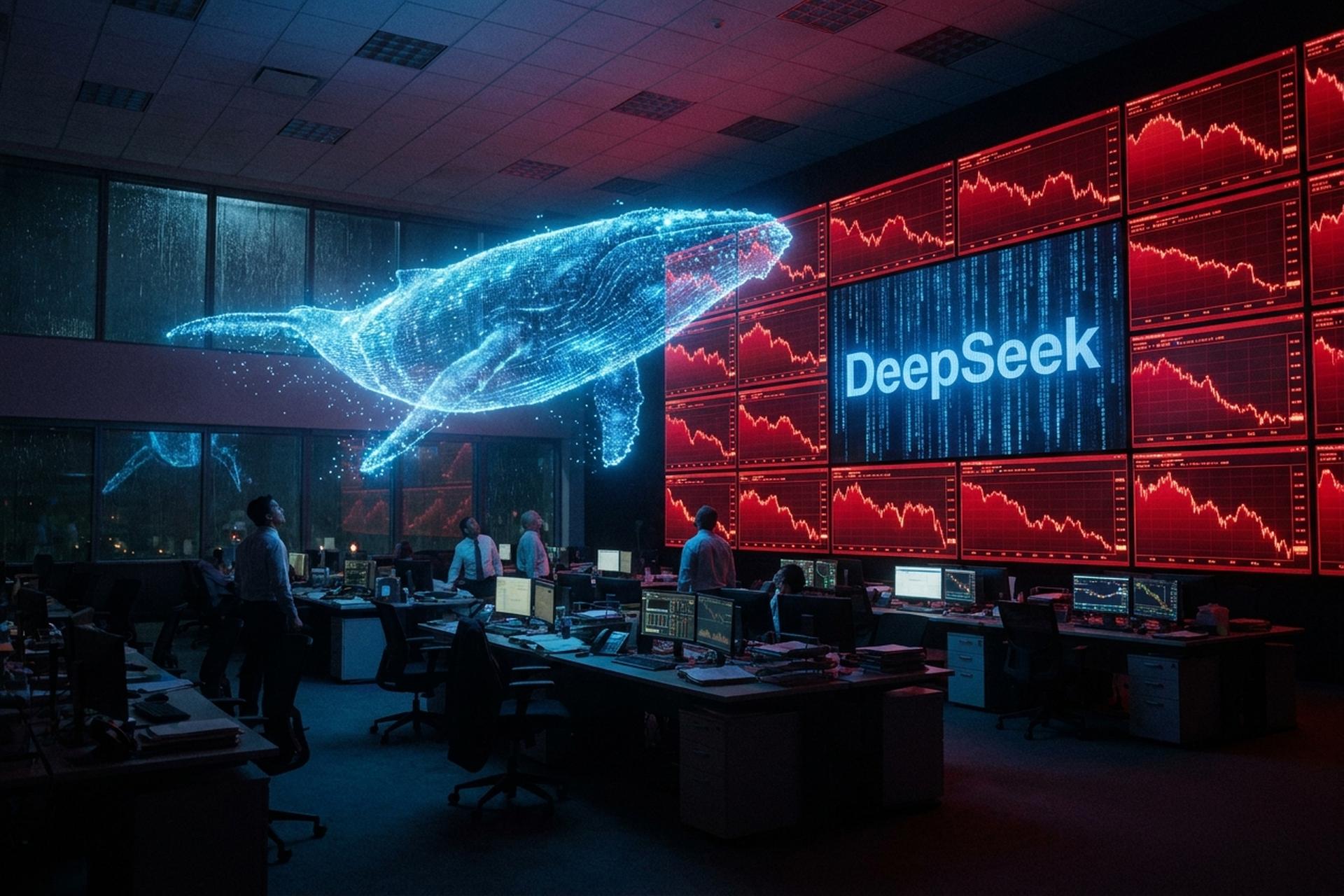
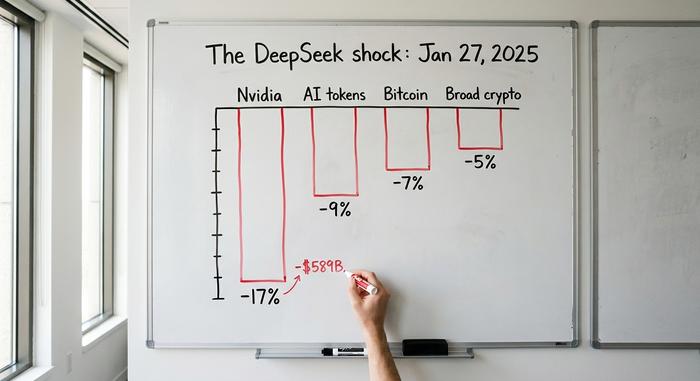
One free app from a little-known Chinese startup did what no crypto crash ever managed. In a single day it erased $589 billion from Nvidia, the largest one-day loss for any company in US stock market history. And it did not stop at Wall Street. Bitcoin slid 7 percent, more than $300 billion evaporated from the total crypto market, and the so-called AI tokens fell hardest of all.
The app was DeepSeek. The model behind it, DeepSeek R1, was an open, cheap AI model good enough to rattle the assumption holding up both the AI trade and a chunk of crypto: that building strong artificial intelligence requires mountains of expensive chips. This guide explains what DeepSeek AI actually is, how it does so much with so little, how it stacks up against ChatGPT, and why it sent a tremor through AI crypto tokens that is still being felt.
What is DeepSeek AI and who built it
DeepSeek is a Chinese artificial intelligence lab, but it did not start as one. It grew out of a hedge fund, and that backstory explains almost everything about how it thinks.
From a quant hedge fund to an AI lab
DeepSeek was founded on July 17, 2023, in Hangzhou, China, by Liang Wenfeng. Liang already ran High-Flyer, a quantitative hedge fund that traded markets using machine learning and had stockpiled a large cluster of Nvidia GPUs for that purpose. When those chips were not busy trading, he pointed them at language models. So DeepSeek began life with cheap compute, a team of researchers, and no investor pressure to chase the biggest possible model. It stayed lean, with only around 160 employees, and it learned to squeeze results out of hardware. Efficiency was not a marketing line. It was the whole culture. There is an irony worth noting. High-Flyer had stockpiled those chips partly ahead of US export controls that later cut China off from Nvidia's best GPUs. Forced to do more with weaker, fewer chips, DeepSeek's engineers got very good at frugality, and that constraint became the advantage.
The model family: V3, R1, and V4
DeepSeek ships fast. DeepSeek Coder arrived in late 2023, V2 in May 2024, and the breakout DeepSeek V3 in December 2024. Then came DeepSeek R1 on January 20, 2025, the reasoning model that lit the fuse. By April 2026 the lab had previewed DeepSeek V4, with a V4-Pro and a lighter V4-Flash, pushing context windows toward a million tokens. Each release followed the same playbook: match the frontier, charge a fraction, and give the weights away.
Open weights, the API, and deepseek.com
That last part matters. Since R1, DeepSeek's models have shipped under the permissive MIT license as open-weight downloads on Hugging Face and GitHub. Anyone can grab them, inspect them, fine-tune them, or run them on their own machine. You can also just use the chatbot free at deepseek.com or plug into the DeepSeek API for pennies. Open weights plus a cheap API is a rare combination, and it is the engine behind the disruption.

How DeepSeek R1 and V3 actually work
DeepSeek's reputation rests on a simple, awkward fact for its rivals. It matches much larger, much pricier models while burning far less compute. The trick is architecture — not magic.
Mixture-of-experts and efficient inference
DeepSeek V3 has 671 billion parameters, but it does not use them all at once. It is a mixture-of-experts model, so for any given token it activates only about 37 billion parameters, the handful of "experts" relevant to the task. The lab paired that with multi-head latent attention, a method that compresses memory during inference. The result is a giant model that runs like a small one. Less memory, less power, lower cost per answer. For a rival that spent billions assuming bigger always means pricier, that is an unwelcome proof of concept.
R1, reasoning, and chain-of-thought
DeepSeek R1 added a second trick: it thinks out loud. Like OpenAI's o1, it is a reasoning model that works through problems step by step using chain-of-thought before answering. That is why it scores so well on hard tasks. R1 hit 97.3 percent on the MATH-500 benchmark and 79.8 percent on AIME 2024, and solved 49.2 percent of real GitHub issues on SWE-bench, putting it shoulder to shoulder with OpenAI's best at the time.
The $5.6 million training cost claim, unpacked
Here is the number that broke the internet. DeepSeek's own paper said the final training run for V3 cost about $5.58 million in GPU time. Set against the $100 million widely cited for GPT-4, it looked like a humiliation. But read the fine print. That figure covers only the final run, not the research, the failed experiments, or the chips themselves. Analysts at SemiAnalysis estimated DeepSeek's real hardware spend was well above $500 million. The headline was accurate and misleading at the same time, which is exactly why it traveled so far.
| DeepSeek model | Released | Type | Notes |
|---|---|---|---|
| DeepSeek V3 | Dec 2024 | MoE LLM | 671B params, 37B active, MIT |
| DeepSeek R1 | Jan 2025 | Reasoning | Open-weight, rivaled OpenAI o1 |
| DeepSeek V4 | Apr 2026 | MoE family | V4-Pro and V4-Flash, ~1M context |
DeepSeek AI vs ChatGPT, Claude, and Gemini
So is DeepSeek better than ChatGPT? It depends what you need. On math, coding, and raw reasoning, it trades blows with the top models from OpenAI and Anthropic. Where it falls short is polish, multimodal input, and trust. The flagship DeepSeek models are mostly text-only, while ChatGPT handles images, voice, and video. OpenAI's prose still reads smoother for everyday writing. Google's Gemini sits in between, strong on multimodal and search, weaker on open access. And for many Western businesses the deciding factor is not a benchmark at all but trust: a model trained and hosted in China carries baggage a US-hosted one does not.
Then there is price, where the gap is not close. The table below tells the story, and it is the reason developers keep migrating workloads to DeepSeek's API.
| Model | Input / 1M tokens | Open weights | Multimodal |
|---|---|---|---|
| DeepSeek V3.2 | ~$0.28 | Yes (MIT) | No |
| GPT-5.2 (OpenAI) | ~$1.75 | No | Yes |
| Claude (Anthropic) | Premium tier | No | Yes |
For text and code at scale, DeepSeek is roughly six times cheaper on input than GPT-5.2, and because the weights are open you can skip the API entirely and run it through local deployment. That makes DeepSeek a remarkably cost-effective option, and a hard one for a closed lab to answer.
The DeepSeek moment that rattled crypto
Marc Andreessen called it "AI's Sputnik moment." He was talking about national pride, but markets heard something colder — maybe the most valuable thing in AI is not a stockpile of chips after all.
$589 billion gone in a day
When DeepSeek topped the US App Store on January 27, 2025, with 16 million downloads in its first 18 days, traders did the math in reverse. If a Chinese lab could reach the frontier on a fraction of the hardware, the future demand for Nvidia's chips suddenly looked shakier. Nvidia fell about 17 percent that day and shed $589 billion in market value, the biggest single-day wipeout in US history. The whole Nasdaq caught the cold.
Why AI crypto tokens fell hardest
Crypto did not escape. Bitcoin dropped roughly 7 percent to around $97,750, and over $300 billion left the total crypto market. But the real carnage was in AI tokens. The category fell about 9 percent on the day, against roughly 5 percent for the broad market, with Render down 12.6 percent and Fetch.ai off about 10 percent. The reason is uncomfortable. A lot of AI token value rested on the same story as Nvidia's: AI is compute-hungry, compute is scarce, so anything selling compute or GPUs is precious. DeepSeek poked a hole in that story, and the tokens leaning hardest on it bled the most. The dip itself did not last; within days Bitcoin clawed back most of its losses as analysts called the panic an overreaction. But the AI-token sector stayed wobbly far longer, a sign the market was repricing the whole narrative, not just having a bad afternoon.
AI crypto tokens after DeepSeek
Here is the twist. The same shock that hammered AI tokens also handed them a longer-term argument. If frontier models can be cheap and open, then the moats of the big closed labs shrink, and open, censorship-resistant AI infrastructure starts to look more valuable, not less. Decentralized compute networks like Akash, rendering networks like Render, and machine-intelligence markets like Bittensor all pitch a world where AI is not locked inside three American companies. DeepSeek made that world feel closer. Bittensor, whose TAO token rewards a network of competing machine-learning models, is the clearest bet on the idea: a marketplace for open intelligence rather than one corporate brain. Whether these networks can actually deliver frontier-grade AI is still unproven, but DeepSeek shifted the burden of doubt onto the closed labs.
The market noticed. By May 2025, Grayscale had formalized a dedicated AI Crypto Sector covering 20 tokens worth around $21 billion combined, up roughly 4.7 times from $4.5 billion in early 2023. Just be careful out there. The launch also drew scammers: in one day, more than 75 fake "DeepSeek" memecoins appeared, and traders chasing them lost over $100 million. DeepSeek never launched a token. Anything claiming otherwise is a trap.
Is DeepSeek AI safe to use? Bans and privacy
This is where caution earns its keep. Use the official DeepSeek app or website and your data, including your prompts, travels to servers in China and is handled under a privacy policy governed by Chinese law. Several governments decided that was a problem. Italy blocked DeepSeek on January 30, 2025 over data protection. More than a dozen US states banned it from official devices through early 2025, and Congress introduced the No DeepSeek on Government Devices Act. The model also reflects Chinese content rules, dodging or sanitizing politically sensitive topics. DeepSeek's methods have drawn fire as well. In early 2026 Anthropic accused the lab of using thousands of fraudulent accounts to harvest millions of Claude conversations for training, a charge DeepSeek disputes. The frugal-genius story has a contested side.
None of that makes the technology itself unsafe to run. Because the weights are open, a privacy-conscious user or company can download the model and run it locally, with no data leaving the building. The hosted app is the risk. The open model is the escape hatch.
How to use DeepSeek AI: local deployment
You have three ways in. The easiest is the free chatbot at deepseek.com or the mobile app, fine for casual questions if the privacy trade-off does not bother you. The second is the DeepSeek API, cheap enough that developers route heavy workloads through it; the DeepSeek API docs walk you through setup, and DeepSeek Coder is tuned for programming. The third, and the safest for sensitive work, is local deployment: pull the open weights from Hugging Face or run a smaller version through a tool like Ollama on your own hardware. Same model, none of the data exposure. For casual questions the free app is plenty; for anyone handling private or regulated data, the local route is worth the extra setup.
What DeepSeek means for AI and crypto
DeepSeek's lasting lesson has little to do with China winning a round. The real shift is that frontier AI got cheap and open faster than anyone priced in. For ordinary users, that means better tools at lower cost. For the closed labs, it means the GPU moat is thinner than their valuations assume. And for crypto, it cuts both ways: the AI tokens built on the scarcity story took a hit, while the ones building open, decentralized AI infrastructure got a new reason to exist. So the real question is not whether DeepSeek is good. It clearly is. The question is who still gets paid when intelligence stops being expensive.