AI crypto tokens: what they are, which ones matter, and how to evaluate them in 2026
OpenAI took $110 billion in funding. Nvidia reported $68.1 billion in a single quarter. These numbers sound like national budgets, and they all flow through the same pipeline: centralized data centers owned by Microsoft, Google, and Amazon. Three companies control the hardware that runs the thing everyone says will change civilization.
Crypto people looked at that concentration and did what crypto people always do. They said: we can decentralize this. What if GPU compute was an open market instead of a cloud subscription? What if AI training data had blockchain provenance? What if autonomous AI agents held their own wallets and transacted without asking permission from any platform?
That impulse spawned the ai crypto tokens sector. Hundreds of projects. Something like $25-35 billion in combined market capitalization by early 2026. Some of them are building real infrastructure that AI developers actually pay for. Others slapped "AI" on a token launch page because it tripled the raise. Telling the difference is the whole game, and that is what this article is about.
What are AI tokens in crypto?
An ai token is a cryptocurrency tied to a project that sits at the intersection of blockchain and artificial intelligence. The token serves as the economic engine inside that project's ecosystem. You use it to pay for compute, access AI models, reward data providers, vote on governance decisions, or stake for network security.
The difference between an ai crypto coin and a regular cryptocurrency? Utility focus. Bitcoin is a store of value. You hold it. Ethereum runs smart contracts. You build on it. An AI token buys something AI-specific: GPU time on a decentralized compute network, inference on a trained model, access to a curated dataset, or voting power over how an AI protocol evolves.
Now here is where people get hurt. Not all ai crypto tokens are real. Some represent genuine infrastructure that AI developers actually pay to use. Others exist because a marketing team figured out that putting "AI" in the token name doubles the funding round. The gap between those two categories is where real money gets lost. If you are putting cash into this sector, learning to tell the difference is not optional.
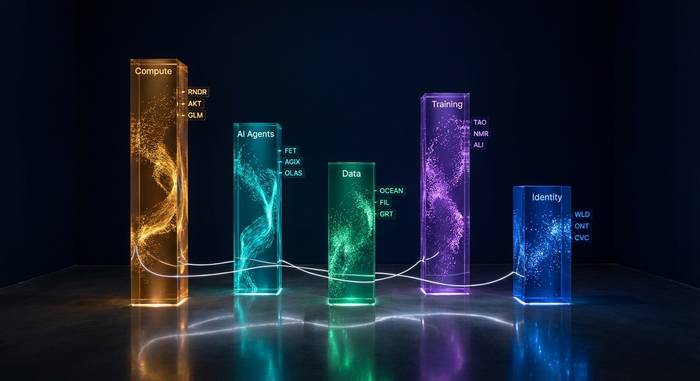
Here is a rough taxonomy of what the category contains:
| Category | What it does | Example tokens |
|---|---|---|
| Decentralized compute | GPU marketplaces for AI training/inference | Render (RNDR), Akash (AKT), io.net |
| AI agents | Autonomous software agents on blockchain | Virtuals (VIRTUAL), ai16z, NEAR AI |
| Data marketplaces | Buy and sell training data | Ocean Protocol (OCEAN) |
| Decentralized AI training | Competitive model training on chain | Bittensor (TAO) |
| AI identity / proof of personhood | Verify humans vs bots | Worldcoin (WLD) |
| AI infrastructure | Developer tools, APIs, model hosting | Fetch.ai (FET/ASI), SingularityNET |
| AI-themed speculation | Memecoins with AI branding | Various, mostly worthless |
That last row is the landmine. Every bull cycle breeds tokens that ride narratives without building product. Metaverse tokens in 2021. AI tokens in 2024-2025. Same playbook: launch a token, put "AI" on the website, raise $20 million, let the community figure out that nothing was ever built. The sorting process takes 2-3 years. We are in the middle of it right now for AI crypto, which means some of today's top projects will be dead by 2028 and some tiny ones will 50x. Nobody knows which are which yet.
The top AI crypto tokens by market cap
I could list 50 tokens here. Most of them would be dead or irrelevant by the time you read this. Instead, here are the projects that have actually shipped working products, keep committing code to their GitHub repos, and hold enough market capitalization to survive a bear market. Early 2026 snapshot:
| Token | Ticker | What it does | Market cap | Category |
|---|---|---|---|---|
| NEAR Protocol | NEAR | AI-native L1 blockchain, chain abstraction | ~$1.7B | AI infrastructure |
| Render Network | RNDR | Decentralized GPU rendering marketplace | ~$2.5B | Compute |
| Bittensor | TAO | Decentralized AI training network | ~$2.8B | AI training |
| Artificial Superintelligence Alliance | FET (ASI) | Merged AI agent + data + AI marketplace | ~$2.0B | AI agents + data |
| Akash Network | AKT | Decentralized cloud compute | ~$800M | Compute |
| Virtuals Protocol | VIRTUAL | AI agent creation and trading | ~$600M | AI agents |
| Worldcoin | WLD | Proof of personhood via iris scanning | ~$1.2B | AI identity |
| Internet Computer | ICP | Decentralized cloud computing platform | ~$2.5B | Infrastructure |
| Filecoin | FIL | Decentralized storage with AI integration | ~$2.0B | Storage/compute |
| Grass | GRASS | Distributed web scraping for AI data | ~$300M | Data |
Let me dig into the ones that I think are most interesting, because they solve the problem in completely different ways.
Bittensor (TAO) is what happens when you turn AI model training into a competition with prize money. Anyone can submit a machine learning model to the network. The models get evaluated against each other. The better your model performs, the more TAO you earn. December 2025 brought the first halving: daily emissions dropped from 7,200 to 3,600 TAO. Max supply is 21 million, same cap as Bitcoin. I find this one fascinating because the core question it answers is wild: can you build a decentralized ai training lab that competes with Google spending $50 billion per year on the same problem?
Render Network (RNDR) tackles something more concrete. Got a $3,000 GPU sitting idle 20 hours a day? Plug it into Render and rent that compute to people who need it. On the other end: AI companies training models, 3D artists rendering scenes, game studios processing assets. They pay in RNDR tokens at rates that undercut AWS by 50-70%. Render moved over $20 million worth of jobs through the network in 2025. That is not speculative. Those are real invoices paid by real customers for real GPU hours.
The ASI Alliance merged three projects in 2024: Fetch.ai, SingularityNET, and Ocean Protocol. The combined entity creates ai agents (Fetch.ai), runs an AI model marketplace (SingularityNET), and provides a data marketplace (Ocean Protocol). The merger consolidated three overlapping visions into one token. Whether that consolidation strengthens the ecosystem or creates coordination problems is still playing out.
Virtuals Protocol took a different approach entirely. Instead of infrastructure, Virtuals lets users create, own, and trade AI agents as tokens. Each agent is a crypto asset you can buy and sell. The protocol became one of the breakout stories of 2025 when AI agent trading volume spiked alongside the broader AI hype cycle. The risk: when hype fades, do the agents retain value?
How to evaluate whether an AI crypto project is real
Most ai crypto coins fail. They fail because the technology does not work, or the team runs out of money, or the token economics implode, or the market moves on to the next narrative. Here is how to check whether a project has substance.
Check the developer activity first. Santiment data from January 2026 showed that meaningful daily code commits were concentrated in a small number of projects: Filecoin (349 daily commits), Chainlink (211), Internet Computer (200), NEAR Protocol (73). If a project claims to be building AI infrastructure but its GitHub repos show 3 commits per week, something is wrong.
Look at actual usage metrics. How many jobs has Render processed? How many agents run on the Virtuals network? How much compute flows through Akash? Tokens without usage data are narrative plays, not businesses. Revenue matters. If the protocol generates fees from real users doing real things, the token has a foundation. If the only demand for the token comes from speculators, the price collapses the moment sentiment shifts.
Check the tokenomics. Vesting schedules, unlock dates, inflation rates, burn mechanisms. A token might look cheap until you discover that 40% of the supply unlocks next quarter and the team has every incentive to dump. Bittensor's halving makes its supply curve predictable. Projects with continuous inflationary issuance and no burn mechanism face constant sell pressure.
Ask: does this project actually need a token? Some AI projects use blockchain because decentralization genuinely helps. Decentralized compute makes sense because GPU markets benefit from permissionless access. Data marketplaces make sense because blockchain enables transparent provenance. But an AI chatbot that issues a token for "governance" probably did not need a blockchain at all.
The AI agent economy: the 2026 narrative
The hottest subcategory in ai crypto right now is autonomous AI agents that can transact on blockchain without human intervention. Your AI assistant does not just answer questions. It holds a wallet. It buys compute. It negotiates with other agents for services. It manages a portfolio. It pays for data. All on chain, all verifiable, all running 24/7.
NEAR Protocol built its entire 2026 strategy around this thesis. Illia Polosukhin, who co-authored the transformer paper that powers ChatGPT and every other large language model, positions NEAR as "the operating system for the agentic economy." AI agents on NEAR use chain signatures to transact across multiple blockchains without bridges.
Virtuals Protocol turned agents into tradeable assets. ai16z built an open-source framework (ElizaOS) for creating AI agents that interact with crypto protocols. The market responded: AI agent tokens as a category went from near zero to billions in market capitalization during 2025.
Whether this category survives depends on whether AI agents actually need blockchain. The bull case: agents need wallets, they need to transact trustlessly, they need verifiable identities. Blockchain provides all of that. The bear case: most agent interactions could happen through APIs and traditional infrastructure. If blockchain adds friction without adding value, the agent-token narrative collapses.
I lean toward the bull case, but I also remember 2017 when every ICO promised to "put X on the blockchain" and 99% of them built nothing. The first generation of crypto AI agents is mostly toys. Trading bots calling themselves "autonomous agents." Chat interfaces with token-gated access. Simple if-then automation wearing an AI costume. The genuinely interesting agent economy, where AI systems negotiate with each other over compute, data, and services without any human in the loop, is probably 3-5 years out. The tokens pricing in that future today are early bets with real downside.
The market for decentralized compute is on firmer ground. Nvidia GPUs cost $30,000-$40,000 per unit. Cloud GPU rental from AWS or Azure runs $2-3 per hour for mid-tier machines. Render, Akash, and io.net offer the same compute at 50-80% lower prices because they aggregate idle hardware from individual owners. That is not a narrative. That is a price advantage. The demand for AI compute is growing faster than centralized providers can build data centers. Decentralized compute fills the gap, and the tokens that facilitate those markets have a concrete reason to exist.
Data is the other concrete use case. Training AI models requires massive datasets. Ocean Protocol and Grass built marketplaces where data providers earn tokens for contributing training data. The provenance is on chain, the payments are automated, and the data buyers get verifiable origin information. In a world where data poisoning and training data lawsuits are real concerns (the New York Times sued OpenAI, Getty Images sued Stability AI), blockchain-verified data provenance has actual value.

Risks of investing in AI crypto tokens
The AI-crypto intersection attracts more hype per dollar than almost any other sector. Here is what can go wrong:
Narrative risk will eat your portfolio faster than any hack. AI tokens rose 300-500% in 2024 because ChatGPT was everywhere and Nvidia stock was the market's favorite trade. Money poured into anything with "AI" in the name. When that narrative rotates, and crypto narratives always rotate, the tokens running on pure sentiment drop 70-90% in weeks. I watched it happen with DeFi tokens in 2022 and metaverse tokens in 2023. Same pattern, different label. The projects generating actual revenue survive. Everything else gets abandoned.
Concentration risk matters too. Bittensor's top 10 stakers control a meaningful chunk of the supply. Render's demand depends heavily on the 3D rendering market. If one or two large customers leave, revenue drops off a cliff. The ASI Alliance bet the house on merging three projects into one. If the merger coordination fails, you get the worst of all three rather than the best.
Centralized competition is fierce. OpenAI, Google DeepMind, and Anthropic are spending tens of billions building AI systems. Decentralized alternatives are underfunded by comparison. If centralized AI becomes "good enough" for most applications, the demand for decentralized alternatives shrinks.
Regulatory uncertainty hangs over the entire crypto market and AI regulation is a separate moving target. The EU AI Act is already law. The US is debating AI-specific legislation. How these rules interact with crypto tokens that power AI services is an open question with no clear answer yet.
Smart contract risk applies to any DeFi protocol. AI crypto tokens that involve staking, liquidity pools, or complex tokenomics carry the same hack risk as any other DeFi system.
Execution risk is enormous. Building decentralized AI infrastructure that competes with Google and Amazon is a multi-year, multi-billion-dollar challenge. Most projects will fail. The question is not whether AI crypto will exist in 2030. It will. The question is which specific tokens survive the journey.