RGTI Stock 2026: Rigetti Computing Quote and Quantum Verdict
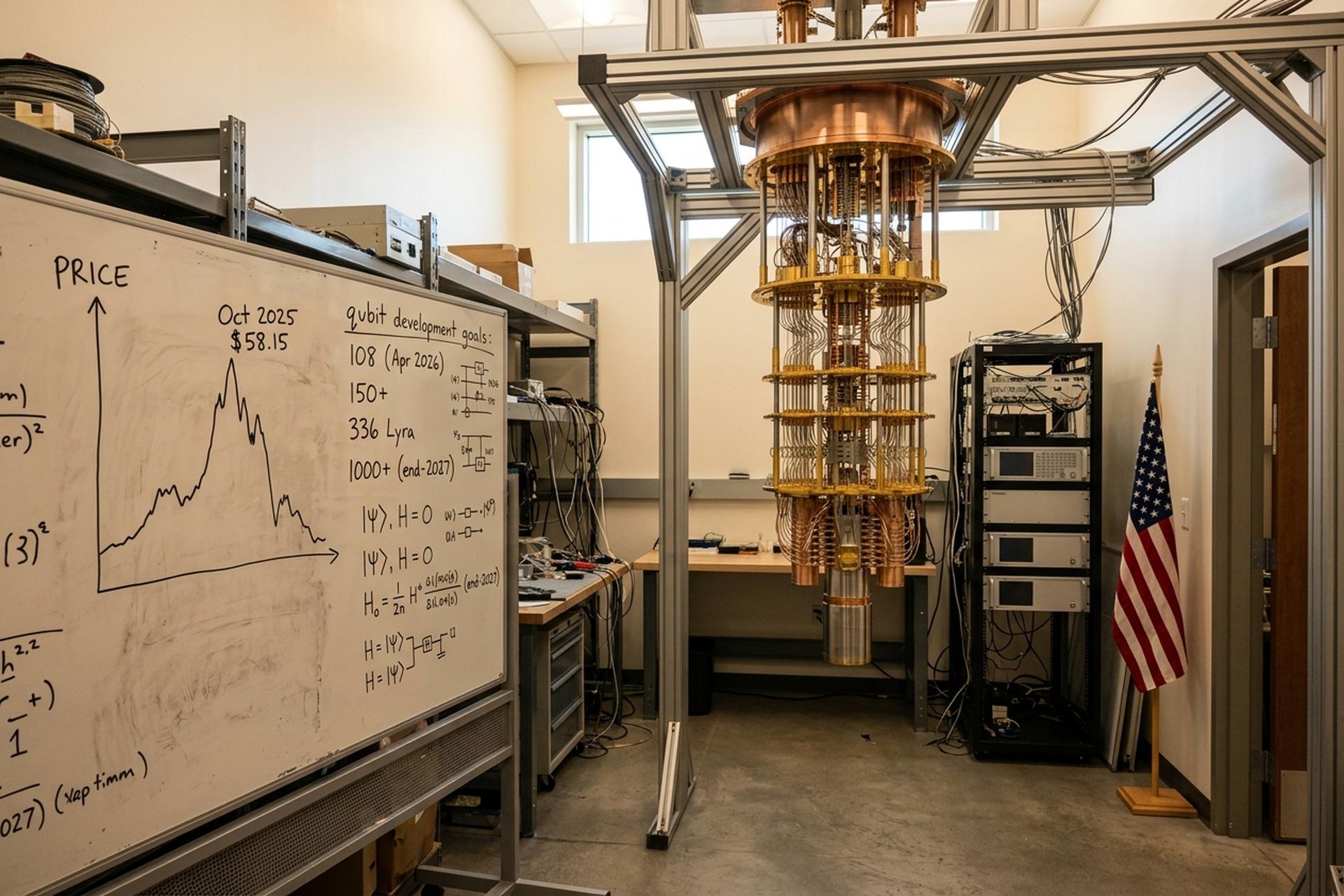
Rigetti Computing trades around $24 with a market cap near $8.3 billion, on revenue of roughly $7 million over the past twelve months. That price-to-sales multiple is 815. The number arrived through a sequence of events worth recounting in order, because they tell you what kind of stock RGTI actually is. The two-line summary: RGTI stock ran more than 1,000% on a sector-wide narrative, then settled at a level that still implies the rest of the decade goes according to plan.
Why RGTI Exploded 1000%+ in Late 2024
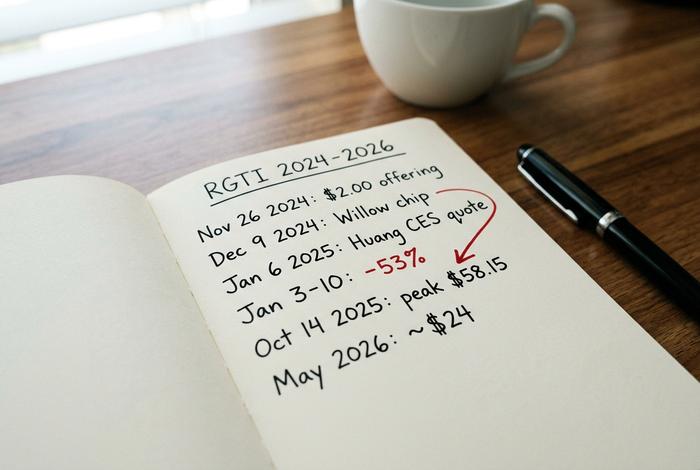
For most of 2024, RGTI traded close to a dollar. The sequence that turned it into a $58 stock began on December 9, when Google announced Willow, a 105-qubit chip that completed a random-circuit sampling benchmark in under five minutes — a calculation the firm said would take the Frontier supercomputer roughly 10 septillion years. The Willow paper drew attention back to commercial quantum names, and Rigetti was the cheapest available. RGTI ran from $4.46 to over $7.46 in the days after the Google post.
The company then did something that would have killed a more fragile rally. On November 26, 2024, ahead of the Willow news, Rigetti had filed a $100 million registered direct offering at $2.00 per share — fifty million new shares of paper sold straight to institutional buyers. In normal markets that kind of dilution prints a hole in the chart — and on the RGTI chart it barely registered. RGTI absorbed the offering inside a week and then kept running.
The peak was on October 14, 2025, at $58.15. Then on January 6, 2025, Jensen Huang gave a CES analyst session in which he was asked about quantum timelines. His exact answer: "If you said 15 years for very useful quantum computers, that'd probably be on the early side. If you said 30 is probably on the late side. But if you picked 20, I think a whole bunch of us would believe it." Quantum stocks were down 40-50% within an hour. RGTI lost 53% in the week of January 3-10, 2025, after rallying 1,654% in the prior twelve months. The interesting thing was not the size of the move but its source — RGTI had not changed. A single comment from the largest GPU vendor in the world moved a small superconducting-quantum company by half. The stock is run by narrative, not fundamentals, and that fact does not go away once you have bought it.
The Rigetti Computing Stock Story Today
Anyone watching the RGTI stock price in May 2026 should look at three lines together. The price is $24.16 to $24.62. The market cap is between $8.3 billion and $8.8 billion. Last reported quarterly revenue (Q1 2026) was $4.4 million, up 193% year over year from $1.5 million but small in absolute terms. Full-year 2025 revenue came to $7.09 million, down 34% from $10.8 million in 2024 — the decline largely a function of contract-revenue lumpiness, not a deteriorating business.
What the price actually represents is therefore not earnings. The trailing price-to-sales ratio sits near 815, the enterprise-value-to-revenue figure near 835. Those numbers are typical for pre-revenue biotech, not for an electronics manufacturer. The price represents a balance sheet, a roadmap, and a narrative beta. The balance sheet is genuinely good: $569 million in cash, no debt, comfortably enough runway to execute the 2026-2027 milestones described in the next section. The roadmap is what bulls are paying for. The narrative beta is what creates the moves like January 2025.
Two structural facts make the picture more uncomfortable. Shares outstanding grew 47.61% year over year to 332.4 million as the company funded its cash burn through repeated equity issuance. Short interest stands at 15.16% of float, or 50.4 million shares, meaning any directional move tends to be amplified. Net loss for fiscal 2025 was $216.2 million on $7.09 million of revenue, with EPS of -$0.70 and free cash flow of -$77.2 million. Sell-side analyst ratings are constructive — 8 Buy, 1 Outperform, 3 Hold, 1 Sell, mean price target around $29 — but the spread between the bull case ($40+) and the bear case ($15) is the widest of any company in this part of the market.
Quantum Hardware Roadmap: What Rigetti Builds
Rigetti's architecture is superconducting gate-based: physical qubits held at near-absolute-zero temperatures, controlled by microwave pulses, executing two-qubit gates between adjacent qubits on a flat chip. This is the same broad approach IBM and Google use; it differs from IonQ's trapped-ion qubits (slower gates, longer coherence times, lower count) and from D-Wave's quantum annealing (different problem class, not gate-based).
The milestones that bulls track:
| Date | System | Qubits | Median 2Q fidelity | Notes |
|---|---|---|---|---|
| Dec 2024 | Ankaa-3 | 84 | 99.5% | Prior generation |
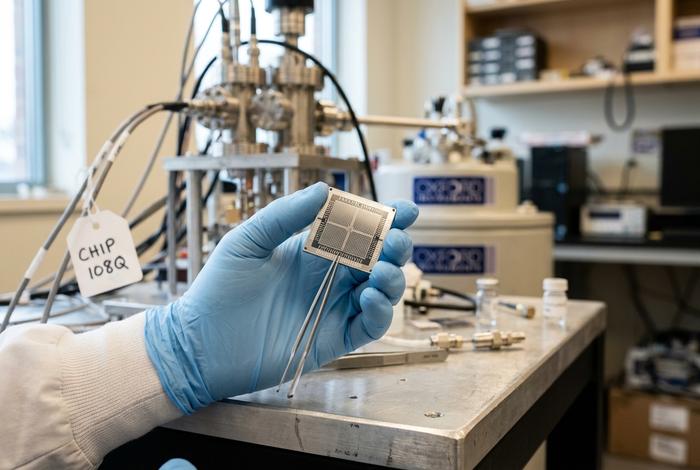
| Apr 7, 2026 | Cepheus-1-108Q | 108 | 99.1% | Modular: 12 × 9-qubit chiplets |
| End-2026 (target) | (next) | 150+ | 99.7% | On Rigetti's published roadmap |
| End-2026 (target) | Lyra | 336 | — | 12+ chiplets |
| End-2027 (target) | (next) | 1,000+ | 99.8% | The number that unlocks new use cases |
Source: Rigetti Q3 2025 earnings release, Cepheus-1-108Q GA announcement (Apr 7, 2026).
Rigetti also sells the Novera QPU, a 9-qubit system for on-premises research use, which sits outside the cloud roadmap but extends the product line. The Cepheus-1-108Q announcement matters more than the qubit count by itself suggests. Modular chiplets are how Rigetti expects to reach 1,000+ qubits without printing impossibly large monolithic chips, and getting the architecture to general availability on Rigetti's own QCS platform and on Amazon Braket gives commercial customers a way to actually run jobs against it. That is closer to revenue than a pure research demonstration would be, even if the dollars are still small.
The number that matters more than qubit count is the two-qubit gate fidelity. At 99.5%, error correction is hard but feasible for short circuits. At 99.7% (end-2026 target), the window of useful programmes widens significantly. At 99.8% with 1,000+ qubits (end-2027 target), the company is operating in the regime where the first useful quantum advantage demonstrations in narrow industrial problems become plausible. None of that is guaranteed. All of it is what the market cap is paying for.
RGTI vs IONQ vs QBTS: Quantum Stock Comparison
Three public quantum names matter most to a stock-picker in 2026. The split is best read by revenue, not by market cap.
| Ticker | Architecture | FY2025 revenue | Q1 2026 revenue | Market cap |
|---|---|---|---|---|
| IONQ | Trapped-ion | $130.0M (+202% YoY) | $64.7M (+755% YoY) | ~$23.75B |
| RGTI | Superconducting | $7.09M (-34% YoY) | $4.4M (+193% YoY) | ~$8.3B |
| QBTS (D-Wave) | Annealing | $24.6M (+179% YoY) | $2.86M | ~$9.5B |
Source: IONQ investor page, StockAnalysis, The Quantum Insider (Feb 2026).
The takeaways are uncomfortable for RGTI bulls. IONQ is the only pure-play quantum stock with nine-figure revenue, and its 2026 guidance was raised to $260-270 million. RGTI is the technology-roadmap leader on superconducting gate-based architecture, but it has half the market cap and one-eighteenth the revenue of IONQ. D-Wave's annealing approach is a different product entirely, and the $24.6 million revenue base is mostly enterprise applications. The comparison only flatters RGTI if you weight the roadmap heavily and the income statement lightly.
CHIPS Act and AFRL Investment in Quantum Stocks
Government money is now a non-trivial slice of the bull case. On May 20-21, 2026, Rigetti announced a Letter of Intent with the US Department of Commerce for up to $100 million over three years under the CHIPS Act, with the DoC taking an equity stake at a 15% discount to market. The LOI is part of a broader $2.013 billion CHIPS-Act quantum programme across nine companies. The stock rose roughly 30% in the week of the announcement.
Separately, Rigetti holds an Air Force Research Laboratory contract worth $5.8 million over three years (Sept 2025) for quantum networking work with QphoX; an AFOSR consortium award of $5.48 million for a fabrication consortium; and a UK Innovate consortium worth £3.5 million for error-correction work, plus DARPA Quantum Benchmarking Initiative participation. None of these contracts alone justifies an $8.3 billion market cap. Taken together they buy time, lend credibility, and shift some funding off the dilution treadmill — which matters for a company that has issued 47.61% more shares in the past twelve months.
When Quantum Returns Real Revenue: 2030s Insight
The honest answer to "when does this make money" sits in the 2030s. Three industry forecasts that any RGTI investor should know.
BCG, in a widely cited July 2024 report, projected quantum computing creating $450 billion to $850 billion in economic value by 2040, with a supplier market between $90 billion and $170 billion. McKinsey's 2026 Quantum Technology Monitor put the total quantum industry above $1 billion in actual revenue for 2025 and projected a path to $4.4 billion by 2028, with a long-run economic-value scenario of $2.7 trillion by 2035. The two reports are independent and broadly agree on the shape — a steady ramp through the late 2020s, with most of the real revenue arriving in the 2030s.
The cryptography deadlines run on a parallel track. NIST finalized the first three post-quantum cryptography standards (FIPS 203, 204, and 205) in August 2024. The NSA's CNSA 2.0 mandates compliance on National Security Systems by 2033; federal TLS 1.3 deadline is January 2030; the broader US goal for widespread post-quantum cryptography adoption is 2035. Those dates are forced moves for the federal government and most regulated industries, and they create a guaranteed installed-base of demand for quantum-capable systems — even if the systems are first used to break cryptography in research environments rather than to deliver commercial workloads.
The technology-side benchmarks have moved this far. Google's Willow announcement of December 2024 used 105 qubits to complete the RCS benchmark in under five minutes. The October 2025 follow-up (published in Nature) demonstrated a 13,000× speedup over the Frontier supercomputer using just 65 qubits on a different problem. Those are real demonstrations of quantum advantage, but on benchmark workloads that nobody pays for. Commercial advantage — the kind that converts to invoiced revenue — is still mostly a 2028-2032 story under the most optimistic credible timeline. The South Sea Company's directors expected the war with Spain to end before the trading monopoly was worth anything; many of them did not live to see whether it would.
RGTI Trading Risks: Volatility, Dilution, Short
Three risks attach specifically to RGTI, separate from the quantum-industry risk above. The first is volatility. RGTI ran from $58.15 on October 14, 2025 to roughly $24 by May 2026, a 58% drawdown from the peak in seven months. Position sizing for that kind of move is closer to a single stock option than to a normal equity holding.
The second is dilution. The 47.61% year-over-year share count growth funded the company's cash burn through 2025 and early 2026 and is the structural reason existing shareholders have not captured the full upside even when the price has cooperated. Each new offering at a higher price is constructive for the balance sheet, but expensive for the holder who bought at the prior issue.
The third is short interest. 50.4 million shares short, 15.16% of float, creates squeeze risk in both directions: a positive surprise can trigger a forced cover; a negative one can accelerate selling as shorts compound the move. The free cash flow run-rate of -$77.2 million for fiscal 2025 frames how much new equity issuance is likely required if no further government grants land.
Buy, Sell or Hold? RGTI Stock by Buyer Type
Four buyer profiles, four answers. A pure quantum speculator who wants direct exposure to the 1,000-qubit 2027 milestone and the Lyra 2026 delivery has a reasonable hold case for RGTI stock, with a strict position size cap. A value or income investor should skip RGTI entirely; there are no earnings, no dividend, and the dilution alone makes the math hostile for long-horizon compounders. An investor who wants broad quantum exposure without single-name risk is better served by the QTUM ETF or the Defiance quantum ETF, which capture the industry without betting on which architecture wins. An existing RGTI holder should consider trimming into rallies and holding the core position through the 2027 milestone, because that is the next event capable of repricing the entire roadmap.
How to Trade RGTI Stock on NASDAQ Today
RGTI trades as NASDAQ:RGTI on every US retail brokerage. The options chain is liquid through several expirations, which makes it tradeable as a covered-call or cash-secured-put vehicle for accounts that want to harvest the elevated implied volatility rather than ride the directional risk. RGTI is also held in the Defiance Quantum ETF (QTUM) and similar baskets, for anyone who wants the exposure but cannot stomach the single-name volatility. A 5% RGTI stock position in a typical portfolio behaves like 18-22% of conventional risk because of the beta-to-quantum-narrative factor described above; size accordingly, or use the ETF instead.