What is Qtum? The hybrid blockchain that merges Bitcoin and Ethereum
Before you Google "QTUM" and end up on a quantum computing ETF page, let me save you the confusion. The Qtum we are talking about here is a blockchain. A weird, ambitious one. It took the transaction engine from Bitcoin, bolted the smart contract system from Ethereum on top, and shipped it to mainnet in September 2017. $15.7 million from believers who looked at Bitcoin and Ethereum and thought: why not both?
Fair question. Bitcoin? Most secure payment network ever built. Thirteen years without a protocol-level hack at that point. But try running a smart contract on it and you get Script, which is about as flexible as a brick. Ethereum? Smart contracts for days. DeFi, NFTs, the whole nine yards. But the account model ditches everything that makes Bitcoin's UTXO approach so hard to break. Dai and two co-founders spent 2016 and 2017 building that bridge.
Now it is 2026. The world moved on. Solana cranks out 4,000 TPS for breakfast. Avalanche has subnets. L2 rollups handle what L1s used to do. Hundred-million-dollar VC rounds go to chains that did not exist when Qtum launched. And Qtum? Still there. Blocks every 32 seconds, 4,800 nodes humming along. Nobody is writing breathless threads about it on crypto Twitter. But it works. So the honest question: does the Bitcoin-Ethereum hybrid approach still matter, or did the market decide this particular experiment is done?
How Qtum works: Bitcoin's UTXO meets Ethereum's smart contracts
This requires a quick detour into how Bitcoin and Ethereum actually work, because Qtum only makes sense once you see the gap it fills.
Bitcoin tracks money through UTXOs. Unspent Transaction Outputs. It is like paying for a $7 coffee with a $10 bill. The barista does not adjust your bank balance. They take the $10, give you $3 back, and the $10 bill ceases to exist as two new "bills" are created: $7 to the shop, $3 to you. Every bitcoin you "own" is really a stack of these digital bills. Ugly? Maybe. But the UTXO approach is simple to verify, hard to exploit, and it has moved trillions of dollars without a single protocol-level hack. Not bad for a design from 2009.
Ethereum went a different direction. Accounts with balances. Like a bank. Send 1 ETH and your balance drops by 1. The recipient's goes up by 1. Clean, intuitive, and it makes smart contracts way easier to program. The downside: you lose the UTXO advantages around verification and privacy.
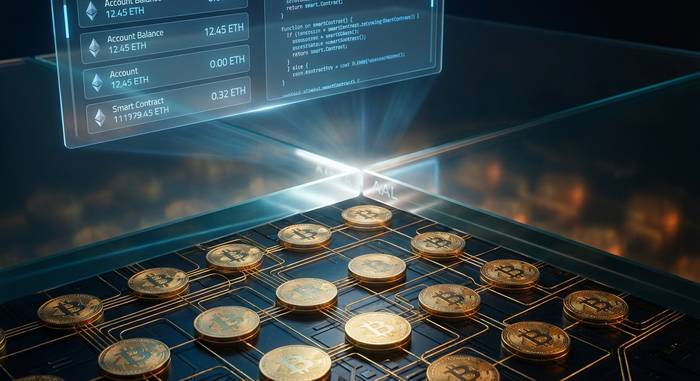
Patrick Dai and his team looked at this split in 2016 and thought: why choose? Build a bridge. They called the bridge the Account Abstraction Layer, AAL for short. Picture a translator sitting between two people who speak different languages. Underneath: a UTXO base layer forked straight from Bitcoin Core. On top: Ethereum's Virtual Machine, ready to run Solidity code. If you write smart contracts in Solidity, you deploy on Qtum the same way you deploy on Ethereum. If you care about Bitcoin-level transaction security and SegWit and Lightning Network, that is all there in the foundation.
| Feature | Bitcoin | Ethereum | Qtum |
|---|---|---|---|
| Transaction model | UTXO | Account-based | UTXO with AAL |
| Smart contracts | No (Script only) | Yes (EVM) | Yes (EVM via AAL) |
| Consensus | Proof of Work | Proof of Stake | Mutualized PoS |
| Block time | ~10 minutes | ~12 seconds | ~32 seconds |
| Smart contract language | N/A | Solidity | Solidity, Rust, C++ |
| Max TPS | ~7 | ~15-30 | ~1,100 (with SegWit) |
So in practical terms, you can run any Ethereum dApp on Qtum. Qtum minted its own token standard too, QRC-20, which works like ERC-20 but lives on top of UTXO infrastructure. One chain speaks two languages. Bitcoin at the base. Ethereum up top. That was the whole thesis.
Mutualized Proof of Stake: how the Qtum network stays secure
No mining rigs here. Qtum runs on Mutualized Proof of Stake, or MPoS. It was designed to fix a nasty loophole that regular PoS chains leave open.
Here is the loophole. On a standard PoS chain, you produce a block and collect the reward immediately. An attacker figured out that if they stuff their own blocks with "junk contracts" (smart contracts that do nothing useful but generate gas fees), they could pay those fees to themselves and pocket the block reward too. Free money, essentially. The attack costs almost nothing and the reward is instant.
MPoS kills this by spreading the block reward across 500 future blocks. You produce block #1000? Your reward trickles in across blocks #1001 through #1500, shared between you and nine other recent validators. An attacker would need to sustain the junk contract spam for four hours straight (500 blocks at 32 seconds each) before seeing any return. At that point, the economics do not work. The attack dies because it is boring and unprofitable.
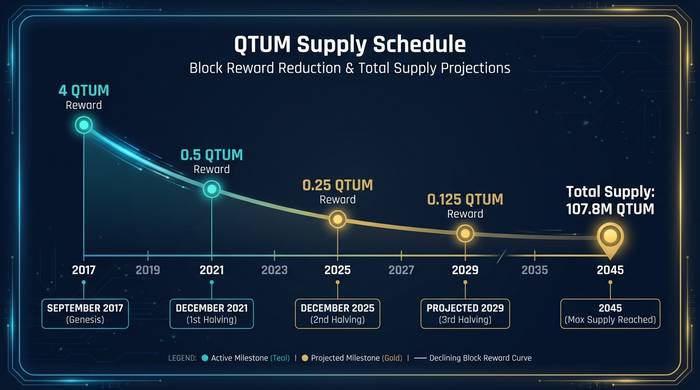
The Qtum network has roughly 4,800 nodes running. Staking starts at just 1 QTUM. That low barrier matters. On Ethereum you need 32 ETH ($57,000+) to solo stake. On Qtum you need one token. Block rewards started at 4 QTUM back in 2017, but the FastLane hard fork in 2021 cut it to 1 QTUM when block times dropped from 128 to 32 seconds. The first halving in December 2021 brought it to 0.5 QTUM. The second halving in December 2025 dropped it again to 0.25 QTUM per block. Annual inflation is now about 0.25%. The hard cap: 107,822,406 QTUM total, reached around 2045.
Decentralized Governance Protocol: changing the rules without hard forks
You remember the Bitcoin block size wars? The screaming matches on Reddit and Twitter that dragged on for three years until Bitcoin Cash forked off in August 2017? Friendships ended. Companies picked sides. The whole mess happened because Bitcoin had no clean way to change a single number: the block size limit. Ethereum went through its own hard fork drama with gas limits. Ugly process every time.
Qtum built the Decentralized Governance Protocol (DGP) so none of that drama is necessary. Block size, gas prices, gas limits, reward parameters. All of these live in smart contracts on chain. Want to increase the block size? Token holders vote. If the vote passes, the change goes live automatically. No hard fork. No chain split. No Reddit war.
Remember how Bitcoin's block size debate dragged on for three years? Qtum could handle that in a week through DGP. It is one of those features that sounds boring until you watch another blockchain community tear itself apart over a parameter change.
The DGP controls:
- Block size (currently up to 8000kb)
- Gas price minimums
- Gas limit per block
- Block reward distribution parameters
In practice, this gives Qtum a scalable mechanism for adapting to changing network conditions without the political drama that hard fork debates generate.
The QTUM token: supply, staking, and market data
QTUM is the gas, the security deposit, and the governance ticket all in one. You burn QTUM to pay transaction fees. You lock QTUM to stake and validate blocks. You hold QTUM to vote on parameter changes through DGP.
The token hit the market through an ICO in March 2017. 51 million QTUM sold to the public at roughly $0.31 each, raising about $15.7 million total. The team kept 12 million tokens locked for four years. Starting supply: 100 million QTUM. New coins come from block rewards that halve every four years, and the hard cap will max out at 107,822,406 QTUM somewhere around 2045.
| QTUM token data | Value |
|---|---|
| Launch | March 2017 (ICO) |
| ICO price | ~$0.31 |
| Max supply | 107,822,406 QTUM |
| Current block reward | 0.25 QTUM (post 2nd halving Dec 2025) |
| Block time | ~32 seconds |
| Minimum stake | 1 QTUM |
| Token standard | QRC-20 |
| SegWit support | Yes |
| Lightning Network | Compatible |
| Price (Apr 2026) | ~$0.93 |
| Market cap | ~$99M (#274) |
| Circulating supply | ~106M QTUM |
| Staking APY | ~5-6% |
If you bought QTUM at the ICO for $0.31, you were briefly sitting on a 300x return when the token cracked $100 in January 2018. If you held through the bear market, you watched 99% of that evaporate. That is the Qtum price story in two sentences. The all-time high belongs to a different era of crypto, when ICO tokens routinely went 100x and then died. Qtum did not die, but the Qtum price never recovered those levels either.
Trading volume fluctuates but has contracted from peak years. The latest Qtum news rarely moves the price the way it once did. You can find QTUM to sell or buy on Binance, KuCoin, Gate.io, and a handful of other exchanges. Every investor should check the Qtum performance and rating data on CoinGecko before making decisions. Note: do not confuse the QTUM crypto token with the Defiance Quantum ETF, which uses the same ticker on the stock market but tracks quantum computing companies, not blockchain. The investment thesis is straightforward: do you think the hybrid UTXO-EVM approach has untapped value that the market has not priced in? If yes, QTUM is cheap relative to its technology. If no, there are dozens of faster-growing L1s competing for the same developer pool.
Qtum 2.0 and the Neutron upgrade: where the technology stands
Qtum 2.0 dropped in 2019 with the first hard fork. The headline feature: offline staking. Before that, you had to keep your node running around the clock to earn block rewards. Offline staking changed the deal. You delegate your QTUM to a staking node operator, the operator keeps the hardware running, and you split the rewards. Your coins never leave your wallet. The operator cannot spend them.
Then came the x86 saga. Qtum had this ambitious plan to build a new virtual machine that could run smart contracts in Rust, C, C++, and Python. Not just Solidity. The pitch: open smart contract development to the millions of programmers who do not write Solidity and never want to learn it. The x86 VM got announced, work started, and then the team quietly shifted back to focusing on EVM compatibility. The market voted with its feet. Developers wanted to reuse their Ethereum code, not learn a new VM. Neutron, the modular execution layer that was supposed to host multiple VMs, went the same direction.
I think the x86 pivot is the most honest thing about Qtum's story. The team had a bold vision, watched what developers actually wanted, and changed course. Some people call that a failure. I call it reading the room.
Today the Qtum blockchain runs 32-second blocks, handles up to 8MB per block, and with SegWit pushes about 1,100 TPS in theory. Nothing that will win a speed contest against Solana. But respectable for a chain that launched in 2017 with a fraction of the funding that newer L1s burn through in a single year.
Who built Qtum: founders, funding, and controversy
Three people started Qtum in 2016. Patrick Dai, who had been CTO at VeChain. Jordan Earls, a developer who ended up writing much of the core codebase. And Neil Mahi, a software engineer with two decades of experience.
Now, the elephant. Patrick Dai caught heat early on because reports linked him to a different name (Steven Dai) and to a failed crypto project called BitBay. He addressed it publicly. Some people forgave him, some did not. The crypto community in 2017 was especially unforgiving about founder backgrounds, and the controversy stuck. The Qtum Foundation, based in Singapore, manages the project treasury and development grants.
Funding was thin by today's standards. That $15.7 million ICO in 2017 was the entire war chest. Compare that to Solana's $335 million, Avalanche's $290 million, or Near's $542 million. Qtum built everything it has on a fraction of what newer chains had to work with. Mainnet has been running nonstop since September 2017. No major outages. No exploits. The uptime record is one of the strongest in the L1 space, even if nobody talks about it.
Development continues but at a quieter pace. The global team ships updates. The community is smaller than 2018 but still active. The question is whether consistent, quiet progress is enough in a market that rewards hype and capital deployment over durability.
The Qtum ecosystem and what gets built on it
What can you actually build on Qtum? Everything Ethereum supports, in theory. DeFi protocols, NFTs, token issuance using the QRC-20 standard (Qtum's version of ERC-20). The network even adopted qBRC-20 tokens after Bitcoin's BRC-20 inscription trend took off.
In practice, though, the ecosystem is thin. I checked DeFiLlama. Qtum's TVL does not even register on most trackers anymore. The DeFi explosion of 2020-2022 happened on Ethereum, BSC, Solana, Avalanche. Qtum was not part of that wave. Most on-chain activity today revolves around staking and basic transfers, not complex liquidity pools or lending protocols.
The enterprise angle is where things get more interesting. Businesses like the UTXO model because it makes auditing simpler. You can trace every coin through every transaction without reconstructing account state changes. Qtum has pursued this in Asia, where the project has stronger connections and community support. Confidential assets give privacy for business transactions. Lightning Network compatibility means cheap micropayments work out of the box.
But I will be honest about the odds. In a market where global distribution and developer mindshare matter more than clean architecture, Qtum is fighting uphill. Ethereum has 5,000+ active developers. Solana has billions in VC backing. Qtum has a solid technology foundation and a fraction of the attention. The future performance of this ecosystem depends on finding the people who care more about UTXO security than about holding the most popular chain on crypto Twitter. Exposure to Qtum is a bet on durability over hype. Whether that bet pays off for any investor is the open question heading into 2027.