Japan Crypto Tax in 2026: Rates, Reform & How to File
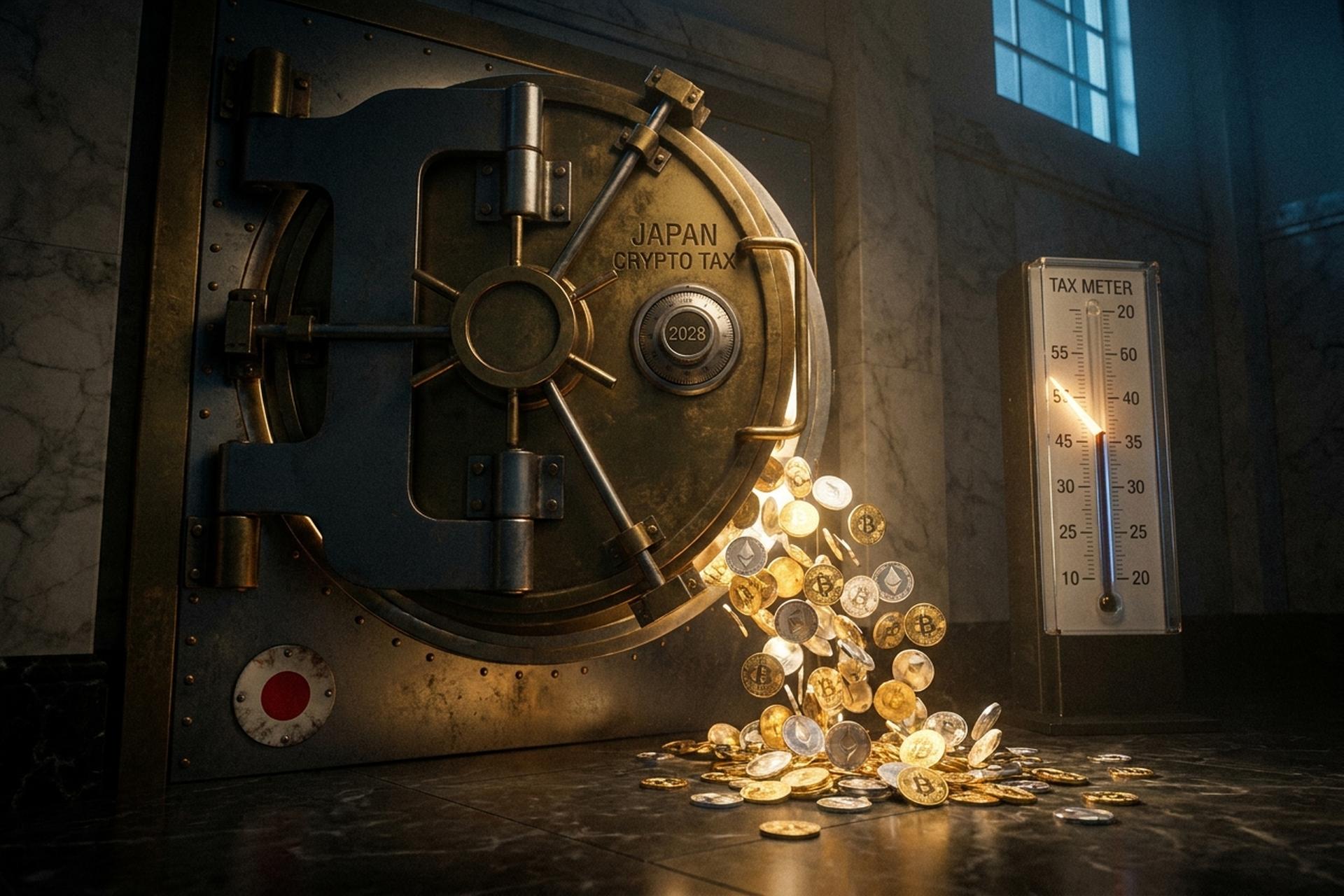
Sell Bitcoin at a profit in Tokyo and the tax office can claim more than half of it. That is not a scare statistic. It is the legal ceiling, and it has pushed founders and traders out of the country toward Dubai and Singapore for years. So when news broke in late 2025 that Japan crypto tax rules might drop to a flat rate near 20%, people understandably cheered.
The cheering was a little premature. The reform is real, and it matters. But it is narrower, slower, and more conditional than the headlines suggest. This guide explains how crypto is taxed in Japan today, what the 2026 tax reform actually changes, and what it pointedly leaves alone.
How crypto is taxed in Japan as income
Everything that frustrates Japanese investors starts with one decision: where the tax code files your crypto profit. In Japan, cryptocurrency gains are classified as "miscellaneous income" (zatsu-shotoku), under the National Tax Agency's Tax Answer No. 1524. Not capital gains. Not investment income. Miscellaneous.
That label sounds harmless. It is not. Capital gains on listed stocks in Japan get their own separate bucket and a flat tax rate of about 20%. Miscellaneous income gets no such mercy. It stacks directly on top of your salary, your bonus, and any other ordinary income, and the combined total is what the brackets are applied to.
Think of it this way. A stock trader and a crypto trader can earn the identical profit in the same year. The stock trader pays roughly 20%. The crypto trader stacks that profit onto their day-job salary and watches it get taxed at whatever marginal rate that pushes them into. Same gain, very different bill. The asset did the same thing; the tax treatment did not.
This single classification choice is the engine behind every complaint you will read about crypto taxation in Japan. The rate everyone quotes is just the symptom. The bucket is the disease. And it explains why the entire Japan crypto tax debate in 2026 has been about moving crypto out of miscellaneous income and into something closer to how equity is treated.
How much tax you actually pay: the brackets
Now for the number that goes viral: 55%. It is true, and it is also misleading. That figure is a ceiling, not an average. You only reach it if your total income lands in the top bracket, which most people never touch.
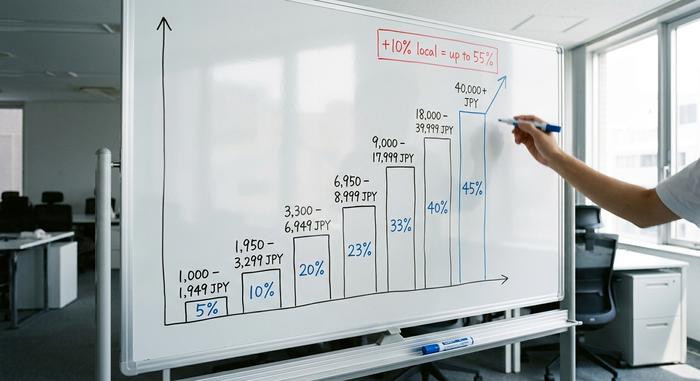
Japan's national income tax runs on seven progressive brackets. On top of that sits a flat 10% local inhabitant tax (4% prefectural plus 6% municipal) and a 2.1% reconstruction surtax applied to the national portion. Here is the national ladder:
| Taxable income (JPY) | National rate |
|---|---|
| 0 – 1,950,000 | 5% |
| 1,950,001 – 3,300,000 | 10% |
| 3,300,001 – 6,950,000 | 20% |
| 6,950,001 – 9,000,000 | 23% |
| 9,000,001 – 18,000,000 | 33% |
| 18,000,001 – 40,000,000 | 40% |
| 40,000,001+ | 45% |
Add the 10% local tax and the effective rate runs from about 15% at the bottom to roughly 55% at the very top, according to PwC's 2025 Japan tax summary. A worked example helps. Say you earn a ¥5,000,000 salary and make a ¥3,000,000 crypto gain. The gain sits on top of the salary, so most of it is taxed in the 20%–23% national bands, not at 45%. Your crypto tax bill is real but nowhere near the doomsday figure.
One relief valve exists for employees. If your total crypto gains and other side income stay under ¥200,000 in a year, you generally do not have to file for them at all. Cross that line and the whole amount becomes reportable. Non-permanent residents are taxed differently again, at a flat 20.42% on Japan-sourced income, which catches many foreign workers by surprise.
Which crypto transactions are taxed in Japan
Here is the trap beginners fall into: you can owe tax without ever seeing a single yen. Japanese rules treat a wide set of crypto transactions as taxable disposals, and a yen sale is only one of them.
Taxable events include selling crypto for fiat, trading one crypto asset for another, spending crypto to buy goods or services, and receiving crypto as payment. That second one stings. Swap Ethereum for Solana and you have triggered a taxable disposal on the Ethereum, even though no cash changed hands and you cannot pay the tax in Solana.
The tax-free side is shorter and kinder. Buying crypto with fiat is not taxed. Holding it is not taxed. Moving coins between your own wallets is not a disposal. The gain on any taxable event is simply your proceeds minus your cost basis, valued in yen at the time of the transaction.
How airdrops, staking and DeFi are taxed
Income-side events work on a different and harsher clock. When you receive new tokens, the taxable amount is their fair market value at the moment they hit your wallet, not when you eventually sell.
That timing creates a genuine risk. Picture a token airdropped to you during a hype spike, valued high on the day you receive it. The tax is locked to that high. If the price then collapses before you can sell, you can owe tax on a paper gain that no longer exists. The rules do not care that your wallet is now worth less.
Mining rewards, staking rewards, lending and DeFi yield, airdrops, and salary paid in crypto are all treated as miscellaneous income at fair market value on receipt. If you stake Ethereum and earn rewards, each reward is income the day it lands. NFT sales are also generally treated as miscellaneous income. And here is the part worth remembering for later: none of these activities are covered by the 2026 tax cut. They stay in the high-rate world.
How tax on crypto losses works in Japan
The asymmetry is what feels unfair. A crypto loss can only offset other miscellaneous income earned in the same calendar year. It cannot reduce your salary tax. It cannot carry forward to next year.
Compare that with listed securities, where Japanese investors can carry losses forward for three years against future gains. Crypto gets none of that. Have a brutal year, sell at a deep loss, and once the calendar flips, that loss is simply gone. Worse, if your only crypto activity was the losing trade, there is no other miscellaneous income to soak it up, so the deduction quietly evaporates. The reform proposes to fix this with a three-year carryforward, but for now the rule stands and it favors no one.
Japan's 2026 crypto tax reform explained
This is where most coverage gets it wrong. The story is not "Japan cut crypto tax to 20%." The accurate version is messier: a two-tier cut, with strict conditions and a long fuse.
On December 19, 2025, the ruling Liberal Democratic Party released its FY2026 Tax Reform Outline, and crypto was finally in it. The plan, summarized by EY Japan and Finance Magnates, would tax qualifying crypto under a separate flat rate of 20.315% — 15% national, 5% local, and a 0.315% surtax — the same structure that applies to stocks and investment trusts. To get there, crypto would be reclassified under the Financial Instruments and Exchange Act (FIEA) as a financial product rather than a means of payment.
That reclassification is a double-edged sword. The lower rate is the upside. The downside is that crypto would then carry the same baggage as regulated financial instruments: insider-trading rules, disclosure requirements, and tighter Financial Services Agency oversight. A tax cut and a regulatory tightening arrive in the same package.
Now the conditions, because they are everything:
| Feature | Now | After reform |
|---|---|---|
| Rate on gains | Up to ~55% (miscellaneous income) | Flat 20.315% (specified crypto assets) |
| Classification | Payment Services Act | Financial Instruments and Exchange Act |
| Loss carry forward | None | Three years |
| Covered assets | All crypto | ~105 listed coins on licensed exchanges |
| Excluded | — | DeFi, staking, NFTs, foreign exchanges |
| Individual start | Current | Around January 1, 2028 |
The flat rate applies only to "specified crypto assets" — roughly 105 digital assets, including Bitcoin and Ethereum, traded on FSA-registered Japanese exchanges. Trade on an offshore platform, farm yield in DeFi, or earn staking rewards, and you stay in the up-to-55% miscellaneous income system. The reform also opens the door to spot crypto ETFs, which is arguably its biggest long-term consequence.
There are two more catches. The individual rate change is not expected to take effect until around January 1, 2028. And the relief that already exists is corporate, not personal: from April 1, 2026, Japanese companies are exempt from tax on the unrealized year-end market value of long-term crypto holdings, a fix to a rule that had taxed firms on paper gains they never sold. The 2028 timing is the part I keep coming back to: a tax cut you cannot use for two more years is, for now, just a promise.
Why bother at all? Because the cost of inaction was visible. Japan had about 12 million crypto accounts and ¥5 trillion in assets under custody as of January 2025, per FSA data, while founders kept relocating to Dubai and Singapore and a large share of domestic exchanges ran at a loss. Japan's crypto tax reform is Tokyo trying to stop the bleeding without giving up control.
Japan crypto tax vs capital gains abroad
Even after the cut, Japan will not be a tax haven. Put it next to the actual havens and you can see it is joining the normal club, not winning a race to zero. The capital gains tax treatment of crypto varies wildly by country.
| Country | Crypto tax on gains |
|---|---|
| Singapore | 0% (no capital gains tax) |
| UAE | 0% for individuals |
| Germany | 0% if held over 1 year |
| Portugal | 0% long-term; 28% short-term |
| United States | Long-term capital gains 0/15/20% |
| Japan (now) | Up to ~55% |
| Japan (reform) | Flat 20.315%, specified assets |
A flat 20% would move Japan from worst-in-class to roughly mid-pack, in line with the United States and just behind the zero-tax jurisdictions. That is a meaningful improvement. It is not a magnet. Anyone leaving Tokyo purely for tax reasons will still find cheaper homes elsewhere.

How to report and file crypto tax in Japan
Two practical truths. The NTA sees more than people assume, and the calendar is strict.
For crypto tax in Japan, the tax year runs from January 1 to December 31. You file the following year between February 16 and March 15, with March 15 as the hard deadline. For cost basis, Japan lets individuals use the total average method by default, or the moving average method if you apply for it, and you are expected to stay consistent once you choose.
On the tracking question: registered exchanges share data with the tax authority, and the NTA runs data matching to connect wallets and accounts to taxpayers. The 2024 collapse of DMM Bitcoin, which lost about ¥48 billion (roughly $305 million) to a hack, was a reminder that exchanges operate under close official watch, not in the shadows. Holdings on foreign exchanges are still reportable; using an overseas platform changes your tax rate, not your obligation to report. Keep transaction records for at least three years, including dates, values in yen, and the purpose of each transfer. And remember the ¥200,000 threshold for salaried filers — below it you may skip filing the side income, above it the full amount is on the table.
The bottom line on Japan crypto tax in 2026
The 2026 reform is good news that has been oversold. If you trade Bitcoin or Ethereum on a licensed Japanese exchange, your future probably looks like a flat 20% and a three-year window to use your losses. If you farm DeFi, stake, collect airdrops, or trade offshore, you are still living in the 55% world, and you will be until at least 2028.
So the smart move for anyone dealing with Japan's crypto tax right now is not to celebrate. It is to keep clean records, watch which exchanges and which coins make the "specified" list, and decide whether your activity will actually qualify. Two investors with the same Bitcoin gain can end up in completely different tax regimes depending only on where and how they traded. The rate is changing. Whether it changes for you is the real question.