How to Buy Bitcoin in Japan: Best Crypto and BTC Guide
Japan takes crypto regulation more seriously than almost any other country. Always has. It was the first major economy to legalize Bitcoin as property, the first to license a cryptocurrency exchange, and the Japanese government is now the first G7 administration to move crypto under a full securities-style framework. For investors in Japan today, three things fall out of that: the rules are clearer, the venues are fewer, and the tax hit is steeper than almost anywhere else. According to a Financial Services Agency discussion paper published in April 2025, Japanese crypto-asset exchange service providers hold more than 12 million accounts with over JPY 5 trillion (about $33 billion) in customer deposits. Roughly 7.3 percent of Japanese investors with prior investment experience now hold crypto. That is a mature market with hard guardrails. Buying into it from Japan is simpler than most guides make it sound.
This guide walks through how to buy crypto in Japan in 2026, which FSA-licensed exchanges are actually worth using, how the registration and KYC flow works step by step, what you will pay in fees and taxes, how the 2026 tax reform changes things, and what to know about the DMM Bitcoin collapse, Mt. Gox payouts, the JPYC stablecoin launch and the 2028 ETF timeline. If you are a Japanese resident or a foreign resident living in Japan, every step below applies to you. The question of how to buy crypto in Japan has a surprisingly specific answer in 2026, and the rest of this article will walk through it end to end.
What to know before buying bitcoin in Japan
Short version of the legal picture before anything else: buying bitcoin in Japan is legal, supervised, and taxed aggressively. The Financial Services Agency (FSA) licenses every exchange that can legally onboard Japanese residents under the Payment Services Act. Any platform offering Japanese-yen deposits or BTC purchases to Japanese residents without an FSA license is operating illegally. That is why Binance pulled out in 2018. It came back in late 2023 only under a locally licensed entity after acquiring Sakura Exchange BitCoin. Kraken left twice. The second exit was effective January 31, 2023. Bybit set a January 22, 2026 deadline for Japanese residents to complete KYC or see their accounts restricted. Rule is simple: use an FSA-licensed venue, or you are out of compliance.
Three things are worth knowing up front. First, crypto purchases in Japan are currently taxed as miscellaneous income at rates up to 55 percent, stacked on top of your salary. That is the single biggest friction point for new users and for crypto investors more broadly. Second, a tax reform is moving through the 2026 Diet session that would cut the headline rate on qualifying crypto assets to a flat 20 percent, matching listed equities. Third, the menu of tokens you can legally buy on a Japanese exchange is limited by the JVCEA Green List, which contained 30-plus approved assets as of April 2026 including BTC, ETH, XRP and SHIB. Any cryptocurrency exchange serving Japanese residents must register with the FSA and stay inside that Green List. If you want access to the long tail of altcoins available on Binance global, Japanese exchanges are not where you will find them.
Japan crypto asset regulation: FSA and JVCEA rules
The FSA runs the whole thing. Every Japanese financial services agency function, including crypto. To legally buy and sell a crypto asset inside Japan, you need a licensed Crypto-Asset Exchange Service Provider (CAESP). Roughly 30 such licensed providers exist as of 2026. The exact count depends on whether you include spot-only exchanges, derivatives venues, and custodians separately. Global Legal Insights puts JVCEA membership at 18 of 21 licensed exchanges in 2025, which is the most reliable narrow count for regulated spot trading.
JVCEA is the Japan Virtual and Crypto Assets Exchange Association. It is the self-regulatory body every licensed exchange belongs to. Its Token Listing Committee decides which crypto assets can be offered to Japanese retail users. In Q2 2025 alone, that committee rejected 72 percent of the 147 token applications it reviewed. Rough ratio. That rejection rate is the single biggest reason Japanese users see a much shorter token menu than they would on Bybit international or Binance global.
The bigger shift is happening at the legal layer. On September 2, 2025, the FSA announced a landmark move: reclassify qualifying crypto from payment instruments under the Payment Services Act to financial instruments under the Financial Instruments and Exchange Act (FIEA). On April 10, 2026, the Japan Cabinet approved the formal FIEA amendment. Insider trading in crypto is now banned. Annual financial disclosures are required. Penalties for unregistered operators got much stiffer. The law is expected to take effect by fiscal 2027. Japan is now the first G7 economy to treat crypto like stocks at the securities-law level.
Top ways to buy bitcoin (BTC) in Japan in 2026
Realistically, there are four ways to buy cryptocurrency in Japan in 2026 that are worth doing. Each one runs through a licensed venue. Everything else is just a variation.
- Domestic FSA-licensed exchange (bitFlyer, Coincheck, BitBank, GMO Coin, SBI VC Trade). The default option for most users. Yen bank deposits, fast KYC, low withdrawal friction.
- Binance Japan. The only major foreign brand operating under a local license, migrated from Sakura Exchange BitCoin (SEBC) in 2023. Smaller asset menu than Binance global.
- Regulated Bitcoin ATMs. Found mainly in Tokyo, Osaka and Kyoto. Higher fees and lower limits than exchanges. Convenient for cash deposits.
- Peer-to-peer with a licensed intermediary. Less common now that FSA rules make direct P2P harder for larger amounts.
For almost everyone, the easiest way to buy is to open a trading account on a Japanese exchange, fund it with fiat money through a bank transfer from a Japanese bank account, and buy BTC at market. This is also the cleanest way to buy and sell bitcoin without hitting the edges of the rules or paying inflated spreads. The main exception is if you already have a Binance global account with verified KYC, in which case you may want to migrate to Binance Japan.
Step-by-step: how to buy and sell bitcoin on bitFlyer
bitFlyer is Japan's largest CAESP by market share and the one most new users land on first. CoinGecko's May 2023 snapshot put its share at 38 percent of Japanese spot volume, ahead of Coincheck (27.2 percent), BitBank (13.5 percent) and GMO Coin (8.6 percent). That is a real gap, not marketing talk. bitFlyer had 3 million-plus global users and over JPY 900 billion in assets under custody as of March 2024 according to company filings. Here is the full flow for a first-time Japanese resident, step by step.
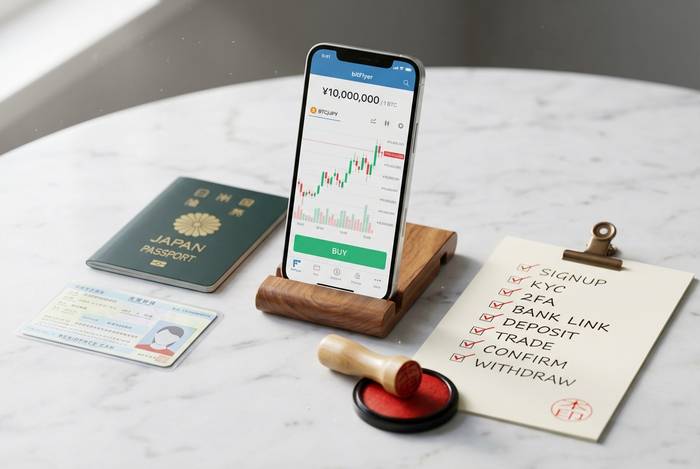
1. Sign up at bitflyer.com. Email, password, accept terms. Two minutes, maybe three.
2. KYC. Japan wants a valid photo ID (driver's license, My Number card, passport, or residence card) plus proof of address. Most people get verified within a business day. Sometimes instant.
3. Turn on two-factor authentication. This is not optional. You will not be able to withdraw anything until it is set up.
4. Link a Japanese bank account. MUFG, SMBC, Mizuho, Resona, Japan Post — all of them work. Deposit side is free.
5. Deposit Japanese yen. Small deposits clear right away through the Furikomi system. Larger ones (above JPY 1 million) can take a couple of hours, sometimes longer if you do it on a Saturday.
6. Go to the BTC/JPY trading pair. One click to buy once you type in how much BTC or how many yen you want to spend. That is it.
7. Confirm the order. bitFlyer supports market orders, limit orders, and a mobile app for both iOS and Android with Touch ID and Face ID.
8. Move the BTC off the exchange if you plan to hold. On the "Withdraw" screen, paste your external wallet address, confirm two-factor, and the BTC arrives in your wallet within roughly 30 minutes to an hour depending on network congestion.
The flow on Coincheck, BitBank and GMO Coin is almost identical. The main difference is the interface and which trading pairs are available. Coincheck and bitFlyer both offer 24/7 live support in Japanese; BitBank and GMO Coin answer tickets within business hours.
Best crypto exchanges in Japan: Coincheck, BitBank, GMO
The top Japanese crypto exchanges all run under full FSA licenses and all offer bank transfer and card funding for Japanese users. Each is a regulated trading platform with real trading volume in Japanese yen, not a gray-market exchange platform of the kind that dominated Japan's crypto space before Mt. Gox. Here is the short comparison most newcomers need.
| Exchange | FSA licensed | Users / accounts | Supported coins | Key feature |
|---|---|---|---|---|
| bitFlyer | Yes | 3M+ global, ~38% domestic share | ~20 FSA-approved assets | Largest CAESP, deepest BTC/JPY liquidity |
| Coincheck | Yes | 2.15M (Nov 2024) | ~20 FSA-approved assets | Nasdaq-listed Dec 2024 via $1.3B SPAC |
| BitBank | Yes | ~1M+ | ~20 FSA-approved assets | Best-regarded order book among domestic retail traders |
| GMO Coin | Yes | ~500k+ | ~20 FSA-approved assets | Part of GMO Internet Group, tight integration with Japanese forex |
| SBI VC Trade | Yes | Expanded 2025 via DMM Bitcoin takeover | ~20 FSA-approved assets | Backed by SBI Holdings, one of Japan's largest financial groups |
| Binance Japan | Yes | Migrated from SEBC in 2023 | Smaller than Binance global | Only major foreign brand under local license |
Coincheck's Nasdaq debut on December 11, 2024 is the detail most foreign coverage misses. It was the first Japanese crypto exchange to go public on a US market, through a $1.3 billion SPAC merger, and its parent Monex Group kept an 82 percent stake. Worth knowing. SBI VC Trade's profile jumped later in 2025, once it took over the accounts and assets of DMM Bitcoin following the May 2024 hack. That takeover closed on March 8, 2025.
Best place to buy bitcoin in Japan right now
If you want the single best place to buy bitcoin in Japan as a first-time resident user, bitFlyer is still the default answer. Highest yen-denominated BTC liquidity. Cleanest KYC flow. English-language option if you do not read Japanese. Longest operational track record. Coincheck is a close second with a slightly easier beginner interface. BitBank is what most serious Japanese traders pick for order-book mechanics. GMO Coin is the best choice if you already have a brokerage account at GMO, because your identity is already verified.
Foreign residents in Japan with Japanese bank accounts and residence cards can use all five. If you are a Japan-resident foreigner without a local bank account yet, the realistic path is painful but short: open a Yucho (Japan Post) or Shinsei bank account first, then come back to the exchange signup. No shortcut around that step.

Fees, payment methods and bitcoin price in Japan
Fees in Japan line up with global averages and come in cheaper than pure card-funded Western services. Here is the current picture as of 2026:
- Bank transfer deposit: Free on bitFlyer, Coincheck, BitBank and GMO Coin. Standard Furikomi fees apply on the bank side.
- Credit/debit card deposit: Available through partner ramps but with 3-5 percent fees. Rarely the right choice for a Japanese resident because bank transfer is free.
- Spot trading fee: 0.01-0.15 percent depending on the exchange and the order type, usually on a maker/taker schedule. bitFlyer Lightning is the low end, Coincheck simple exchange is the higher end.
- BTC withdrawal fee: A flat rate, typically 0.0004-0.001 BTC depending on the exchange.
- Yen withdrawal fee: JPY 220-770 depending on the bank and the amount.
Bitcoin transactions in yen settle at a small premium or discount to global rates depending on which way flow is running. The bitcoin price on a Japanese venue is rarely identical to the global screen price. Transaction fees on every major FSA-licensed bitcoin exchange are disclosed upfront, which is more than you can say for most Western retail apps. The "kimchi premium" equivalent never got as extreme as Korea's did, but you can still see 0.5-1 percent gaps between BTC/JPY on bitFlyer and BTC/USD on Coinbase during periods of heavy Japanese retail buying or selling. If you care about the exact execution price, compare the JPY/USD FX rate plus the global BTC/USD rate against your local BTC/JPY quote before submitting the order.
How to keep your bitcoin safe: wallets and storage
Leaving everything on a Japanese exchange is legal and common. It is also not the safest long-term approach for serious crypto asset trading or long-hold positions. Japan has two big lessons on this, and they still sting. The Mt. Gox collapse in 2014 locked up roughly 850,000 BTC for over a decade; the trustee still holds about 34,689 BTC as of 2025 and recently pushed the final creditor repayment deadline to October 31, 2026, which is the third extension so far. More recently, the DMM Bitcoin hack on May 30, 2024 drained 4,502.9 BTC (about $305 million at the time) from a licensed exchange. The FBI, Japan's National Police Agency and DC3 formally attributed the breach to North Korea's TraderTraitor group in December 2024. Both events happened on FSA-licensed platforms that had passed compliance reviews.
The practical takeaway: if you plan to keep your bitcoin for more than a few weeks, move it to self-custody. The short list of sensible options for a Japanese user:
- Hardware wallet: Ledger Nano X or S Plus, Trezor Safe 3. Both ship to Japan and both have Japanese-language support. Prices start around JPY 10,000.
- Software wallet: Rabby, MetaMask (for ETH and EVM tokens), Electrum for BTC. All free.
- Paper backup of the seed phrase: store in a fireproof location or a bank safety deposit box. Never photograph the seed phrase or store it in cloud storage.
For amounts below roughly JPY 500,000, leaving crypto on the exchange is a reasonable convenience tradeoff. Above that, self-custody with a hardware wallet is the right answer for the same reason it is the right answer in every other country.
Japan crypto taxes: the 55% problem
This is the single biggest decision point for any Japanese crypto buyer. It is also the reason the 2026 tax reform matters so much. Under current rules, crypto gains are classified as miscellaneous income (zatsu shotoku, 雑所得) and taxed at Japan's progressive income-tax schedule, stacked on top of your salary. Top combined rate: 55 percent (45 percent national plus 10 percent local resident tax). Brutal. The reporting threshold for salaried workers is JPY 200,000 of miscellaneous income per year. Below that, salaried workers do not need to file a separate return. Above it, they do.
| Taxable income (JPY, including crypto gains) | National rate | Local rate | Combined |
|---|---|---|---|
| Up to 1,950,000 | 5% | 10% | 15% |
| 1,950,001 - 3,300,000 | 10% | 10% | 20% |
| 3,300,001 - 6,950,000 | 20% | 10% | 30% |
| 6,950,001 - 9,000,000 | 23% | 10% | 33% |
| 9,000,001 - 18,000,000 | 33% | 10% | 43% |
| 18,000,001 - 40,000,000 | 40% | 10% | 50% |
| Over 40,000,000 | 45% | 10% | 55% |
Under the 2026 reform tied to the FIEA transition, crypto gains on "specified crypto assets" traded on registered venues would move to a flat 20 percent separate-taxation rate (15 percent national plus 5 percent local). Same treatment as listed stocks. The reform would also introduce a three-year loss carryforward, which current zatsu shotoku rules flat-out deny. Timing: the bill is working through the 2026 ordinary Diet session, with an effective date likely in fiscal 2026 or fiscal 2027 depending on how quickly the Diet actually passes the text. Not fast.
Practical advice right now: keep complete trade records, use an FSA-licensed exchange that can export clean transaction logs, and assume you still owe the higher miscellaneous-income rate until the reform bill actually takes effect. A Japanese licensed tax accountant (zeirishi) who understands crypto is worth every yen above a few million in gains. Do not try to DIY this if you have meaningful positions.
DMM Bitcoin hack and 2025-2026 market state
DMM Bitcoin was the defining Japanese crypto story of the 2024-2025 cycle. On May 30, 2024, hackers drained 4,502.9 BTC from DMM Bitcoin's hot wallets, worth roughly $305 million at the time. DMM's parent company scrambled a JPY 55 billion loan to cover user withdrawals. A few months later, the exchange announced it would wind down and transfer every customer account and asset to SBI VC Trade. Transfer closed on March 8, 2025 per CoinDesk. DMM Bitcoin is gone as a trading venue. Done.
The broader 2025-2026 picture for the Japanese crypto market is the combination of three things. First, JPYC launched on October 27, 2025 as the first fully regulated yen-pegged stablecoin, backed by bank deposits and JGBs and issued on Ethereum, Avalanche and Polygon. The goal is to give Japanese users a yen-denominated digital asset that behaves like fiat currency on-chain. JPYC targets JPY 10 trillion in circulation within three years according to PYMNTS. Second, MUFG, SMBC and Mizuho launched a joint corporate-settlement yen stablecoin on October 31, 2025 through MUFG's Progmat platform. Third, Nomura and SBI are preparing spot Bitcoin and Ethereum ETFs, but CoinDesk reports that Japanese spot crypto ETFs are unlikely to trade before 2028 due to the pace of the FIEA amendment process and Tokyo Stock Exchange listing rules. The world of cryptocurrency moves faster than the Diet does; that is a structural feature.
Using crypto in Japan: spending, ETFs and stablecoins
Using crypto for actual payments in Japan is still niche. Bic Camera and Yamada Denki have accepted Bitcoin at select retail outlets for years, and some JR train stations have experimented with crypto-linked loyalty programs, but card networks and QR code payment systems (PayPay, LINE Pay, Rakuten Pay) dominate everyday spending. Most Japanese retail crypto users buy, hold, and eventually sell back to yen. Actual on-chain spending is rare.
The more interesting 2026 shift is institutional access. JPYC finally gives Japanese users a yen-denominated on-chain settlement asset backed by regulated reserves. The Progmat corporate yen stablecoin gives banks their own rail for B2B settlement. Once the FIEA amendment takes effect and crypto ETFs list on the Tokyo Stock Exchange, Japanese retail investors will finally be able to hold BTC and ETH through regular brokerage accounts, paying the flat 20 percent tax rate on gains that would otherwise hit 55 percent on a direct exchange. That is the quiet revolution the 2026 reforms are setting up.
The bottom line on buying crypto in Japan
Buying crypto in Japan is simple in mechanics and complicated in taxes. Open an account with a licensed exchange, pass KYC, deposit yen through a Japanese bank account, buy bitcoin, move it to a hardware wallet if you plan to hold. The friction is not the buying step. It is the tax rate, the limited Green List of tradable assets, and the long wait for spot ETFs. If the 2026 tax reform passes and the FIEA transition ships on schedule, every one of those friction points gets materially smaller. Big if.
For 2026 specifically: default to bitFlyer or Coincheck if you want the most liquid yen-denominated BTC market, use BitBank if you care about order-book mechanics, and use SBI VC Trade if you value balance-sheet backing from a big Japanese financial group. Keep clean trade records, assume the current 55 percent rate applies until the Diet says otherwise, and watch the JPYC stablecoin rollout because that is probably where the next interesting use cases will appear first. Selling crypto in Japan follows the same flow in reverse, subject to the same miscellaneous-income tax treatment on realized gains until the reform takes effect. That is the short guide to trading in Japan for 2026; the bigger picture will keep changing as the FIEA bill moves through the Diet.