CRCL Stock: Is Circle Internet Group Inc a Buy?

A stock that runs up nine-fold and then hands almost all of it back tells you something. Not about the company, necessarily, but about the people trading it. CRCL stock did exactly that in its first year on the market: priced at $31, briefly worth nearly $299, and back near $106 by late May 2026. The chart looks like a heartbeat that flatlined.
So the obvious question, "is CRCL a buy," is the wrong one to start with. The better question is the one most buyers skip: when you buy a share of Circle Internet Group, what are you actually buying? It is not a crypto coin. It is closer to a bet on interest rates wearing a blockchain jersey, and that distinction changes everything.
What CRCL Stock Actually Represents Today
Here is the reframe that does the most work. CRCL is equity in the company that issues USDC, the second-largest dollar stablecoin. You are not buying USDC when you buy the stock. You are buying the business that mints it, holds the reserves behind it, and collects the income those reserves throw off.
Circle Internet Group trades on the New York Stock Exchange under the ticker CRCL. The company was founded in 2013, runs on a platform that issues stablecoins and provides developer infrastructure for digital-payment applications, and is led by co-founder Jeremy Allaire. By the first quarter of 2026, USDC in circulation had reached about $77 billion, up 28% year over year. That growth is real and it matters. Circle also runs developer services and is building its own ARC blockchain, but for now those are side dishes, not the main course.
But notice what the profit engine is. It is not trading fees, not a subscription product, not app downloads. The engine is the yield on the assets backing the coin. Most people new to CRCL stock assume they are making a crypto-price bet. They are making a Federal Reserve bet. Keep that straight and the rest of the analysis falls into place.
How Circle Internet Group Makes Money
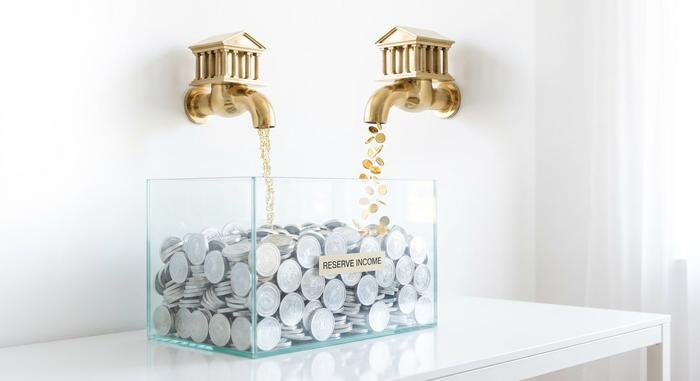
Let me say this as plainly as I can: Circle is, in financial terms, a money-market fund with a crypto brand stapled to the front. Roughly the entire revenue line comes from interest earned on the cash and short-term US Treasuries that back every USDC token. When a stablecoin holder parks a dollar with Circle, Circle invests the matching reserve and keeps the interest. The holder gets a token; Circle gets the yield. Most of those reserves sit in the Circle Reserve Fund, a government money-market fund managed by BlackRock and held in short-dated US Treasuries and overnight repos. That makes Circle's balance sheet about as boring and safe as crypto gets, which is exactly the point.
The numbers back this up. Full-year 2025 revenue came in at $2.7 billion, up 64% from the year before. In the first quarter of 2026, revenue was $694 million, and reserve income alone was $653 million of it. That is not a company with a diversified income statement. That is a single faucet.
Which raises the uncomfortable part. A faucet fed by interest rates runs dry when rates fall. Every cut from the Fed trims Circle's take on the same pile of reserves. The business looked spectacular through the high-rate stretch of 2023 to 2025 for a reason that had nothing to do with how good the product is.
| What drives CRCL revenue | Detail | Why it matters |
|---|---|---|
| Reserve income | ~94% of Q1 2026 revenue ($653M of $694M) | The whole story is here |
| USDC in circulation | ~$77B, +28% YoY | More coins means more reserves to invest |
| Federal funds rate | The yield on those reserves | Rate cuts directly shrink revenue |
| Other services | Small share | Not yet material |
Read that table twice. It explains why a "crypto stock" can be wrecked by a monetary-policy decision made in Washington.
CRCL Stock Price: From $31 IPO to $299 and Back
The price history of CRCL stock is almost a teaching case in how not to buy a hot IPO. Circle went public on June 5, 2025, pricing 34 million shares at $31 and raising roughly $1.05 billion. The deal was clearly underpriced. The stock closed its first day at $83.23, up 168%, and the trading frenzy did not stop there.
By June 23, just over two weeks later, CRCL touched an all-time high of $298.99. Think about that. A near ten-fold gain from the IPO price in under a month, on a company whose revenue depends on rates nobody at Circle controls. That is not investing. That is a crowd.
Gravity did the rest. Over the following months the stock gave back the vast majority of the move, bottoming near $49.90 in early February 2026 before settling around $106 by late May. Anyone who bought the chart at the top and held is still down roughly two-thirds.
| Date | CRCL stock price | Note |
|---|---|---|
| Jun 5, 2025 | $31.00 | IPO price |
| Jun 5, 2025 | $83.23 | Day-one close, +168% |
| Jun 23, 2025 | $298.99 | All-time high |
| Feb 5, 2026 | $49.90 | All-time low |
| Late May 2026 | ~$106 | Recent quote |
The lesson here is older than crypto. A great company and a great stock are not the same thing, and the gap between them is usually the price you pay.
Key Statistics and Financial Snapshot
If you only want the numbers that move the needle, here they are in one place. One caveat first: CRCL shows a net loss on a trailing basis, but a chunk of that is stock-based compensation tied to the IPO rather than the business burning cash. Operating cash flow was positive. The headline loss flatters the bears a little.
| Metric | Value (May 2026) |
|---|---|
| Market capitalization | ~$25.5–26.5 billion |
| Revenue (TTM) | ~$2.7–2.86 billion |
| Net income (TTM) | Small net loss (SBC-distorted) |
| Forward P/E | ~62–86x |
| Price-to-sales | ~9x |
| 52-week range | $49.90 – $298.99 |
| Exchange | NYSE (not Nasdaq) |
A forward P/E in the 60s to 80s is a growth-stock multiple. The market is still pricing CRCL stock for expansion, not for a rate-driven slowdown. That is the tension the whole thesis hangs on.
What Analyst Ratings Miss About Coinbase
Here is the structural risk that rarely makes the headline next to the analyst ratings, and it is the part I keep coming back to when evaluating CRCL stock. Circle does not keep all the interest its reserves generate. Coinbase does.
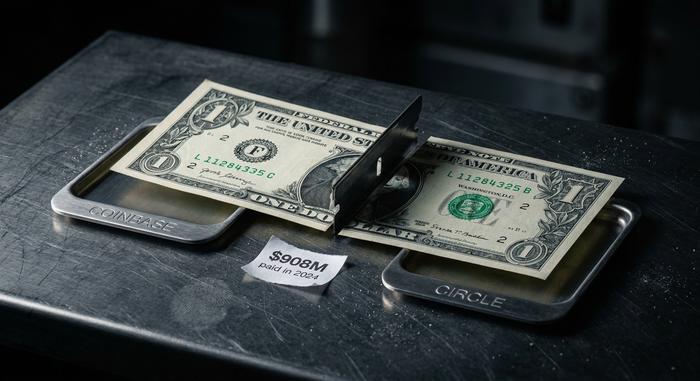
Under their long-standing arrangement, Coinbase receives 100% of the reserve income on any USDC sitting in Coinbase products, plus 50% of the residual reserve income across the rest of the network. In 2024 alone, Circle paid Coinbase roughly $908 million. Coinbase holds something like 22% of all USDC. So the distribution partner that helped USDC scale also takes one of the largest bites out of its economics.
Strip that out and the picture changes. Of every gross dollar of reserve income, Circle keeps closer to 40 to 45 cents before paying its own operating costs. The revenue line looks like a giant; the retained economics look more ordinary. When an analyst slaps a target on CRCL based on top-line growth, ask whether the model accounts for the Coinbase cut. Often it does not, and that is where the optimism leaks in.
This is not a hidden scandal. It is disclosed plainly in Circle's filings. But disclosure and attention are different things, and the market spent most of 2025 paying attention to the wrong number. The deal also runs for years, so Circle cannot simply renegotiate the toll the moment it wants more margin.
CRCL vs COIN: Two Bets on the Same Trend
People frame CRCL and COIN as rivals. They are closer to business partners, which makes the comparison more interesting than a simple head-to-head. Coinbase literally earns money from Circle's reserves, so a bet on USDC growth helps both. The difference is in what else you get.
Buy COIN and you own a diversified crypto exchange: trading fees, custody, staking, subscriptions, and a slice of USDC economics on top. Buy CRCL and you own a near-pure bet on stablecoin reserves and interest rates. One is a basket; the other is a single, concentrated wager.
| Factor | CRCL (Circle) | COIN (Coinbase) |
|---|---|---|
| Core revenue | USDC reserve interest | Trading + diversified |
| Forward P/S | ~6x | ~8x |
| Rate sensitivity | Very high | Moderate |
| Crypto-price sensitivity | Lower | Higher |
| Profile | Pure-play rate bet | Diversified exchange |
Neither is obviously cheap. But if you have a strong view on where interest rates go next, CRCL gives you a cleaner way to express it. If you would rather not bet the house on the Fed, COIN spreads the risk.
Why the GENIUS Act Cuts Both Ways for CRCL
The biggest piece of news for the whole sector was a law, not an earnings report. The GENIUS Act, signed on July 18, 2025, gave US stablecoins their first real federal framework. It confirmed that compliant stablecoins are not securities, mandated full 1:1 reserve backing, and set the rules of the road that Circle had been asking for.
For CRCL stock, that is genuinely good. Regulatory clarity removes an existential threat and validates the model Circle bet the company on. A blockchain payment asset that regulators understand is far easier to scale.
But the same law cuts the other way. By creating a clean path to issue a compliant stablecoin, it invites competition straight into Circle's lane. Banks and other issuers get a roughly three-year window to enter under the same framework. The rules that legitimized Circle also lowered the wall around it. A moat built on "we are the compliant one" gets shallower the moment everyone can be compliant too.
Latest CRCL News, Analyst Ratings and Price Targets
The Wall Street consensus on CRCL stock is best read as a polite shrug. Across roughly 25 analysts, the average rating lands around Hold to Moderate Buy, and the average price target sits near $137 to $146 depending on the day you check. The latest moves have leaned positive, with recent Buy ratings from firms like H.C. Wainwright and KeyBanc, yet the headline numbers still say split.
| Analyst view | Figure |
|---|---|
| Consensus rating | Hold / Moderate Buy |
| Analysts covering | ~25 |
| Average price target | ~$137–146 |
| Target range | $60 – $243 |
Look at that range. A low of $60 and a high of $243 on the same stock is less a forecast than a confession that nobody really knows. When the spread between the bull and bear target is that wide, the "average" target is almost meaningless. It tells you the pros are as split as everyone else.
The Bull and Bear Case for CRCL Stock
Time to take a position. My read is that the two cases are not symmetric, and that asymmetry is the whole investment decision.
The bull case needs two things to go right at the same time. USDC supply has to keep climbing, and interest rates have to stay high enough to make those reserves pay. There is real evidence for the first: USDC on-chain volume hit $21.5 trillion in the first quarter of 2026, up 263% year over year, and Circle is building out its ARC blockchain and developer services for more upside. The GENIUS Act is a tailwind. If volume compounds and the Fed holds, $106 will look cheap.
The bear case only needs one thing to break. Rates fall, and the reserve faucet narrows. Or the Coinbase cut keeps eating the margin. Or a bank launches a competing coin and chips at share. Any single one of those does damage, and the early warning is already on the tape: Q1 2026 revenue growth slowed to 20% and net income fell about 15% year over year.
| Bull case | Bear case |
|---|---|
| USDC volume +263% YoY | Rate cuts shrink reserve income |
| GENIUS Act tailwind | Coinbase takes ~50%+ of residual |
| ARC blockchain optionality | New bank issuers erode share |
| Supply at record ~$77B | Growth already decelerating |
So is CRCL a buy or sell? At around $106 the stock is priced for a soft landing in interest rates that Circle does not get to control. That is the crux. You are not really forming a view on Circle; you are forming a view on the Fed and pretending it is a view on crypto.
Conclusion: Is CRCL Stock Worth It?
CRCL is one of the cleanest companies to understand once you accept what it is: a stablecoin issuer whose profits rise and fall with interest rates, minus a heavy toll paid to Coinbase. The growth is real, the regulatory backdrop just improved, and the valuation still assumes the good times continue. Investors who buy it as a crypto play are buying a rate play by mistake, and the market keeps making that mistake in both directions.
So before you put CRCL stock in your portfolio, answer one question honestly: do you actually have an edge on where US interest rates are headed over the next two years? If yes, this is a sharp tool for that view. If not, you are guessing, and the chart already showed you what guessing costs.