
APLD Stock: AI Data Center vs Semiconductor Stocks
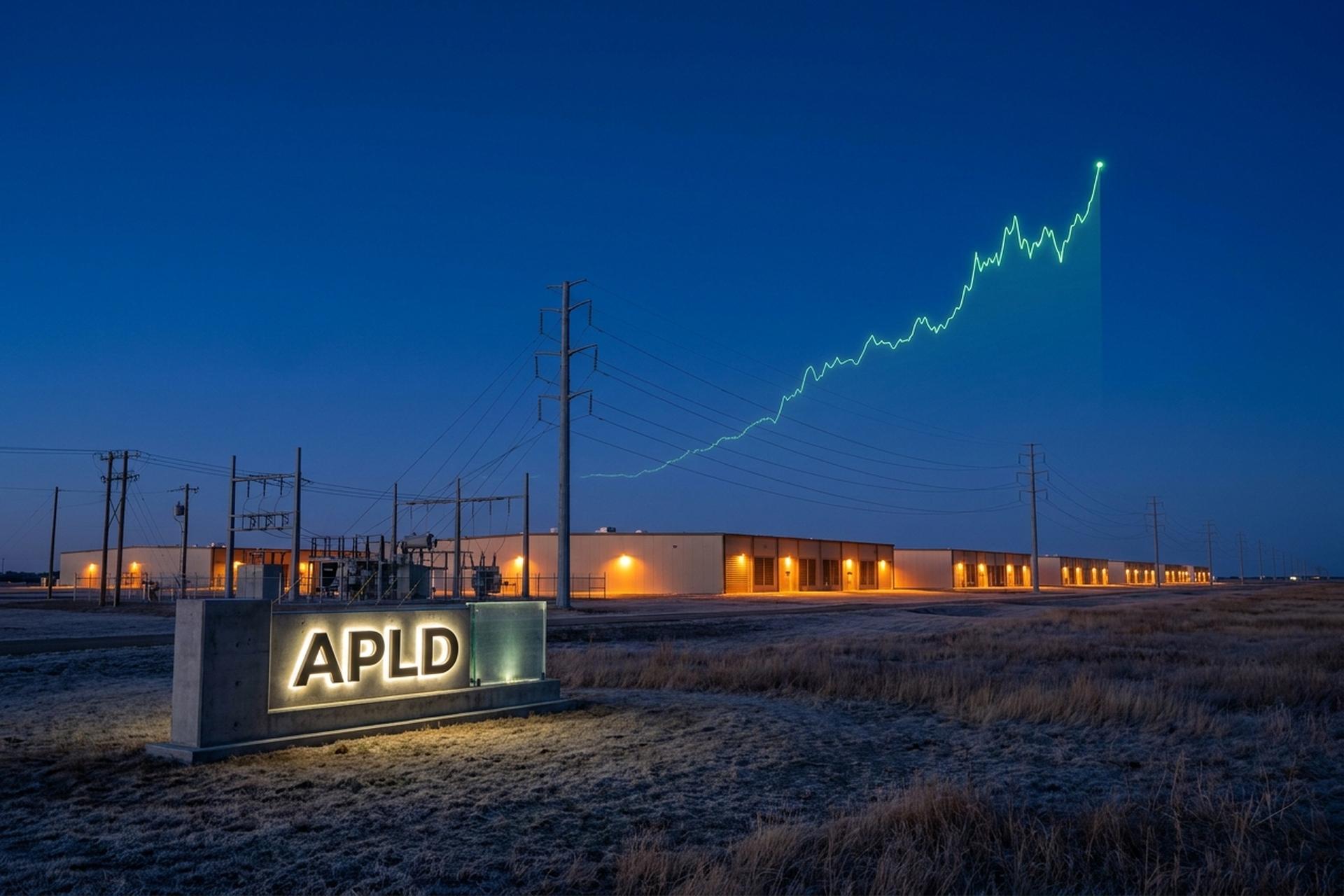
Every list of the best semiconductor stocks names the same handful: NVIDIA, TSMC, Broadcom, AMD. None of them mention the company that actually houses those chips. Applied Digital, ticker APLD, is a different kind of bet on the same artificial intelligence boom — not the chipmaker, but the landlord renting out the buildings and the power the chips run inside.
The stock has behaved like one, too. APLD stock traded as low as $6.68 over the past year and changed hands near $49 by late May 2026, a roughly $14 billion company built on more than $31 billion in signed data-center leases. This guide explains what APLD is, how a crypto miner became an AI landlord, how it stacks up against the semiconductor names, the bull and bear cases, and where, if anywhere, it belongs in a portfolio. None of this is investment advice.
What APLD stock is in the semiconductor industry
Start with what APLD is not. It is not a semiconductor stock. It does not design chips, it does not run a fab, and it has no part in semiconductor manufacturing. Applied Digital builds and operates the data centers where other people's chips do the work.
The company trades on the Nasdaq under the ticker APLD. It went public in April 2022 at $5 a share as Applied Blockchain, then renamed itself Applied Digital that November. Inside its buildings sit racks of NVIDIA GPUs, the same processors at the center of every AI story. Applied Digital owns the concrete, the cooling, and the power contracts; the silicon belongs to its tenants. Increasingly the scarce resource in AI is not the chip itself but the power and cooling needed to run it at scale, and that bottleneck is precisely what Applied Digital sells. That is the distinction that explains both the opportunity and the risk. When you buy this stock, you are buying real estate and electricity wrapped around the AI trade, not a piece of the chip itself.
From crypto miner to AI data center landlord
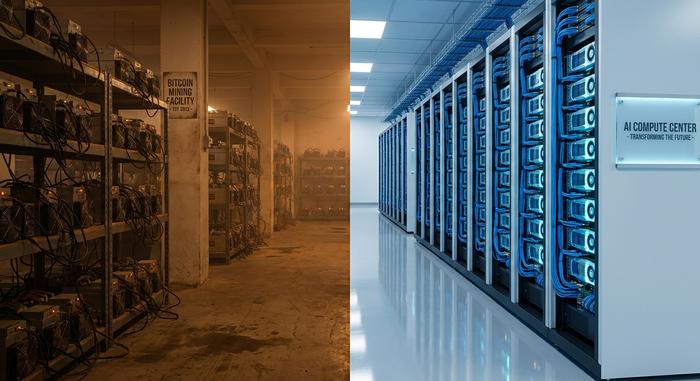
The pivot is the whole story. Applied Digital began by hosting Bitcoin miners, renting space and cheap power to crypto operations. That was a low-margin, cyclical business tied to the price of one volatile asset. Hosting miners meant betting your revenue on Bitcoin's mood, and a single bear market could empty the racks overnight. Then the demand for AI computing arrived, and the company turned the one asset it really owned — the ability to build power-dense data centers fast — toward a far hungrier and far stickier customer.
The reinvention shows up in the contracts. In August 2025, Applied Digital leased its 400-megawatt Polaris Forge 1 campus in Ellendale, North Dakota to the AI cloud computing provider CoreWeave, a deal worth roughly $11 billion over about fifteen years. In April 2026 it signed Delta Forge 1, a 430-megawatt site worth about $7.5 billion over a similar term, to an unnamed investment-grade hyperscaler. Add the rest and the company is sitting on more than $31 billion in contracted backlog, the kind of long-dated revenue a Bitcoin host could only dream about.
The market noticed, and so did one famous name. In September 2024, NVIDIA disclosed a 3.6% stake worth about $63.7 million, and the shares soared on the validation. The halo did not last. By the fourth quarter of 2025 NVIDIA had sold its entire position, around 7.7 million shares, for roughly $177 million. Financing has leaned on others since: Macquarie committed up to $5 billion in preferred equity for the HPC business, with about $787.5 million drawn by November 2025. The transformation from crypto landlord to AI infrastructure is real, expensive, and still unfinished.
| APLD financial snapshot | Figure | As of |
|---|---|---|
| Q3 FY2026 revenue | $126.6M (+139% YoY) | Apr 2026 |
| GAAP net loss (quarter) | $100.9M | Apr 2026 |
| Total debt / cash | $2.7B / $2.1B | Feb 2026 |
| Contracted backlog | $31B+ | Apr 2026 |
| 52-week range | $6.68 to $50.04 | May 2026 |
How APLD compares to top semiconductor stocks
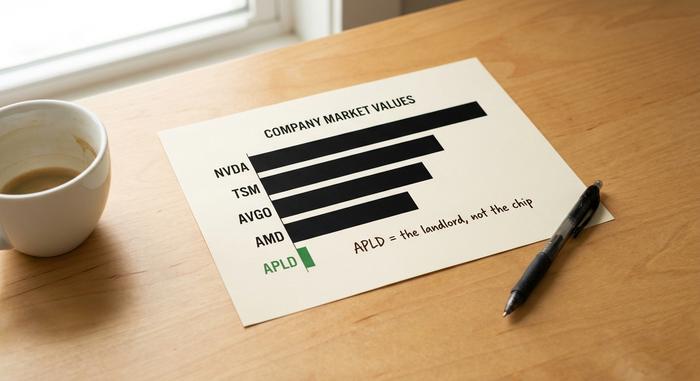
APLD and the chip giants are different species feeding the same boom. The chipmakers sell the shovels; Applied Digital rents the mine. Putting them side by side shows why the stock trades the way it does.
NVIDIA Corporation, ticker NVDA, is the designer whose GPUs define AI computing, a company worth around $5 trillion. Taiwan Semiconductor, TSM, is the foundry that actually prints those chips; Taiwan Semiconductor Manufacturing holds roughly 70% of the global foundry market and depends on EUV lithography machines that only ASML makes. Around them sit fabless designers like Advanced Micro Devices (AMD), Broadcom (AVGO), Qualcomm (QCOM), and Marvell (MRVL), older names like Intel (INTC) and Texas Instruments (TXN), and equipment makers like Lam Research and KLA, the rest of the semiconductor companies that fill most top semiconductor stock lists. They share a few traits APLD does not: they are profitable, several pay a dividend, and they sell into a global supply chain. The global semiconductor industry pulled in about $630 billion in 2024, double its 2012 size on demand from data centers, consumer electronics, and electric vehicles, and is projected to clear $1 trillion by 2035.
There is a dependency worth spelling out, because it cuts both ways. Applied Digital does not escape the semiconductor supply chain; it sits at the end of it. The GPUs (graphics processing units) filling its halls are designed by NVIDIA, sent out for fabrication at Taiwan Semiconductor, and built on EUV machines from a single Dutch supplier. Supply chain disruptions anywhere in that chain, a Taiwan shock, a manufacturing bottleneck, slow the hardware APLD's whole model depends on. The company is insulated from chip-pricing swings, but not from chip scarcity.
Applied Digital is the odd one out, and deliberately so. It is a roughly $14 billion company, it is not profitable, it pays no dividend, and it makes nothing. What it offers is leverage to the same demand without the manufacturing risk that a semiconductor stock carries directly.
| Company | Ticker | What it does | ~Market cap | Profitable? |
|---|---|---|---|---|
| NVIDIA | NVDA | Designs AI GPUs | ~$5T | Yes |
| Taiwan Semiconductor | TSM | Makes the chips | ~$2.2T | Yes |
| AMD | AMD | Designs CPUs/GPUs | ~$300B | Yes |
| Broadcom | AVGO | Chips + software | ~$1.5T | Yes |
| Applied Digital | APLD | Hosts the chips | ~$14B | No |
The bull case: AI data center demand
The bull case for APLD stock is almost embarrassingly simple. Applied Digital has pre-sold its capacity to AI tenants on contracts that run for fifteen years, against a wave of demand for AI compute nobody expects to fade soon. The $31 billion backlog towers over the company's own market value, an unusual gap that bulls read as proof the stock is still early.
The numbers behind it are moving fast. Third-quarter fiscal 2026 revenue came in at $126.6 million, up 139% year over year, against $144 million for the entire prior fiscal year. Adjusted EBITDA turned positive at $44.1 million. Zoom out and the tailwind is enormous: hyperscaler capital spending is projected near $600 billion in 2026, a 36% jump in infrastructure spending on the year, and Goldman Sachs expects AI infrastructure investment to top $500 billion in 2026. In that world, the company that has already signed the data center leases looks less like a gamble and more like a toll booth on artificial intelligence. The appeal of a fifteen-year contract is durability: it does not care whether AI stocks are in or out of favor next quarter, only whether the tenant keeps paying. Compared with a chipmaker exposed to product cycles and price wars, pre-sold infrastructure revenue is, on paper, the steadier line of business. That is the case the buyers are making.
The bear case: debt, dilution and no dividend
This is where I would slow down, because a leveraged construction bet on a single theme has more ways to break than the headline backlog suggests. Three holes stand out.
The first is concentration. CoreWeave accounted for roughly 69% of the original $16 billion backlog, which means Applied Digital's fortunes are lashed to one tenant whose own finances draw plenty of debate. If that customer stumbles, the contracted revenue is only as good as the counterparty behind it.
The second is the money going out the door. The company burned about $720 million in free cash flow in the third quarter of fiscal 2026, up from $251.6 million a year earlier, and carried $2.7 billion in debt against $2.1 billion in cash as of February 2026. It posted a $100.9 million GAAP net loss for the quarter. Building data centers is enormously capital-hungry, and the bill comes due long before the fifteen-year leases pay it back.
The third is dilution. Shares outstanding rose about 28% year over year to 285.4 million, so each existing owner's slice keeps shrinking. And unlike the mature semiconductor names, APLD pays no dividend, so you are paid only if the stock rises. NVIDIA's clean exit in late 2025 removed the most visible vote of confidence.
There is also a structural mismatch hiding in the model. The revenue is locked in for fifteen years, but the debt that funds the construction is not; if interest rates stay high or lenders turn cautious, refinancing $2.7 billion gets more expensive while the lease payments stay fixed. A single large tenant renegotiating, or a delay in bringing a campus online, could turn a backlog headline into a cash crunch. Strip away the story and you own a fifteen-year wager that demand, rates, and counterparties all hold at once.
Should APLD be in a semiconductor ETF portfolio?
Here is a quiet fact that matters: APLD is missing from the big semiconductor funds. The popular semiconductor ETFs, such as SOXX and SMH, hold chip designers and foundries like NVDA, TSM, AVGO, and AMD. They do not hold data-center landlords. So owning the sector through an ETF does not get you this kind of bet at all.
If you want exposure to the picks-and-shovels infrastructure underneath AI rather than the chips themselves, you have to buy it directly. In a portfolio, APLD is a high-beta satellite position, not a core holding, and it sits more naturally alongside AI-infrastructure peers like CoreWeave, IREN, Core Scientific, and Nebius than next to a steady dividend payer. The semiconductor ETFs give you the boom's winners with diversification; a name like APLD gives you concentrated leverage and the volatility that comes with it. Those are different jobs, and confusing them is how portfolios get hurt. It is also why index investors tend to miss companies like this entirely: the funds rebalance toward the largest, most profitable chip names, and a loss-making infrastructure builder simply never qualifies until it is far bigger. If you want it, you have to go and get it on purpose.
Investing in semiconductor stocks and APLD
The mechanics are trivial. Any US brokerage lists APLD by its ticker, and most allow fractional shares, so a small position costs almost nothing to open. If you want the broad sector instead, you can buy individual chip names like NVDA or AMD, or a single semiconductor ETF that bundles them.
The only real decision is size. Because APLD swings hard, the sane approach to investing in semiconductor stocks and their infrastructure cousins is to size the volatile names small and decide your exit before you buy. A position you can hold through a 40% drawdown is a position; one that keeps you up at night is a mistake.
Is APLD stock a good buy in 2026?
For the right investor, APLD is a high-conviction, high-risk way to bet on AI infrastructure, best suited to someone who already owns the chip names and wants leverage to the same demand. For anyone who needs stability or income, it is the wrong stock. Eleven analysts rate it a Strong Buy with an average target near $63.77, but analyst enthusiasm is not a floor, and a $720 million quarterly cash burn is not a detail. So the question is not whether AI demand is real. It plainly is. The question is whether this balance sheet survives long enough to collect on a fifteen-year promise. Decide that before you decide the stock.



