UAE Crypto Tax in 2026: Is Dubai Really Tax-Free?

Picture two people on the same floor of a Dubai tower. One trades Bitcoin from a laptop all day and, at the end of the year, owes the government nothing. The other runs a small crypto brokerage two doors down and hands over 9% of its profit. Same building, same coins, very different tax bills.
That gap is what UAE crypto tax is really about. The headline everyone repeats, that the United Arab Emirates is tax-free for crypto, is true for most individual investors. But it has a hard edge, and the moment your activity crosses from personal investing into something that looks like a business, the picture changes. This guide walks through where the 0% actually holds, where it quietly turns into 9%, how VAT now works after a 2024 reform, what residency really requires, and why "tax-free" will not stay invisible for much longer.
How the UAE taxes crypto for individuals
For a private investor, the simple version is the correct one. The UAE has no personal income tax. None. There is no federal tax on salaries, and there is no separate capital gains tax sitting on top of it. So when an individual buys, holds, and later sells crypto, the profit is theirs to keep. The Federal Tax Authority's guidance on natural persons, published in November 2023, treats gains on a digital asset held as a personal investment as personal investment income, which sits outside the corporate tax net entirely.
This is not a loophole someone found in the fine print. It is the default. A resident who turned 1 Bitcoin into ten over three years pays the same crypto tax on that gain as they would on a winning stock trade: zero.
Which crypto activities stay tax-free
The 0% covers more than buying low and selling high. For an individual treating crypto as a personal holding, none of the usual events trigger a tax bill:
- Selling crypto for dirhams or dollars
- Swapping one token for another
- Spending crypto on goods and services
- Earning rewards when you stake a proof-of-stake coin
- Receiving an airdrop or minting and flipping an NFT
In most high-tax countries, several of those are taxable moments. In the UAE, for a genuine personal investor, they are not. There is no taxable event to report because there is no tax to apply.
The 183-day residency test that unlocks 0%
Here is the part people skip. The 0% belongs to UAE tax residents, not to anyone who books a week at a Dubai hotel. Cabinet Decision No. 85 of 2022, in force since 1 March 2023, sets the test. You are a tax resident if you spend 183 days or more in the country in a 12-month period. There is also a 90-day route for those who hold a residence permit and keep a permanent home or a business in the UAE. Spend a fortnight there and keep your old tax home, and your old country still has a claim on your gains. Residency is the price of admission.
Where 0% becomes 9%: corporate tax on crypto
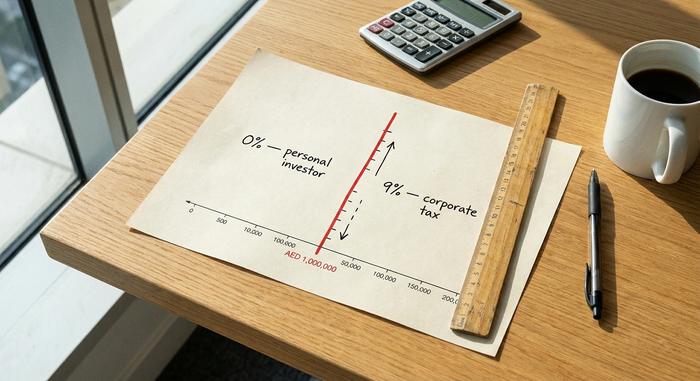
Now the edge. The UAE introduced a federal corporate tax through Federal Decree-Law No. 47 of 2022, effective for financial years starting on or after 1 June 2023. The rate is 9% on profit above AED 375,000, modest by global standards but no longer zero. The question that decides your bill is whether your crypto activity counts as a business.
For most individuals it does not. The FTA's natural-person rules say a private individual only falls into corporate tax if their business turnover exceeds AED 1 million in a calendar year, and personal investment income is explicitly carved out even then. Buy and hold Ethereum in your own wallet and you are an investor. The trouble starts when the activity starts to look like a trade you run for a living.
The AED 1 million line for individual traders
This is the single most under-explained risk in UAE crypto tax, and most guides wave it away. The AED 1 million figure is a turnover threshold, not a gains threshold — it looks at how much business you do, not how much you net. And the FTA has not published a bright-line test for when frequent trading becomes a "business activity." How many trades is too many? What size of operation tips a hobby into a profession? The law does not say, and I would not trust anyone who quotes you a precise number.
For a passive holder, none of this bites. For a high-frequency trader running size from a desk in Dubai, it is a real grey zone, and the burden of showing the activity was personal investment rather than a business sits with the taxpayer. If you are trading at that scale, this is the question to take to a UAE tax adviser before, not after, the year closes.
Free zones vs mainland: the conditional 0%
Crypto companies, not just traders, also get sold a 0% story, and it is only half true. Firms set up in free zones such as the DMCC Crypto Centre, ADGM, or DIFC can qualify for a 0% corporate tax rate, but only on what the law calls Qualifying Income. Income that falls outside those rules is taxed at the standard 9%. The 0% free-zone rate is conditional and has to be earned by meeting substance and activity requirements; it is not a switch that flips the moment you register a company. Plenty of write-ups imply otherwise, and that is how founders get an unpleasant surprise at their first filing.
To put the whole picture in one place, here is who pays what:
| Who you are | Crypto activity | UAE tax |
|---|---|---|
| Individual investor (resident) | Buy, hold, sell, swap, stake | 0% |
| Individual investor | Spending crypto on goods and services | 0% |
| High-volume trader | Activity judged a business (turnover over AED 1M) | 9% corporate tax |
| Crypto company, mainland | Profit above AED 375,000 | 9% corporate tax |
| Crypto company, free zone | Qualifying Income | 0% |
| Crypto company, free zone | Income outside the qualifying rules | 9% corporate tax |
| Any business | Custody, brokerage, or management fees | 5% VAT |
The pattern is consistent: passive personal investing sits at zero, and tax shows up only when crypto becomes a business or a paid service.
VAT on crypto transactions in the UAE
VAT is the one area of UAE crypto tax that shifted most dramatically in 2024, and almost nobody cites the actual instrument that changed it. Through Cabinet Decision No. 100 of 2024, effective 15 November 2024, the UAE exempted the transfer and conversion of virtual assets from value-added tax. The striking detail is that the exemption was applied retroactively to 1 January 2018 — so years of crypto transfers and conversions were brought under the exemption after the fact.
That does not make every crypto-related cost VAT-free. The exemption covers moving and converting the assets themselves. Fee-based services around them, such as custody, brokerage, and management, generally remain taxable at the standard 5% VAT rate, as the FTA spelled out in its public clarification VATP040. So a swap between two tokens carries no VAT, but the platform charging you a custody fee for holding them does. The split matters for any business doing cryptocurrency transactions at volume, because the VAT treatment of the service and of the asset are now two different things.
Who regulates crypto in Dubai and the UAE
Low tax is not the same as light rules, and 2025 made that obvious. Crypto in Dubai falls primarily under VARA, the Virtual Assets Regulatory Authority. At the federal level the Securities and Commodities Authority (SCA) sets the national framework, while Abu Dhabi's ADGM regulates through the FSRA, and the DMCC hosts one of the region's largest clusters of licensed firms.
The framework tightened quickly. In August 2025 the SCA and VARA moved to a unified licensing approach so a firm authorised by VARA can passport across the country. Federal Decree-Law No. 6 of 2025 extended the Central Bank's oversight to stablecoins and parts of DeFi, effective September 2025 with a transition window running to September 2026. Licences are not cheap either: VARA's published fees run from roughly AED 40,000 to AED 100,000 per activity, with annual supervision fees of AED 80,000 to AED 200,000. Tax-free, heavily licensed.

Moving to Dubai as a crypto investor
If the plan is to move to Dubai for the 0%, the first thing to understand about UAE crypto tax is that the math is about residency, not vibes. The gains only become yours once you are a UAE tax resident, and that means actually living there or running a genuine business or home in the country. The 10-year Golden Visa is the usual long-term route, typically reached through AED 2 million in property or a qualifying investment. There is no standalone "crypto wealth" visa — large holders qualify through the general investment and property routes, or by setting up a free-zone company.
Then there is the cost of living and the paperwork: a tax residency certificate from the FTA is what you show your former tax authority to prove the move is real. For someone sitting on a large unrealised gain in a high-tax country, the savings can dwarf the relocation cost. For someone with a modest portfolio, the visa fees, rent, and company setup can eat the benefit. Run the numbers before you book the flight.
Tax implications: why tax-free is not invisible
Here is the part the relocation blogs leave out. Zero tax does not mean zero reporting, and the walls are going up. The UAE has aligned with the OECD's Crypto-Asset Reporting Framework (CARF), the global standard for the automatic exchange of crypto-asset information between tax authorities. Under CARF, the first exchanges of data are scheduled to begin around 2027, with reporting obligations ramping through 2028.
What that means in practice: your home country may soon receive information on your crypto-asset activity in the UAE automatically, the same way bank data already moves across borders. Exchanges already run KYC, so the identity layer exists; CARF connects it to tax authorities. The UAE is not a small player being dragged along, either. Chainalysis put UAE crypto transaction value at roughly $56 billion across 2024–2025, up about 33% year on year, second in the MENA region, and ownership surveys from Triple-A place adoption somewhere between 25% and 31% of residents. A market that size does not stay off the radar. Tax-free, yes. Untraceable, not for much longer.
UAE crypto tax vs the US, EU and India
The contrast is the whole reason people move. A quick comparison of how individual crypto gains are treated:
| Jurisdiction | Personal crypto gains | Headline rate |
|---|---|---|
| UAE | No capital gains tax | 0% |
| United States | Taxed as capital gains | up to 37% (short-term) |
| Germany | Tax-free if held over 1 year | 0% after 12 months |
| India | Flat tax on gains + 1% TDS | 30% + 1% |
For a US citizen the table comes with an asterisk, which the next section covers. But the gap between 0% and 30–37% explains why "UAE crypto tax" is one of the most searched relocation questions in the space.
How to calculate and report your crypto taxes
For an individual investor, there is almost nothing to calculate. With no personal income tax and no capital gains tax, there is no crypto tax return to file and no annual reckoning of gains. The work is record-keeping, not filing: keep a clear history of your transactions to prove residency and satisfy exchange KYC and anti-money-laundering checks.
Businesses are a different story. A crypto company owes real compliance: corporate tax filings after the financial year ends, quarterly VAT returns where it applies, and proper books that value assets at fair market value. The lighter your activity, the lighter the paperwork. The line, again, is whether you are investing or operating.
The bottom line on UAE crypto tax
The 0% is real, but it is conditional. It rewards genuine residents and patient investors, and it quietly withdraws from anyone who turns trading into a business or a company that earns outside the free-zone rules. UAE crypto tax is not one fixed rule — it is a set of conditions, and the conditions are getting more visible every year. The interesting question is no longer whether the UAE taxes crypto, since for most people it does not, but how long "no tax" and "no reporting" stay in the same sentence. With CARF data starting to move in 2027, the answer is probably: not very. If you are planning around Dubai's 0%, plan around the residency test and the reporting that is coming, not just the headline. Which side of that tower floor are you really on?