Crypto Tax-Free Countries
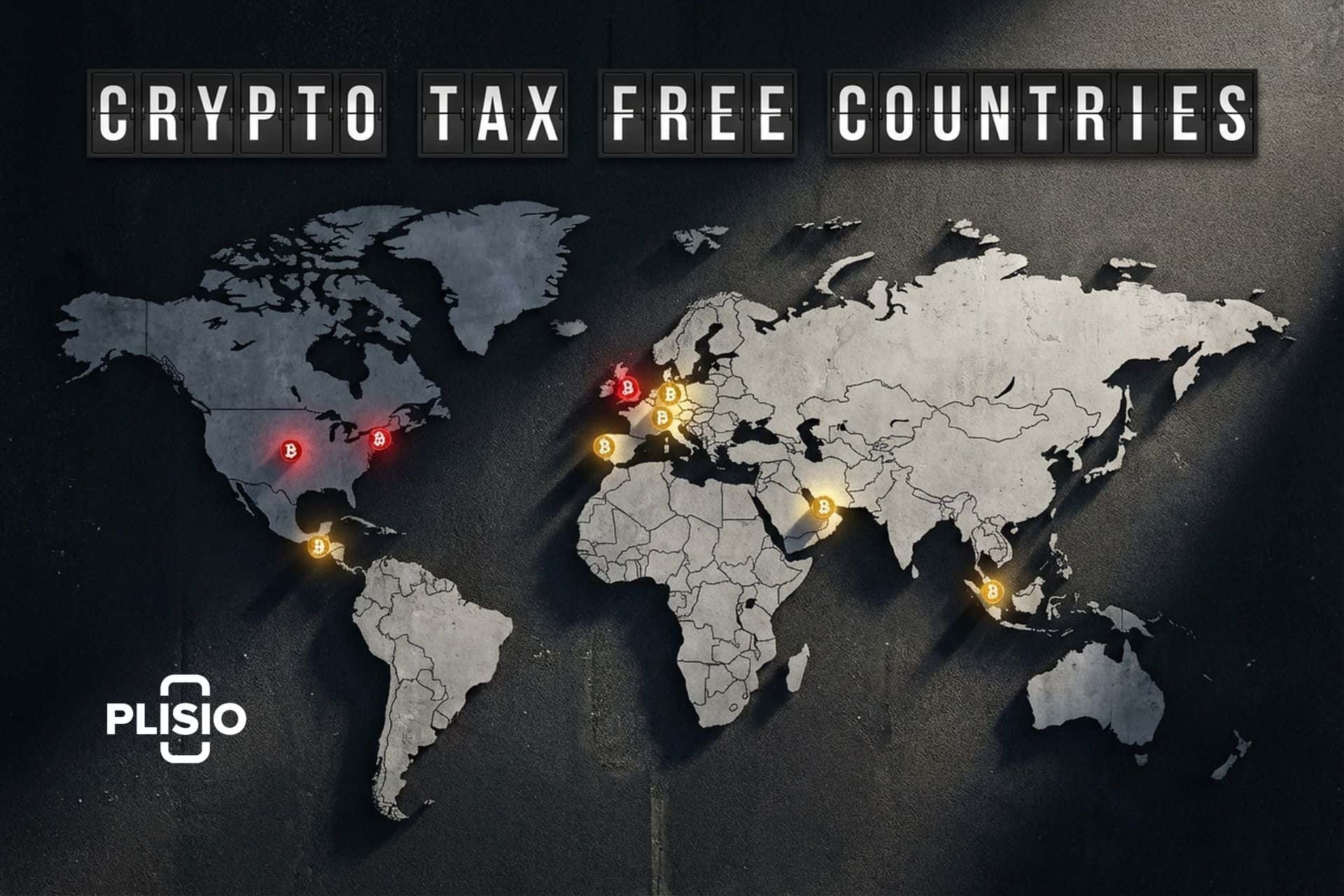
I sold some ETH in the U.S. last year and lost nearly a third of the profit to federal and state capital gains tax. That's the moment I started paying attention to how other countries handle crypto. Turns out, a lot of them don't tax it at all. Some charge zero capital gains tax on crypto. Others exempt long-term holders. A few have no income tax period. The differences are massive and they have real consequences for anyone holding a serious crypto portfolio.
This isn't a guide for tax evasion. Moving your life to another country to legally pay less tax is a well-established practice that corporations and wealthy individuals have used for decades. Crypto just makes the math more dramatic because the gains can be so large and the tax rates so punishing in places like the U.S. (up to 37% for short-term) or some EU countries.
Here's a breakdown of the best crypto tax free countries in 2026, what the actual rules are, and the catches that most lists don't mention.
UAE: the zero-tax heavyweight
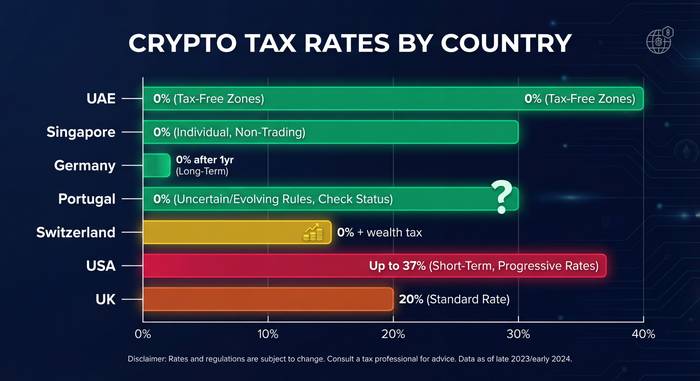
The United Arab Emirates charges zero personal income tax and zero capital gains tax on crypto. Trading, staking, mining, selling, none of it is taxed for individuals across all seven emirates including Dubai and Abu Dhabi.
This is why so many crypto companies and wealthy traders have relocated to Dubai over the past few years. Free zones like DMCC and DAFZA offer 100% foreign ownership, zero customs duties, and dedicated crypto regulatory frameworks. The UAE has become the de facto hub for crypto businesses that want to operate without a tax burden on their investors.
The catch? Cost of living is high, especially in Dubai. Housing, schooling, and lifestyle expenses eat into the savings. And you need to actually live there. Getting a tax residency certificate requires physical presence, a local address, and real ties to the country. Flying in once a year and claiming UAE residency won't hold up under scrutiny.
El Salvador: Bitcoin's legal tender experiment
El Salvador became the first country to adopt Bitcoin as legal tender in September 2021. In 2023, they went further: zero income tax, zero capital gains tax, and zero property tax on anything classified as "technological innovation," which includes cryptocurrency.
For foreign crypto investors, El Salvador offers a straightforward deal. No tax on your crypto gains. Period. The government has doubled down on the Bitcoin bet, building a national BTC reserve and pushing adoption across the economy.
The reality on the ground is more complicated. Infrastructure outside San Salvador is limited. Banking can be difficult. The country has a complicated security history. And the regulatory framework is still evolving. If you're considering it purely for tax purposes, the savings are real, but the lifestyle trade-offs are significant.

Singapore: the clean option
Singapore has no capital gains tax. Full stop. When you sell, trade, or spend your crypto as an individual investor, you don't pay capital gains tax on the profit. This applies to all crypto assets. The government also exempted digital payment tokens from GST in 2020 to encourage adoption.
The exception: if you're trading crypto as a business or if the tax authority classifies your activity as professional trading, your profits get taxed as income. Singapore's corporate income tax rate is 17%, which is low by global standards but not zero.
Singapore is expensive to live in. Really expensive. But it's clean, safe, well-regulated, and has a thriving blockchain scene. Ethereum was partly developed here. The Monetary Authority of Singapore has been proactive about creating clear rules without killing innovation. For crypto businesses and high-net-worth individuals, it's probably the most "legitimate" feeling option on this list.
Germany: hold for a year, pay nothing
Germany doesn't tax crypto as a capital asset. It classifies bitcoin and other cryptocurrencies as "private money." If you hold your crypto for more than one year and then sell, trade, or spend it, you owe zero tax on the gains. Nothing. No matter how much you made.
Short-term gains (under one year) are a different story. They're taxed as regular income, which in Germany can run up to 45% plus solidarity surcharge. But the one-year exemption is remarkably generous by European standards.
There's also a small bonus: crypto gains under 600 euros per year are tax-free regardless of holding period. And if you've held for ten years, there's an additional layer of exemption that covers even lending and staking income.
Germany's cost of living is moderate for Western Europe. Berlin in particular has a large crypto and startup community. The tax rules are clear and well-established. For someone willing to adopt a hold strategy, it's one of the best places in the world to own crypto.
| Country | Capital gains tax on crypto | Income tax on crypto | Key condition |
|---|---|---|---|
| UAE | 0% | 0% | Must establish residency |
| El Salvador | 0% | 0% | Applies to "tech innovation" |
| Singapore | 0% (individuals) | 17% (if business) | Personal investing only |
| Germany | 0% (after 1 year hold) | Up to 45% (short-term) | Must hold 12+ months |
| Portugal | 0% (individuals) | 0% | Possible 28% tax incoming |
| Switzerland | 0% (individuals) | Wealth tax 0.1-1% | Assets declared annually |
| Hong Kong | 0% | 0% (personal investment) | Territorial tax system |
| Georgia | 0% | 0% | Stable policy since 2023 |
| Malta | 0% (long-term) | 0-35% (short-term) | Long vs short-term matters |
| Czechia | 0% (after 3 years) | 0% under CZK 100K/yr | New rules from Jan 2025 |
Portugal: the question mark
Portugal has been a favorite destination for crypto nomads for years. No capital gains tax on crypto. No income tax on trading profits. Individual crypto transactions exempt from VAT.
But there's been a cloud hanging over it. A 2023 draft budget proposed a 28% flat tax on short-term crypto gains. That proposal has been debated and delayed, but it hasn't fully disappeared. As of early 2026, the zero-tax status for individuals still holds, but the regulatory direction suggests that Portugal's crypto tax paradise may have an expiration date.
If you're thinking about Portugal, the current rules are great. Lisbon has a booming tech scene. Cost of living is reasonable for Western Europe. The weather is excellent. But plan with the understanding that the tax situation could change.
Switzerland: Crypto Valley with a wealth tax
Switzerland doesn't charge capital gains tax on crypto for individual investors. They treat crypto like movable property, similar to stocks. Buy, hold, sell at a profit? No tax.
But Switzerland has a wealth tax. Every canton taxes the total value of your assets annually, including crypto holdings. Rates vary by canton but typically fall between 0.1% and 1%. On a $5 million crypto portfolio, that's $5,000-50,000 per year even if you don't sell anything. Also, mining income is classified as self-employment and taxed accordingly.
The canton of Zug, known as "Crypto Valley," has deliberately built itself into a blockchain ecosystem. Ethereum's foundation is based there. Multiple major crypto companies operate from Zug and nearby Zurich. The city of Lugano accepts tax payments in cryptocurrency.
Switzerland is expensive. Very expensive. But the regulatory clarity, political stability, and crypto-specific infrastructure are hard to beat.
Hong Kong: the territorial approach
Hong Kong doesn't have a capital gains tax at all, and its territorial tax system means profits from crypto held as a personal investment are generally not taxable. If you're not running a crypto business from Hong Kong, your trading profits are likely exempt.
The city has been actively courting crypto businesses since 2023, issuing exchange licenses and creating regulatory frameworks. Living costs are extremely high, but the financial infrastructure and access to Asian markets make it attractive for institutional crypto operations.
Georgia: the quiet contender
Georgia doesn't get the attention Dubai or Singapore get, but its crypto tax policy is remarkably simple: individuals pay zero tax on crypto gains. The policy has been stable since 2023 and is aimed specifically at attracting IT and blockchain innovation.
Tbilisi has a growing tech community. Cost of living is low by any standard. The regulatory environment is straightforward. For someone who wants tax-free crypto without the Dubai price tag, Georgia deserves a serious look.
Czechia: the newest entry
New rules took effect in January 2025. Crypto gains are exempt from personal income tax after a three-year holding period. Transactions below CZK 100,000 (roughly $4,200) per year are also exempt regardless of holding period.
Prague has a vibrant tech scene and crypto adoption is relatively high. Cost of living sits between Western and Eastern European levels. The three-year hold requirement is longer than Germany's one year, but the exemption is clean and the rules are clear.
The big warning: CARF is coming
Here's something most "crypto tax haven" articles skip. The OECD's Crypto-Asset Reporting Framework (CARF) is rolling out across the EU and partner countries starting in 2026. This means crypto exchanges will automatically report your trading activity to tax authorities across participating countries.
If you're a tax resident of one country but trading on an exchange in another, that data will be shared. Moving to a zero-tax jurisdiction only works if you genuinely change your tax residency. Maintaining a fake address in Dubai while actually living in London isn't going to work once CARF data sharing kicks in.
This framework is the crypto equivalent of FATCA for banks. It will significantly reduce the ability to use offshore exchanges to avoid domestic tax obligations. The countries listed in this article are legitimate low-tax or zero-tax jurisdictions for actual residents. They're not backdoors for people who want to avoid taxes without actually relocating.