Dogecoin Upgrade 2026 : The Real DOGE Roadmap and ETFs
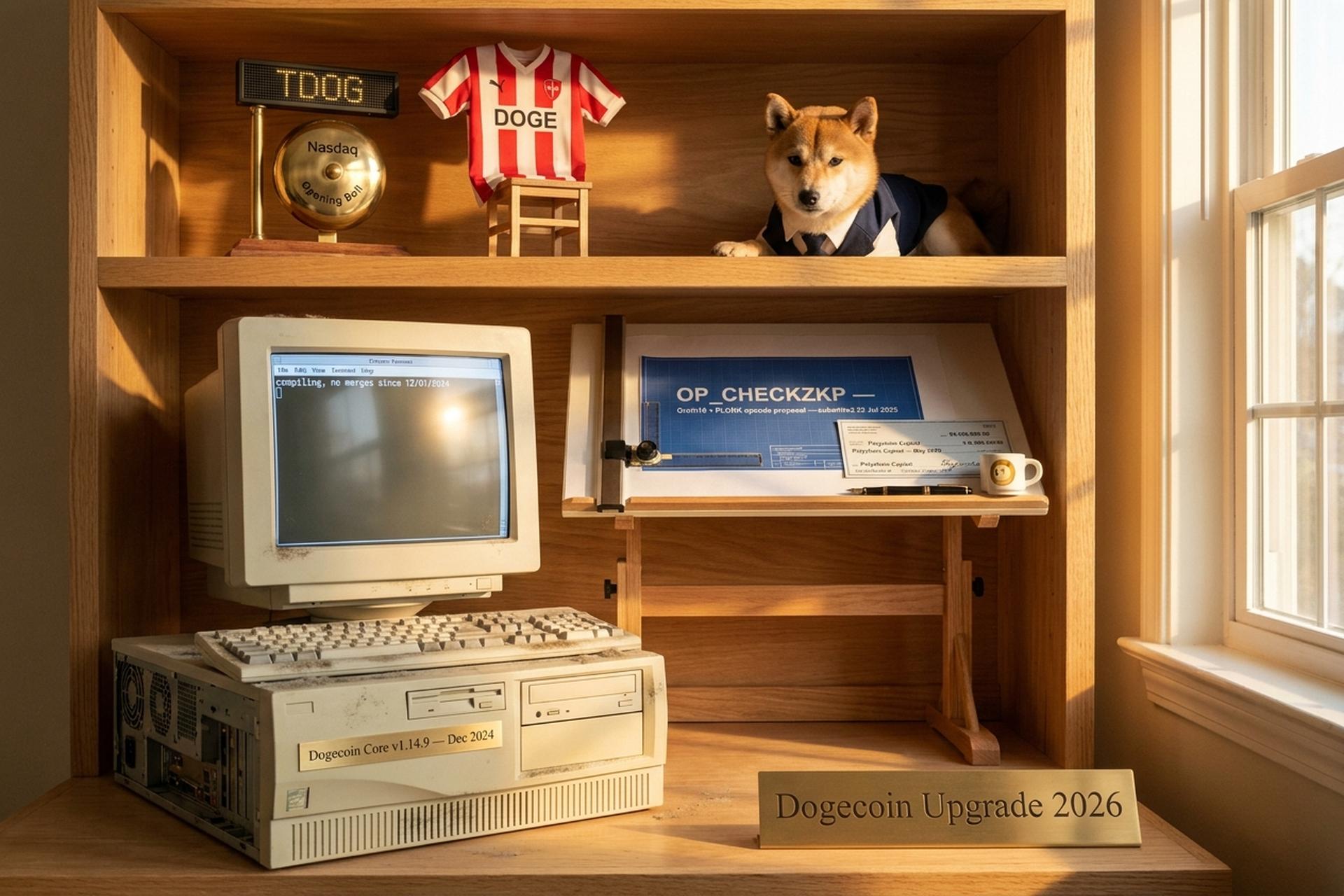
On December 12, 2024, an attacker named Andreas Kohl crashed roughly 69 percent of Dogecoin's reachable nodes in a few hours. The exploit, nicknamed DogeReaper, did not require new cryptography or a chain split. It worked because 87 percent of node operators had not yet applied the patch in Dogecoin Core v1.14.9, released only ten days earlier. That single afternoon is the truest picture of where Dogecoin's protocol layer sat heading into 2026: the fix existed, the people running the network had not installed it.
The "Dogecoin upgrade 2026" search trend lumps together three very different stories. There is the actual on-chain protocol layer, where Core v1.14.9 from December 2024 is still the latest release as of May 2026 and no formal Core upgrade has shipped this year. There is an outside development shop, DogeOS, run by the MyDoge wallet team, pushing the most consequential technical proposal Dogecoin has seen in years. And there is a Wall-Street-facing ecosystem rally — TDOG and DOJE ETFs, House of Doge listing on Nasdaq, a Serie B football jersey deal, an X Money launch — that is loud, real, and easy to mistake for protocol progress.
The pages below walk through what is shipping, what is proposed, and what is purely brand momentum, with named sources for every claim.
Dogecoin in 2026: where the protocol actually stands
Dogecoin Core v1.14.9 shipped on December 1, 2024. It is still the latest release. The version inherited Bitcoin and Namecoin bug fixes, updated the Berkeley DB to 5.3 and OpenSSL to 1.0.2u, added a `-rpcnamecoinapi` flag for Namecoin auxiliary proof of work, and most importantly included the patch for the bug that the DogeReaper attack would exploit a week and a half later. Tobias Ruck disclosed the vulnerability privately; Andreas Kohl, working with Sequentia, demonstrated it in the wild, dropping 437 of about 647 reachable nodes in real time.
The lesson the network drew from that incident was not technical, it was operational. Core had been patched. Operators had not patched their nodes. As of May 2026 there has been no v1.15 line; the dogecoin/dogecoin GitHub repository continues to ship maintenance work without a major release. For a chain that frequently appears in lists of the world's largest cryptocurrencies, that pace is unusual. Bitcoin Core typically issues two to four point releases a year. Litecoin, Dogecoin's merge-mining partner, shipped 0.21.4 in 2024. Dogecoin Core's gap is now seventeen months and counting.
Network statistics in May 2026 do not look like a chain in trouble. The dogecoin network hashrate sits in the 2-to-4 petahash range, tracking Litecoin almost one-for-one because roughly 91 percent of Litecoin's hashrate also merge-mines DOGE. The dogecoin and litecoin pairing is fully peer-to-peer at the consensus layer. CoinGecko shows the trading price near $0.12, market cap close to $16.97 billion, rank ten in the broader crypto market. The dogecoin network processes about a million transactions a day across four-to-five million monthly active addresses. The network is alive. The protocol layer, separately, is quiet.

DogeOS, OP_CHECKZKP, and Doge smart contracts
The most consequential technical move of 2025 came from outside the Foundation. On July 22, 2025, DogeOS, the development team behind the MyDoge wallet, formally submitted a soft-fork opcode proposal called `OP_CHECKZKP` to the Dogecoin developer mailing list. The opcode would let Dogecoin verify Groth16 and PLONK zero-knowledge proofs natively, in script, without changing the chain's existing security model. The proposal reuses `OP_NOP10`, an opcode reserved for exactly this kind of upgrade path, which keeps it backwards-compatible: nodes that do not understand it would still treat the transaction as valid.
The funding behind it is real. In May 2025, DogeOS raised $6.9 million in a round led by Polychain Capital. By the team's August 2025 "State of Doge" report, a DogeOS devnet was live on Ankr's RPC infrastructure, with more than 100 projects in some stage of development. Tim Stebbing, a Director of the Dogecoin Foundation, publicly endorsed the work, which matters because the Foundation has historically been cautious about anything that risks reframing Dogecoin as a smart contracts platform.
What `OP_CHECKZKP` would unlock is a different chain in practice. Dogecoin today does payments and not much else: a dogecoin payments rail, a meme coin token used for tipping on social platforms, and not much DeFi. With native ZK verification, rollup-style applications and a layer 2 ecosystem could post compressed state to Dogecoin while inheriting its hashrate as security, the way Bitcoin's BitVM and Citrea projects aim to do. DogeOS frames this as a path to scaling and programmability without changing the base layer's monetary properties or the meme branding that drove early adoption.
The hard caveat is that none of this is merged. As of the most recent commit history visible on dogecoin/dogecoin in May 2026, the proposal lives in discussion, not in master. Soft forks need miner signaling, node-operator buy-in, and conservative review. Given the DogeReaper episode, the bar for any consensus change in the network's mind has gone up, not down. The honest 2026 status is "real proposal, real funding, no block-height activation."
| Item | Date | Status | Source |
|---|---|---|---|
| Dogecoin Core v1.14.9 | 2024-12-01 | Shipped (latest) | github.com/dogecoin/dogecoin |
| DogeReaper exploit / patch verified | 2024-12-12 | Network impact, fix confirmed | The Blockchain |
| DogeOS `OP_CHECKZKP` proposal | 2025-07-22 | Submitted, discussion only | The Block / DogeOS |
| Issue #3776 block-reward cut | open | Discussion only | github.com/dogecoin/dogecoin |
| Project Sakura hybrid consensus R&D | 2025-2026 | Research | Foundation / Bitdeer |
| Libdogecoin 0.1.3 | 2024 | Step 1 marked complete | Foundation blog |
Dogecoin ETFs in 2026: DOJE, TDOG, and what they actually buy
Of the three buckets in this article, the ETF story is the one that most resembles a true 2026 upgrade for the typical investor, even though it changes nothing at the protocol level. As of May 2026 there are two live U.S. spot-Dogecoin products and they are structured very differently.
REX-Osprey DOJE listed on Cboe BZX on September 18, 2025 with a 1.50 percent expense ratio. It uses a 1940 Act structure with a Cayman subsidiary that holds derivatives rather than DOGE itself, which is how it cleared the SEC under the new rule changes that opened single-asset spot crypto products. Day-one inflows were about $17 million. Eight months later, AUM stood at $17.82 million, essentially flat after a brutal first quarter; net asset value was down 55.58 percent from inception to December 31, 2025.
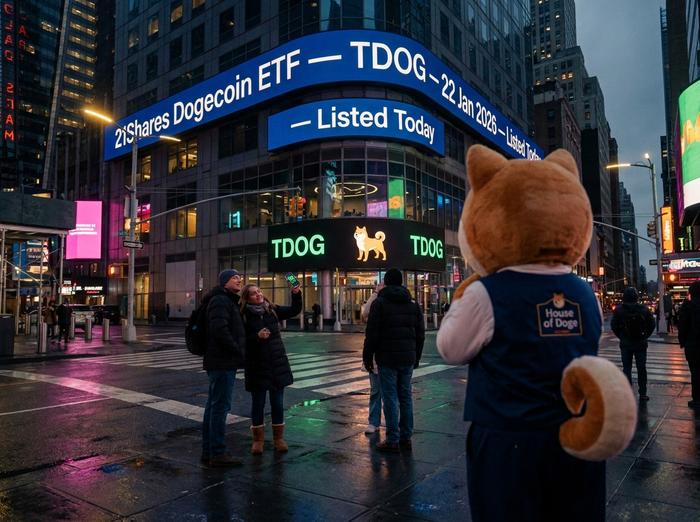
21Shares TDOG is the cleaner product. It launched on the Nasdaq on January 22, 2026, is physically backed one-for-one by DOGE held in cold storage, charges a 0.50 percent fee, and is the only Dogecoin ETF endorsed by the Dogecoin Foundation. House of Doge and 21Shares rang the Nasdaq opening bell together on March 4, 2026, the kind of event that would have read as parody in 2021.
| ETF | Listed | Structure | Fee | AUM (May 2026) | Foundation-endorsed |
|---|---|---|---|---|---|
| REX-Osprey DOJE | 2025-09-18 (Cboe BZX) | 1940 Act + Cayman subsidiary, derivatives | 1.50% | $17.82M | No |
| 21Shares TDOG | 2026-01-22 (Nasdaq) | Physically backed 1:1 | 0.50% | Not pinned | Yes |
The legal anchor under both products is the joint SEC and CFTC framework from March 2026 that classified Dogecoin as a digital commodity, the same status XRP received earlier. The classification places DOGE alongside other digital assets cleared for spot ETF wrappers and away from the unregistered-security framing that governed crypto enforcement before 2024. That single decision, more than any of the marketing around the listings, is why TDOG and DOJE exist at all and why other filers, including Bitwise and Grayscale, queued S-1 paths through 2025. The Foundation's TDOG endorsement is a rare on-the-record statement; most ETFs ship without that kind of endorsement.
A second-order point worth flagging: a physically backed ETF is, in a strict sense, a kind of upgrade to Dogecoin's role in capital markets. It pulls supply off exchanges into custody, it gives traditional advisers a CUSIP they can buy, and it ties some part of price discovery to a regulated wrapper. It does not, however, change a single line in Dogecoin Core.
Foundation Trailmap: Libdogecoin and real-world tooling
Inside the Dogecoin Foundation itself, the Trailmap is the formal roadmap, and it has continued shipping in small increments. Libdogecoin is the headline item: a portable C library that lets non-protocol engineers build wallets and integrations without running a full node. Version 0.1.3 added Android bindings and the Foundation now marks Step 1 of the Libdogecoin program complete. Average confirmation targets sit around forty seconds in test integrations.
GigaWallet, the merchant-facing API service, launched a WooCommerce plugin in 2023 and had a Shopify connector on the 2024 roadmap, though that integration has slipped. RadioDoge, the long-shot project that lets Dogecoin transactions move over LoRa radio and Starlink relays in regions without reliable internet, has run pilot trials in emerging markets with the help of partners such as the GeckoDOS team. None of these are headline-grabbing, and that is the point. They are the slow real-world plumbing that was always meant to outlast price cycles.
Project Sakura, the Foundation's R&D track on hybrid consensus models, is the item that gets confused with full PoS migration. It is research, not a release, and the next section explains why that distinction matters.
PoS rumor vs reality: Scrypt miners and Project Sakura
In early 2026, social media surfaced a recurring claim that Dogecoin was about to drop proof of work and migrate to proof of stake. It is not. The claim conflates three separate facts.
First, Vitalik Buterin has been an advisor to the Dogecoin Foundation since 2021. In that capacity he has proposed a "Community Staking" mechanism for governance participation and reward distribution, modelled loosely on early Ethereum staking patterns, that would sit alongside mining rather than replace it. Second, Project Sakura is researching hybrid consensus designs, not a full PoW-to-PoS substitution. Third, Dogecoin's mining operates as auxiliary proof of work merge-mined with Litecoin: about 91 percent of Litecoin's hashrate also secures DOGE, which is part of why the combined network is one of the strongest Scrypt-secured blockchains in existence. SEALMINER DL1 hardware is currently the most efficient Scrypt rig at around 149 joules per gigahash.
Replacing that hashrate base unilaterally would be a hostile move against Litecoin miners, who would have no economic reason to keep merge-mining a chain that no longer pays them. The Foundation has been clear that any consensus change would involve a long hybrid period, not an overnight cutover. The honest read of 2026 is that Scrypt-Auxiliary PoW is the consensus mechanism, with research toward optional staking layers above it.
Block reward, miner economics, and Issue 3776
Dogecoin's monetary policy is the structural fact that explains most of its trading character. Since block 600,000, the block reward has been fixed at 10,000 DOGE. The chain produces blocks every 60 seconds, which means about 14.4 million new DOGE come into circulation each day, or roughly 5.256 billion per year. There is no halving and no maximum supply. Circulating supply in May 2026 sits around 150 billion DOGE.
This is, by design, mildly inflationary. Founder Jackson Palmer's original argument was that a small fixed inflation incentivized actual use over hoarding and kept the security budget solvent without depending on fee markets. In 2026, annual issuance — roughly 5 billion new coins, or about 5 billion DOGE per year — is worth around $600 million at current prices, which is what miners are incentivized to secure the network with. The chart of dogecoin's circulating supply has therefore been a clean upward line since 2015, untouched by the halvings that decentralize Bitcoin's issuance.
The argument against the policy resurfaces every time DOGE rallies. GitHub Issue #3776, currently open in the dogecoin/dogecoin repository, proposes cutting the block reward to 1,000 DOGE — about 526 million per year — to tighten supply and give the asset a more deflationary character. The proposal has not been merged and there is no formal client implementation. It is a discussion thread, not a roadmap item. Honest commentary should treat it as such.
If the DogeOS `OP_CHECKZKP` route advances, miner economics could change in a different way. ZK-rollup applications would post compressed transactions to the base chain, generating fee revenue without altering issuance. That is a more conservative path to fee-funded security than the route Bitcoin maximalists assume Dogecoin must take.
House of Doge rally: Nasdaq, Triestina, X Money
The loudest 2026 signals come from outside the protocol. House of Doge, the corporate arm of the Dogecoin Foundation, agreed in October 2025 to list on the Nasdaq through a reverse merger with Brag House Holdings, a transaction expected to close in the first half of 2026 and creating a publicly traded DOGE-treasury company. On October 30, 2025, House of Doge announced that DOGE would appear on the U.S. Triestina Calcio 1918 jerseys and stadium signage for the 2025/26 and 2026/27 Serie B seasons, the first time a cryptocurrency had taken on a major-owner role at a professional European football club.
January 2026 added two more deals. A tripartite agreement on January 8 set up Japan-based real-world-asset initiatives tied to DOGE, and on January 20, House of Doge and Brag House announced "Such," a payments app targeted for first-half 2026 launch. Robinhood is the named custody partner.
Then there is X Money. Elon Musk announced on March 11, 2026 that the platform's payments product would launch in April. It launched fiat-only, on Visa rails, in more than 40 U.S. states. Musk re-shared third-party forecasts that hinted at future "crypto integration," but no DOGE settlement is live in the product as of May 2026. As a brand catalyst, the X Money launch is enormous; as a Dogecoin upgrade, it is a placeholder.
A short disambiguation note. The Trump administration's "Department of Government Efficiency" shares the DOGE acronym but is unrelated to the cryptocurrency. Social media sentiment around the policy story still drives short bursts of new doge buying, but neither political tweets nor Elon Musk's social posts change anything in the dogecoin core repository.
DOGE price action May 2026: analyst targets
As of early May 2026, DOGE trades near $0.1131. Market cap is around $16.97 billion, ranking the altcoin tenth in the cryptocurrency market. The Crypto Fear and Greed Index reads 50, neutral, up from 38 a week earlier. Futures open interest sits above $1.75 billion. Year-to-date price action is up roughly 45 percent; volatility has eased as liquidity returned.
Technical analysis: support sits at $0.10, the 200-day moving average is around $0.19, and the 0.15 area is the next major level once $0.13 breaks. Bullish 2026 dogecoin price prediction targets cluster between $0.25 and $0.45 in scenarios that depend on ETF inflows and merchant onboarding under accept doge programs; bearish forecasts revisit the $0.087 February floor. Treat all dogecoin price prediction 2026 forecasts as opinions, not data; price movements in meme-driven assets often outrun the chart. DOGE's role as a store of value remains contested: bulls treat it as a long-cycle bet on payments, bears point to the lack of total supply cap.