Coin Clipping: From Medieval Edge-Shaving to MEV Bots

On 22 March 1699, William Chaloner was hanged at Tyburn for high treason. His crime was a mix of counterfeiting and coin clipping: forging guineas and shaving silver from circulating shillings. The man who built the case against him was Isaac Newton, freshly appointed Master of the Royal Mint. Newton ran informants out of London taverns, paid witnesses, prosecuted twenty-eight coiners in three years, and watched Chaloner swing.
Three hundred and twenty-seven years later, an Ethereum address known as jaredfromsubway.eth is doing something Newton would recognize on sight as coin clipping in another medium. It does not melt anything down. It does not own a file or a pair of shears. It runs a bot that inserts itself between a regular trader and the exchange, takes a few dollars off the top, and exits before anyone notices. In 2025, that one bot was behind roughly 70% of the sandwich attacks on Ethereum.
Coin clipping never died. It just stopped touching metal.
What is coin clipping? A short definition
Coin clipping is the practice of shaving small amounts of precious metal from the edge of the coin, then passing the lighter coin on at full face value. The clippings get melted into bullion and sold. Each shaved coin loses a sliver of its intrinsic value while keeping its currency value. Multiplied across millions of coins, the result is a slow, hidden tax on everyone who holds money. It is the original form of currency debasement — and it was a capital crime for most of European history.
Coin clipping in medieval Europe: rings, raids, and the cross penny
Medieval Europe had a coin clipping problem from the moment silver and gold coins began circulating in volume. An English royal survey in 1247 found that most coins in circulation had lost roughly a third of their original weight. The kingdom was running on debased currency without ever passing a debasement decree.
Henry III's response was technological. The 1247 Long Cross penny ran the cross design all the way to the rim of the coin. Anyone who clipped the edge would chop off part of the cross, making the tampering visible at a glance. It was an early version of the milled edge — a security feature designed into the coin itself.
Coin clippers worked in rings. Tools, melting pots, and distribution networks were shared. One Bradford-in-Somerset merchant was alleged to have clipped nearly 120 ounces of gold in 1414, an extraordinary haul for a single private operator. Venice took the problem seriously enough to appoint dedicated officials called "The Officials of Clipped Grossi", tasked with weeding shaved silver coins out of circulation.
The most disturbing chapter belongs to England in 1278. Edward I ordered mass arrests of suspected coin clippers; around 600 Jews were jailed in London, and 269 were executed by hanging. The legal vehicle was the Statute of the Jewry (1275), reinforced by the Statute of Westminster in 1280. Modern historians treat the prosecutions as partly real and largely a pretext: Edward owed Jewish financiers significant sums, and the charges enabled wholesale confiscation of property. Coin clipping was real. Mass execution was the cover story.
The lesson medieval Europe kept relearning: a precious metal coinage relies on weight, weight relies on edges, and unprotected edges are an open invitation.
Henry VIII and the Great Debasement: clipping from the top
When the king does it, it is not a crime, it is policy. Between 1544 and 1551, Henry VIII drove the silver content of English coinage from the sterling standard of 92.5% down to roughly 25%. The crown bought silver, struck base coins, and pocketed the difference. Contemporaries gave Henry the nickname "Old Coppernose" because copper showed through on the coin portrait's nose first as the silver wash wore off.
The mechanic differs from a clipper's only in scale and signature. Coin clipping is bottom-up debasement. The Great Debasement was top-down debasement. The medium of exchange got thinner; the people who held it lost real wealth. Mary I and Elizabeth I spent the 1550s and 1560s trying to undo the damage and restore confidence in the coin.
Newton at the Royal Mint: the gallows that ended clipping
By 1695, England's silver coinage was a wreck. Roughly half of the silver in face value had been shaved away. Trade contracts were quoted in clipped or unclipped pence. Two parallel currencies, one denomination.
The Great Recoinage of 1696 was the response. Every silver coin in circulation was recalled and replaced with newly struck, milled-edge coins. The cost to the crown reached about £2.7 million — roughly half of annual government revenue. Between 1696 and 1700, the mint struck £5,106,019 of silver, more than the £3,302,193 produced in the previous thirty-five years combined.
Isaac Newton was appointed Warden of the Royal Mint in 1696, then promoted to Master in 1699. The role was meant to be a sinecure — Newton turned it into a prosecutor's office. He paid informants out of pocket. He conducted interviews in the Dogg tavern near the Mint. Twenty-eight coiners went on trial because of cases he personally assembled. The most famous of them was William Chaloner, who had openly accused Newton of mismanagement and called for the Mint to be reformed by him personally. A bold move against the wrong opponent. Newton spent years gathering evidence on Chaloner's counterfeiting and clipping operation. The verdict came down in March 1699. Chaloner was hanged at Tyburn on 22 March for high treason against the coinage.
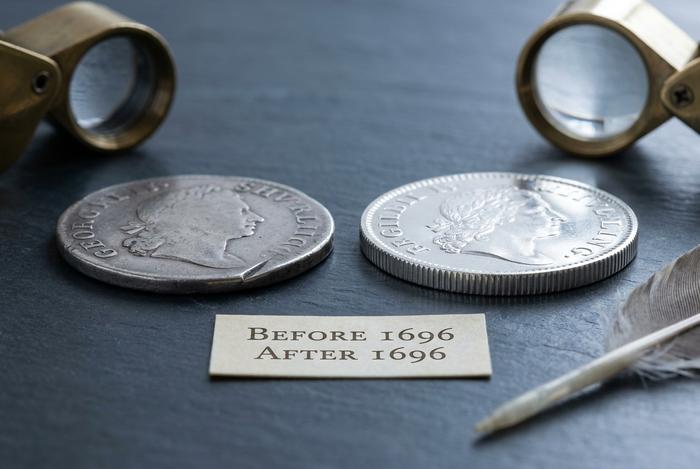
The technical fix mattered as much as the prosecutions. The new milled edges, with their evenly spaced grooves, made shaving a coin obvious. A clipped coin no longer matched its neighbors. Combined with capital punishment, the mechanical change made coin clipping uneconomic for the first time in centuries. England's currency stabilized. Each new coin minted at the Royal Mint after 1696 carried a milled rim by default, a small mechanical fact that quietly ended a craft six centuries old.
Penalties for coin clipping: hanged, drawn, quartered
Coin clipping was never treated as a property offense. The Treason Act of 1351 classified tampering with the king's coinage as high treason, on the same legal footing as plotting to kill the sovereign. For men, that meant the full ritual punishment of treason; for women, burning at the stake, a sentence that stayed on the English books until 1790.
Thomas Green, a London goldsmith, was hanged, beheaded and quartered at Tyburn in 1576 after he was caught clipping gold and silver. Venice scaled its punishments differently. By 1359, a clipper of grossi could expect to lose both eyes and a hand, be banished from the republic, and pay a 1,000-lire fine on top. The cruelty made sense to the people imposing it. To the medieval state, a shaved coin was not stolen property; it was forged sovereignty walking around in your purse.
Why every coin system gets clipped: Rome to Aurelian
Rome ran the same play in slow motion, from the top. The Roman denarius started at roughly 95-98% silver under Augustus, around 3.9 grams of nearly pure metal. The fineness held for a generation, then began drifting downward as imperial finances tightened.
| Emperor / period | Coin | Approx. silver content |
|---|---|---|
| Augustus (27 BC – AD 14) | Denarius | 95-98% |
| Nero (after AD 64) | Denarius | ~90% |
| Septimius Severus (AD 193-211) | Denarius | ~50% |
| Caracalla (AD 215) | Antoninianus introduced | ~50% |
| Aurelian (AD 270-275) | Antoninianus | ~5% |
Source: TheCollector, Wikipedia, UNRV.
By the late third century, the silver coin that descended from the denarius was 95% base metal with a thin silver wash. The empire's monetary base had been clipped, just by emperors instead of subjects. The outcome was the same as private coin clipping: holders of the currency lost intrinsic value they could not see and did not consent to. The Ottoman akçe followed a similar trajectory: 0.85 grams of silver in the 1450s, 0.048 grams by 1800.
The throughline is simple. Wherever the medium of exchange has slack between official value and actual access, someone takes the slack. Sometimes a king. Sometimes a goldsmith with a file. Always someone.
Digital coin clipping: how MEV bots became modern edge-shavers
The metal is gone. The mechanism is back. Digital coin clipping does not need a file or a coin; it needs a mempool.
On Ethereum and other blockchains, a transaction submitted by a user is not instantly executed. It sits in a mempool, public and visible, for some seconds before a validator includes it in a block. Specialized bots, known in the industry as MEV searchers, watch the mempool for trades they can exploit. The most common pattern is the sandwich. A bot buys a token a fraction of a second before the victim's trade pushes the price up, then sells immediately after at a profit. The victim gets a worse price. The bot pockets the difference. Most users never notice. A few cents here, three dollars there, repeated across tens of thousands of trades a month.
In 2025, sandwich-attack bots extracted approximately $40 million from Ethereum users across the year. The monthly figure fell from about $10 million in early 2025 to roughly $2.5 million by year-end, even as decentralized exchange volume rose from $65 billion to over $100 billion per month. There were 60,000 to 90,000 sandwich attacks every month, with an average profit of around $3 per attack. One address, jaredfromsubway.eth, was responsible for roughly 70% of them.
A second technique — just-in-time (JIT) liquidity — plays the same trick on Uniswap V3. A bot mints a tight liquidity position around a single large trade, captures most of the fees, then burns the position in the same block. Kaiko Research estimated that JIT-related liquidity events on Uniswap V3 totaled around $750 billion in 2025. An academic study from 2023 documented 36,671 JIT attacks in a 20-month window, generating 7,498 ETH in profit.
| Newton's coin clippers (1690s) | MEV searchers (2026) | |
|---|---|---|
| Target | Edge of the silver coin between transactions | Transaction between submission and inclusion |
| Mechanism | Shave metal, melt, resell as bullion | Frontrun, sandwich, JIT mint-and-burn |
| Victim | Whoever holds the coin next | Whoever submits the trade |
| Per-incident take | Fractions of a penny per coin | ~$3 per sandwich, larger for JIT |
| Annual scale (peak) | Half of England's silver specie by 1695 | ~$40M sandwich + ~$750B JIT volume in 2025 |
| Detection | Long Cross design, weighing | On-chain analytics, EigenPhi |
| Penalty | High treason, death | None; permissionless and legal |
About 90% of Ethereum blocks today are produced through MEV-Boost, the auction system Flashbots built to make MEV extraction more orderly. The mempool is no longer just a queue. It is a market for the right to tamper with the order of trades, which is the digital coin clipping of our era.
Does coin clipping still happen in 2026?
Not in the medieval sense. Modern coins are alloy tokens; their melt value is roughly nothing, so nobody bothers shaving a quarter. The pattern moved instead of dying.
Chainalysis flagged up to $2.57 billion of suspected wash trading on decentralized exchanges in 2024, most of it on ERC20 and BEP20 tokens. Wash trading is a different mechanic from coin clipping, but the shape is familiar: extract value from honest participants by manipulating the medium of exchange. Hidden spreads on centralized order books do something similar, as do dust attacks that taint wallet histories and stablecoin issuers who quietly dilute their reserves. Metal content stopped being the variable a long time ago. Trust in the medium took its place.

The modern milled edge: stopping digital coin clipping
Newton's solution to coin clipping was two-part: a technical fix (milled edges) and an enforcement regime (Tyburn). The 2026 response to MEV mirrors that split, minus the gallows.
Flashbots Protect routes user transactions through a private order flow that bypasses the public mempool, denying searchers the seconds they need to sandwich a trade. As of October 2024, Flashbots Protect had served 2.1 million unique wallets and shielded $43 billion of decentralized exchange volume; 313 ETH had been refunded to users from positive MEV.
Shutter Network has gone further. Its threshold-encrypted mempool, where transactions stay encrypted until they are included in a block, went live on Gnosis Chain in July 2024. Ethereum mainnet deployment is targeted for late 2025 or early 2026. Encrypted mempools attack the problem at its root: a searcher cannot frontrun a trade it cannot read.
MEV-Burn — sometimes called Execution Tickets — is the protocol-level reset. The proposal, currently in early-spec phase as part of Ethereum's "Scourge" roadmap, would auction the right to order transactions and burn the proceeds, redirecting MEV rents from a handful of bots to all ETH holders. It is the closest thing the digital era has produced to a Great Recoinage. Whether it ships, and whether it works, is open.
What 700 years of clipping teach us
Money is clippable wherever there is slack between official value and actual access. Medieval coin clipping exploited the slack of a precious metal coin sitting in a stranger's purse. MEV bots exploit the slack of a public transaction sitting in a public mempool. Close one gap and the value-skimmers find another. Newton's milled edges did not end coin clipping or debasement. They forced both to evolve.