Phantom Wallet for Solana: The 2026 Crypto Guide
Fifteen million people. One browser tab. Phantom sits behind a lot of crypto people's daily life, and that is exactly why the people building wallet drainers have made it their favourite single mark. The wallet started in 2021, built by a small team of ex-0x engineers who thought MetaMask felt wrong on Solana. They were right. Four years later Phantom raised $150 million from Sequoia and Paradigm at a $3 billion valuation, off the back of 15 million monthly users and roughly $25 billion held in self-custody. The same year, Scam Sniffer counted $494 million stolen by wallet drainers from 332,000 victims. Phantom users were a meaningful slice of that figure.
What follows: install, first deposit, the two setup paths the wallet now offers, every chain it currently supports, the swap fees that quietly fund the company, and the security rules nobody can run for you.
What Phantom is and why Solana made it inevitable
Phantom is non-custodial. That word does the heavy lifting. The private keys live on your device, your phone, nowhere else. The company never sees them. You have full control, and you have all the responsibility, in equal measure. In plain Web3 language, it is a self-custody key manager wrapped in a UI that does not make you want to throw your laptop out of a window.
You can install it as a browser extension on Chrome, Brave, Edge, or Firefox. Or you grab the mobile app — iOS landed in January 2022, Android followed three months later in April. By the end of 2024 the mobile apps alone had clocked twenty-four million downloads.
People keep calling it the MetaMask of Solana. The shorthand sells the product short. MetaMask physically cannot talk to Solana the way it talks to Ethereum. Solana uses a different keypair scheme (Ed25519, not the secp256k1 every EVM chain uses), a different RPC layer, and a rent model that has no analogue on the EVM side. Somebody had to write the wallet from scratch. Phantom got there first, shipped a polished beta to 40,000 users in mid-2021, and turned the production extension live within months. Variant, Andreessen Horowitz, and Jump Crypto had already put in over $100 million across earlier rounds before the 2025 Series C added $150 million on top.
Now for the awkward part. The same non-custodial design that protects you from a corporate freeze also means there is no recovery desk. Lose the twelve-word secret recovery phrase, and your funds are gone. Not "harder to access". Gone. This is intentional, and it is the single biggest fork in the road between Phantom and a custodial product like Plisio's Solana wallet. A merchant taking SOL or USDC at scale, with refunds, accounting, and an API to integrate, does not want self-custody headaches. They want a payment gateway. Two different problems, two different tools.
In 2024 the wallet processed about 850 million on-chain transactions and generated $20 billion in cumulative swap volume. The wallet itself remains free. The money comes from a small in-wallet swap fee, which we will get to.

Getting started — using Phantom wallet on Solana
Go to phantom.com. Or, on phone, to the App Store or Google Play. Anywhere else, and you are about to install a clone built to steal whatever you load into it. The Chrome Web Store listing is the only browser-extension page that is safe to install from, and even there, check the publisher field. It must read "Phantom Technologies, Inc." If it does not, close the tab.
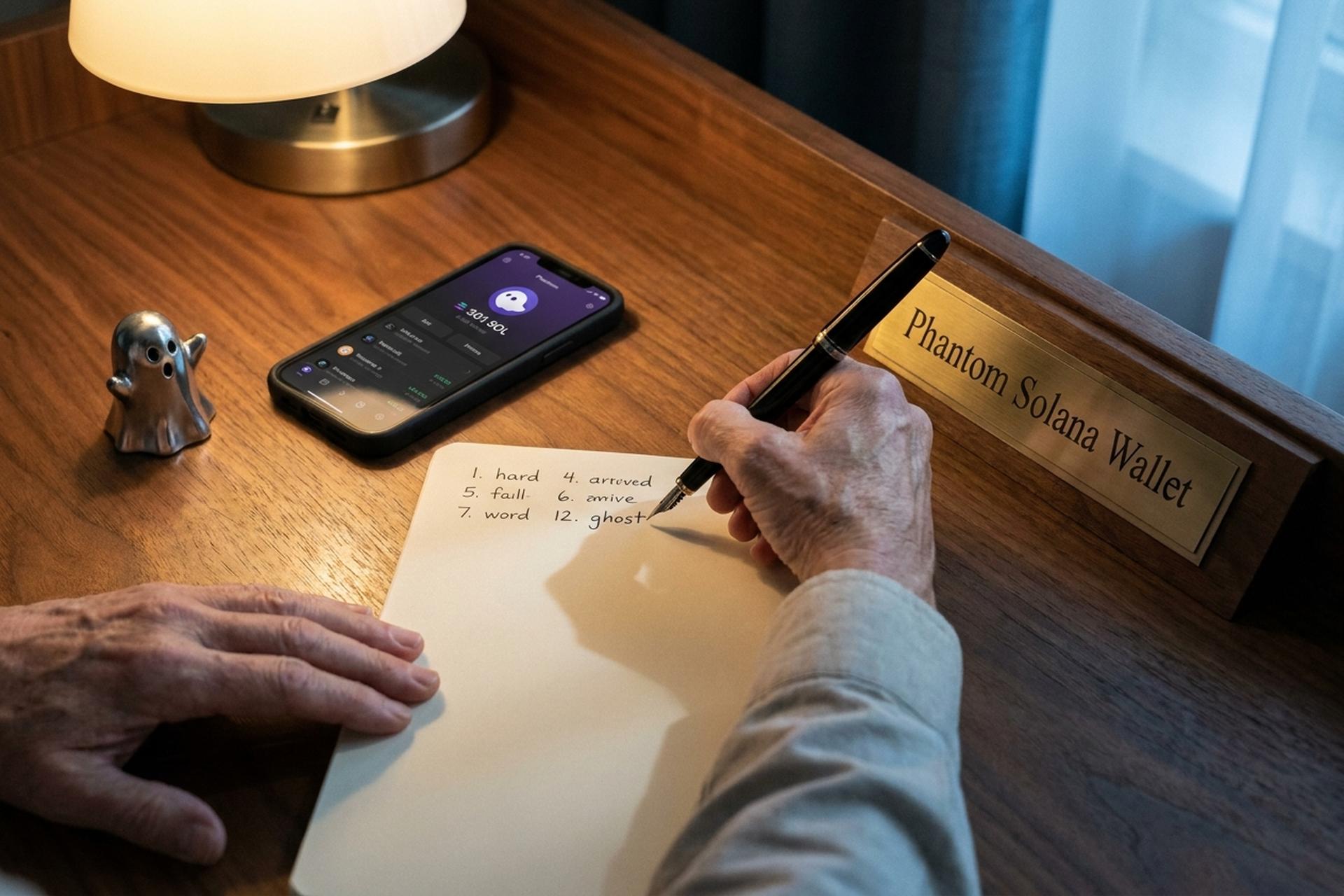
Setup runs through five short steps. Open Phantom. Pick "Create a new wallet." Choose a setup path (we will look at the two options next). Set a strong password, the one that unlocks the wallet on this device. Write the secret recovery phrase on paper. Yes, paper. Not a screenshot, not a notes app, not a synced password manager that backs itself up to somebody's cloud. Confirm the phrase by retyping the words you are asked for, pin the extension to the browser toolbar, and you are done. The wallet address sits at the top of the home screen; copy it from there whenever you need to receive funds.
That second step matters more than it looks. Phantom now ships two setup paths, and they are not interchangeable.
Path one is the traditional one. A twelve-word BIP-39 secret recovery phrase, generated locally, never sent anywhere. Hold that phrase and you hold the wallet. Lose it and nobody, including Phantom, can put you back inside. This is still the default for anyone who already understands self-custody and intends to put the words on paper, in a safe, in two physical places.
Path two arrived in 2024. It uses multi-party computation paired with social recovery, tied to a Google or Apple account, locked behind a four-digit PIN. No twelve-word phrase to memorise, no paper to hide. The catch is that you are now trusting a wider recovery surface than your own paper backup; the keys still live on-device, but the doors back in are now plural. For somebody moving twenty dollars to buy their first NFT, seedless slashes the rate of self-inflicted loss. For somebody storing a quarter of their savings, the seed phrase plus a hardware wallet is still the sober answer.
Speaking of hardware wallets: Ledger works, the others do not. Chrome, Brave, and Edge on desktop pair with Ledger fine. Firefox does not. Mobile does not. If you keep real money in this wallet and use Firefox, that gap is going to bother you. After the install, drop a tiny amount of the chain's native token into the wallet to pay the first transaction fee. On Solana that fee is about $0.0005 — yes, three zeros. A single dollar of SOL covers hundreds of operations.
Key features of the Phantom crypto wallet
The in-wallet swap is Phantom's main revenue line. It aggregates routes across Jupiter, Raydium, Orca, and other Solana DEX venues, and across Uniswap-style routers on the EVM chains, charging a flat 0.85% fee on top of the underlying pool spread. Daily volume runs around $20 million, with cumulative swap volume above $1 billion since launch. The 0.85% is real money — routing directly through Jupiter saves it — but the convenience of one click without leaving the wallet is what most users buy.
SOL staking happens through validator delegation. The wallet surfaces smaller validators with higher annual yields and lower commission, and shows the resulting APY (currently in the 7–9% range) before commitment. Phantom also issues PSOL, a liquid-staking token that stays liquid while the underlying SOL accrues rewards. Unstaking through the standard delegation path requires an epoch wait (roughly two to three days) and a small SOL fee to cover the transaction.
NFT management plugs into Magic Eden and Tensor with real-time floor prices, an instant-sell button that accepts the best live bid without leaving the wallet, and a burn function that lets users remove spam airdrops in exchange for a small SOL rent refund. Perpetuals trading is available through a Hyperliquid integration for users who want leveraged exposure without a separate exchange account.
A quick snapshot of the fees and limits that actually matter day to day:
| Feature | What it costs / pays | Notes |
|---|---|---|
| Wallet itself | $0 | Free download, no subscription |
| In-wallet swap | 0.85% per trade | On top of underlying DEX spread |
| SOL staking APY | ~7–9% | Validator-dependent; PSOL stays liquid |
| Unstake delay | ~2–3 days (one epoch) | Plus small SOL gas fee |
| Solana network fee | ~$0.0005 per tx | A dollar of SOL = hundreds of operations |
| Bug bounty payout | Up to $50,000 | Run by Phantom on a public program |
Phantom across the chains it now supports
| Chain | Token standard | Native swap | Staking | Added |
|---|---|---|---|---|
| Solana | SPL | Yes | Yes (7–9% APY) | 2021 |
| Ethereum | ERC-20/721/1155 | Yes | No | May 2023 |
| Polygon | ERC-20 | Yes | No | May 2023 |
| Base | ERC-20 | Yes | No | 2024 |
| Bitcoin | BRC-20 + Ordinals | Limited | No | 2024 |
| Sui | Sui standard | Yes | No | January 2025 |
| Monad | ERC-20 (EVM) | Yes | No | 2025–2026 |
| HyperEVM | ERC-20 | Yes | No | 2026 |
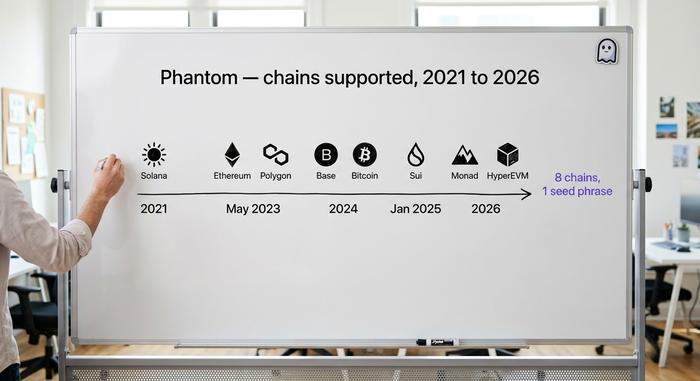
Eight chains, one interface, one seed phrase. Notable absences: BNB Chain, Arbitrum, Optimism, Avalanche, and Linea. Users who need those networks still keep MetaMask installed alongside.
Security and the wallet-drainer threat
Phantom is the safest popular Solana wallet and the most-targeted one, which sounds contradictory but follows directly from its market share. Scam Sniffer's 2024 annual report attributed $494 million in stolen funds to wallet drainers across 332,000 individual victims — a 67% increase over 2023. The largest absolute losses by chain were on Ethereum, but Solana-specific drainer campaigns were among the fastest-growing. The CLINKSINK family, first documented by Mandiant in January 2024, was a drainer-as-a-service kit built specifically to empty Solana wallets, with at least thirty-five affiliate IDs and over $900,000 in confirmed losses in its first month.
In response, Phantom acquired the transaction-security firm Blowfish on November 20, 2024. Blowfish had by then scanned 1.3 billion transactions, prevented 2.8 million attempted scams, and protected an estimated $18 billion in assets across the wallets that used its API. Its core function is integrated into Phantom: transaction previews now show what a contract will do in plain language before the user signs, suspicious approvals trigger explicit warnings, and known malicious domains are blocked at the extension level. Independent audits by Kudelski Security review the code on a recurring schedule, and a public bug bounty pays up to $50,000 for critical findings.
These defences stop most automated drainer campaigns. They cannot stop a user who reads "Approve" and clicks "Approve" without understanding that the contract is requesting unlimited token spend on USDC. The human-layer rules are unchanged from the cypherpunk era: keep large balances cold, use a hardware wallet for the daily-driver hot wallet, never paste the seed phrase into a "support" form (Phantom support will never ask), and verify the URL of any site before signing a wallet approval. A practical heuristic is that any unprompted Telegram or Discord direct message that mentions your wallet is a scam.
Beyond Solana: the Phantom wallet multichain pivot
Phantom calling itself "the crypto wallet" rather than "the Solana wallet" is a defensive move, not a marketing one. Solana's share of total cryptocurrency activity is volatile; in any given month it can lead or trail Ethereum by an order of magnitude. A wallet that lives or dies on a single chain shares that volatility. So Phantom de-risked. Ethereum and Polygon support landed in May 2023, then Base and Bitcoin (with Ordinals) in 2024, then Sui in January 2025, then Monad and HyperEVM through 2026. Each addition broadens the addressable user base.
Inside Solana the position is dominant. A 2025 analysis of on-chain wallet activity put Phantom's Solana market share at 39.4%, ahead of Solflare (roughly 4 million users) and Backpack. Across all chains the comparison is less flattering: MetaMask still runs above 30 million MAU on EVM alone, and Trust Wallet covers more chains. Phantom's bet is that its Solana stronghold plus a clean multichain UX is a defensible position that neither of those competitors will replicate quickly.
Phantom versus custodial alternatives like Plisio
The non-custodial argument is strongest for individuals. For businesses it weakens. A merchant accepting Solana payments needs API-driven invoice generation, automatic conversion to a stable accounting currency, refund flows that do not require a human to sign each transaction, and multi-signer approvals for treasury movements. Self-custody complicates each of those steps. Plisio's custodial Solana wallet, paired with its crypto payment gateway, handles them server-side: SOL and SPL-USDC invoices, REST API integration, automatic settlement, and standard merchant tooling around it. The model is the opposite of Phantom's, and the two products serve different needs rather than competing — end-user self-custody on one side, business custody with operational tooling on the other.
Phantom wallet pros and cons in 2026
Pros: free to use, polished interface, eight-chain support, integrated swaps and SOL staking, Blowfish security baked in by default, Ledger hardware-wallet pairing on the main desktop browsers, native Solana speed.
Cons: a lost seed phrase means a permanent loss of funds, with no support recourse (the inherent cost of self-custody); Ledger does not yet work on Firefox or mobile; Bitcoin support is thinner than dedicated BTC-only wallets; BNB Chain, Arbitrum, Optimism, and Avalanche are still missing; the 0.85% in-wallet swap fee is convenient but not the cheapest route available.