
What Is a Self-Custody Wallet? Custody vs Custodial Risks
In February 2025, hackers drained roughly $1.5 billion from Bybit's hot wallet in what Chainalysis calls the largest digital heist in history. Across the full year, attackers stole about $3.4 billion in crypto, and North Korean groups alone accounted for $2.02 billion of that. Stories like this are why "not your keys, not your coins" stopped sounding like a slogan and started sounding like advice.
A self-custody wallet is the answer most experienced users land on. You hold your own private keys, no exchange or custodian sits between you and the blockchain, and nobody can freeze or seize your funds because of a bankruptcy filing or a regulator's letter. The trade-off is real: you also become the bank's IT department, vault, and fraud team. This guide explains what a self-custody wallet is, how it differs from a custodial wallet, the practical risks on both sides, and how a beginner can start managing their own crypto without losing it in the first month.
What Self-Custody in Crypto Actually Means
Self-custody means you hold your private keys. Just you. Self custody in crypto cuts out every third-party custodian, every centralized exchange holding your balance in some internal database, every support team you might call to reset a password. The keys live on your physical device or hardware wallet. The blockchain does not care who you are. It cares about the signature. You manage your crypto without relying on anyone else, and that is the whole point.
Here is the part most newcomers miss. A self-custody wallet does not actually store your bitcoin or any other cryptocurrency. The coins sit on the blockchain. Your wallet stores the private key that lets you transact with them and send crypto to other addresses. Lose that key and the coins are still there. Nobody can move them. Ever.
Combined estimates from Chainalysis, Glassnode, and CoinLedger put the number of permanently lost BTC somewhere between 2.3 and 3.7 million, roughly 11 to 18 percent of Bitcoin's 21 million cap. Most of that is from the early days, when storing crypto meant scribbling a key on a sticky note and forgetting which laptop it was on. It is the long shadow of bad self-custody habits.
The opposite is third-party custody. That is where most people start. When you use a custodial wallet on Coinbase, Kraken, or Binance, the crypto exchange holds your private keys. You see a balance. They control the funds. The Securities and Exchange Commission groups all of this under custodial crypto services and treats it as one regulated category.
Custodial Wallet vs Self-Custody Wallet: The Real Difference
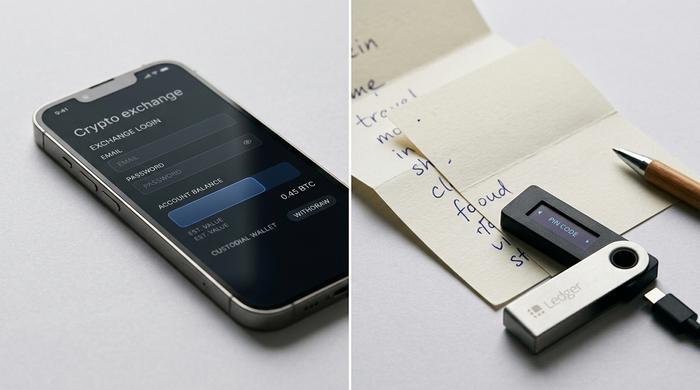
The two models look similar on the surface. You log in, you see a balance, you can send and receive crypto. The difference shows up the moment something goes wrong.
| Feature | Custodial Wallet | Self-Custody Wallet |
|---|---|---|
| Who holds the private keys | The exchange or wallet provider | You |
| Recovery if you forget the password | Email reset, support ticket | Only your seed phrase works, period |
| KYC/AML required | Yes, in most jurisdictions | Usually no |
| Counterparty risk | Yes (exchange hack, insolvency, freeze) | No, but you bear all user-error risk |
| Access to DeFi and dApps | Limited | Full, including non-custodial services |
| Suitable for large amounts | Risky long-term | Yes, with hardware wallet |
| Best for absolute beginners | Yes | Only with proper setup |
Custodial services like Coinbase or Kraken are easier for first-time buyers. They handle compliance, reset your password when you forget it, even buy a bit of insurance. They are also single points of failure. FTX, Celsius, BlockFi. All of them marketed safety. All of them collapsed. The customers holding funds there at the wrong moment learned counterparty risk the hard way.
A self-custodial wallet flips the trade. Nobody can freeze you. Nobody can rescue you either. Self-custody also means that if you lose access to your wallet and the recovery phrase, your coins are gone. Done. The SEC put out a December 2025 investor bulletin on this exact split and refused to bless either side. Two sets of risks, the bulletin says, not safer versus less safe.
Custodial wallets offer convenience. Non-custodial crypto setups offer financial independence and direct control of your crypto. Pick the one that matches how you sleep at night. If you want to control your assets the way you control cash in a safe, self-custody is the only model that fits.
How Private Keys and Wallet Addresses Work
Every self-custody wallet is built on a key pair. One private key, one public key. The public key generates your wallet address, which is the string of characters you share when someone wants to send you funds. The private key signs transactions and proves you actually own what is sitting at that wallet address.
Think of the wallet address as an email address and the private key as the password to that inbox. The catch: there is no "forgot password" link. Anyone who learns your private key can move your crypto in seconds and you cannot reverse a thing. That is why wallet apps never ask you to type your private key into a website. It is also why the most common scam in self-custody is just convincing somebody to enter their seed phrase into a fake interface that looks legit.
The seed phrase, sometimes called the recovery phrase, is a readable encoding of that same private key. Most modern wallets generate either 12 or 24 words off the BIP-39 standard. From those words, the wallet can rebuild every private key for every cryptocurrency it manages. It is the master backup. Store your seed phrase securely and you can lose the device, restore on a fresh wallet, and pick up where you left off. Lose the phrase, though, and no wallet provider on earth can help you. Not Ledger, not Coinbase, not your cousin who works at a hedge fund. Gone is gone.
Benefits of Self-Custody for Bitcoin and Cryptocurrency
So why take on the responsibility? A few reasons keep coming up.
True ownership is the big one. With a self-custodial wallet you actually own the asset. No platform can freeze it, lend it out, lose it in a bankruptcy, or block a withdrawal because the market is having a bad day. Glassnode says Bitcoin's illiquid supply, the coins that almost never move, hit about 14.37 million BTC in early 2026. That is roughly 72 percent of all mined BTC. Most of that pile is people who watched FTX die in 2022 and quietly decided enough.
Then there is DeFi access. Most decentralized apps simply will not connect to a custodial account because they need direct signatures from your wallet. DEX trades, NFT mints, staking on a protocol, all require a non-custodial wallet. The exchange version cannot get you in.
Privacy is the next piece. A self-custody wallet does not require KYC. Your wallet address is public on the blockchain, sure, but it is not stapled to your passport, social security number, and home address like a Coinbase account.
Fees add up too. Custodial services skim withdrawal fees, conversion spreads, and quiet little costs you stop noticing. A self-custody setup pays the network and that is it.
Counterparty risk sounds dry until it bites. Mt. Gox failed in 2014 and the survivors waited over a decade for a partial payout. FTX users are still working through claims today. Self-custody removes that whole category of pain.
Last one: optionality. A seed phrase is portable. Hate your current wallet app? Import the same recovery phrase somewhere else and keep going. You are not locked in. The seed phrase follows the BIP-39 standard, which is why it allows you to restore funds across hundreds of wallet options that share the same backup format. That portability is what hold your private keys actually means in practice. Ownership travels with you.
Types of Self-Custody Wallets: Hardware, Software, Paper
Not every self-custody wallet works the same way. There are four broad categories most users will encounter.
| Wallet Type | How It Works | Best For | Main Weakness |
|---|---|---|---|
| Software wallets (mobile/desktop) | App on your phone or computer holds the keys | Daily use, small to medium amounts | Connected to the internet, vulnerable to malware |
| Hardware wallets | Physical device, keys never leave the chip | Long-term storage, large amounts | Costs $60–$200, physical loss risk |
| Paper wallets | Keys printed or written on paper | Cold backup only | Damage, theft, hard to use safely |
| Smart contract wallets | Wallet logic on-chain, supports recovery and multisig | DeFi power users, advanced security | Higher gas fees, EVM chains only |
Software wallets like Trust Wallet, MetaMask, Phantom, or Exodus are the entry point for most users. They are free, fast to set up, and connect easily to the rest of the crypto ecosystem. A software hot wallet is connected to the internet by definition, meaning the private key sits on a device that touches the network, so they are best for amounts you actively spend your crypto with rather than long-term savings. Self-custody wallets allow this kind of daily flexibility while you keep full control of your private keys.
Hardware wallets keep your keys on a dedicated secure hardware chip inside a physical device. The keys never leave that chip, even when you sign a transaction. Ledger has shipped more than 8 million devices since 2014, and Trezor sold 2.4 million units in 2024 alone, according to CoinLaw market data. The combined hardware wallet market sat around $560 to $680 million in 2025 and is projected to grow at roughly 30 percent a year. If you hold large amounts, a hardware wallet is the standard recommendation, and most experienced users use a hardware wallet for anything they would not be willing to lose to a hack.
Paper wallets were popular in early Bitcoin days and still have a niche use as a cold backup. You print the public and private key on paper, store it somewhere safe, and never type the private key into a connected device. The risk is obvious: paper burns, fades, gets thrown out, or photographed.
Smart contract wallets are the newer category. Built on standards like ERC-4337, they replace the basic key pair with on-chain logic that can support social recovery, multi-signature approvals, gas sponsorship, and spending limits. More than 40 million smart accounts have been deployed across Ethereum and Layer 2 networks, with 20 million added in 2024 alone, according to Alchemy data. Ethereum's Pectra upgrade activated EIP-7702 on May 7, 2025, which lets ordinary externally-owned accounts borrow smart-account features for a transaction. Recovery, batched approvals, and sponsored gas are no longer reserved for power users.

Real Risks of Self-Custody: Hacks, Phishing, Lost Keys
This is where the beginner guides usually get vague. The risks of running a self-custody wallet are concrete and worth naming.
Phishing and wallet drainers come first. Scam Sniffer recorded 106,000 phishing victims in 2025 and roughly $83.85 million stolen, down 83 percent from 2024 but still a real number. The biggest single loss that year was a $6.5 million Permit-signature exploit in September. Permit-style attacks, where a malicious site asks you to sign what looks like a routine approval but is actually a token transfer, made up 38 percent of large incidents. EIP-7702 abuse appeared within months of the Pectra upgrade, with two cases in August 2025 alone draining a combined $2.54 million.
Seed phrase mistakes are next. People write down 11 words instead of 12, mix up handwriting (zero vs O, one vs l), or store the phrase digitally and lose it when a hard drive dies. Once that backup is gone, you can lose access to your crypto permanently, regardless of how careful you were with the wallet itself. Chainalysis logged 158,000 personal wallet compromise incidents in 2025, up from 54,000 in 2022.
Approval abuse is sneakier. Even without your seed phrase, a malicious smart contract approval can drain a specific token. A standard self-custody hygiene practice is to revoke unused approvals every few months using a tool like Revoke.cash.
Physical theft is the rarer but ugliest scenario. If someone knows you hold crypto in self-custody, the threat shifts from digital to physical. Multisig setups, where two or three keys are required to move funds, exist precisely to defeat this kind of attack.
Plain user error rounds out the list. Sending crypto to the wrong wallet address, picking the wrong network, or forgetting to set a memo on chains that need one. None of it is reversible.
| Risk | 2025 data | What it tells you |
|---|---|---|
| Total crypto stolen | $3.4 billion (Chainalysis) | Most losses hit exchanges, not personal wallets |
| Personal wallet incidents | 158,000 events, $713M (Chainalysis) | More victims, lower average loss |
| Phishing losses | $83.85M, down 83% YoY (Scam Sniffer) | Drainers still common, but defenses are working |
| BTC permanently lost | 2.3M–3.7M (~11–18% of supply) | Most loss is historical, mostly self-custody mistakes |
The pattern is clear. Centralized exchanges remain the biggest single targets in dollar terms, but personal self-custody users are the most numerous victims of social-engineering attacks. The fix is rarely technical. It is behavioral.
How to Self-Custody: A Step-by-Step for Beginners
If you have never held your own keys, the setup is shorter than the warnings make it sound.
Start with the right wallet type. A free software wallet works for spending balances under a few hundred dollars. A hardware wallet earns its place the moment you hold something you would feel sick about losing. Plenty of people run both. Hot wallet for daily moves, hardware for savings.
Pick a wallet provider you can verify. On the software side that means Trust Wallet, MetaMask, Rabby, Phantom, or Exodus. On the hardware side, Ledger or Trezor. Type the URL yourself. Never download from a link somebody DMed you, no matter how friendly the message looks.
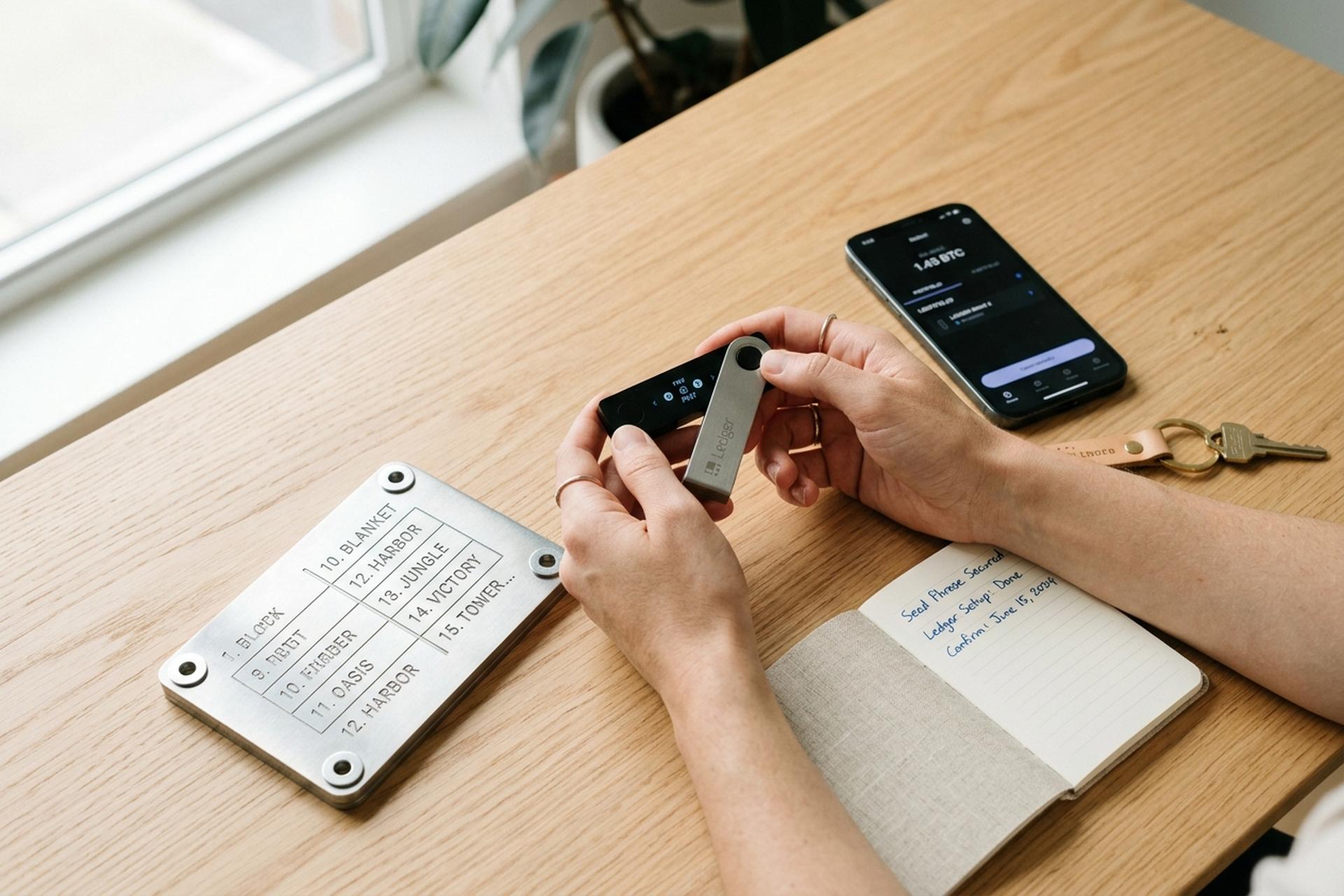
Generate the wallet. Write down the recovery phrase. The app shows you 12 or 24 words. Put them on paper or, better, on a metal backup plate. Do not photograph them. Do not save them in a password manager that syncs to the cloud. Do not email them to yourself "just to be safe." This single step decides whether your funds survive a stolen laptop or a kitchen fire.
Verify the backup before any real money goes in. Most wallets make you confirm the phrase by re-typing certain words. Do it carefully. If you wrote one wrong, this is when you find out, not three years from now when you actually need to recover.
Fund with a tiny test first. Ten or twenty bucks from the exchange to your new wallet address. Wait for the confirmation. Check the balance shows up. Then send the rest.
Then run a recovery drill. Wipe the wallet app, reinstall, restore from the seed phrase. Do it once, on purpose, before you store serious value. Half of all "I lost my crypto" stories trace back to a backup that was never tested.
For bigger holdings, add a hardware wallet to the mix. Hardware devices sign transactions offline, so even a fully owned laptop cannot leak the private key. The hardware wallet becomes the way you control your private keys for long-term storage. The software wallet handles spending. That split keeps access to your funds protected even when your daily-use device gets hit.
Self-Custody Best Practices to Protect Your Crypto
The self-custody best practices below are the ones that experienced users settle into after a few mistakes. Apply them once to your self-custody wallet setup and they take almost no ongoing effort.
- Store your seed phrase on physical media in two locations. A safe at home, a deposit box, a trusted relative. Geographically separated if possible. Back up your wallet on something digital or physical that survives water and fire when you can.
- Never type a recovery phrase into a website, a wallet app you did not initiate, or a Zoom screen-share. No legitimate support team will ever ask for it. Treat the phrase as the most sensitive crypto information you own.
- Use a hardware wallet for any balance you would feel sick about losing. The $79 to $199 cost is trivial against the protection, and it gives you full control over your private keys at all times.
- Segregate funds across multiple accounts: one wallet for trading, one for long-term storage, one for experimentation with new dApps. A drainer that hits one wallet or exchange leaves savings untouched.
- Verify the receiving wallet address before sending. Compare the first and last six characters carefully.
- Revoke unused token approvals every few months. Tools like Revoke.cash and Etherscan's Token Approval Checker make it a 30-second task.
- Bookmark the official site of any wallet or dApp you use. Phishing sites buy ads on Google to outrank the real ones.
- Keep your wallet software up to date. Many drainer exploits target outdated versions.
- Consider multi-signature for very large amounts. Two-of-three or three-of-five setups split responsibility for the security of your funds across keys and remove single points of failure entirely.
These rules apply whether you hold $200 or $200,000. The discipline scales for free.
What About Crypto Taxes and Exchange Reporting?
Quick reality check: self-custody changes nothing about your tax bill. Only how messy the tracking gets.
In the US, the IRS treats crypto as property. Sell it, swap it, spend it on coffee, all taxable. Coinbase or a hardware wallet, same rules. The agency does not need to see your wallet to know it exists. On-chain data is public. Exchanges file 1099s when you deposit and withdraw. Form 1040 now asks every taxpayer the digital asset question right at the top. Self-custody is legal. Hiding gains is not.
Over in the EU, MiCA became fully applicable on December 30, 2024, with a grandfathering deadline of July 1, 2026. MiCA does not police purely personal self-custody. What it does do: when a regulated provider receives more than €1,000 from a self-hosted wallet, the provider has to collect originator and beneficiary data under the Travel Rule. Annoying but not the end of self-custody.
US politics has actually swung self-custody's way. Trump signed Executive Order "Strengthening American Leadership in Digital Financial Technology" on January 23, 2025, with explicit language protecting the right to self-custody digital assets. The President's Working Group report from July 2025 went further, asking Congress to lock in that right and clarify how broker-dealer rules treat self-hosted wallet providers.
For active users, a tax tracker like CoinTracker, Koinly, or TokenTax saves a long weekend in April. Plug in your wallet addresses. Tool reads the chain. Export the report. Done.



