Diamond Hands in Crypto: Meaning, When Holding Pays and Burns

Half a million Redditors watched GameStop punch through $400 in late January 2021, and the most common reply in the thread was a diamond and a pair of hands. r/wallstreetbets jumped from 2 million subscribers to 6.2 million in five days. Melvin Capital posted a 53% loss on its short book. GME hit $483 intraday on January 28. That was the week "diamond hands" stopped being niche WSB slang and started showing up in Bloomberg headlines.
The phrase carries a strange double life. To crypto investors who held Bitcoin and other cryptocurrencies from 2018 to 2024, it describes a real edge: staying put through a 70% downturn in price volatility and ending up roughly six times richer at the next peak. To the half a million users still subscribed to r/terraluna, it describes a wipeout, with retail investors losing money they never imagined could disappear. Same posture. Opposite outcome. This piece unpacks what diamond hands actually means in the crypto space, where the term diamond hands came from, how it differs from paper hands, and, most importantly, when holding onto a position is conviction and when it's just expensive denial regardless of market volatility.
Meaning of diamond hands: crypto trading slang explained
Diamond hands refers to investors who hold a highly volatile digital asset through sharp declines in value without selling, betting that long-term gains will eventually exceed the dip. The emoji shorthand is 💎🙌 (or 💎👐), and the unwavering conviction it signals has become a badge of identity in online trading communities. The opposite is paper hands (🧻🙌), used to describe investors who exit at the first sign of trouble, often during a market crash.
The phrase is online trading slang, born on Reddit and adopted by crypto Twitter to describe investors who hold onto their assets through extreme price volatility. It overlaps heavily with HODL, the older 2013 Bitcoin forum typo that got backronymed into "Hold On for Dear Life." Both describe the same behaviour: refusing to panic sell stocks or cryptocurrencies when the chart goes red. Diamond hands is the meme-stock vocabulary; HODL is the crypto-native vocabulary; in practice, they are cousins, not synonyms.
Origin story: from WallStreetBets typo to GameStop battle cry
The phrase did not start during the short squeeze on GameStop stock. It was already drifting around r/wallstreetbets posts in 2018-2020, mostly attached to earnings-week biotech bets and the occasional weekly options gamble on meme stocks. Know Your Meme places its emergence on WSB in the late 2010s, although no one has dug up the canonical first post. What January 2021 did was give it CNBC airtime as the GameStop short squeeze exploded into the mainstream.
The numbers from that week still feel unreal. GameStop traded 197 million shares on January 22 against a 30-day average of 29.8 million. By January 27, the US equity market set an all-time volume record of 24.48 billion shares. r/wallstreetbets gained roughly a million new subscribers on January 28 alone. Keith Gill, posting as DeepF*ingValue, had turned a $53,000 GME position into a fortune that peaked above $585 million in June 2024. That is the textbook payoff for not flinching.
The term migrated to crypto within weeks. By May 2021, Elon Musk was tweeting "Tesla has 💎🙌" during a 30% Bitcoin intraday drop. (Tesla quietly sold 75% of its BTC the following year, not exactly diamond hands in practice, but the meme had already escaped containment.) Crypto enthusiasts adopted the symbol for BTC, ETH, DOGE, SHIB, and every meme coin that exploded into the mainstream during that cycle.

Diamond hands vs paper hands: the real difference
Most articles frame this as the brave investor versus the weak coward. That framing is lazy. The actual difference is whether you set your exit rules before the volatility started. Paper hands aren't a personality defect; they're a symptom of buying without a plan.
| Trait | Diamond hands | Paper hands |
|---|---|---|
| Time horizon | Years | Days to weeks |
| Reaction to a 30% drawdown | Add or hold | Sell |
| Decision basis | Pre-set thesis | Real-time fear or social pressure |
| Information diet | Long charts, fundamentals, roadmap | Twitter feed, Discord rumours |
| Default emotional state | Boredom (and occasional doubt) | Anxiety |
| Risk tolerance | High | Low |
| Common failure mode | Refusing to update a broken thesis | Selling local bottoms |
Picture the same flash crash from two desks. The diamond hands investor sees the price, closes the tab, goes back to sleep. The paper-hands trader sells, then watches the chart bounce four hours later and posts a screenshot to their group chat with a self-deprecating joke. Both happen every cycle, and both happen to the same person at different times.
The behavioural science behind this market pressure is well documented. Kahneman and Tversky's 1979 prospect theory established that losses register psychologically about twice as strongly as equivalent gains, which is why pressure to sell at the wrong moment is so common during market crashes. That asymmetry, the simple fact that watching $1,000 evaporate hurts more than watching $1,000 appear, is the engine behind every paper hands moment. Terrance Odean's 1998 paper in the Journal of Finance, "Are Investors Reluctant to Realize Their Losses?", showed something even more uncomfortable: ordinary investors sell their winners too early and hold their losers too long. The diamond hands meme operationalises the second half of that finding and rebrands it as a virtue.
I'm not convinced the binary captures anything useful, honestly. Most people I know cycle between both modes depending on position size. Holding 0.5% of net worth in some shitcoin is easy; holding 30% of net worth in the same coin is a different experience, regardless of conviction. Risk tolerance isn't a fixed personality trait. It's a function of how much money is actually on the line and how recently you last had a panic-sell hangover. Anyone who claims permanent diamond hands has either never had a real position size or is lying.
What separates a healthy diamond hands approach from stubbornness is one habit: re-checking the thesis. Did anything fundamental change, or did the price just move? FUD on Twitter is not fundamental. FOMO is not fundamental either. A regulator banning the asset is. An exchange freezing withdrawals is. A protocol's reserve mechanism breaking is. If the answer is "nothing material changed," holding is rational, regardless of market noise. If the answer is "the thing I bought no longer exists," holding is bagholding.
When diamond hands paid off for crypto long-term holders
Some success stories get repeated because they keep paying. Bitcoin's 2017 cycle is the cleanest example. Investors who bought near the December 2017 peak around $19,700 watched the price collapse to roughly $3,200 in December 2018, an 84% drawdown that lasted twelve grim months. The investors who refused to panic sell saw BTC reclaim $20,000 in late 2020, hit $69,000 in November 2021, and break $108,000 in December 2024. The realised return for an investor who held through the entire bear market was roughly five to six times their original capital.
Ethereum tells a similar story. ETH crashed from $1,400 in January 2018 to $80 in December 2018, a 94% loss. Anyone who held through that drawdown was sitting on a roughly forty-fold return by November 2021. Long-term holders, by Glassnode's definition (coins not moved in 155+ days), control about 73% of circulating BTC supply according to CoinDesk reporting from mid-2025, and the share rose to roughly 80% by April 2026. Levels above 85% have historically marked cycle lows.
Roughly one in five Bitcoins has not moved in five or more years, per Chainalysis methodology. Some of that supply is genuinely lost (estimated at 2.3-3.7 million BTC, or 11-18% of the 21 million cap, by Decrypt). The rest is in the hands of long-term holding crypto investors who own cryptocurrencies like Bitcoin and Ethereum across multiple cycles. These investors are not paid in headlines; they're paid in the calmness of not having to make a decision every week. That is the actual diamond hands trade: boring, slow, occasionally agonising, and statistically the highest-return way to own crypto for individuals who can't trade better than the market. The capital gains accrue to those with high risk tolerance who tolerated extreme price drops without selling.
Cons of diamond hands: the LUNA, FTT and Celsius lessons
This is the section every surface-level explainer skips. Holding is not a virtue when the asset is structurally broken, and the diamond hands meme provided emotional cover for some of the worst losses retail investors ever absorbed.
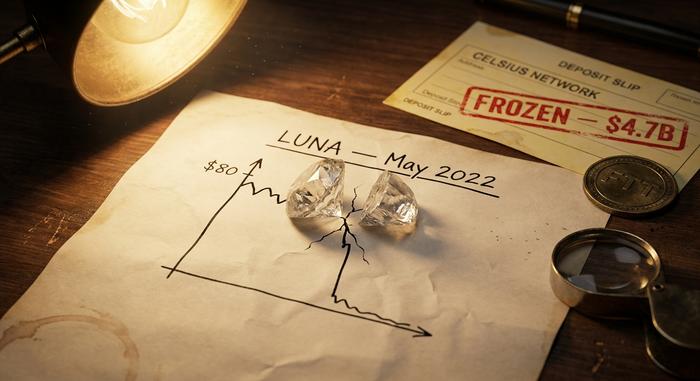
Terra/LUNA, May 2022. LUNA traded near $80 in early April. By mid-May, after the UST stablecoin lost its peg and the algorithmic mint-burn mechanism unwound, the price collapsed to fractions of a cent. Combined LUNA and UST market cap evaporated by roughly $40-60 billion in three days, per Harvard Law School Forum on Corporate Governance and MIT Sloan summaries. NBER working paper w31160 found that less-sophisticated retail investors were systematically the last to exit, and that diamond hands rhetoric on r/terraluna ("stay strong, we'll rebuild") kept many of them locked in as the chart went to zero. Founder Do Kwon was sentenced to 15 years in 2025.
FTT, the FTX exchange token, November 2022. The price dropped 90.4% in one week, from $24.01 on November 6 to $2.10 by November 13, after CoinDesk leaked a balance sheet showing Alameda Research held large amounts of FTT as collateral. Roughly 2.7 million FTX account holders saw their funds frozen overnight. The "diamond hands, SBF will fix this" posts from those days have not aged well.
Celsius, Voyager, 3AC. Celsius Network owed customers $4.7 billion when it filed for Chapter 11 in July 2022. Voyager halted withdrawals on July 1, filed Chapter 11 four days later, and took a $646 million loss on a defaulted loan to Three Arrows Capital. 3AC itself went from managing roughly $10 billion in assets to bankruptcy in weeks, owing more than $3.5 billion to over twenty creditors. Many Celsius depositors refused to withdraw earlier because the 17% APY and CEO Alex Mashinsky's "trust us" messaging felt like a thesis. It wasn't a thesis. It was marketing.
The throughline is uncomfortable for the crypto industry. Holding without thesis revision is bagholding with better branding. The part that doesn't add up for me: a community that watched Terra collapse in May still adopted the same posture for FTT six months later. The meme survived the losses better than the holders did. Morningstar columnist John Rekenthaler put it bluntly: diamond hands only make sense for assets that have positive long-term expected return and no terminal-failure risk. Index funds clear that bar. Most single tokens do not.
When diamond hands fit your investment risk management
Here is the practical filter. Three questions, each one designed to separate conviction from cope.
| Question | Diamond hands if... | Sell if... |
|---|---|---|
| Is the thesis still intact? | Yes — same reasons you bought | No — fundamentals broke |
| Is your position sized right? | You can sleep | You check the price 20× a day |
| Is the volatility temporary or terminal? | Macro fear, range-bound chop | Insolvency, exploit, regulatory kill-shot |
The first filter is the hardest because it requires honesty about whether you ever had a thesis. "Number go up" is not a thesis. "Bitcoin's supply is capped at 21 million, regulated spot ETFs in major markets are pulling in net inflows every month, and central banks are signalling looser policy" is a thesis. The second filter, the sleep test, comes from professional traders and is the single most reliable position-sizing rule for retail. If you check the price more than a few times a day, your position is too big.
The third filter is the one that fails most often. Investors confuse a normal cycle dip with a death spiral. Bitcoin has drawn down 30-50% from local highs multiple times in every bull market on record without breaking. Counter-party failure (FTX), broken token mechanics (UST), or a permanent regulatory action are categorically different events. The Motley Fool's standing recommendation for highly volatile assets (keep speculative crypto and meme exposure to 5-10% of a balanced portfolio) exists exactly because the third filter is hard to apply in real time.
The behaviour is downstream of these three filters. The strategy is your pre-set thesis, your position sizing, and your ability to spot a terminal event. The posture takes care of itself once the underlying decisions are sound.
How diamond hands relates to HODL in crypto
HODL came first. In December 2013, during a Bitcoin crash from roughly $1,150 to under $500, a Bitcointalk user named GameKyuubi posted a drunken rant titled "I AM HODLING", a misspelling of "holding" that the community immediately adopted. The post was later backronymed to "Hold On for Dear Life," which captured the panic-resistance flavour better than the original typo.
The newer term inherits HODL's posture but adds two things: the visual (💎🙌) and the meme-stock energy from January 2021. HODL implies multi-year horizons specifically for crypto. Diamond hands applies to anything volatile (GME, AMC, DOGE, the next narrative coin) and is more about the moment of refusing to sell than the time horizon.
Honest takeaway on diamond hands risk management
The meme is a posture, not a strategy. The strategy is your thesis and your position size. If those are sound, the posture takes care of itself. If they aren't, calling yourself diamond-handed is just a label you give the bagholder you became.
Would you have sold Bitcoin at $3,200 in December 2018? Most people who answer "no" also held LUNA all the way down. The honest answer is that nobody knows their own pain tolerance until the chart shows it. Write your exit rules down before the next drawdown, not during it. Remember that genuine diamond hands grow out of preparation, not bravery.