JOMO Meaning: Embrace JOMO, Less FOMO Worry, Finding Joy

Most JOMO articles skip the part where the word came from a single blog post by a guy whose son was four days old. Anil Dash, July 2012, New York. He typed the four-letter inversion of the year's loudest internet acronym and posted it the same night. The framing was sharper than the wellness version that took over later. By the time Merriam-Webster picked JOMO up, it had softened into a vague self-care label. The real story is more interesting. Psychology research. A $2 trillion crypto crash. $1.25 trillion in US credit-card debt. A generation quietly setting its phone down. This piece walks through what JOMO actually means, where it came from, what the science says, and why the people who get the most out of it are not on retreats. They are the ones skipping the next pump and the next $80 takeout order.
JOMO meaning, in one paragraph
JOMO stands for the joy of missing out. The working JOMO definition is roughly this: the satisfaction of choosing not to attend, not to chase, not to buy in. No guilt attached. Merriam-Webster phrases it as "joy experienced when not attending events to which one has been invited" and dates the first known use to 2012. The dictionary calls it informal slang. Anil Dash, who invented it, called it something more specific: the antidote to FOMO, the pleasure of taking time alone, the chance to prioritize self-care over the next invitation that lands in your inbox.
Where JOMO came from: the 2012 origin story
Anil Dash hit publish on a post titled "JOMO!" on July 19, 2012. His son was four days old. The family was home. Dash watched a slow drip of social-media envy at events he was deliberately skipping, and the post came out of that. He defined JOMO as "a blissful, serene enjoyment in knowing, and celebrating, that there are folks out there having the time of their life at something that you might have loved to, but are simply skipping."
It was a direct shot at FOMO. Tech entrepreneur Caterina Fake had coined that one in March 2011, in a post called "FOMO and Social Media," after watching the SXSW party-hopping cycle online. The deeper marketing trail goes back to Dan Herman, a consumer researcher in the early 2000s. Fake gave it the social-media frame that stuck.
Then JOMO did the usual slow march through pop culture. Dictionary.com picked it for Word of the Day on May 13, 2019. Oxford Learner's Dictionaries added it later, with the gentler gloss "a feeling of pleasure that you get from not doing an activity that other people are doing." Dash himself wrote a 2019 retrospective called "I Should Have Written a JOMO Book." Half wry. Half pleased the word had outlasted seven internet years.
JOMO vs FOMO: the opposite of FOMO in daily life
Put them next to each other and the contrast lands fast. FOMO pulls. JOMO settles. One is the tight feeling in your chest at 11pm when a group chat keeps lighting up about a party you skipped. The other is the cup of tea you make instead.
Andrew Przybylski's research team built the first peer-reviewed FOMO Scale in 2013. Ten items on a Likert scale. They called FOMO "a pervasive apprehension that others might be having rewarding experiences from which one is absent." Cronbach's alpha came in between .87 and .90, which is unusually clean for a self-report instrument. The scale has since been cited thousands of times across psychology and marketing journals.
| Signs of FOMO | Signs of JOMO |
|---|---|
| Compulsive scrolling between activities | Comfort with one slow activity at a time |
| Restlessness, anxiety, the dictionary-perfect feeling of missing out | Contentment, no urge to check what others did |
| Saying yes to invitations to avoid regret | Saying no to invitations without guilt |
| Worry that the best version of life is somewhere else | Belief that the best version of life is the one in front of you |
| Buying into trends to fit in | Opting out of trends to spend on what matters |
| News-cycle exhaustion | News-cycle indifference |
Those FOMO traits add up. Hedepy puts the share of social-media users who battle FOMO at over half. Ulliance pegs the adult rate near 70%. After a long scroll, jealousy and inadequacy show up first, then sleep slips, then a low-grade burnout creeps in. JOMO does not deny any of that. It just rearranges the relationship. Silence a single notification. Unplug for one hour. Spend time without checking the feed once. That is where most people I have met start.
What Merriam-Webster, psychotherapy, and wellbeing research say
The dictionary entries describe what JOMO is. The psychotherapy and wellbeing literature describes what it does. Three studies stand out.
Aranda and Baig published "Toward 'JOMO': the joy of missing out and the freedom of disconnecting" at the MobileHCI 2018 conference in Barcelona. It was the first academic paper to put JOMO at the center, based on a qualitative ethnography of people who deliberately stepped back from devices. Anand and colleagues built a multi-factor JOMO scale in 2022 with five dimensions: mindfulness, social-media usage, contentment of solitude, social detachment, and social comparison.
The most direct test came in 2025. Kantar, Yalçın, Kocabıyık, and Barry published "Joy of Missing Out (JOMO) and Its Role in Reducing Social Media Addiction" in the Journal of Psychology. They found JOMO was negatively associated with FOMO and social-media addiction, and positively associated with psychological wellbeing, with loneliness and psychological distress as serial mediators. A separate 2025 paper in The Educational and Developmental Psychologist showed JOMO mediates the link between self-compassion and wellbeing.
A 2024 Common Sense Media and Hopelab survey added a sobering data point: 53% of young adults say they cannot control their social-media use. JOMO is not a magic word for that population. It is a slow practice that has to outcompete a feed that has been engineered for FOMO.
JOMO in crypto: the discipline of skipping pumps
Crypto is where JOMO has the hardest dollar value. The fear of missing the next pump is probably the most expensive emotion in the asset class. Sitting on your hands beats chasing, measurably, over a full cycle.
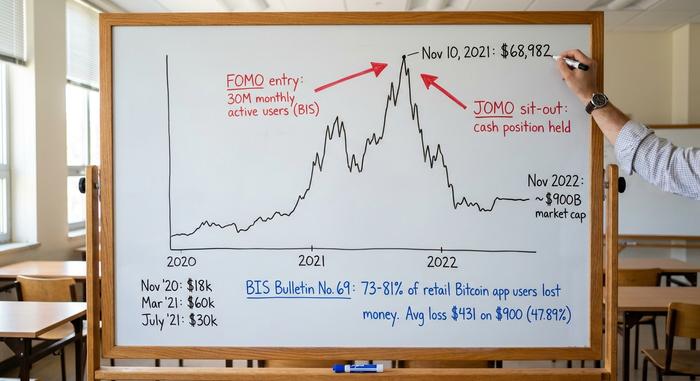
Bitcoin printed an all-time high of $68,982 on November 10, 2021. A Bank for International Settlements bulletin out of Basel that December laid out the customer side. Monthly active users on crypto-exchange apps went from roughly 100,000 in August 2015 to over 30 million by the November 2021 peak. Translation: the biggest cohort of retail buyers in crypto history showed up at the literal top.
Then the chart broke. Total crypto market cap fell from around $3 trillion in November 2021 to about $900 billion a year later. Seventy percent gone. The BIS math on that cohort is brutal. Between 73% and 81% of retail Bitcoin app users who entered between 2015 and 2022 ended up underwater. Average loss: $431 on a $900 stake, roughly 47.89%. The Australian regulator ASIC ran a 2022 survey of crypto holders and found only 20% described their own behavior as "risk-taking." So 80% bought without consciously pricing the risk they were taking on.
Academic work backs up the pattern. Baur and Dimpfl, 2018, showed crypto markets carry inverted volatility asymmetry. Positive price shocks raise volatility more than negative ones, opposite of equities. A 2023 paper called "FoMO in the Bitcoin market" in the Quarterly Review of Economics and Finance confirmed it, and tied the effect to a happiness index, the short-versus-long volume ratio, and geopolitical risk. Plain English: price ticks up, more buyers pile in because price ticked up, volatility blows out. FOMO in chart form.
| The Nov 2021 BTC FOMO buyer | The Nov 2021 BTC JOMO sitter |
|---|---|
| Opened a Coinbase or Binance app for the first time | Already had an account but did not add capital |
| Bought near $65,000 to $69,000 | Bought nothing, or trimmed |
| Watched the position lose 50% by mid-2022 | Held cash or stables through the drawdown |
| Felt the worry of "should I sell now" weekly | Felt the JOMO of "I am not part of this drama" |
| Net result: -47.89% per BIS average | Net result: opportunity to redeploy in 2023 |
JOMO here is not anti-crypto. It is a discipline. The cycle traders who survived multiple drawdowns built their careers on the joy of sitting out moves they could not value. The crypto industry sells the exact opposite of that posture, every minute of every day.
Embrace JOMO in personal finance: less lifestyle creep
The same loop plays out smaller, every month, in everyone's checking account. The pressure shows up as lifestyle inflation. Second car. Upgraded phone. Third streaming service. The fourth takeout night. Embracing JOMO in personal finance just means opting out of that comparison ladder.
The macro picture in early 2026 makes the case. The US personal saving rate slid from 4.5% in January 2026 to 4.0% in February to 3.6% in March, per FRED and the Bureau of Economic Analysis. Outside a recession, that is unusually low. At the same time, US household credit-card debt hit $1.252 trillion in Q1 2026 according to the New York Fed. The Q4 2025 peak was $1.277 trillion, the highest reading since tracking started in 1999. Average household balance: $6,715.
Look at it by generation and the JOMO opening becomes obvious. LendingTree pegs Gen X at the highest average card balance, $9,600. Gen Z sits at the bottom, $3,493. Bank of America's 2025 Better Money Habits survey found 72% of young adults had taken at least one deliberate step to improve their finances in the past year. Half of that group (51%) routed money into savings. About a quarter (24%) paid down debt. Bankrate puts the Gen Z side-gig average at $958 a month, and most of that does not go to consumption. A 2025 Harris Poll has Gen Z aiming for financial independence by age 32, earlier than any prior cohort's stated target.
None of these numbers proves Gen Z has fully embraced JOMO. But the most chronically online generation is also the one most consciously refusing to spend on what the feed keeps showing them.

JOMO and Gen Z: introvert and extrovert energy in the feed
Gen Z grew up with FOMO as the default. Now they are writing the playbook for stepping out. The data is genuinely interesting.
Pew Research Center's Teens, Social Media and Technology 2024 report, published December 12 of that year, put YouTube use at 90% of US teens and TikTok and Instagram at roughly 60% each. Sixteen percent are on TikTok "almost constantly." Almost half of US teens describe themselves as online "almost constantly," full stop. Then the inverse shows up in the same data. Sprout Social's 2024 survey found 63% of Gen Z had a planned social-media detox, more than any other generation. Deloitte's 2025 Digital Media Trends report tracked nearly one-third of Gen Z deleting a social app in the past year, against about 25% of all consumers. 16% walked away from at least one app entirely.
The Financial Times analyzed GWI data covering 250,000 adults in more than 50 countries. Average daily social-media use dropped to 2 hours 20 minutes by end-2024. That is down close to 10% since 2022, with the steepest decline among teens and twenty-somethings. GWI's own 2025 Gen Z report flagged a related shift inside the platforms themselves. Sharing has gone private. 68% of Gen Z post to Close Friends lists rather than the main grid. Public posts by 16-to-24-year-olds fell 28% in two years. Close Friends Stories engagement rose 42% over the same window.
The classic introvert-versus-extrovert framing that older JOMO articles like still applies, sort of. The Cleveland Clinic notes that introverts gravitate toward JOMO and extroverts toward FOMO. Gen Z complicates that. Even the cohort's extroverts are routing their public energy into private channels. The crowd shrank. The conversations did not stop.
| Gen Z digital signal | 2022 | 2024-2025 |
|---|---|---|
| Avg daily social-media use (GWI) | ~2h 35m | 2h 20m |
| Public grid posts (16-24, IG) | baseline | -28% |
| Planned social-media detox (Sprout) | not tracked | 63% |
| Deleted at least one social app in past year (Deloitte) | n/a | ~33% |
| Use content-avoidance tools (Common Sense) | n/a | 81% young adults / 68% teens |
The 2025 Mind the Workplace report by Mental Health America added the burnout side: only 36% of Gen Z feel "very engaged" at work, 13 points below the US workforce average, and 91% report at least one mental-health challenge or burnout episode. JOMO is the rational adaptive response to that environment.
Finding joy offline: books, dumbphones, JOMO products
The JOMO bookshelf is small. Four titles, in roughly chronological order.
Christina Crook, 2014, The Joy of Missing Out: Finding Balance in a Wired World. Memoir of her 31-day internet fast. The #JOMO hashtag really traces back to her. Tonya Dalton's 2019 book uses the same title with a different subtitle: Live More by Doing Less. Fortune slotted it into the top-ten business books list that year. Cal Newport's Digital Minimalism showed up the same year and is the philosophy cousin most readers go to next. Svend Brinkmann's Stand Firm: Resisting the Self-Improvement Craze is the spikier pick, English edition 2017, deliberately anti-wellness in tone.
Now the hardware part. Feature phones (dumbphones, again) had a quiet $10.6 billion year worldwide in 2024 on 1.1 billion units. UK forecasts call for 21% year-over-year growth into 2025. Google search interest for "dumb phone" jumped more than 300% over twelve months and peaked early 2025. Three brands keep showing up: Light Phone from New York, Punkt from Switzerland, Mudita Pure from Poland. The pitches are nearly identical. Cultivate fulfillment with a good book. Carve out time for what you actually want to do. Enjoy the present moment. Skip the dopamine pull of the feed.
Is JOMO just for people who can afford it?
Worth flagging an honest critique. JOMO can read as a privilege. The journalist Joan Westenberg argued in 2024 that wellness has become "a commodity with status symbols, exclusivity, and privilege." Opting out of social events, taking a digital detox week, buying a $300 minimalist phone, or sitting out a crypto pump because you already have savings are easier when the basic boxes are already checked. A gig worker with two jobs and no buffer has less room to embrace JOMO. I keep coming back to this whenever a JOMO-branded retreat shows up in my feed; the frame is still useful, but the marketing version deserves the side-eye it gets.