What Is Jito? Solana Staking, MEV, and the JTO Token

One piece of software now runs underneath most of the Solana network, and it quietly hands a slice of the profits back to everyday stakers. That software, and the protocol built around it, is Jito. If you have heard the name and assumed it was just another token to trade, you have only seen a sliver of it.
Jito is really two things wearing one brand. It is a liquid staking protocol that gives you a token called JitoSOL, and it is the infrastructure that controls how a large share of Solana blocks get built. The connection between those two halves is the whole point, and it is the part most explainers skip. Let me walk through both, then show you how they feed each other.
What Is Jito on Solana, in Plain Terms
Start with the simplest version. Jito lets you stake SOL and stay liquid. You deposit SOL, you receive JitoSOL, and that JitoSOL keeps earning while you remain free to trade it, lend it, or drop it into a DeFi pool. The asset keeps working even while you move it around. There is no 2-to-3 day unstaking wait if you do not want one.
The second half is less visible but arguably more important. Jito Labs built a custom validator client, Jito-Solana, that most of the network's validators now run. That client decides how transactions get ordered inside a block, and it captures the value that ordering creates. The Jito Foundation oversees the protocol, and a governance token, JTO, sits on top so the community can steer it. Three pieces, one system. Once you see how they link, the rest of Jito stops being confusing.
The MEV Problem Jito Was Built to Solve
To understand why Jito matters, you need to understand MEV. It sounds technical. The idea behind it is not.
MEV in one plain sentence
MEV stands for maximal extractable value: the extra profit a validator can earn by choosing the order of transactions in a block, not just by collecting fees. Put your buy order right before a big known buy, and you profit from the price move. On most chains this happens in a public waiting room called a mempool, where bots fight over it. Solana never had a public mempool, which made the whole game murkier and harder to watch.
How Jito turns MEV into staking rewards
Here is Jito's bet. Instead of letting validators and bots extract this value in the dark, Jito runs an open auction for it. Searchers, the traders hunting these opportunities, submit bundles of transactions and attach a tip to get them included in a specific order. The Block Engine picks the highest bidders. The tips then flow back to the validator and, just as importantly, to the people who staked with that validator through JitoSOL.
The numbers are not small. In 2024 alone, Jito's system distributed roughly 3.75 million SOL in tips across more than 3 billion bundles, according to Helius. That is value that used to leak out invisibly, now partly recycled into yield for regular stakers. Whether that is a clean fix or just a tidier version of the same extraction is a fair debate, and one I keep going back and forth on.

JitoSOL: Liquid Staking Without the Lockup
JitoSOL is the part most users actually touch. It is a liquid staking token, an IOU that proves you staked SOL and hold a claim on the growing pile.
How the JitoSOL exchange rate works
JitoSOL does not pay you by dropping more tokens into your wallet. Your balance stays the same number. Instead, each JitoSOL slowly becomes worth more SOL. The exchange rate climbs as rewards accumulate, so 1 JitoSOL that bought 1 SOL at launch now redeems for noticeably more. When you finally convert back, you collect the difference. This non-rebasing design is also why JitoSOL behaves predictably inside DeFi protocols, where a constantly changing balance would break things.
Where the yield comes from
Two streams feed the rate. The first is ordinary Solana staking rewards, paid for helping secure the proof-of-stake network. The second is the MEV tips described above, spread across the pool to JitoSOL holders. As of June 2026, JitoSOL covered roughly 9.8 million SOL through 244 validators, per Solana Compass, with an APY around 5.4% to 5.6%, according to DeFiLlama. The MEV slice is what lets Jito edge out plain staking in busy weeks. In quiet ones, the gap narrows. Over its life the pool has paid out more than $312 million in cumulative fees to stakers, per the same DeFiLlama data, which is a useful reminder that liquid staking is not a marketing gimmick. It moves real money.
JitoSOL vs Other Solana Liquid Staking Tokens
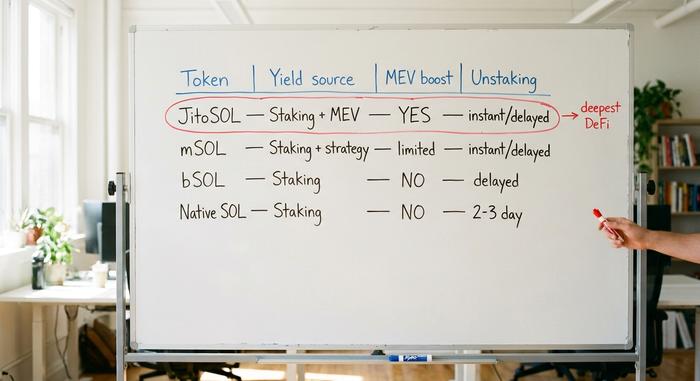
JitoSOL is not the only liquid staking token on Solana, and it is no longer the largest by market cap. That title recently passed to bnSOL. But JitoSOL still leads on something harder to copy: how deeply it is wired into Solana DeFi. Liquid staking now covers about 17.6% of all staked SOL as of Q4 2025, up from 11.6% a quarter earlier, so the whole category is still climbing.
| Token | Protocol | Yield source | MEV boost | Unstaking | DeFi depth |
|---|---|---|---|---|---|
| JitoSOL | Jito | Staking + MEV tips | Yes | Instant via DEX, or delayed | Very high |
| mSOL | Marinade | Staking + delegation strategy | Limited | Instant via DEX, or delayed | High |
| bSOL | BlazeStake | Staking only | No | Delayed | Medium |
| Native SOL | Direct staking | Staking only | No | 2-3 day cooldown | None (locked) |
The takeaway is simple. If you only want raw yield, several tokens land close together. If you want yield plus the freedom to use the token everywhere, JitoSOL's web of integrations is the real moat.
Inside Jito's MEV Engine: Bundles and Tips
For traders and developers, this is where Jito gets concrete. A bundle is a group of up to five transactions that execute atomically and in the exact order you set. All of them land, or none do. That guarantee is gold for arbitrage, liquidations, and any strategy where sequence decides the profit.
To get a bundle prioritized, you attach a tip, a separate payment on top of normal Solana fees. The Block Engine runs the auction, and the highest tips win the slot. It is a clean market for blockspace ordering, and the competition is fierce: searchers run their own infrastructure to spot opportunities milliseconds faster than rivals. Jito even offers a service called ShredStream that delivers transaction data to validators sooner, shaving precious latency. One choice along the way is worth knowing: in March 2024, Jito shut down its public mempool function after it was being used for sandwich attacks on ordinary users. The team chose to kill a profitable feature to protect the network's reputation, which tells you something about how they weigh the long game.
The Jito-Solana Validator Client and BAM
Scale is what makes Jito systemically important. By early 2025, the Jito-Solana client ran on around 92% of all staked SOL, based on the same Helius data. When nearly the entire network runs your software, you are not just a participant in Solana's block production. You are the plumbing.
In September 2025, Jito pushed further with the mainnet launch of BAM, the Block Assembly Marketplace. BAM rethinks how blocks get assembled on the Solana blockchain, aiming to make on-chain transaction ordering more transparent and to open new revenue from block building. It is the kind of upgrade that rarely makes headlines but changes how a chain works under the hood.
The JTO Token and the Jito DAO
JTO is the governance token, and it is worth being clear about what that means. Holding JTO does not pay you staking yield. It gives you a vote over the protocol, exercised through the Jito DAO. That is a different kind of value, and the market prices it that way.
| JTO metric | Value (June 2026) |
|---|---|
| Price | ~$0.53 |
| Market cap | ~$256M |
| Circulating supply | 482.2M JTO |
| Total supply | 1B JTO |
| Fully diluted value | ~$532M |
| Airdrop | Dec 7, 2023 (100M, 10% of supply) |
JTO trades far below its launch-day high near $6, per CoinGecko. The more interesting story is governance. In August 2025, the JIP-24 proposal suggested routing 100% of Block Engine fees to the DAO treasury, as CoinDesk reported. If the community wants the protocol to genuinely decentralize, that fee switch is where it gets decided. A token that controls Jito's real cash flow is worth more than one that controls a logo.
How JitoSOL, MEV, and JTO Connect in DeFi
Now the loop. More stake routed through Jito means more MEV captured. More MEV means a higher JitoSOL yield. Higher yield pulls in more stake, and JTO holders govern the fee switch that decides who keeps the surplus. It is a flywheel, and JitoSOL is the part that spins inside DeFi: posted as collateral to borrow against, paired in liquidity pools, and looped for leveraged yield. The token earns staking rewards while it works somewhere else, which is the entire pitch of liquid staking. A common move looks like this: stake SOL for JitoSOL, supply it to a lending market, borrow more SOL against it, and stake that too. The yield compounds, and so does the risk if SOL drops sharply.
Risks: Staking, Smart Contracts, and MEV
None of this is risk-free, and the risks come from both halves. On the staking side, JitoSOL can briefly trade below its true SOL value during market stress, a temporary depeg, and any liquid staking token carries smart-contract risk if the code is exploited. Validators can also be slashed for misbehavior, though that is rare.
The bigger, quieter risk is centralization. When one client runs about 92% of Solana's stake, a bug or a bad actor inside that software becomes a network-wide problem, not a Jito problem. That concentration is the trade-off for Jito's efficiency, and it is the part the cheerful threads tend to leave out. A healthy ecosystem needs client diversity. Right now Solana does not have much, and Jito's success is a big reason why. The Solana community has openly debated this, and rival clients like Frankendancer and the upcoming Firedancer exist partly to dilute that concentration. None of it makes JitoSOL a bad product. It just means the convenient choice and the healthy-for-the-network choice are not always the same, and that tension is worth holding onto before you commit capital.
How to Start With Jito Staking and Rewards
Getting JitoSOL is straightforward. Connect a Solana wallet to the Jito app, deposit SOL, and receive JitoSOL, your liquid stake, that starts earning immediately. You can also buy JitoSOL directly on a DEX if you would rather skip the deposit step. When you want out, swap back to SOL instantly on a DEX, or use the standard unstake and wait out the cooldown for the exact rate. JTO is a separate decision. You buy it only if you want a say in governance, not to collect the staking rewards.
What Jito's Rise Says About Solana
Jito did something genuinely clever: it took MEV, a hidden tax most users never noticed, and turned it into an open auction that pays part of the proceeds back to stakers. That is a real improvement over the old dark-forest model. But the same success concentrated an enormous share of Solana's block production inside one piece of software. So here is the question worth sitting with: when decentralized infrastructure wins purely on merit, at what point does its own dominance start to undercut the decentralization it was built to serve?