DefiLlama: the free DeFi analytics dashboard that replaced everything else
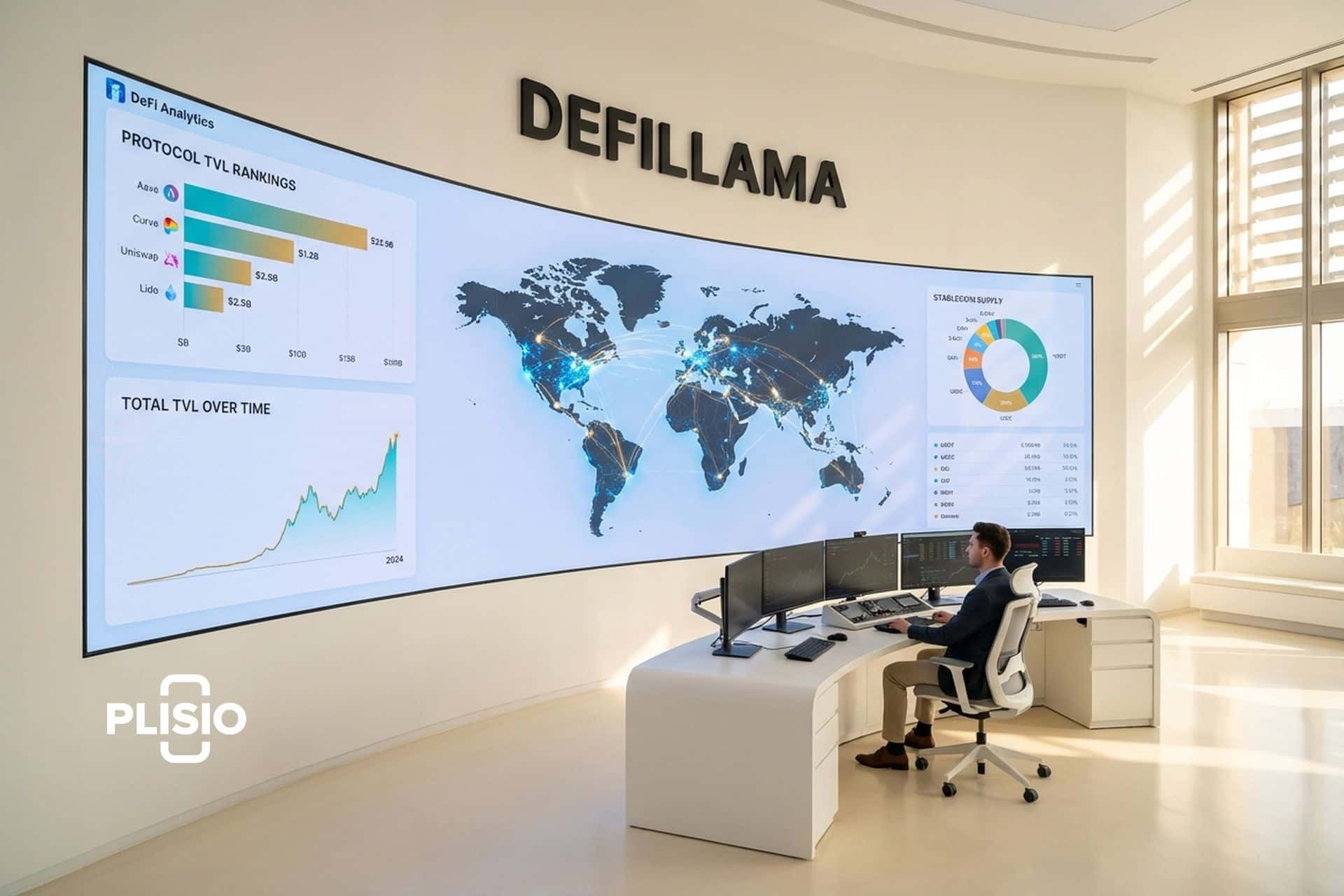
I keep DefiLlama open in a browser tab 18 hours a day. Not exaggerating. When I want to check which chain is gaining TVL this week, I open DefiLlama. When I need to find the best stablecoin yield across 200 protocols, DefiLlama. When a new project claims $500 million in TVL and I want to verify whether that number is real, DefiLlama. When the market crashes and I need to see which protocols are bleeding deposits in real time, guess where I go.
The platform tracks over 2,400 DeFi protocols across 180+ blockchains. It shows total value locked, yields, DEX volumes, stablecoin flows, bridge activity, protocol revenues, funding rounds, hacks, and token unlocks. All free. No ads. No token. No subscription. No login. Built by an anonymous developer who goes by 0xngmi and maintained by a community of open source contributors.
DefiLlama killed DeFi Pulse. It made most paid analytics dashboards feel overpriced. And in 2026 it remains the single most important tool in any DeFi trader's stack. Here is how to actually use it.
What DefiLlama tracks and why TVL matters
The core metric on DefiLlama is TVL: Total Value Locked. This number represents how much crypto is deposited in a DeFi protocol at any given moment. Aave has $25 billion TVL? That means $25 billion in assets sits in Aave's smart contracts, being lent, borrowed, or used as collateral.
TVL tells you three things about a protocol. First, confidence. People do not deposit billions into contracts they do not trust. High TVL signals that the market has vetted the protocol's security and usefulness. Second, liquidity. More TVL in a DEX means deeper pools and less slippage for traders. Third, trends. If a protocol's TVL is climbing, capital is flowing in. If it is dropping, people are pulling out. That directional movement often predicts price action.
What TVL does not tell you: profitability. A protocol can have $10 billion in TVL and still generate minimal revenue. TVL measures trust and usage, not whether the token is a good investment. DefiLlama shows both TVL and revenue data, which is why serious analysts use them together.
The homepage gives you the global picture. Total DeFi TVL across all chains and protocols. A chart showing the trend over time. A breakdown by chain showing how much lives on Ethereum versus Solana versus BSC versus Arbitrum. Below that, a ranked list of every tracked protocol with its TVL, chain, category, and 24-hour change.
| DefiLlama at a glance | Details |
|---|---|
| Protocols tracked | 2,400+ |
| Chains covered | 180+ |
| Total DeFi TVL (2026) | $90-100B+ |
| Price | Free |
| Token | None |
| Ads | None |
| Open source | Yes (GitHub) |
| API | Free, no key required |
The dashboards every DeFi trader should know
DefiLlama is not one tool. It is a dozen tools stitched together under one roof. Let me walk through the ones that actually matter for trading decisions.
Yields. This is my most-used dashboard. It aggregates APY data from hundreds of pools across every chain. Want the best stablecoin yield right now? Filter by USDC, sort by APY, and you get a ranked list showing which protocol on which chain pays the most. The data updates continuously. Pool sizes, historical APY trends, and audit status are all visible. I have found 8-12% stablecoin yields on audited protocols through this dashboard that I never would have discovered manually.
DEX Volume. Which decentralized exchanges are processing the most volume today? Uniswap versus PancakeSwap versus Raydium versus Aerodrome. The volume tracker breaks it down by chain, by DEX, by day/week/month. When a chain's DEX volume suddenly spikes, something is happening there worth investigating.
Stablecoins. Total stablecoin supply across every chain. Where is USDT concentrated? How fast is USDC growing on Base? Did any stablecoin's market cap drop suddenly (a potential depeg warning)? The stablecoin dashboard tracks supply, chain distribution, and price data for every major stablecoin.
Fees and Revenue. This is the one that separates DefiLlama from most competitors. It shows how much money protocols actually earn from fees. Aave might have $25 billion TVL, but how much revenue does that generate? The fees dashboard shows daily, weekly, and monthly revenue per protocol. Compare Uniswap's fee revenue to SushiSwap's and you immediately see which protocol has genuine product-market fit.
Raises. Every crypto funding round tracked in one place. Who raised money, from whom, how much, and when. Filter by category (DeFi, gaming, infrastructure), chain, or investor. When you see three protocols in the same category raise $50M+ in the same month, that category is about to get competitive.
Hacks. A complete database of every DeFi exploit, hack, and rug pull with the amount lost, the protocol affected, and the chain. Sorted by size and date. It is sobering reading. And it is useful: before depositing into any protocol, check the hacks database to see if it has been exploited before.
Unlocks. Token unlock schedules for projects that have vesting. When 10% of a token's supply unlocks next week, that sell pressure is coming whether the market is ready or not. The unlock calendar helps you avoid buying before a major unlock event.
LlamaSwap. DefiLlama built its own DEX aggregator. It routes swaps through multiple DEXs to find the best rate. Works like 1inch or Paraswap but integrated into the analytics platform. No fees on top of the DEX fees.
How I use DefiLlama for actual trading decisions
Let me give you three real workflows I run weekly.
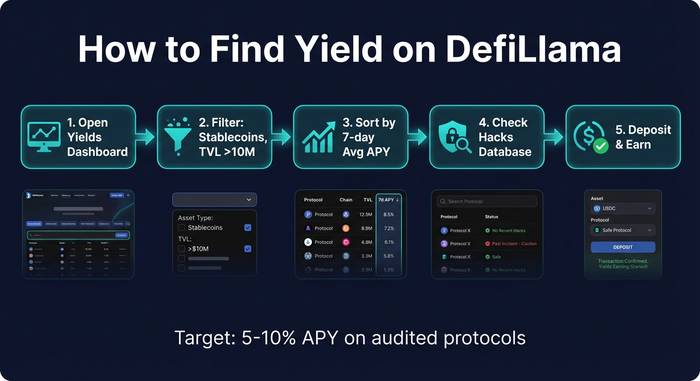
Workflow 1: finding yield. I open the Yields dashboard. Filter: stablecoin pools only. Minimum TVL: $10 million (anything smaller is too risky for serious capital). Sort by 7-day average APY. I ignore anything above 20% because that is usually unsustainable incentive farming. The sweet spot is 5-10% on audited protocols with stable TVL. I check the historical APY chart to confirm the yield has been consistent, not a one-week spike. Then I verify the protocol on the hacks dashboard. If clean, I deposit.
Workflow 2: tracking smart money. When a protocol's TVL jumps 15% in a day without an obvious reason (no announcement, no incentive program), someone is depositing large amounts. I check which chain it is on, look at the protocol's token price, and research what might be driving the inflow. Sometimes it is a whale positioning before a governance vote. Sometimes it is a new integration with a major protocol. The TVL movement leads me to opportunities I would not find on Twitter until days later.
Workflow 3: sell signals. If I hold a DeFi protocol's token and the TVL starts declining week over week while the overall market is flat or rising, that is a red flag. Capital leaving means users are losing confidence. I cross-reference with the fees dashboard. If revenue is dropping alongside TVL, the sell case gets stronger. TVL decline plus revenue decline in a flat market usually means the protocol is losing competitive ground.
The API: free data for developers and automated strategies
DefiLlama's API is genuinely free. No API key. No rate limit that a normal user would hit. No paywall behind "pro" features. The data that powers the entire website is accessible programmatically.
Base URL: https://api.llama.fi
Key endpoints:
- /tvl/{protocol} returns TVL for a specific protocol
- /chains returns TVL per chain
- /protocols returns all tracked protocols with metadata
- /yields/pools returns current yield data for every tracked pool
Developers build monitoring dashboards, trading bots, and research tools on top of this API. A quant fund might pull TVL data every hour to detect capital flows before they show up on the website. A DeFi aggregator might use the yield data to route user capital to the best opportunities automatically.
The API also powers third-party tools. CoinGecko, Token Terminal, and dozens of smaller analytics platforms pull data from DefiLlama's API. The open data model means the entire DeFi analytics ecosystem benefits from DefiLlama's protocol coverage.
DefiLlama vs other analytics platforms
The analytics space has multiple players. Here is where DefiLlama fits and where alternatives do things better.
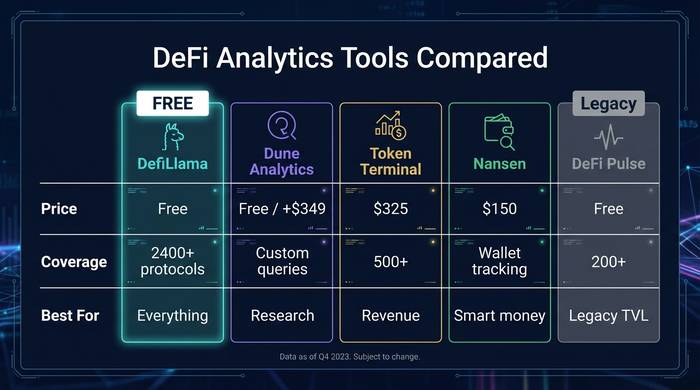
| Platform | Best for | Price | Unique strength |
|---|---|---|---|
| DefiLlama | TVL, yields, protocol metrics | Free | Broadest coverage, open source, no login |
| Dune Analytics | Custom queries, on-chain research | Free + paid ($349/mo) | SQL-based custom dashboards |
| Token Terminal | Financial metrics, revenue analysis | $325/mo+ | Traditional finance framing of crypto data |
| Nansen | Wallet tracking, smart money | $150/mo+ | Label database (knows which wallets belong to funds) |
| DeFi Pulse | TVL tracking (legacy) | Free | Was the original, now largely superseded |
DefiLlama wins on breadth and accessibility. Nobody else tracks 2,400+ protocols across 180+ chains for free. Dune wins if you need custom queries that DefiLlama does not support. Token Terminal wins if you think about DeFi protocols like stocks and want P/E ratios and revenue multiples. Nansen wins if you need to know which wallets belong to Paradigm or Jump Trading.
For 90% of DeFi users, DefiLlama covers everything they need. The 10% who need more are usually professional analysts, quant researchers, or institutional traders who also use Dune and Nansen alongside DefiLlama, not instead of it.
Why DefiLlama works: the 0xngmi model
Most crypto analytics platforms launch a token, run ads, or charge subscriptions. DefiLlama does none of these. The platform has no token. It runs no ads. It charges nothing. So how does it survive?
The answer involves LlamaCorp, the parent entity that also operates LlamaSwap (the DEX aggregator that earns referral fees), DefiLlama Pro (some premium API features for institutional users), and other revenue-generating products. The core analytics platform remains free and open source.
0xngmi, the anonymous founder, has been vocal about keeping DefiLlama independent and ad-free. The open source model means anyone can verify the data methodology, submit corrections, or add new protocol adapters. Protocols themselves often submit their TVL adapters to get listed.
The result is a platform that the DeFi community trusts more than any alternative. When there is a dispute about a protocol's real TVL, people check DefiLlama. When a chain claims its ecosystem is growing, the proof (or lack of it) lives on DefiLlama. It has become the de facto source of truth for decentralized finance data, and it achieved that position by giving everything away for free.
There was a brief controversy in early 2023 when 0xngmi and parts of the team had a disagreement about launching a token (LlamaSwap was the flashpoint). Some contributors forked the data and created a competing site briefly. The dispute resolved, no token was launched, and DefiLlama continued as a free, open source tool. The incident actually reinforced the community's trust: when the community rejected the token idea, the platform stayed token-free. That is rare in crypto.
I think the 0xngmi model is the most underrated business model in crypto. No token means no speculation-driven community that treats the project like a stock. No ads means no incentive to inflate metrics or promote partnered protocols. No subscription means the data has to be good enough that people voluntarily contribute protocol adapters and bug fixes. The whole thing runs on reputation and minimal revenue from adjacent products. It should not work. It does. And the DeFi ecosystem is better for it.
What DefiLlama tells you about the DeFi market right now
Some numbers from DefiLlama as of early 2026 that paint the current picture of decentralized finance:
Total DeFi TVL sits around $90-100 billion. Ethereum holds the majority at roughly $55-60 billion. Solana runs $7-9 billion. BNB Chain at $5-6 billion. Arbitrum and Base split the Layer 2 share. Tron carries a disproportionate amount because of USDT deposits.
The top 5 protocols by TVL: Lido (liquid staking, ~$17-20B), Aave (lending, ~$25-27B), EigenLayer (restaking, ~$8-9B), Maker/Sky (stablecoin, ~$5-6B), and Uniswap (DEX, ~$3-4B). These five alone account for over half of all DeFi TVL.
DEX monthly volumes have been running $100-200+ billion depending on market conditions. Stablecoin total supply crossed $300 billion. DeFi is not a niche experiment anymore. It is financial infrastructure processing real volume, and DefiLlama is where you go to measure it.