Akash Network Explained: Decentralized AI Cloud

Akash Network is the rare project in decentralized infrastructure that already ships a real, working product, and one of the few whose token chart tells you to stay careful anyway. You can rent a GPU on it today, run a model, and pay a fraction of what Amazon charges. Yet AKT trades more than 90% below its 2021 high, the network runs a few hundred GPUs against rivals with tens of thousands, and the AI-compute story told about Akash implies something far larger than the meters show.
That gap, between the pitch and the dashboard, is the most honest way into what Akash Network is and whether it matters. This guide covers how the marketplace works, what the AKT token does, how the AWS comparison holds up, and what the 2026 numbers actually say.
What Akash Network is, and what it isn't
Akash Network is a marketplace for cloud computing, not a cloud provider. It owns no servers and no GPUs. Instead, it is a Cosmos-based blockchain that matches people who have spare compute, the providers, with people who need it, the tenants, and settles the deal on-chain. The team calls the result a "supercloud": one open market stitched together from many independent data centers and operators rather than a single company's racks.
The pitch is straightforward. Traditional cloud is concentrated in a handful of hyperscalers, and a lot of server capacity sits idle. Akash turns that idle capacity into a permissionless service anyone can access, sell into, or buy from, with no account approval and no long-term contract. It is open-source software, built by Overclock Labs, with the main network live since 2020 and a dedicated GPU marketplace added in 2024 as demand shifted toward AI. Overclock Labs, founded by Greg Osuri and Adam Bozanich and seeded back in 2017, has leaned on one observation since the start: a large share of the world's server and GPU capacity sits idle most of the time, and a market can put it to work instead of letting it depreciate in a rack.
One housekeeping note, because the name is noisy: "Akash" is a common personal name, so search results mix in unrelated people and products. The Akash discussed here is the decentralized cloud and its AKT token, nothing else.
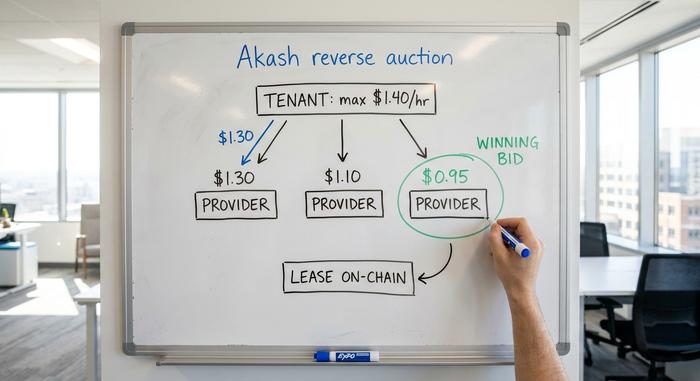
How the Akash decentralized cloud works
The clever part of Akash is the pricing. Most clouds publish a rate card and you take it. On Akash, the buyer sets the ceiling and the market bids underneath it. Everything else is plumbing around that one idea.
Providers, tenants, and the reverse auction
On Akash Network, a tenant writes a deployment file describing what they want to run and the maximum price they will pay, then posts it to the chain. Providers with spare capacity see the order and bid, competing to go lower. The tenant picks a winning bid, usually the cheapest acceptable one, and a lease is created on-chain. This is a reverse auction: instead of sellers naming a price and buyers accepting, buyers name a budget and sellers undercut each other to win the work. The blockchain records the lease and escrows payment; the actual workload runs off-chain on the provider's hardware.
Deploying with Docker and SDL
If you have ever shipped a Docker container, Akash's developer experience will feel familiar. You package your application as a container, then describe the resources it needs in a manifest written in SDL, the Stack Definition Language. You submit that through the command line or a graphical console, fund an escrow account, and the lease goes live. There is a learning curve if you are coming from a one-click host, but for anyone used to infrastructure-as-code it is a short one.
What you can actually run on it
In practice people run web apps, blockchain nodes, rendering jobs, and, increasingly, AI models. AkashML, a managed inference layer, serves open models such as Llama, DeepSeek, and Qwen, so you can hit an API instead of wiring up a GPU yourself. Real deployments back this up: privacy-focused services like Venice.ai and AI-agent frameworks such as ElizaOS have run production workloads on Akash rather than on a hyperscaler. The trade-off is that Akash is a young platform, and historically it has carried limits that a mature cloud does not, which we will get to.
How AKT secures the Akash network
AKT does four jobs. It secures the chain through staking, pays transaction fees, runs governance, and is meant to capture value from real network usage. The first three are standard Cosmos-chain mechanics. The fourth is where things get interesting, and thin.
What the AKT token does
AKT is the native token of the Akash blockchain. Validators and delegators stake it to secure the network and earn rewards. Holders vote with it. And underneath every lease, it works as the settlement and collateral asset. When the network takes a cut of a deployment, that cut can be paid in AKT, which is supposed to tie token demand to actual compute usage.
Staking, inflation, and real yield
Here the headline yield flatters the reality. Staking AKT pays roughly 7% a year in nominal terms, but the network also inflates supply by close to 9% annually to fund those rewards and security. Net the two and the real yield for a staker is close to zero; you are mostly being paid in freshly minted tokens to stand still. Circulating supply is about 292 million AKT against a 388.5 million cap, according to CoinGecko as of June 2026, so meaningful dilution is still ahead.
Take fees and the burn switch
Akash charges a take fee on deployments, around 4% when settled in AKT and higher, near 20%, when settled in stablecoins, which nudges users toward the native token. In March 2026 the network switched on a Burn-Mint Equilibrium mechanism designed to burn AKT as usage grows. The intent is sound; the scale is not there yet. In its first nine days the mechanism burned about 53,520 AKT, a rounding error against annual inflation. For the burn to matter, compute spend has to multiply many times over.
| AKT metric | Value (as of June 2026) |
|---|---|
| Price | ~$0.61 |
| Market cap / rank | ~$178M / #185 |
| Circulating / max supply | 292M / 388.5M |
| All-time high | $8.07 (Apr 2021), about −92% |
| Staking APY vs inflation | ~7% vs ~9% (real yield near zero) |
Akash for AI: GPU compute against AWS
The reason anyone talks about Akash in 2026 is GPUs. Training and serving AI models is expensive on the big clouds, and Akash undercuts them hard on the sticker price. Independent comparisons put an H100 on Akash in the rough neighborhood of $1.40 an hour against roughly $4.33 on-demand at AWS, and the network markets savings of 60% to 85% versus traditional providers. Those numbers are directional, because Akash pricing is dynamic and set by auction, but the direction is real. Supported hardware ranges from current data-center cards like the H100 and A100 down to older and consumer GPUs, so a small team can match the chip to the job instead of paying flagship rates for everything. For a startup serving an open model on a budget, that flexibility is the whole appeal.
The catch is everything that does not show up in the hourly rate. You are renting from independent providers, not a single vendor with global SLAs, enterprise support, and a compliance department. Availability of a specific GPU at a specific moment is not guaranteed, and you are trusting the operator with whatever runs on their box. For a hobbyist running inference, that is a fine deal. For a regulated enterprise, the cheaper hour can cost more in everything around it.
| GPU | Akash (approx) | AWS on-demand | Note |
|---|---|---|---|
| H100 | ~$1.40/hr | ~$4.33/hr | Akash rate is auction-set, varies |
| A100 | ~$1.00/hr | ~$3.00/hr | Availability depends on providers |

Akash Network usage and performance in 2026
This is the part the evergreen explainers leave out. The dashboard is where Akash gets honest about itself. Network spend grew quickly through 2025, reaching about $3.15 million for the year, up 128% from 2024, which sounds great until you notice how small the base is for something pitched against AWS. Measured in AKT rather than dollars the jump looked even louder, with spending up several-fold year over year, a reminder that percentage growth off a tiny base is easy to dress up.
Then early 2026 cracked. According to Messari, GPU utilization fell around 57% quarter-over-quarter to roughly a third of available capacity, and the average number of active providers dropped to a record low before recovering somewhat by mid-year. The slump tracked the broader cooling in AI-compute speculation through late 2025, as some capacity that had rushed in chasing rewards quietly churned back out. Reported revenue figures diverge depending on what you count: Messari tracked about $253,000 in on-chain lease fees for the first quarter, while Akash's own reporting cites several million in total compute spend. Both can be true. They measure different things: the on-chain fees the protocol takes versus gross spend across every deployment. Keep that gap in mind the next time a headline number flies past. The one clear bright spot is AkashML, which by early 2026 was serving on the order of 1.7 billion tokens a day through inference marketplaces, real demand rather than speculation.
| Metric | 2025 | Q1 2026 |
|---|---|---|
| Annual / quarterly network spend | ~$3.15M (full year, +128%) | ~$253K on-chain lease fees (Messari) |
| GPU utilization | — | ~34% (down ~57% QoQ) |
| Avg active providers | — | record low, ~58 |
| AKT price vs ATH | — | ~$0.61, about −92% |
Where Akash fits among AI compute networks
On raw hardware, Akash is not winning. Rival decentralized compute networks have raced to stack GPUs: io.net has advertised tens of thousands, and Aethir claims a fleet north of 40,000, against Akash's few hundred, while Render and Nosana crowd the same space from their own angles. If the contest is purely "who has the most H100s to rent," Akash loses that comparison badly, and pretending otherwise does no one any favors.
Its real edge is shape, not size. Akash is general-purpose and permissionless. It runs any Docker workload, not just GPU rentals, and it has been settling real leases for years instead of launching on a token and a roadmap. Whether that breadth beats raw GPU scale is the open question. For now Akash is the veteran with the better architecture story and the smaller scoreboard.
Getting started, and the real limitations
Trying Akash is easy; trusting it for production is the harder call. You can deploy in an afternoon if you know Docker, either through the web console or the CLI, and the cost savings are immediate. What you give up is the polish of a hyperscaler. Historically the platform carried per-deployment resource caps and lacked niceties like guaranteed unique IPs and native HTTPS, things the ecosystem has been steadily closing but that still surprise newcomers. And because workloads run on independent providers, sensitive data needs encryption and care you would not think twice about on a single trusted vendor. None of this makes Akash unusable. It makes it a tool with sharp edges, best matched to users who know what they are doing.
The bottom line on Akash Network
Akash is the most real product in decentralized compute and one of its least-hyped scoreboards, and both of those things are true at the same time, which I find more clarifying than disqualifying. It does something genuinely useful, cheaply, with open-source code and years of uptime behind it. It also runs a fraction of its competitors' hardware, pays stakers in inflation, and depends on a burn mechanism that needs far more usage than it has. The bull case is that AI inference demand is still young, and a cheaper, open venue eventually pulls real volume its way; the bear case is that enterprises never trust a marketplace with serious workloads, and the cheap GPUs stay a hobbyist corner. The open question for Akash Network is whether a permissionless marketplace can win compute when both scale and trust still favor centralized GPU farms. If you are looking at AKT, judge it on that question, not on the hourly price of an H100.