Render Crypto: RNDR, the Render Network and GPU Rendering
Here is the tension that makes render crypto interesting. The RENDER token trades around 85% below the peak it hit in 2024, yet the network behind it has quietly pushed past its 74-millionth rendered frame and keeps adding GPU nodes. The price chart and the usage chart are pointing in opposite directions. So the real question is not "will it pump" but something harder: is this a working business that rents out idle graphics cards, or a token riding the artificial intelligence narrative? This guide covers what render crypto actually is, how the Render Network works, the RNDR-to-RENDER move to Solana, what the token's numbers say, how it stacks up against cloud rendering and rival decentralized GPU projects, and whether the AI demand story holds.
What Render Crypto Is in Plain Terms
Render is not a coin that magically "renders" anything. It is a decentralized marketplace that connects people who need heavy graphics work done with people who own GPUs sitting idle. The RENDER token is simply the settlement layer that pays for the work.
Rendering is the process of turning 3D scenes into finished images or video, and it is brutally hardware-hungry. A single frame of a detailed animation can take hours on one machine, and a short film can need thousands of frames. Studios solve this by buying or renting expensive render farms; independent artists often just wait. The Render Network spreads that load across a global pool of graphics cards, so an artist can rent the GPU compute power of strangers instead of buying hardware. In return, GPU owners earn tokens for computing power they would otherwise leave idle. A gaming rig that sits dark while its owner sleeps can be quietly earning overnight.
The project sits in a category the industry now calls DePIN, short for decentralized physical infrastructure networks. It was founded by OTOY CEO Jules Urbach, the maker of OctaneRender, software that visual-effects studios already knew well. That heritage matters — Render did not arrive as a generic crypto idea looking for a use. It grew out of a rendering company that understood the problem first.
How the Render Network Actually Works
The clever part is coordinating supply and demand without a company in the middle taking the cut a cloud provider would. The network has to match jobs to hardware, prove the work was done, and release payment, all without anyone trusting anyone in particular.
Submitting a job and matching a GPU node
A creator packages a rendering or compute job and locks RENDER tokens to pay for it. The network routes that job to one or more node operators, the people running GPUs, sorted into tiers by reputation and reliability. A node with a long record of clean, fast work earns access to higher-value jobs, which gives operators a reason to behave. The heavy computation runs off-chain on the actual graphics cards, because no blockchain could process pixel data directly. Only the accounting, who did what and who gets paid, is recorded on-chain. This split, compute off-chain and settlement on-chain, is the standard pattern for serious decentralized GPU compute, and it is why the network can stay fast while the payments stay verifiable.
Proof of render and getting paid
Before any tokens change hands, the output is checked against the job that was requested. This proof-of-render step is what lets a stranger's GPU be trusted with paid work. During the interim stages, watermarking reduces the risk that someone walks off with a creator's unfinished assets. Payment is released only once the creator accepts the result; if something is wrong, a dispute can be opened instead.
Why this counts as DePIN
The reason this is DePIN and not just another token is that real hardware is doing real work. The network coordinates physical machines through software and pays for them with a cryptocurrency, which is a very different thing from a token whose only activity is being traded. Render reports more than 5,600 GPU nodes contributing since inception, according to the Render Foundation dashboard. That is the asset that does not show up on a price chart.
RNDR to RENDER: the ERC-20 to Solana Move
If you have ever been confused about whether the token is called RNDR or RENDER, you are not alone, and the answer is the single most important piece of history here. The migration changed the chain, the ticker, and part of the economics all at once.
The 2023 migration and why Solana
Render began life as RNDR, an ERC-20 token on Ethereum. The project ran an ICO in October 2017 at $0.25 per token, and the network reached its genesis mainnet on Ethereum in June 2019. Years later the community voted to move the token to Solana as an SPL asset, and that upgrade completed on November 2, 2023, with a 1:1 swap handled through the Wormhole bridge, per Render's own migration post. The stated reasons were Solana's speed and far lower fees, which matter when you are settling thousands of small payments. Legacy RNDR on Ethereum still exists in wallets, but RENDER on Solana is the version the Foundation now maintains.
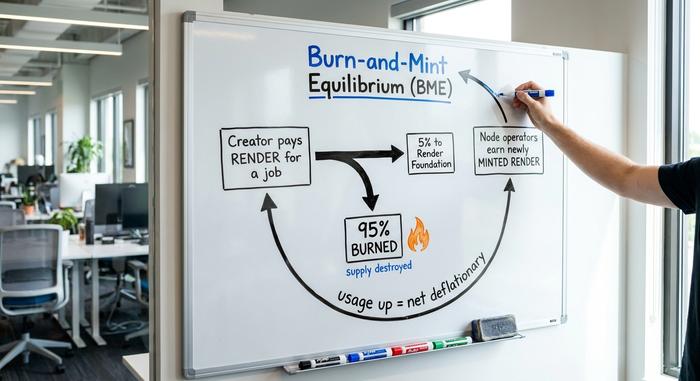
Burn-and-mint equilibrium, explained
The token economics run on a model called burn-and-mint equilibrium, or BME. When a creator pays for completed work, the tokens used are mostly burned, removed from supply, while a small share funds the Render Network Foundation. Node operators are then paid in freshly minted tokens. The design intends a balance: as real usage rises, more tokens are burned than minted, which makes RENDER net deflationary when the network is busy. The mechanism is not just theory. The network reached its one-millionth RENDER burned around December 2025, and burn activity was up sharply year over year, a rare case of on-chain proof that people are paying for actual rendering rather than only speculating. It is worth being precise about what this does and does not do. Burning ties supply to usage, so heavy demand can make the token scarcer over time. It does not guarantee the price rises, because supply is only one side of the equation and the market sets the other. A token can burn steadily and still fall if buyers lose interest faster than supply shrinks, which is roughly what the chart has shown.
RENDER Token Price, Supply and Market Cap
This is where render crypto's two charts collide. The render price as of June 2026 sits near $2.02, giving it a market cap of roughly $1.05 billion and a rank somewhere in the mid-50s to high-60s among all cryptocurrencies, according to CoinGecko. The circulating supply of RENDER is about 518.7 million against a maximum near 644 million. The all-time high was $13.60 on March 17, 2024, which means the token is down roughly 85% from that peak even after the network kept growing.
| RENDER token | Value (as of June 2026) |
|---|---|
| Price | ~$2.02 |
| Market cap | ~$1.05 billion |
| Market rank | ~#56-68 |
| Circulating supply | ~518.7M RENDER |
| Max supply | ~644M RENDER |
| All-time high | $13.60 (Mar 17, 2024) |
| Decline from ATH | ~85% |
That ATH was set during the first wave of AI-compute excitement, when anything touching GPUs was bid up. The slow grind down since then is the market repricing a story that got ahead of itself, while the underlying rendering work carried on at its own pace.
Render vs Cloud Rendering and DePIN Rivals
The easy pitch for render crypto is cheaper-than-AWS. For batch rendering, tapping idle consumer GPUs can undercut a centralized cloud provider, because those machines are already bought and paid for and their owners treat any income as a bonus. Cloud rendering on Amazon or Google bills you for dedicated, always-on capacity; Render bills you for spare capacity.
The harder fight is against other decentralized GPU networks. Render is not the raw-compute leader in DePIN. Akash Network and io.net both chase general AI and machine-learning compute, and on pure hardware numbers they are competitive. Akash's market cap sits near $222 million as of June 2026, a fraction of Render's, according to CoinGecko, yet it posts higher GPU utilization, which tells you market cap and real usage are not the same thing in this sector. The table below shows the rough shape of the field.
| Network | Market cap (Jun 2026) | Primary focus | GPU / usage signal |
|---|---|---|---|
| Render (RENDER) | ~$1.05B | 3D rendering, expanding to AI | 74M+ frames, 5,600+ nodes |
| Akash (AKT) | ~$222M | General cloud and AI compute | ~60% GPU utilization, record spend in early 2026 |
| io.net (IO) | ~$57M | AI/ML GPU clusters | tens of thousands of GPUs |
What this table hides is that Render carries the largest market cap of the three despite a narrower core use case. Its edge is not raw GPU count; it is the creative and entertainment heritage, the OTOY and OctaneRender pipeline that real studios already use. That distribution advantage is real: an artist who already works in OctaneRender can reach the network without learning a new tool, which is a softer moat than raw price but a stickier one. In a pure AI-compute race, though, Akash's utilization rate and io.net's GPU volume arguably give them stronger near-term footing, because AI buyers care about available capacity and price per hour, not about a rendering pedigree. Render is betting its rendering roots translate into the AI era; that bet is not yet proven.

The AI Compute Pivot and the Render Team
Here is where I get cautious. The AI pivot is real and it is sensible, but the valuation is running well ahead of the revenue. This looks like a sentiment trade wearing the costume of an infrastructure trade.
RNP-019 and the Dispersed subnet
The Render team did not just bolt "AI" onto a press release. A formal governance proposal, RNP-019, passed in April 2025 to extend the network beyond 3D rendering into general and AI compute. The follow-through was the Dispersed subnet, unveiled at Solana's Breakpoint conference in December 2025. The direction is coherent: the same idle-GPU model that renders a frame can, in principle, run an inference job or a generative AI workload. The catch is timing. Dispersed launched into a limited regional rollout with no confirmed full-launch date, so the AI revenue is mostly ahead of the network, not behind it.
Does the AI demand story hold up?
Run the math and the gap is hard to ignore. Estimates put the network's annualized revenue in the low single-digit millions of dollars against a market cap near a billion, which implies a revenue multiple in the hundreds. Price-prediction sites are happy to fill the void, floating ranges like $5 to $18 for 2026 and $62 to $100 by 2030, but those numbers are sentiment dressed as forecasts; none are built on rendering fees. My honest read: the usage story is worth respecting, the price-target story is not. Decentralized GPU computing is a genuine market, and Render has a real claim on the creative slice of it. Whether that justifies today's valuation is a different question, and the answer depends almost entirely on AI demand the network has not captured yet. It is also worth remembering that the broader AI-compute bet is crowded. Centralized providers are pouring tens of billions into GPU data centers, and the decentralized challengers are fighting for the overflow. Render's advantage in that fight is narrow and specific: it already has paying creative users. The risk is that AI compute turns out to be a commodity, where the cheapest capacity wins and heritage counts for little.
Render Crypto: Hype, Usage and the Gap
Render crypto is best understood as a real network with real graphics cards and a working burn mechanic, wrapped in a token whose price is set more by the AI narrative than by what the network earns today. The decentralized GPU model is sound, the Solana move and BME give it cleaner economics, and the frames keep getting rendered. The valuation is the part that asks for faith. If you want to judge this project honestly, watch the numbers that are hard to fake — frames rendered and tokens burned — more closely than the daily price. The open question is simple: when the AI-compute demand finally shows up at scale, will it arrive at Render, or at the rivals already optimized for it?