Suno AI Music: Crypto Payments, NFTs, and Royalties

Making a song used to require a band, a studio, or at least a few years with a guitar. Now it takes a sentence. Type "melancholy lo-fi track about missing the last train home" into Suno AI and ninety seconds later you have vocals, lyrics, and a full mix. The hard part is no longer creation. It's what happens when you try to get paid. Who owns that song? How do you charge for it without handing a card processor a cut of every sale? And can crypto rails do for AI music what streaming royalties have failed to do? Those are money questions, not music questions, and Suno put them in front of millions of people who never expected to ask them.
How the Suno AI Music Generator Actually Works
Suno is a generative AI system that turns text into complete songs. It was built by four researchers who met at Kensho, an AI analytics firm: Mikey Shulman, Georg Kucsko, Martin Camacho, and Keenan Freyberg. They started with an open-source text-to-speech model called Bark in 2023, then pivoted to full music. By the time the V3 model arrived in March 2024, a free account could produce a four-minute track. V4 followed that November, and the V5 line landed through 2026. The platform now generates around 7 million tracks a day, a number that tells you this stopped being a novelty a while ago.
From a single text prompt to a full song
The core loop is simple enough that a ten-year-old can use it. You write a prompt describing mood, genre, and subject, and the model returns a full song with synth lines, drums, and a vocal performance singing AI-written lyrics. You can supply your own lyrics instead, pick a genre, or let it invent one. There is no instrument to learn and no session to book. That accessibility is the whole point, and it's also the reason the songwriter's role is suddenly up for debate. When making any song you can imagine costs nothing and takes seconds, scarcity moves somewhere else.
Suno Studio, stems, and remix tools
For people who want more than a one-shot generation, Suno added editing tools. Suno Studio, released in September 2025, works like a lightweight digital audio workstation in the browser. Paid users can split a track into as many as twelve time-aligned WAV stems, swap sections, rewrite lyrics, and remix what the model produced. There is MIDI export and a feature that lets you build reusable voice "personas." This matters for monetization later: stems and editable projects are the difference between a disposable clip and something you can actually license or sell.
What Suno Costs: Free, Pro, and Premier Plans
Suno AI's free tier is generous on purpose. You get roughly ten songs a day at no charge, which is enough to get hooked and not enough to build a business. The catch is rights. Songs made on the free plan come with no commercial license, so you cannot legally sell them or run ads against them. The actual product Suno sells is permission.
| Plan | Price (approx.) | Songs per month | Commercial rights | Suno Studio |
|---|---|---|---|---|
| Free | $0 | ~10 per day | No | No |
| Pro | $10/mo | 500 | Yes | No |
| Premier | $30/mo | 2,000 | Yes | Yes |
The strategy is working. Suno reported more than 2 million paying subscribers and about $300 million in annual recurring revenue by early 2026, up 404% year over year, according to Tech Funding News. The same reporting pegged a fresh raise of $400 million at a $5.4 billion valuation. For scale, one 2026 industry estimate put the entire AI music market at $5.55 billion, growing roughly 24% a year, so Suno's revenue alone is a meaningful slice of its own category. People are paying, and most of what they are paying for is the right to use suno output as their own.
Paying for Suno AI Subscriptions With Crypto
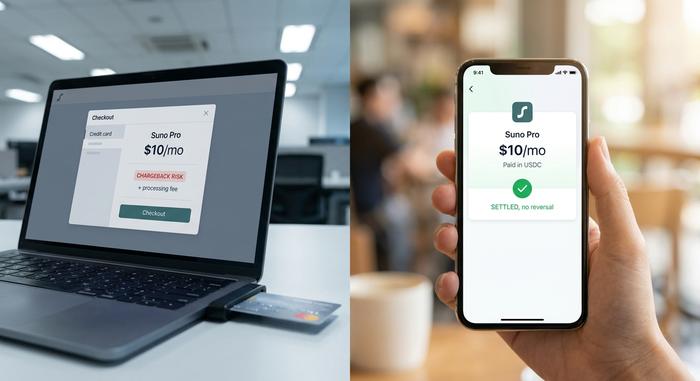
Recurring software subscriptions billed to a global user base are exactly the use case stablecoin payments were built for. Suno users sit all over the world, card acceptance is uneven outside the US and Europe, and every monthly charge feeds a processing fee to a card network. Crypto rails change that math, and as of 2025 the infrastructure is no longer theoretical.
Why crypto fits AI subscriptions
A stablecoin payment settles the same whether the buyer is in Lagos or Lisbon, and it doesn't require a card the buyer may not have. For the merchant, the bigger draw is cost and finality. Stablecoin transactions can run roughly half the cost of card processing, and once settled they don't reverse, so there are no chargebacks to fight. For a digital product with near-zero marginal cost, like an AI song subscription, shaving payment fees flows almost directly to margin.
Stablecoins, Stripe, and gateways like Plisio
In October 2025, Stripe launched stablecoin subscription billing in USDC on the Base and Polygon networks, the first time a mainstream processor let companies charge recurring crypto payments at scale. Stablecoins moved roughly $33 trillion in 2025, a 72% jump on the year. You don't need to be a payments giant to use any of this. A crypto payment gateway lets a SaaS product bill customers in Bitcoin, USDT, or other coins and convert at settlement, which is how a tool like Suno could in principle accept crypto without touching a bank. Plisio is one such gateway built for exactly that kind of checkout. The honest caveat: Suno does not publicly offer a crypto checkout today. The rails exist; the merchant has to flip the switch.
Making Money When You Make Music With AI
Generating a Suno AI track is free and instant. Getting paid for it is neither, and this is where AI music keeps breaking. Distribution platforms will happily take your song. The trouble is that everyone else's song is there too, and the payout per stream was already tiny before the flood.
Streaming royalties and the flood problem
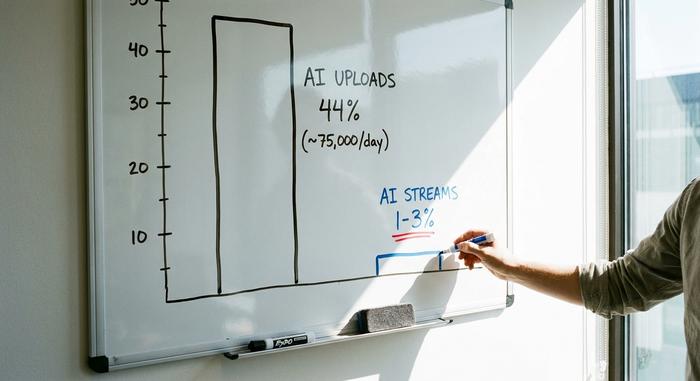
The scale of the flood is hard to overstate. By April 2026, the streaming service Deezer reported that AI-generated tracks made up about 44% of daily uploads, roughly 75,000 songs a day, yet those tracks drew only 1% to 3% of actual streams. Spotify pays somewhere in the range of a third of a cent to half a cent per stream, so a song needs hundreds of thousands of plays to earn real money. When you make music with AI at near-zero cost, you can upload endlessly, but so can everyone, and the listener attention to pay for it all does not multiply. Volume is not a strategy when the channel is already drowning.
Music NFTs and on-chain royalties
This is why some creators went looking for crypto-native models. A music NFT ties a track, or a share of its royalties, to a token on a blockchain, and the resale terms can be written into the token itself, so the original creator keeps earning when it changes hands. Platforms such as Audius, Royal, and Sound.xyz built around this idea, selling limited song editions and royalty splits directly to fans. The market is real but small, and the figures conflict: conservative estimates put music NFTs around $184 million, while broader counts reach into the billions. The pitch is control rather than scale. Instead of fractions of a cent from a platform, you sell directly and program the royalty.
| Route | Payout speed | Fees | Royalty control | The catch |
|---|---|---|---|---|
| Streaming (Spotify, Deezer) | Slow, monthly | Distributor cut | Low | Cents per stream, AI flood |
| Sync licensing | Per deal | Agency cut | Medium | Hard to land without a catalog |
| Music NFT | Instant on sale | Gas + platform | High, programmable | Small market, needs a fanbase |
| Direct crypto tips | Instant | Near-zero | Full | You bring your own audience |
Who Owns It? Copyright and Suno AI Music
Here is the problem that sits underneath every monetization idea above: you cannot tokenize, license, or exclusively sell what you don't own. And under current US law, a purely AI-generated song may be something nobody owns.
In January 2025, the US Copyright Office published guidance stating that a prompt alone is not enough to make a human the author of an AI output. Music generated entirely from a text prompt, with no meaningful human authorship, is not copyrightable. Suno's Pro and Premier plans grant you contractual commercial rights, meaning the company agrees not to come after you for selling your tracks. That is not the same as copyright. A contract from Suno does not stop a stranger from reposting your song, because there may be no underlying exclusive right to enforce. An NFT of an uncopyrightable track is a receipt, not a deed. If you want a song you can defend, you generally need to add real human authorship: write the lyrics, rework the arrangement in Studio, edit the stems into something that is yours.
The Suno and Udio Lawsuits, Explained
The legal cloud over Suno AI is genuine, but it has been resolving in a direction that quietly legitimizes the whole business. In June 2024, the Recording Industry Association of America sued both Suno and rival Udio for copyright infringement, alleging the models were trained on copyrighted recordings and seeking damages of up to $150,000 per work. For a year it looked like an existential threat.
Then the deals started. Universal Music Group settled with Udio in October 2025, agreeing to an opt-in royalty model and a planned joint AI music service. In November 2025, Warner Music Group settled with Suno in a deal reported around $500 million that gives Suno licensed access to Warner's catalog for training. Suno also acquired Songkick, a concert-discovery platform, from Warner the same month. Sony has not settled and continues to litigate against Suno, which means a fair-use ruling could still arrive and set precedent for the entire sector. The pattern so far, though, is licensing rather than shutdown. The labels appear to have decided it is better to get paid than to win.
Is Suno AI Music Worth Paying For?
Treated as a tool, yes. Treated as a business foundation, be careful — and I keep landing on that same split every time I test it. The output is competent and fast, which is exactly what you want for jingles, background music, demos, and ideas. It is also, as one reviewer put it, a bit like clip art for music: ask for five genres and it tends to drift toward the same polished, slightly generic feel. The cracks show on anything that needs real originality. If you are a creator who owns the monetization stack and treats Suno as one input, a Pro plan pays for itself. If you are betting a company on selling songs you may not legally own, the math is shakier than the marketing suggests.
What Suno AI Music Means for Your Money
The two ends of the Suno AI story are solved. You can make a studio-quality song from a sentence, and you can get paid in stablecoins that settle in seconds anywhere on earth. The unsolved part is the middle — ownership. Until copyright catches up, the most valuable thing you can add to an AI song is yourself, the human authorship that turns a generated clip into an asset you can actually defend, license, or tokenize. Watch the Sony case this year, because the ruling will shape what an AI song is worth. And before you mint one, ask the unglamorous question first: can I prove this is mine to sell?