NFT Meaning: The Non-Fungible Token Guide for 2026
NFTs arrived like a supernova in 2021 and then imploded. Trading volume jumped from $82 million in 2020 to $17 billion in 2021. Then by May 2022, volume was down 92% from its September 2021 peak. By September 2023, one widely-cited report claimed 95% of NFTs had fallen to zero value. The people who got out early made generational money. The people who bought the top are still holding JPEGs most buyers ignore.
But saying "NFTs are dead" in 2026 is also wrong. The market is smaller, quieter, and more functional. 2025 recorded $5.6 billion in NFT sales. Q3 2025 saw $1.6 billion in volume, up 45% quarter over quarter. Pudgy Penguins sold over $13 million in physical plush toys through Walmart and its PENGU token hit a $1.2 billion market cap. Real-world asset tokenization hit $26.4 billion on-chain by March 2026, four times the prior year. Nike made more than $185 million from NFTs before winding down its RTFKT brand in December 2025.
So the NFT meaning question is not just "what does it stand for." It is also: what are NFTs actually for in 2026, who is using them, and how do you interact with them without losing money? This guide covers the full picture.
The meaning of NFT explained simply
So first up. NFT stands for non-fungible token. That's literally it. That phrase is the meaning of NFT at its absolute simplest.
But what does it actually mean in practice? Break down the three words, one at a time. "Non-fungible." That's the heart of it. Something's fungible when you can swap any unit for another identical unit without anything changing. Pull a $20 from your pocket. Swap with a friend's $20. Same result. Fungible. Non-fungible flips it. Every single unit is different, not interchangeable. Your specific car. A specific painting. An apartment at one specific address. You can't trade one for another without changing what you actually own. Then "token." Just a digital record that sits on a blockchain. One of the cryptographic tokens that make Web3 apps possible. Stick the two pieces together? You get an NFT: a unique digital asset stored on a blockchain, which proves a specific digital thing (or sometimes a physical one) belongs to a specific wallet. You get verifiable proof of ownership on-chain.
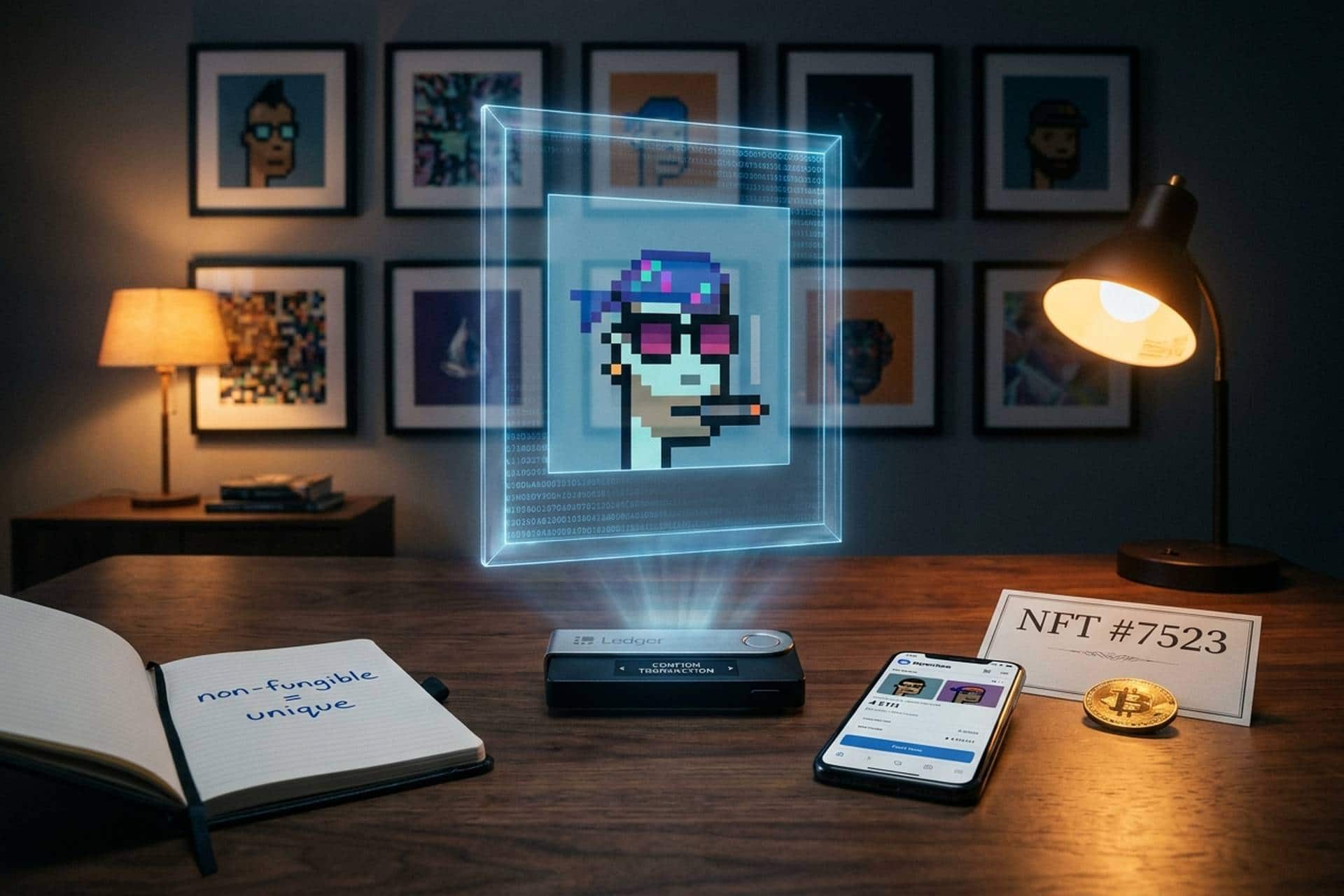
OK so what do NFTs actually represent today, in the wild? Really, just a handful of things. Digital art. A character in some game. A membership pass for an online community. A domain name, like yourname.eth. Trading cards style collectibles. And increasingly, a claim on a real-world asset. Put simply: NFTs represent unique claims on specific digital content recorded on a blockchain. Inside a well-designed collection, no two NFTs are ever identical. CryptoPunk #7523 is not CryptoPunk #3100. Same project name on the box, sure. Different on-chain IDs though. Different metadata. Different transaction history. Different price.
Keep one line for later: an NFT is a blockchain-verified certificate of ownership for a specific digital item.
How NFTs work on blockchains and crypto rails
Under the hood, NFTs run on blockchain technology across networks like Ethereum, Solana, Polygon, Base, and increasingly Bitcoin via Ordinals. Each blockchain acts as a decentralized digital ledger, permanently storing every transaction. Most NFTs are built on standardized smart contract templates, so wallets and any NFT marketplace can recognize them consistently without extra work.
On Ethereum, two standards dominate. ERC-721 and ERC-1155. ERC-721 was formalized in 2018 by William Entriken and a few co-authors, and it defines each token as fully unique. One token, one owner, one ID. Simple. ERC-1155 came later. It allows semi-fungible tokens, which matters for game items, you might have 1,000 identical swords but also exactly one unique legendary weapon. Solana does its own thing with the SPL (Solana Program Library) standard. Bitcoin's Ordinals protocol goes another direction again, inscribing data directly onto individual satoshis.
When someone creates an NFT, they "mint" it. Minting writes the token onto the blockchain, usually along with metadata: a pointer to the image or media, the creator's wallet address, the date, the attributes. Ownership is public and permanent. Send my NFT to you? The blockchain records that transfer instantly. You now own it. Anyone on Earth can verify. Collections built on blockchain technology this way can decentralize art and collectibles markets in ways Web2 platforms never pulled off.
The image itself often sits off-chain, on IPFS or Arweave (decentralized storage networks), because on-chain storage gets expensive fast. Some newer collections go fully on-chain. Either way, the token links cryptographically back to the content.
Fungible vs non-fungible: the core difference
Quick mental test. Swap one Bitcoin for another Bitcoin? Nothing changes. Both fungible. Swap one CryptoPunk for another CryptoPunk? You now own a different piece of art, different visual traits, different market price. Non-fungible.
Cryptocurrency tokens like BTC, ETH, SOL, USDT are all fungible. Every unit is identical and interchangeable. That's exactly what makes them useful as money. Non-fungible tokens are the flip of that. Their value comes from being unique, or at least scarce within a defined collection.
The line gets blurry in some cases. Take ERC-1155 tokens: depending on how they're designed, they can be fully fungible, semi-fungible, or fully non-fungible. Game items live in that messy middle. A common health potion is fungible (every one identical). A legendary sword is not. But when someone says "NFT" in casual conversation, they almost always mean the one-of-one variant, a specific collectible or access pass. Not some interchangeable commodity token.
Examples of NFTs: art, gaming, domains
Here are the real-world examples of NFTs you'll actually run into out there.
- Digital art. The original category, and still the biggest. NFT digital art dragged the art world on-chain almost overnight back in 2021. Beeple's "Everydays: The First 5000 Days" is the flagship example. That single piece of art sold at Christie's for $69.3 million in March 2021, and that sale is what pushed NFTs into mainstream attention in the first place. Pak's "Merge" went even higher, reaching $91.8 million, which still holds the record for the highest recorded NFT price. The value of an NFT from artists like these basically set the pricing floor for the rest of the art NFT segment.
- Profile picture (PFP) collections. CryptoPunks (launched April 2017). Bored Ape Yacht Club. Azuki, Pudgy Penguins, DeGods, Milady. Each one is a set of roughly 10,000 algorithmically generated avatars, and most owners use them as social media profile pictures.
- Gaming items. Axie Infinity monsters. Sorare football cards. Gods Unchained game pieces. Items in pretty much every Web3 game out there.
- Music NFTs. Kings of Leon released their 2021 album as an NFT, which was a first. Platforms like Sound and Catalog host music drops for independent artists.
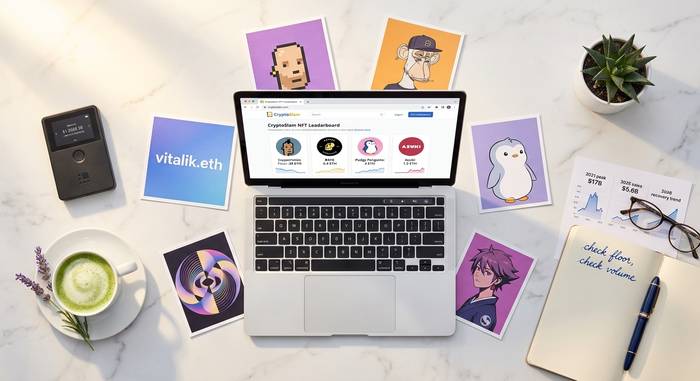
- Domains. ENS (Ethereum Name Service) and Unstoppable Domains issue NFTs that act as human-readable wallet addresses. Think "vitalik.eth" instead of a long hex string.
- Tickets. Event passes for concerts, sports, and conferences, all with blockchain-backed authenticity baked in.
- Real-world assets (RWAs). Tokenized real estate. Art. Luxury goods. Debt instruments. Fastest-growing segment right now, with $26.4 billion on-chain as of March 2026.
Most of these still exist today. Some thrive. Some survive. Some are basically dead code that nobody has bothered to remove.
Use cases of NFTs in 2026 and beyond
Use cases of NFTs have narrowed and matured since the 2021 hype cycle. NFTs can be used across gaming, ticketing, membership, and tokenized real-world assets. The strongest NFT projects and NFT platforms are the ones where the token actually does something. The ones that stuck have consistent utility beyond speculation.
- Community membership and access. Bored Ape Yacht Club pioneered the "NFT as club membership" model. Owning the NFT unlocks events, airdrops, merch. Pudgy Penguins evolved this into a full consumer brand with plush toys on Walmart shelves.
- Digital identity and domains. ENS records are used by millions as Ethereum username equivalents.
- RWA tokenization. The fastest-growing serious use case in 2026. Franklin Templeton's tokenized money market fund BENJI hit $1.5 billion. Ondo's tokenized stocks surpassed $7 billion cumulative trading volume. Real estate, private credit, and carbon credits are active categories.
- Gaming and virtual worlds. NFT-based game items and virtual land persist, though at much smaller scale than 2021 projections. Axie Infinity and The Sandbox retain active user bases.
- Ticketing and IP rights. Event organizers and musicians use NFTs for primary sales plus royalty flows on resales.
- Brand loyalty. Nike earned $185 million+ from RTFKT and its .SWOOSH program before shutting RTFKT in December 2025. Adidas earned roughly $10.9 million, Gucci $11.6 million. Starbucks Odyssey closed in March 2024. The takeaway: brand NFTs work for some, not for most.
What does not work anymore as a use case: pure speculative JPEG trading on thin liquidity. That era is over. What works: utility plus community plus stable infrastructure.
The NFTs market today: collapse and recovery
Here is the honest numerical state of the NFT market in April 2026. After the 2021 NFT boom and the 2022 NFT craze reversed, NFT sales settled into a smaller but more functional baseline.
| Metric | Value |
|---|---|
| Total NFT market cap | ~$1.5 billion (down ~95% from 2021 peak) |
| 2025 full-year sales | $5.6 billion |
| 2025 YoY sales change | -37% |
| Q3 2025 sales | $1.6 billion (+45% QoQ) |
| Q1 2026 ETH monthly avg volume | $720 million |
| Q1 2026 ETH unique buyers | ~216,000/month |
| Share of collections considered "dead" | 96% overall, 98% of 2024 launches |
| Average NFT sale price | $96 (down from $124 in 2024) |
Read these numbers carefully. The market is 95% smaller than its peak. Most collections are effectively worthless. But there is a functional core (OpenSea, blue-chip collections, major PFP projects, tokenized real-world assets) that is actually recovering since mid-2025. If you zoom out past the 2021 bubble and look at where NFTs are today versus three years ago, the picture is "smaller and saner," not "zero."
Top NFT collections and floor prices 2026
These are the collections still trading with real liquidity as of April 2026. Floor price means the cheapest listing in the collection.
| Collection | Floor (approx.) | In USD |
|---|---|---|
| CryptoPunks | ~29 ETH | ~$65,000 |
| Bored Ape Yacht Club | ~6.4 ETH | ~$14,300 |
| Pudgy Penguins | ~4 ETH | ~$9,000 |
| Azuki | ~1.5 ETH | ~$3,400 |
| Mutant Ape Yacht Club | ~0.7 ETH | ~$1,570 |
| Doodles | ~0.4 ETH | ~$900 |
CryptoPunks remains the blue-chip benchmark, the de facto first NFT collection that most collectors still reference. The highest-ever Punk sale remains #5822 at $23 million (February 2022). #7523, the "Covid Alien" Punk, sold for $11.75 million at Sotheby's in 2021. Each Punk NFT represents a distinct piece of art with distinct traits, and buying an NFT from this set is as close to owning an original on the blockchain as the NFT market gets. The NFT marketplace OpenSea still lists the largest share of Punk activity.
Pudgy Penguins has been the 2024-2025 outlier success story, transitioning from a mid-tier PFP collection into a genuine consumer brand. Their PENGU token reached $1.2 billion market cap, and their physical toy line generated $13+ million in Walmart sales. That is unusual. Most PFP collections have flat or declining floors.
How to buy NFTs: step-by-step guide
Want to buy and sell NFTs? Or just buy an NFT for the first time in 2026? Here's the clean path. Same flow applies whether you plan on selling NFTs later or just holding one.
1. Pick a blockchain first. For mainstream collections, Ethereum. For cheaper mints, Solana or Base.
2. Set up a wallet. MetaMask or Rainbow work for Ethereum. Phantom for Solana. Both free. Write the seed phrase down on paper, not in a screenshot.
3. Fund the wallet. Buy ETH or SOL on Coinbase, Kraken, or Binance. Then withdraw to your wallet address.
4. Pick a marketplace. OpenSea for Ethereum (67% market share). Blur if you're an active ETH trader. Magic Eden for Solana and cross-chain.
5. Browse. Verify. Check the collection's verified status, total volume, holder count, Twitter activity. Confirm the contract address on the project's official site.
6. Place a bid or buy now. Review the gas cost before hitting confirm. Ethereum gas on a mint or transfer can hit $10-100+ depending on congestion. Solana gas is usually $0.001 or less.
7. Confirm the transaction in your wallet. Wait for blockchain confirmation. Solana clears in 30 seconds. Ethereum takes 1-3 minutes.
8. View the NFT inside your wallet or on the marketplace. Double-check the transaction on Etherscan or Solscan.
Mint cost for brand new projects varies wildly. On Ethereum, minting an NFT can run $70-300 combined between mint price and gas. Same mint on Solana? Usually under $1. For a first NFT purchase, start with Solana or Base. Keeps the learning cost low while you make your early mistakes.
Choosing a crypto wallet and digital asset storage
Your NFTs live inside a crypto wallet. And wallet choice matters way more than most beginners think.
Three tiers, basically:
- Hot wallets like MetaMask, Phantom, Rainbow. Free browser and mobile apps. Fine for active trading and small holdings. But vulnerable to phishing if you're not careful with what you sign.
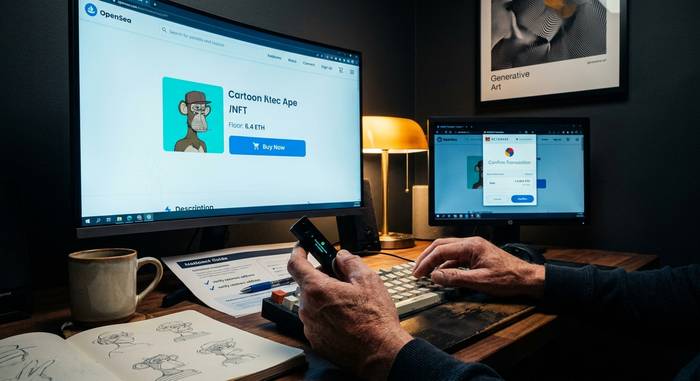
- Hardware wallets like Ledger or Trezor. Physical devices that store your keys offline. You sign transactions through USB or Bluetooth. Recommended for any NFT worth more than about $1,000. Ledger Nano X and Ledger Flex are the current consumer standards.
- Multisig wallets like Safe or Gnosis. Require multiple signatures for any transfer. Mostly used by high-value collectors and DAOs.
Here's the rule for anything you plan to hold past a few weeks: use a hardware wallet. The most common NFT losses in 2024-2025 weren't hacks. They were social engineering. Someone tricks you into signing a bad transaction with a hot wallet, and your NFT vanishes. Hardware wallets force physical confirmation on every transfer. That single step blocks most phishing attacks cold.
One backup rule that saves more wallets than anything else: write your seed phrase on paper on day one. Stamp it on a steel plate if you can. Store in two separate physical locations. Never photograph it. Never type it into any website, no matter what. That habit alone prevents most wallet losses.
Benefits of NFTs and real-world applications
The benefits of NFTs split into two groups: the ones that hold up under scrutiny, and the ones that have not.
Benefits that still make sense:
- Verifiable digital ownership. On-chain provenance, unforgeable history, transferable between wallets.
- Creator royalties. Smart contracts can pay creators a percentage of every secondary sale. Adoption varies but the infrastructure works.
- Global 24/7 market. No dealer, no auction house, no border. For digital art this genuinely changed accessibility.
- Real-world asset rails. Tokenizing property, securities, carbon credits. The most commercially important NFT use in 2026.
- Gaming ownership. Items that persist across games and can be sold by the player rather than the publisher.
- Digital identity. ENS-style human-readable wallet addresses and verifiable credentials.
Benefits that looked real in 2021 but deflated:
- Mass-market digital collectibles as investment assets.
- Brand-launched NFT programs as loyalty replacements.
- Metaverse land as scarce real estate.
Treat the current functional benefits as the base case. Treat speculative upside as speculative, because the 2021 version of that story is already priced in.
Risks, scams, and regulation in the world of NFTs
The world of NFTs is quieter in 2026 but still scammer-dense. Here is what to watch.
Core risks:
- Scams. Fake mint links, phishing signatures, discord DMs claiming "your wallet has been flagged." Drainer losses hit ~$500M in 2024 before falling to roughly $84M in 2025 (Scam Sniffer), thanks mostly to wallet UI improvements warning on unlimited approvals.
- Wash trading. Fake volume created by sellers trading to themselves across wallets. Chainalysis flagged $2.57 billion in suspected NFT wash trades in 2024.
- Rug pulls. Founders take mint proceeds and vanish. Rarer on blue-chip projects, common on new meme-drop launches.
- Sleepminting. Attacker mints a fake version in a creator's name, then transfers it to the real creator to fake provenance.
- Price collapse. Blue chips can drop 80% in a quarter on thin liquidity.
- Front-running and MEV. OpenSea had issues with bot-driven front-running on early listings; most have been addressed by late 2025.
Regulation:
- SEC v. Stoner Cats (September 2023). First major NFT securities settlement, $1M penalty.
- SEC v. Impact Theory (August 2023). Treated certain NFTs as securities. Affected how founder-sold NFT projects handle disclosures.
- EU MiCA (fully in force December 30, 2024). Excludes NFTs unless they are fractionalized or behave as financial instruments. Tokenized securities face separate MiFID II rules.
- US IRS treats NFT trades as property disposals, same as other crypto. Capital gains tax on sale.
Protect your wallet by using hardware, double-checking every signature, never typing a seed phrase into any website, and treating unsolicited DMs as hostile.
NFTs vs cryptocurrency: what's different
People mix these up all the time. NFTs and cryptocurrency? Not the same thing. Both sit on blockchains. Both land in the same wallet. They do totally different jobs though.
Crypto first. BTC, ETH, SOL, USDT. All fungible. Every unit is a clone of every other unit. Designed to work as money. Split it, trade it, stack it, and the math stays identical. NFTs flip the script. Non-fungible. Every token is unique, or at least scarce inside its collection. Their job is to represent specific ownership of something, not act as money.
Same blockchain, totally different functional roles. Buying an NFT usually means paying in cryptocurrency first. You buy ETH. Then you spend that ETH on the NFT. Wallets like MetaMask, Phantom, or Ledger hold both, usually in separate tabs.
Now where does it get weird? In 2026, NFTs and cryptocurrency keep braiding together tighter. Token-bound accounts (ERC-6551) let the NFT own cryptocurrency and other NFTs by itself. A game character becomes its own wallet, basically. Tokenized real-world assets, RWAs, often issue as NFTs representing specific real estate or art but trade with security-style mechanics. The boundaries blur more each quarter. The core distinction though? That's holding steady. Fungible versus non-fungible. That's what separates a crypto from an NFT.