Finsta Meaning: What a Fake Instagram Account Really Is
On October 5, 2021, Frances Haugen sat in front of the US Senate Commerce subcommittee with a stack of internal Meta research she had quietly copied on her way out of the company. One leaked slide had already become famous: among teen girls who said they felt bad about their bodies, thirty-two percent told Meta researchers that Instagram made the feeling worse. Across the testimony, she kept using a piece of teen vocabulary that the senators eventually had to stop and ask her to define. The word was finsta. By the end of the hearing, Senator Blumenthal had revealed that his own staff had set one up — registered as a fictional thirteen-year-old girl — and watched Instagram's algorithm recommend eating-disorder accounts within hours. The term was now in the Congressional Record.
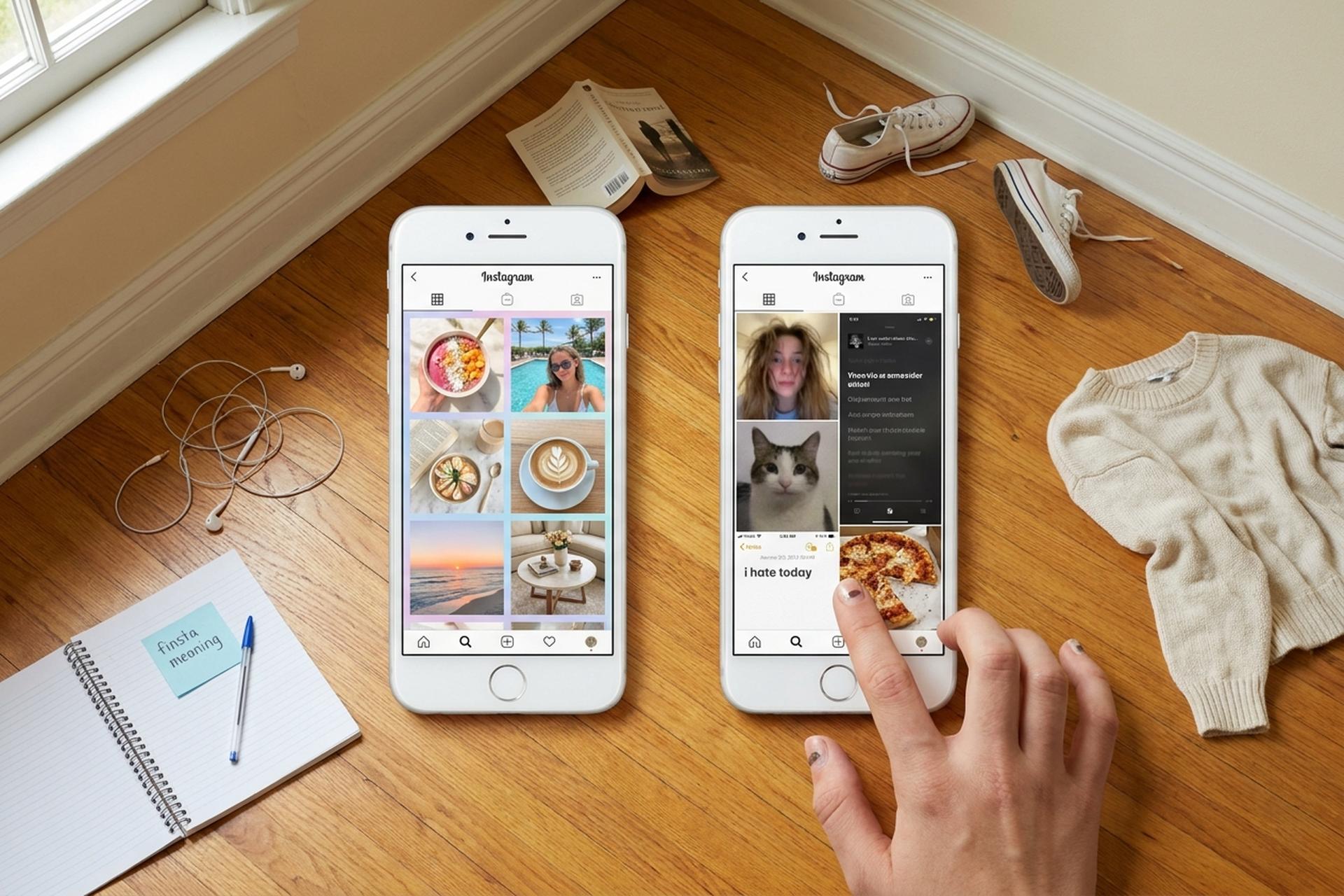
A finsta is, on paper, a fake Instagram account. In practice it carries the most honest content on the app. That contradiction is the whole point. It is the part most parents, brands, and even reporters keep getting wrong. The account is not "fake" in the sense of pretending to be someone. It is fake in the sense that the main profile is the show. The finsta is for the people who already know the truth.
This article walks through what the term actually means, where it came from, why a generation that grew up on Instagram now hides on Instagram, and what to do if you are a parent, a teacher, or a brand thinking about wading in.
Finsta meaning: what the slang term actually refers to
In the simplest definition, a finsta is a private secondary Instagram account, kept distinct from the user's main public account, used for raw or unfiltered content shared with a small trusted circle. The term is a portmanteau of "fake" and "insta," short for fake Instagram. The earliest public uses appear on Twitter in July 2011, with an Urban Dictionary entry following in 2013 and mainstream news coverage arriving by mid-2015 as the early Instagram generation hit their late teens. Merriam-Webster has tracked the word among informal English additions, alongside related teen vocabulary that has done the journey from group chat to dictionary in roughly a decade.
Outside the US, you will more often hear "spam account" — another term to refer to the exact same thing. As one example, an Australian teen and an American teen describing the same behavior will often pick different vocabulary for it. It is the same idea — a private second profile, often with a deliberately silly username — but the regional vocabulary differs. In Australian, UK, and parts of Asian English, "spam" is the dominant term. "Finsta" remains the American standard.
A few common surface markers identify these popular accounts on sight, with examples easy to spot once you know what you're looking at. The usernames are almost always a variation on the user's first name plus a suffix like ".spam," ".priv," ".finsta," or a private nickname only their immediate friend group would recognize. The handle is intentionally not searchable; teens reserve their full name and main photo for the public-facing account. The profile picture is rarely the user's face. The bio is a joke, an inside reference, or empty. The account is set to private. Follower counts are low — somewhere between five and fifty close friends, almost never higher. The mainstream Instagram metric of "growing your following" has no purchase here. A finsta with five hundred followers has lost the plot.
Rinsta vs finsta: the public face and the real face
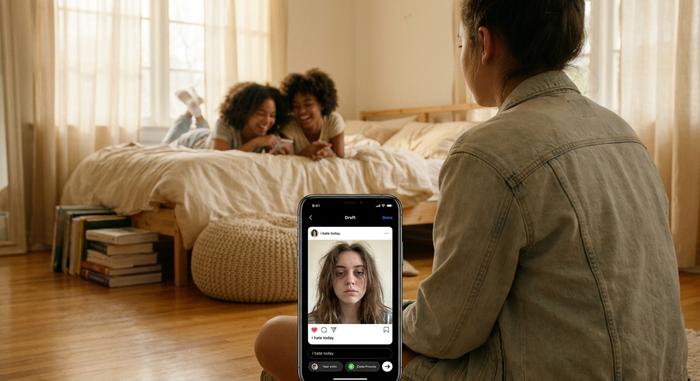
The complement to finsta is rinsta — short for "real Instagram," meaning the main, public-facing, curated account. The naming is deliberately backwards: the real account is the staged one, and the fake account is where actual life happens. Teen vocabulary often runs on this kind of inversion.
| Rinsta (real) | Finsta (fake) | |
|---|---|---|
| Visibility | Public or semi-open | Private, invite-only |
| Followers | Hundreds to thousands | Five to fifty |
| Username | Real name or established handle | Pseudonym, often a joke |
| Content | Curated, edited, on-brand | Raw, candid, memes, vents |
| Posting frequency | Weekly or less | Multiple times per day |
| Audience | Acquaintances and strangers | Inner friend circle |
The split mirrors a deeper tension. Instagram's main feed rewards performance. The algorithm pushes posts that drive engagement; engagement rewards photos that look like a magazine spread; a magazine-spread feed exhausts the user maintaining it. The finsta is where actual life — bad selfies, ugly food, lyric posts at 2 a.m., venting screenshots — happens. Two different stages, one phone, one user.
A few related terms travel near "finsta." An "alt account" is a broader phrase covering secondary profiles across any platform: alt Twitter, alt Tumblr, alt TikTok. A "burner account" is a stricter cousin, typically created for one purpose and then abandoned. A "close friends" Instagram story — Meta's official feature for sharing posts with a tagged subset of followers — addresses the same need with a softer mechanic. None of those quite replace the finsta, because the finsta carries an entire separate identity, not just a separate audience for one post.
Why people make a finsta in the first place
The finsta exists because Instagram's main feed became unlivable for the same generation that grew up on it. Pew Research's 2024 teen technology survey found that roughly six in ten US teens use Instagram, and around twelve percent describe themselves as on the app "almost constantly" — up from eight percent the year before. Instagram itself permits up to five accounts logged in simultaneously on one device, a feature that quietly normalizes the dual-profile habit. Common Sense Media's adolescent research repeatedly logs the same finding: teens feel pressure to curate.
That pressure is what creates the demand for a relief valve. The main account performs. The finsta vents. On the second account, the user can post a blurry selfie at midnight without worrying about brand consistency, share a meme that would seem off-tone for the rinsta audience, complain about a teacher or a manager without worrying that the wrong follower will screenshot it, and process a hard day in writing without composing a public statement.
Frances Haugen's leaked Meta documents include slides that explicitly reference teens migrating to "finstas and other private spaces" as coping behavior. The internal research framed it as a worrying signal: the platform was driving its youngest users to hide from the platform. The Wall Street Journal's "Facebook Files" series, published in September and October 2021, ran the same point. Meta knew. The leadership team had named the dynamic and continued shipping product against it.
Adults increasingly have finstas too. The phenomenon is no longer purely a teen story. Niche subcommunity accounts — "bookstagram" sub-alts, fitness logging accounts kept private, professional venting profiles for mid-career workers — share the same underlying mechanic of a separate audience for a separate kind of content. Pew's 2022 and 2024 teen-and-adult comparison data shows the gap closing.
A persistent gender skew turns up across the research. Teenager-aged girls and young women have historically been heavier finsta users than boys, partly because the curation pressure on the public main account falls harder on them. The Wall Street Journal's coverage cited the same Meta internal data on this point. The picture for non-binary and trans teens is harder to read, but the relevant studies suggest similar or higher rates. Celebrity culture amplifies the dynamic: when a mainstream pop star or athlete is publicly outed as keeping a finsta, the wider audience is reminded that the dual-account habit is not a teenager-only behavior.
How to spot a finsta on someone's phone
For a parent, an educator, or a partner trying to understand a friend's account ecosystem, a few signs identify a finsta on sight. Inside the Instagram app, an arrow next to the username at the top of a profile means the user has multiple accounts logged in on that device. That arrow is the most reliable single indicator. The naming convention follows: "@firstname.spam" or ".priv" or ".finsta" or a nickname only friends would recognize, paired with a profile picture that is a meme or a cropped object instead of the user's face.
The bio almost never contains a full real name, a school, or a workplace. The account is set to private, so the post grid only loads for approved followers. The follower-and-following list, when accessible, will run to a small, tight cluster — five to fifty names, almost all close friends or recurring tagged accounts. The account itself is not findable by searching the user's real name. That invisibility is the design feature, not a glitch.
Privacy and safety realities of a finsta account
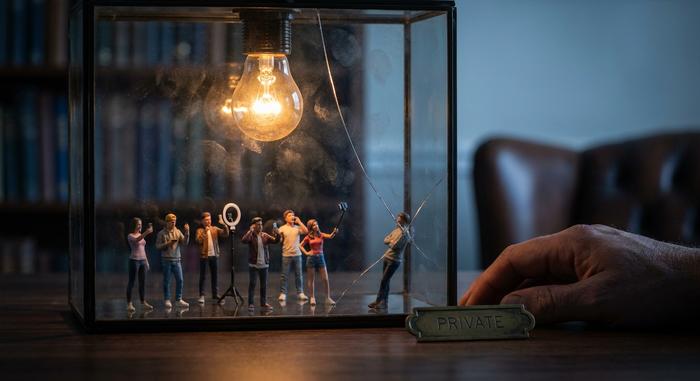
Here is the part most teens do not internalize: "private" on Instagram is not the same as "secret." Meta still scans the content of every post for advertising, trust-and-safety, and law-enforcement compliance. A subpoena reaches a finsta as easily as a public account. The platform is private only relative to the rest of the platform. The platform itself is not.
Then there is the screenshot risk. Any of those five to fifty trusted followers can capture a post and forward it elsewhere — a separate group chat, a public Twitter, a court filing, a college disciplinary board. Several recent high-profile cases have surfaced finsta posts as evidence in 2024 and 2025: athlete controversies, school-bullying investigations, even a few employment lawsuits. The "trusted circle" turns out to be exactly as trustworthy as the least careful person in it.
Institutions have already acted on this. In 2017, Harvard rescinded admission to ten incoming freshmen after offensive content in a private Facebook group attached to their accepted-student community went public. A 2023 ResumeBuilder survey found that seventy-three percent of US hiring managers screen candidate social media. Several US universities now run admissions checks against semi-public social presence, including looking for private accounts when applicants tag them on public ones. None of this is universal in 2026, but the surface area is growing year over year.
Bullying is the other risk worth naming. Exclusionary friend-group dynamics — who is followed back, who is silently dropped, who never gets approved — play out at small scale on private accounts in ways that show up later in school counselor offices. The platform's smallness is its strength and its specific weakness.
The illusion of privacy is the most dangerous part. The platform is private. The audience is human.
How parents should approach a teen's finsta
The wrong move is panic. The right move is curiosity.
Parental responses that consistently backfire: demanding passwords, demanding the account be deleted, installing monitoring spyware, or showing up in the comments. All four push the behavior underground onto a different app, a different device, or a friend's phone. Common Sense Media and the American Psychological Association frame the same point in different language: authentic, semi-private spaces are developmentally important for teenagers. Adolescents need somewhere their parents are not watching. The finsta, much of the time, is a healthy version of that need.
Useful conversations focus on the why. Who follows the account — close friends, or a distant acquaintance the teen barely knows? What is the unwritten rule of the friend group about screenshots? What kinds of activity get posted there that would not work on the main? How does the teen distinguish what belongs on each profile, and what would they want to keep private from a future employer? Parents who can ask those questions without flinching usually get honest answers, and a quick check of the follower list rarely needs to escalate further.
Genuine red flags do exist. A finsta with one or two followers can indicate a single private channel for a relationship that should be examined. Sudden phone-checking urgency, isolation patterns, content referencing substances or self-harm, or a pattern of conflict spilling into school all justify a closer look. The audit is not the relationship; the conversation is the relationship.
Brands, marketing, and the "corporate finsta" failure
Between roughly 2017 and 2021, several consumer brands tried to import finsta aesthetics into marketing. Casper, MoonPie, Sunny D, and Wendy's all experimented with lower-polish, joke-driven, almost diary-toned secondary accounts. Wendy's Twitter is the canonical case where the approach worked. Most others felt forced.
The reason is structural. A finsta works because the user is genuinely vulnerable to a small circle of friends. A brand cannot be genuinely vulnerable. It is vulnerable to its quarterly earnings report. The performance of unguarded honesty falls flat without the relationship that makes honesty meaningful. Browse the social-media history of the late 2010s and the genuine finsta remains a non-commercial space. Marketing teams that try to colonize it tend to end up parodying it instead.
Finsta in 2026: where the slang is heading
The word finsta is itself becoming dated. Younger Gen-Z, the cohort entering high school in the mid-2020s, increasingly says "spam," "priv," or "alt" instead. The phenomenon — a private secondary social presence on top of a public one — is growing, not shrinking. It has migrated outward to BeReal, Discord servers, group chats, and even Substack notes. Meta has experimented with formalizing the pattern through "close friends" stories and dual-profile features. Whatever vocabulary wins out, the cultural need persists.