Finelo Review 2026 : Master Trading App, Refund, Pricing
People Google "finelo scam" almost as often as "finelo review". And yet, on the same week that search trend held, the app sat at 4.6 stars across more than 88,000 ratings on the Apple App Store and 4.6 stars across more than 17,000 reviews on Trustpilot, with 94 percent of those Trustpilot ratings in the top two stars. That gap between perceived and actual reputation is the central puzzle of this Finelo review. The short answer is that Finelo is a legitimate, Cyprus-registered investing-education app whose subscription mechanics, not its product, are doing the damage to its public name. The longer answer, and what the rest of this guide covers, is who runs it, what it actually teaches at each stage of a beginner's trading journey, what it costs, why the complaints exist, and whether it earns the price for someone who genuinely wants to understand investing.
What is Finelo? The company behind the app
Finelo is an all-in-one trading learning platform — a mobile-first investment education app focused on financial literacy for retail beginners — available on iOS, the Google Play store and the web. The legal entity behind the brand is Finelo Limited, registered in Limassol, Cyprus, which sits inside a wider Kazakhstan-origin EdTech holding called Zimran Ltd. Zimran was founded in 2021 by three people who are still with the company in 2026: Zhanibek Sydykov as chief executive, Eduard Tupikov as chief marketing officer and Arman Nurgaziyev as chief technology officer. The Finelo brand itself began trading in late 2022, according to the Better Business Bureau profile, which lists 1 December 2022 as the business start date. The BBB file was opened on 25 July 2025 with a Las Vegas correspondence address.
A persistent claim circulating online is that Finelo's parent is "Genesis Tech." That is a misattribution. The actual parent group is Zimran, with no relationship to any Genesis-branded fintech. The distinction matters for anyone running due diligence, because Genesis-related searches return mostly unrelated companies, some of which have their own controversies. Zimran's profile on Crunchbase, Tracxn and the Cyprus i-Cyprus register is consistent.
What this corporate footprint adds up to is a small, founder-led EdTech, not a faceless white-label scam. The team has not flipped, the legal address is real, and the company has been operating under the same brand for more than three years. That does not by itself prove the product is good. It does mean readers should set aside the "ghost startup" theory before evaluating the actual app.

Finelo features: simulator, trading challenge, AI tools
What you get inside the app falls into four buckets: lessons, simulators, AI tools and challenges. The lesson library is the spine. As of 2026 it carries more than 300 bite-sized lessons of educational content averaging around three minutes each, organized into four learning tracks (Investor, Trader, Crypto and Passive Income) for users who want to learn investing or learn trading from scratch, a total of roughly 150 hours, in 10 to 11 languages. The pacing is deliberately gamified: short lessons, immediate quizzes, streaks, badges and XP, on the assumption that absolute beginners are more likely to retain a small idea today than to sit through a one-hour video.
The second bucket is the simulator. Finelo's Trading Simulator (sometimes called the Market Simulator inside the app) runs a virtual AI trading simulator: a $1,000 paper-trading account plugged into a real-time market data feed, which lets a beginner attempt the entire lifecycle of a trade — find an idea, place an order, manage the position, review the result — without risking actual capital. The app markets it as a risk-free way to practice trading and to start trading at zero stakes before any real money is involved. There is also a 28-day Trading Challenge that bundles the simulator with daily lessons and unlocks the conditional refund window discussed later. The simulator is more than a static screenshot, but it is also not a brokerage; you cannot move from a winning paper trade to an actual position from inside Finelo.
The third bucket is the AI features, and this is where readers should slow down. The headline product is the AI Chart Analyzer, an AI tool that automatically flags candlestick patterns, support and resistance levels, and other basic chart analysis formations on real symbols. Marketing copy describes the product as "Finelo is an AI-powered investment learning platform", and on the chart-analysis side that label is fair. Users can practice trading and read a quick AI commentary on what the pattern usually means. There is also a Personal AI Mentor, sold separately as an add-on. In practice the AI Mentor is a chat assistant trained on Finelo's curriculum; it answers homework-style questions and explains terms. It is not a robo-advisor, it does not give personalized portfolio advice, and there is no fiduciary relationship. Treating it as a tutor rather than a fund manager is the right mental model.
The fourth bucket is the challenge layer: more than 100 small interactive challenges sitting alongside the courses, designed to push a learner from passive consumption into active recall. None of this is unique to Finelo, but the bundle is unusually beginner-friendly compared to text-heavy alternatives like Investopedia.
A fair summary is that the features are real, not slideware, but the entire interactive teaching method is calibrated for a complete beginner. An experienced trader will find the depth shallow, and that is a recurring complaint in the App Store reviews. Finelo is built to take someone learning the basics from zero to "I understand a candlestick", not from intermediate to professional.
Finelo cost: pricing, free trial, hidden charges
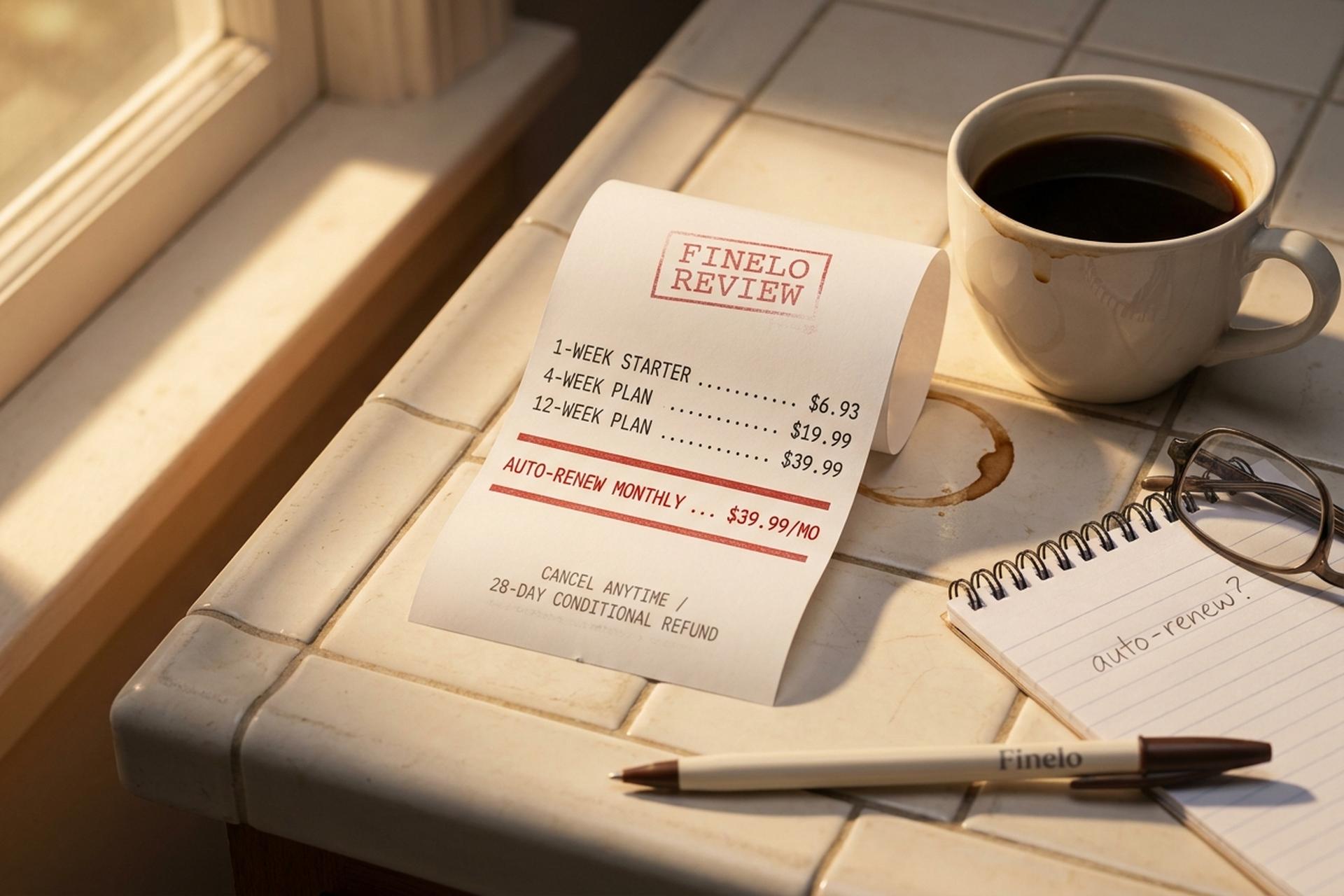
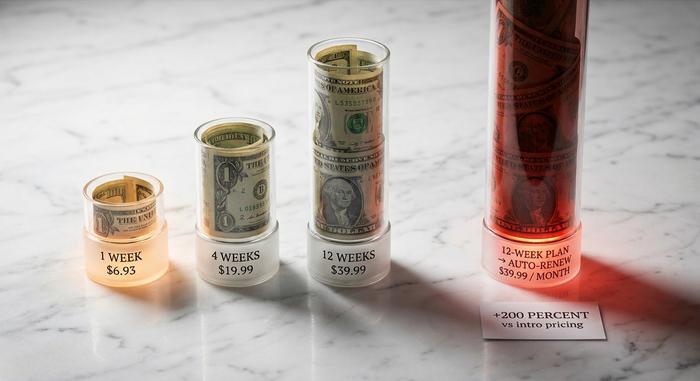
There is no one time fee tier; the base subscription comes in three intro plans, each charging a recurring subscription fee after the intro window expires. As of 2026 these are roughly $6.93 to $6.99 for one week, $19.99 for four weeks, and $39.99 for 12 weeks. Each one auto-renews unless cancelled. After the first 12-week cycle, the plan reverts to a $39.99 monthly recurring charge. There is no permanent free tier.
| Plan | Intro price | Auto-renews to |
|---|---|---|
| 1-week starter | $6.93 to $6.99 | Same plan, weekly |
| 4-week | $19.99 | Same plan, every 4 weeks |
| 12-week | $39.99 | $39.99 monthly after the first cycle |
| iOS Premium IAPs | $9.99 to $29.99 | Per-pack, no recurring |
| Personal AI Coach | $19.99 to $49.99 | Per-purchase add-on |
The detail most often missed is the cycle change after the 12-week plan. A user who sees "12 weeks for $39.99" and assumes the monthly equivalent is roughly $13 will find the actual ongoing cost is $39.99 a month after the first three months. That is a 200 percent jump, and it is the single most common complaint thread on the App Store and Trustpilot. The intro pricing is honest, but the post-intro pricing has historically been buried.
Two other categories live next to the base subscription. iOS in-app purchases run from $9.99 to $29.99 for premium course packs that are not in the standard subscription. The Personal AI Coach is sold as a separate add-on at $19.99 to $49.99 depending on the bundle, and AI Tools packs are $19.99 to $29.99. None of these are required to use the core app, but the upsell prompts are aggressive enough that a careless tap can produce a charge a user did not plan for.
Finelo's 28-day refund guarantee is real, but conditional. To qualify, the user has to have completed a daily lesson on most days inside the 28-day window, demonstrating "active use." Outside that condition, refund requests are routinely declined. The condition is disclosed in the terms, but it is not as visible as the headline "money-back guarantee" framing.
Is Finelo legit or a scam? What 17,000 reviews say
By any reasonable definition, Finelo is not a scam. The product exists, the company exists, the courses are delivered, and the simulator works. The 4.6 average across more than 17,000 Trustpilot reviews, with 94 percent of those reviews in the top two stars, is hard to fake at that volume, and the same average shows up across more than 88,000 ratings on the Apple App Store and roughly 4.3 on Google Play. In 2025 the app was named to the Newsweek and Statista list of "America's Best Online Platform 2025" in Education and Learning, with reviewers calling it an excellent educational tool for first-time investors. The Better Business Bureau gives Finelo a B-, which reflects an open file with around 50 complaints — material but not catastrophic for a consumer app at this user scale.
What I keep coming back to is that the "scam" reputation is almost entirely about billing friction, not fraud. Three patterns dominate the BBB and Trustpilot complaints. First, the post-intro auto-renewal that I described in the pricing section. Second, the conditional refund window, where users assume any refund inside 28 days will be honored. Third, the AI add-on prompts, which surprise users with separate charges on top of the base plan. None of these are evidence of a fake company. All of them are evidence of a subscription product whose disclosure could be louder.
It is worth noting that Finelo updated its renewal terms in late 2025 to display the next billing date more prominently on the payment screen, and the support team now responds to roughly 88 percent of negative Trustpilot reviews. Both are signs of an operator that hears the complaints, even if the headline pricing strategy has not changed.
Finelo refund policy and cancellation: how to cancel
If you decide Finelo is not for you, the practical question is how to stop the charges before the next cycle starts. The Finelo dashboard does not contain a one-button cancel for app-store purchases, which is the single biggest source of confusion in user reviews. Here is the canonical path for each surface:
For iOS subscriptions, open Settings on the iPhone, tap your Apple ID at the top, choose Subscriptions, locate Finelo and select Cancel. The cancellation takes effect at the end of the current paid period, not immediately. For Android, open the Google Play app, tap your profile photo, select Payments and Subscriptions, then Subscriptions, choose Finelo and cancel. For web subscriptions purchased directly through finelo.com, the cancellation runs through the support contact form on the website.
The 28-day refund guarantee is requested through Finelo support, not through Apple or Google. To qualify for the conditional money-back, the user has to demonstrate that they used the app actively (typically a daily lesson on most days). If you were billed by surprise and never opened the app, the refund is unlikely to be granted; the better route in that case is to dispute the charge with the platform that processed the payment (Apple, Google, or your card issuer).
A simple rule of thumb: cancel where you bought. Apple-billed plans cancel at Apple, Google-billed plans cancel at Google, web plans cancel through the Finelo support form.
Finelo vs alternatives: Blinkist, Investopedia, Robinhood Learn
Finelo is one of several trading platforms aimed at first-time learners. The comparison below maps the most common alternatives against the same use case: gamified, mobile-first trading and investing literacy for a non-expert who wants to start learning before opening a real-world brokerage account.
| Platform | Model | Price (2026) | Best for |
|---|---|---|---|
| Finelo | Subscription, gamified app | $6.99 to $39.99 per cycle | Mobile-first beginners |
| Blinkist | Subscription, audio summaries | ~$99.99 a year | General-knowledge readers |
| MasterClass | Subscription, video lectures | ~$120 a year | Inspiration from named experts |
| Coursera (Investing) | Per course or specialization | $49 to $79 a month | Academic, certificate-track learners |
| Investopedia Academy | One-time courses | $19.95 to $279 | Self-paced specialists |
| Robinhood Learn | Free articles | $0 | Quick reference |
| FT IQ (Financial Times) | Free or premium | $0 to $25 a month | News-driven literacy |
The honest framing is that Finelo competes on convenience and gamification, not depth. If you want a structured college-style course, Coursera will go further. If you want one-and-done specialist topics, Investopedia Academy is cheaper per course. If you want zero spend, Robinhood Learn and FT IQ both publish solid free content. Finelo's argument is that its onboarding, simulator and habit loop make a beginner more likely to actually finish; the data behind that is the 8.8 million lessons completed across the user base, which is a real engagement number.
Who Finelo is right for (and who should skip it)
Finelo is right for an absolute beginner who has never bought a stock, who has no existing stock portfolio to manage, who learns better in three-minute increments on a phone than in 60-minute video lectures, and who is willing to treat the subscription as a tutoring fee rather than a one-off purchase. Anyone in that bucket who reads the auto-renew terms before tapping Confirm will probably get value out of the app.
If you already know order types and basic chart reading, Finelo is the wrong tool; the curriculum will feel slow. The same goes for anyone unwilling to actively manage subscription billing, and for anyone hoping the app will execute trades on their behalf — it does not, by design.