Solo Mining in 2026 : Lottery, Math, and Lucky Block Wins
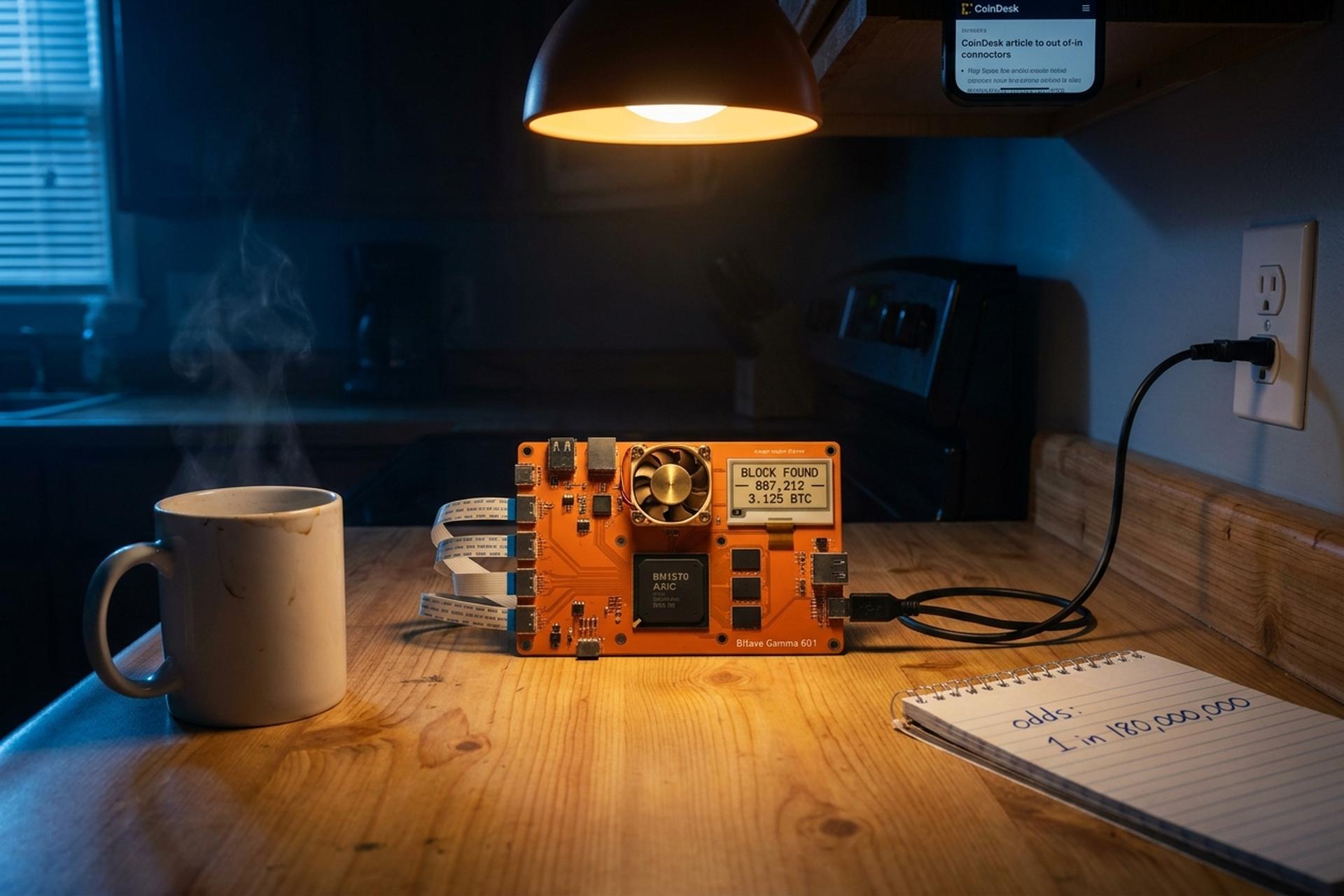
On November 21, 2025, a hobbyist running a stack of consumer Bitaxe Gamma boards (about six terahashes per second of total hash rate, a setup smaller than most home gaming rigs) submitted a winning block to Solo CKPool. The reward was 3.146 BTC, worth roughly $265,000 at the time. CoinDesk framed the odds at "one in 180 million."
That is the strange thing about solo mining in 2026. Bitcoin's network hashrate sits near 905 EH/s; difficulty is 132 trillion; some 144 blocks are produced every day across hundreds of EH/s of industrial machines. A single 1 TH/s board is a rounding error in that ocean. And yet, every few months, somebody on a Bitaxe scores. Solo mining today is closer to a national lottery than to a steady job, but a real lottery, with verifiable winners, and tickets you can buy at home for the price of a desk lamp.
This article walks through what solo mining actually is, the probability math, the hardware tiers, how to set it up, the 2024-2025 wins that have made the lottery framing canonical, the economics, and a frank verdict on who should bother.
What solo mining is, and how it differs from a mining pool
A solo mine is the original way Bitcoin was mined: one operator runs a Bitcoin node, pulls block templates, hashes through nonces, and broadcasts the solution if their machine is the first to find one. The entire bitcoin network competes for the same block, but only one solo miner wins. The whole reward goes to that miner; there is no fee, no pool operator, no shared payout. There is also no consolation prize. If you do not find a block, you earn nothing.
Pool mining inverts that. A mining pool aggregates the hash rate of many bitcoin miners; the pool runs the node, hands out work, and pays each participant a reward instead of sharing the lottery variance. Bitcoin's classic model is winner-take-all; the pool reshapes that into proportional shares. The trade-off is a 1-3% pool fee and the loss of full custody over the search itself.
Sitting between the two is what most modern "solo" miners actually use: a pseudo-pool such as solo.ckpool.org. Solo CKPool, run by long-time Bitcoin developer Con Kolivas, has logged 308 solo blocks since 2014 — eight of them in 2025 alone. It charges a 2% fee and runs the node for you, but it does not split rewards: whoever submits the winning share keeps the entire 3.125 BTC plus transaction fees, minus the fee. Public Pool (public-pool.io) is the open-source, MIT-licensed, zero-fee equivalent, with one-click installs on Umbrel and Start9 home servers.
The Bitcoin protocol itself has not changed. The block reward is 3.125 BTC after the April 2024 halving and will halve again at block 1,050,000 (around April 2028) to 1.5625 BTC. Daily issuance is roughly 450 BTC across about 144 blocks, set by the 10-minute target. Difficulty retargets every 2,016 blocks. Stratum is the standard pool/solo protocol; getblocktemplate is the modern node interface that replaced getwork.
The math: your real chance to find a block
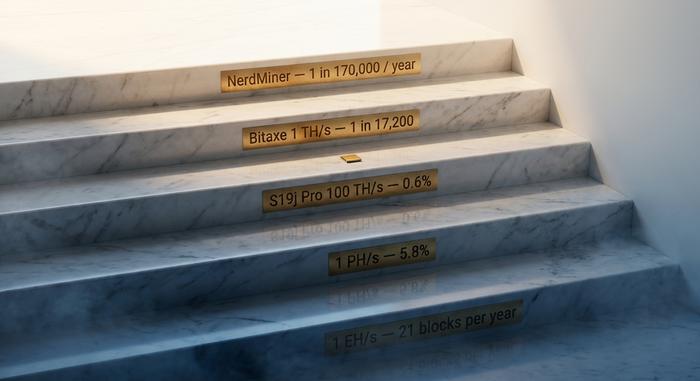
Solo mining odds are arithmetic, not opinion. The network difficulty fixes the search target, and the expected time between blocks for a given miner is the network hashrate divided by the miner's hashrate, multiplied by 600 seconds. At 905 EH/s the table works out as follows.
| Tier | Example device | Hashrate | Expected time per block | Annual odds |
|---|---|---|---|---|
| Symbolic | NerdMiner V2 | ~50-100 GH/s | ~170,000 years | ~1 in 170,000 |
| Lottery | Bitaxe Gamma 601 | 1.2 TH/s | ~17,200 years | ~1 in 17,200 |
| Hobby | Antminer S19j Pro | ~104 TH/s | ~165 years | ~0.6% |
| Serious home | 1 PH/s (5× S21) | 1,000 TH/s | ~17.2 years | ~5.8% |
| Industrial | 1 EH/s | 1,000,000 TH/s | ~17.2 days | ~21 blocks/year |
Two things to note. First, the network is roughly three to four times higher than when most older "1 TH/s = 1 in 4,750 per year" calculators were written; today's odds are correspondingly worse. Second, the variance is enormous. The expected time is a mean, not a forecast. A 1 TH/s Bitaxe is a lottery ticket — it could find its block tomorrow, in five years, or never. The entire point of CoinDesk's "one in 180 million" headline for the November 2025 win was that the realised draw was wildly outside the expected range, and the realised draw is the whole story for any individual home miner.
For sub-1 TH/s gear, expected pool earnings round to a few cents per day after fees. Pool variance is a worse deal than solo variance because the expected pool payout is so small. That is exactly why solo miners on Bitaxe gear gravitate to solo. They are not pretending to mine for steady income; they are explicitly buying tickets, hoping to win a block at the right moment, knowing that growing electricity costs will eat the marginal expected return either way.
Solo bitcoin mining hardware tiers in 2026
Mining hardware has stratified neatly into four tiers. Each is sold by mainstream resellers like Solo Satoshi, D-Central, BT-Miners, and direct manufacturer channels, and each represents a different scale of mining infrastructure.
The symbolic tier is the NerdMiner V2, an open-source ESP32-based machine that hashes at 50-100 KH/s while drawing under five watts. It will not realistically find a Bitcoin block in any human lifetime, but it teaches the protocol cheaply.
The lottery tier is the Bitaxe family. The Bitaxe Gamma 601, built around the BM1370 ASIC, hashes at roughly 1.2 TH/s stock (1.8-2.0 TH/s overclocked) while drawing 17 watts at 14 J/TH. The Bitaxe Supra Hex 701 is a six-chip board doing 4.2 TH/s at around 90 W. NerdQAxe++ sits in the same range. These are the boxes powering the 2025 lottery wins.
The hobby tier covers older, secondhand asic miner gear: the Antminer S19j Pro at roughly 104 TH/s and 3,068 W, and the Whatsminer M50 at ~114 TH/s, both around 29 J/TH. They are loud, hot, and economically marginal at residential power rates, but they buy a real if still small chance of solo.
The industrial tier is current-gen Bitmain mining hardware: the Antminer S21 (200 TH/s, 17.5 J/TH), S21 Pro (234 TH/s, 15 J/TH), S21 XP (270 TH/s, 13.5 J/TH), and the liquid-cooled S21 XP Hyd at 473 TH/s and 12 J/TH. Five S21 XP Hyds together approach 2.4 PH/s — "1-2 expected blocks per decade" territory.
How to set up a solo mining operation
The setup is more straightforward than the math. Five steps.
Step one is hardware. Pick a tier you can power and cool. Step two is a Bitcoin wallet that will receive the payout. Most miners use a hardware wallet or a watch-only address generated by Sparrow or Bitcoin Core. Step three is choosing a route. True solo means running your own bitcoind full node and pointing cgminer or bfgminer at it through getblocktemplate; that gives you maximum sovereignty, but requires roughly 700 GB of disk and a lot of operational care. The more common route is solo.ckpool.org or public-pool.io, which run the bitcoin node for you. Step four is to configure the miner. Paste the stratum URL into the miner's web UI (AxeOS for Bitaxe, Braiins OS+ for many Antminers), set the username to your BTC address, and start hashing. Step five is to monitor it: Bitaxe boxes expose AxeOS at a local IP, third-party dashboards like mining.dutch.fyi visualise hashrate and uptime, and CKPool itself shows your worker's submitted shares.
A small setup hint: a modest overclock with stable cooling typically yields better long-term hashrate than aggressive tuning that thermal-throttles. The miner that runs at 1.4 TH/s for 720 hours a month beats the one that spikes to 2.0 TH/s and crashes after four. Solo mining works on cumulative hash, not peak — software stability matters more than benchmark numbers.
If you do go true solo, make sure your node is well-connected; orphaned shares and stale work are a real concern when latency to the broader network is high.
Real solo wins: 2024-2025 lottery hits
The lottery framing is not just a vibe. It is a documented record. Below is a partial table of the cleanest 2024-2025 solo block wins.
| Date | Hashrate | Hardware | Block | Reward |
|---|---|---|---|---|
| Mar 10, 2025 | 480 GH/s | Bitaxe | 887,212 | ~$258,000 |
| Mar 2025 | 1.1 TH/s | Bitaxe Gamma | 889,975 | 3.125 BTC + fees |
| Jul 26, 2025 | small | solo rig | 907,283 | ~$372,700 |
| Aug 2025 | small | solo rig | 910,440 | ~$362,000 |
| Oct 2025 | NerdQAxe++ | self-hosted Public Pool | 920,440 | full block |
| Nov 21, 2025 | ~6 TH/s | Bitaxe Gamma swarm | — | ~$265,000 |
Eight CKPool solo blocks were confirmed across calendar 2025; the cadence has been roughly one lottery hit per quarter. The most ideologically pure win is the October 2025 NerdQAxe++ block found through a self-hosted Public Pool instance running on an Umbrel home server. That is a full block reward going to a hobbyist running their own node, their own pool, and their own open-source mining hardware. There is no operator skim of any kind. The whole reward, paid out by the protocol itself, was basically a lottery jackpot won as the thrill of pure self-custody.
The November 2025 win is the one that made mainstream press. A swarm of Bitaxe Gamma boards drawing roughly 100 watts total submitted block 920,920-class to Solo CKPool and walked away with 3.146 BTC, 308th solo block in the pool's history. The press calls every one of these "1 in 180 million," which is not literally the per-block probability but a fair shorthand for the realised odds against expected variance.
Solo mining economics: cost, breakeven, and taxes
The economics are simpler than they look. At the May 6, 2026 BTC price of about $81,286, a 3.125 BTC reward per block is roughly $254,000. Variable transaction fees are currently negligible; mempool fees have pinned at 1 sat/vB through April 2026, although Ordinals and Runes congestion has historically pushed fees above 100 sat/vB and turned a few lucky solo blocks into fee-fat windfalls worth more than the base subsidy.
Hashprice (the daily revenue per PH/s) is sitting at $28-$30 per day in Q1 2026, a post-halving low. Industrial break-even hovers around $0.07/kWh for top-tier 12-15 J/TH machines, so the cost of electricity is the binding constraint at scale. A Bitaxe Gamma at 17 watts, by contrast, runs about 12 kWh per month, which is $1.20 to $1.80 at typical residential rates. That is the cost of a modest streaming subscription, except the subscription occasionally pays out $250,000.
For tax purposes in the United States, IRS Notice 2014-21 still governs: mined coins are ordinary income at fair-market value on the day they are received. A hobbyist reports on Schedule 1; a business mining operation reports on Schedule C and pays self-employment tax. The fair-market value at receipt becomes the cost basis, and a second taxable event triggers when the BTC is sold. Cheap solar power can shift the breakeven dramatically for industrial sites. A solo lottery winner who hits a block on the same day BTC trades at $81k owes income tax on $254,000, regardless of whether they sell.
Solo mining beyond Bitcoin: Kaspa, Monero, Ergo
Bitcoin is the headline, but the solo mining does not require BTC specifically — it is more practical on smaller networks where the variance is friendlier. Kaspa, with its blockDAG and sub-second block times, has the lowest realistic variance for solo mining of any major coin; SoloPool.org runs a Kaspa endpoint that produces frequent small wins for multi-GPU rigs. Monero's RandomX algorithm is CPU-friendly, which keeps Monero decentralized, but the network has scaled enough that home-CPU solo is realistically a lottery only. Ergo (Autolykos2) and Ravencoin (KAWPOW) are GPU-friendly and accessible to anyone with a multi-card rig willing to tolerate a few months between hits. Ethereum Classic (Etchash) is far smaller than ETH was before the Merge, but the network is still industrial enough that hobbyist solo there is also a long shot.
Who should solo mine in 2026: an honest verdict
For steady income, pool. Full stop. Pool the cryptocurrency you want to mine through Braiins, F2Pool, AntPool, ViaBTC, and live with the 1-3% fee.
For sovereignty and decentralize-the-network reasons, true solo with your own bitcoind node is the cleanest path; you own the work, the validation, and the reward end to end. For lottery thrill at ~$1.80 a month, a Bitaxe Gamma is plainly cheaper tech entertainment than most streaming services, and it produces real, occasionally life-changing payouts. To mine solo with no operator skim, just plug it in. And for solo block winners who do hit one, crypto-payment rails like Plisio matter for converting an unexpected $250,000 BTC reward into spendable money, especially in jurisdictions where mining-related deposits face debanking pressure. The honest question to ask is the one the November 2025 winner already answered: would you rather earn $5 a day pooling steadily, or take a one-in-180-million shot at $265,000 once?