Current Mortgage Rates Today: Your 2026 Guide to Lower Rates

A buyer who locked a 30-year fixed in January 2021 paid 2.65 percent on the loan. The same buyer shopping the same house this week is looking at 6.37 percent, the Freddie Mac average for the week ending May 7, 2026. On a $400,000 loan, that delta is the difference between $1,612 and $2,495 in monthly principal and interest. The same kitchen, the same school district, the same property tax bill. About $883 more leaving the checking account every month for thirty years.
That is the practical question this guide answers. What are today's mortgage rates, what is moving them in 2026, and what can you actually do to land a lower interest rate on your home loan. We will start with the basics, walk through the May 2026 snapshot and the forces behind it, then close with the levers a borrower controls.
What Is a Mortgage Rate? Interest Rate vs APR
A mortgage rate is the cost of borrowing the money you use to buy a home, expressed as an annual percentage. Two figures show up on every loan estimate. The interest rate covers only the cost of the borrowed principal of a fixed rate or adjustable mortgage. The annual percentage rate, or APR, also folds in lender fees, discount points, and mortgage insurance, expressed as a single annual percentage that approximates the true cost over the life of the homebuying loan. APR will always sit at or above the interest rate. The gap between the two is where lender pricing hides. Read both. A mortgage loan with a tempting rate and a heavy APR is paying for itself with fees you did not see in the headline.
Current Mortgage Rates Today: May 2026 National Average
Pinning down "the" national average mortgage rate is harder than it sounds. Three reputable sources tracking the same week of May 10, 2026 publish three different numbers, because their survey methods differ.
| Source | 30-yr fixed | 15-yr fixed | 5/1 ARM | 30-yr FHA | 30-yr VA |
|---|---|---|---|---|---|
| Freddie Mac PMMS (week of May 7) | 6.37% | 5.72% | n/a | n/a | n/a |
| Bankrate (May 7) | 6.46% | 5.79% | 5.66% | n/a | n/a |
| Mortgage Reports (May 10) | 6.45% | 5.81% | 5.68% | 6.24% | 6.46% |
Freddie Mac surveys lenders on Loan Product Advisor submissions and reports a Thursday-through-Wednesday average. Bankrate aggregates rates from a daily lender panel. Both move the same way week to week, but the absolute number can differ by 5 to 10 basis points on any given day. Use one source consistently rather than flipping between them, and remember that a national average mortgage rate is a snapshot, not your personalized quote.
Refinance rates today run roughly 30 basis points above purchase rates on the same loan term. Bankrate has the 30-year refinance at 6.74 percent as of May 7, against 6.46 percent for a purchase. The premium reflects a market preference for purchase originations and the slightly different risk profile of cash-out refinances.
A note on direction. The Freddie Mac 30-year ticked up from 6.30 percent the prior week. Year over year, it is down from 6.76 percent. The trajectory has been flat-to-slightly-improving for most of the spring of 2026, with intraweek volatility tied to bond market reactions to inflation prints. None of this implies a coming break below 6 percent. The current rates today reflect a market that has decided sticky inflation is the more probable outcome.

What Drives Mortgage Interest Rates: Fed, Bonds, Inflation
Most borrowers believe the Fed sets mortgage rates. It does not. 2026 is the cleanest proof in years.
April 29, 2026. FOMC voted 8 to 4 for a cut. Federal funds target down to 3.50 to 3.75 percent. The 30-year fixed mortgage rate that morning. 6.37 percent. Two weeks later. 6.45 percent. The Fed cut, and mortgage rates rose. Why.
Mortgage rates do not track the Fed funds rate. They track the 10-year Treasury yield, plus roughly a 2 percentage point spread. May 10, 2026. The 10-year was 4.36 percent. Add the spread. You land in the mid-6s. That is the math. Fed funds is priced into the yield curve, but the 10-year itself is set by bond traders, not by Jay Powell.
So what sets the 10-year. Inflation expectations. When traders believe inflation is heading back to the 2 percent target, they accept a lower yield. When they suspect inflation stays sticky, they demand more. The real value of the principal has to be defended. Through the first four months of 2026, headline CPI ran above target on almost every print. Bond yields stayed elevated. Mortgage interest rates went sideways.
A second piece lives on the lender side. Banks and nonbank lenders mark up their cost of capital. The markup pays for credit risk, MBS demand, and operational expense. A jumbo loan above the conforming loan limit cannot be sold to Fannie Mae or Freddie Mac, so it carries a real premium. A 30-year fixed quoted to a 620 FICO carries a larger one. None of these resets the second the Fed announces a cut.
The practical read. Summer 2026. If CPI prints cool and the 10-year drifts toward 4 percent, mortgage rates follow. If inflation stays sticky, the Fed can chop a hundred basis points and mortgage and refinance rates barely move. The honest answer for someone watching CNBC. Skip the press conference. Watch the bond market.
2026 Mortgage Rate Forecast and Recent Mortgage News
Forecasters do not agree on where 30-year mortgage rates land by year-end. The two most-cited 2026 outlooks diverge by roughly 50 basis points.
| Forecaster | Q2 2026 | Q3 2026 | Q4 2026 | Q1 2027 |
|---|---|---|---|---|
| Fannie Mae | 5.9% | 5.8% | 5.7% | 5.7% |
| Mortgage Bankers Association (MBA) | 6.3% | 6.3% | 6.2% | 6.2% |
Fannie Mae models a faster inflation cooldown and a softer 10-year. MBA models a stickier path. Both economics shops have skin in the game. Neither track record is good enough to bet a home purchase on the precise number. Use the spread between them as the actual forecast.
The MBA also pencils $2.2 trillion in total 2026 origination volume. That is an 8 percent jump over 2025. Refinance share lands at $737 billion, mostly cash-out from buyers who locked at 7 percent in 2023 and 2024. Mortgage news through early May 2026 has not been kind to the optimistic case. Brent crude above $94 a barrel. Mid-east risk premium back in the bond market. A spring buying season that real-estate brokers in Atlanta, Phoenix, and Boston have all called tepid. None of that argues for a fast slide back to 5.
Types of Mortgage Loans: Fixed, Adjustable-Rate, FHA, Jumbo
The market sells four loan families, each a different tradeoff.
The 30-year fixed rate mortgage locks one rate for thirty years. Predictable monthly mortgage payment. High total interest paid. About nine in ten US buyers pick this product anyway, because the predictability is worth the price tag. The 30 year fixed is the default for a reason. A 15-year fixed mortgage cuts that lifetime interest by more than half. The monthly payment runs 30 to 40 percent higher.
An adjustable-rate mortgage, or ARM, fixes the rate for the first 5, 7, or 10 years. After that, it adjusts every year against an index plus a margin. ARMs price about 70 basis points under the comparable fixed today. They suit a buyer who plans to sell, refinance, or pay off before the first adjustment.
FHA loans accept a 580 FICO with 3.5 percent down. The catch is monthly mortgage insurance at roughly 0.55 percent of the balance, often kept for the life of the loan. VA loans are zero down for qualifying veterans, with no mortgage insurance. Jumbos sit above the 2026 conforming limit of $806,500 and price 10 to 20 basis points above conforming because Fannie and Freddie cannot buy them.
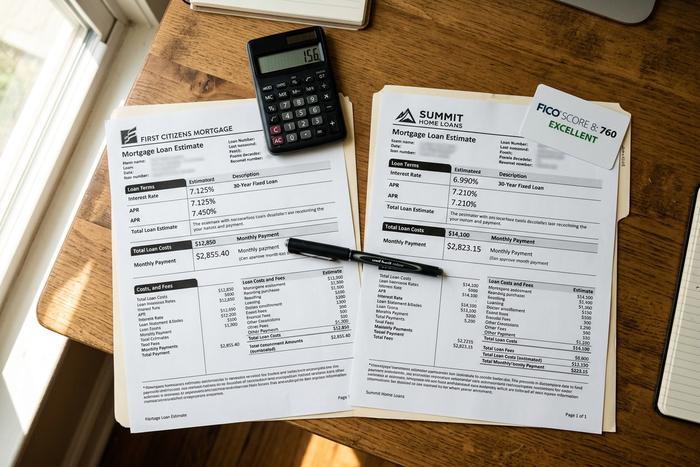
Compare Mortgage Lenders to Get a Personalized Rate
Pull three quotes. Not one.
That is the single highest-paid hour in a home purchase. NerdWallet pegs the average savings from comparing mortgage lenders at $600 to $1,200 a year. A 2018 Freddie Mac study found buyers who pulled five quotes saved roughly $1,500 over the life of the loan, against buyers who pulled one. Real money.
Most buyers pull one. They walk into the branch that holds their checking and take whatever the loan officer slides across the desk. That habit costs more than every other rookie homebuying mistake combined.
Soft-pull quotes do not ding the FICO. Three or four lenders, all inside the same 14-day window, count as one inquiry on the report. Run the quotes the same day. Inside the same hour if you can. Rates move every business day at 10 a.m. and again at 2. Compare the APR, not just the headline rate. Compare the discount points charged on each quote, not just the bottom-line monthly. A loan estimate is a four-page form. The second page is where the real math lives.
How to Get a Lower Mortgage Rate in 2026
Four levers move a rate. They are not equal in size and they are not equal in speed.
Credit score is the heavyweight. Pull up myFICO's loan savings calculator and run a $300,000 30-year loan side by side. A 760 FICO. A 620 FICO. Same day, same lender, same product. The 760 borrower pays roughly $156 less every month. Across 360 payments that is about $56,000 in interest the lower-score buyer hands the bank for nothing. Credit score is also the slowest lever to move. Disputing a stale collection, paying revolving balances down below 30 percent utilization, asking a relative to add you as an authorized user. Each of those takes 60 to 180 days to show up on the report. If you are thinking about getting a mortgage in late 2026, the work begins now, not at the loan application.
Down payment is the second lever. Twenty percent down clears private mortgage insurance, which runs 0.5 to 1.5 percent of the loan amount per year. The larger payment also drops loan-to-value, which the lender prices in. Stop at 20. The marginal benefit above that point is small, and savings are more useful in a reserve account than in equity that is hard to pull back out.
Debt-to-income, or DTI, is the silent third. Total monthly debt at or below 36 percent of gross income usually qualifies for the best pricing tier. Above 43, options narrow fast. Pay off the car loan if you can. A smaller installment payment can move you a whole tier on lender pricing.
Discount points are the smallest and most misunderstood lever. One point costs 1 percent of the loan amount up front. It buys roughly a 0.20 to 0.25 percent rate cut. Break-even on a one-point buydown sits at five to six years on a typical 30-year loan. Plan to sell, refinance, or pay off in fewer years and you have lit money on fire. Plan to stay a decade and points pencil. Run the math, do not buy points because the loan officer suggests it.
Closing costs run 2 to 5 percent of the loan amount. Title, origination, recording, escrow setup. Some lines are negotiable. Some are pure pass-through. Ask for the itemized loan estimate and shop the lender-controlled fees specifically. Two competing estimates side by side is the only honest way to compare lenders.
The rate lock is the last detail. A standard 60-day mortgage rate lock costs nothing on most loans. A 90-day or 120-day lock costs a fraction of a point. Lock once the purchase contract is signed, not before. Credit union lenders sometimes price 5 to 10 basis points under the big national banks. If you qualify for a credit union membership, get a quote.
Refinancing in 2026: When a New Mortgage Pays Off
The refinance math is simple but the rules of thumb most people use are wrong. The right test is not "is the new rate at least 0.75 percent lower." It is "does the break-even time fit how long I plan to stay."
Closing costs on a refinance run 2 to 5 percent of the new loan, the same as a purchase. On a $300,000 refi, that is $6,000 to $15,000 paid up front. If a refinance saves $200 per month, the break-even sits at 30 to 75 months. Sell or move before then and the refinance lost money.
The MBA forecasts $737 billion in 2026 refinance volume, mostly cash-out activity from buyers who took loans at higher rates in 2023 and 2024. A pure rate-and-term refi only makes sense if rates have moved meaningfully below the existing note. Many 2024 borrowers signed at 7 percent and could trim 50 to 80 basis points today.
Mortgage Calculator: 2021 vs 2026 Affordability Gap
Run the same purchase through a basic mortgage calculator at two different rates to see what the rate environment has actually done to buyers.
| Scenario | Home price | Loan (20% down) | Rate | Monthly P&I |
|---|---|---|---|---|
| January 2021 | $408,800 | $327,040 | 2.65% | $1,316 |
| May 2026 | $408,800 | $327,040 | 6.37% | $2,038 |
Same house, same down payment, and a payment amount $722 higher per month, or about $260,000 across 30 years. Higher interest rates compound that gap on every loan amount in the market. The NAR Housing Affordability Index sat at 113.7 in early 2026, barely above the 100 mark that defines "affordable for the median household." That is what higher mortgage interest rates do at scale.
Final Thoughts on Mortgage Rates Today
The rate environment is what it is. Inflation, the 10-year Treasury, and Fed credibility set the floor. The lever that a homebuyer actually controls is which lender they call, what their FICO looks like, and whether they shop three quotes or one. Get the credit work done early, compare APRs not headline rates, and the mortgage you sign will be cheaper than the one most of your neighbors got.