What is a stablecoin? The crypto that stays at $1 (until it does not)
On May 9, 2022, a stablecoin called UST started trading at $0.98. Not a big deal, people thought. Dollar pegs wobble sometimes. By May 12 it was worth $0.10. By May 13 it was under a penny. Forty billion dollars vanished in four days. People lost their homes. A South Korean developer got arrested. And the entire crypto market crashed 30% because one stablecoin forgot how to be stable.
That is the story everybody remembers about stablecoins. But here is the story they should remember: on that same week, USDT held its peg. USDC held its peg. DAI held its peg. The working stablecoins kept working. They processed billions in transactions while the rest of crypto was on fire. Because stablecoins, when they work, are the most useful thing in all of cryptocurrency.
Think about it this way. Bitcoin moves 5% on a random Tuesday. Ethereum can drop 15% in a weekend. You cannot run a business, pay salaries, or settle invoices with an asset that changes value every hour. Stablecoins fix that problem. They give you the speed, programmability, and borderless access of crypto with the price stability of the dollar. One USDT is one dollar. One USDC is one dollar. Every day, every hour, regardless of what bitcoin is doing.
This article breaks down how stablecoins actually work, the different types and why some fail and others survive, which ones dominate in 2026, what happened with Terra, and where regulation is heading.
How stablecoins maintain their peg
Here is the weird part: a token living on a blockchain has zero natural connection to the US dollar. ETH does not know what a dollar is. Solana does not care about Federal Reserve policy. So how does a digital token stay at exactly $1.00 when the blockchain underneath it has no concept of dollars?
Three answers. Pick your poison.
Answer one: someone holds actual dollars in a bank. For every token floating around, there is a real dollar (or a Treasury bill, or a money market fund share) sitting in a vault somewhere. Tether says they have $140+ billion backing USDT. Circle says they have $60+ billion backing USDC. You want your cash back? Hand in the token, the issuer burns it, and wires you the money. Simple. The catch: you are trusting a company to actually have the money. Tether has dodged full audits for a decade. Circle publishes Deloitte attestation reports monthly. Trust is earned differently by different issuers.
Answer two: lock up more crypto than you borrow. Want $100 in DAI? Deposit $150 worth of ETH into a MakerDAO vault. If ETH drops and your collateral gets thin, the protocol sells your ETH automatically before the loan goes bad. Nobody needs a bank account. Nobody needs to trust a company. The blockchain handles everything. Downside: you tie up 50% more capital than you actually use. And if crypto drops 40% in a day, the liquidation cascade can get ugly fast.
Answer three: let code handle it. Algorithms expand supply when demand is high and contract it when demand drops. No reserves. No locked collateral. Just math. On paper it is the most elegant solution. In practice, Terra's UST proved that when confidence cracks, math alone cannot catch a falling knife. More on that disaster shortly.
Every stablecoin picks one of these approaches or mixes them together. None is perfect. The question is which set of risks you can live with.
The types of stablecoins and who issues them
Not all stablecoins are built the same way. The backing mechanism determines the risk profile.
| Type | How it works | Examples | Risk |
|---|---|---|---|
| Fiat-collateralized | 1:1 backed by USD/treasuries in bank accounts | USDT, USDC, FDUSD | Counterparty risk, bank failure, issuer transparency |
| Crypto-collateralized | Over-collateralized by ETH, BTC, or other crypto | DAI, sUSD | Liquidation cascades, smart contract bugs |
| Algorithmic | Supply adjusted by code, no or partial collateral | UST (failed), FRAX (hybrid) | Death spiral, loss of confidence |
| Commodity-backed | Backed by gold, oil, or other physical assets | PAXG, tGOLD | Storage/audit costs, lower liquidity |
| Yield-bearing | Generates yield from underlying strategy | USDe (Ethena), sDAI | Strategy risk, depegging under stress |
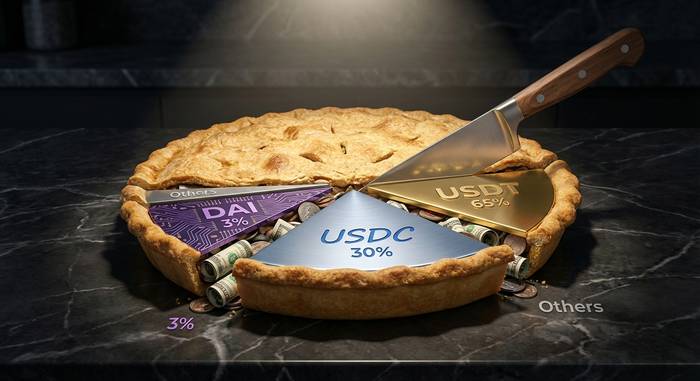
Fiat-backed stablecoins dominate the market. Tether (USDT) and Circle (USDC) together account for over 80% of the total stablecoin market cap. They are the simplest concept: the stablecoin issuer collects dollars, issues tokens, and promises to redeem them. The trust question is whether the issuer actually has the money. Tether has been fighting that question for years. Circle publishes monthly attestation reports and is regulated in the US. The transparency gap between the two biggest stablecoins is real and worth understanding.
Crypto-backed stablecoins like DAI remove the trust in a central issuer but introduce smart contract risk. DAI is minted when users deposit collateral into MakerDAO vaults. The protocol manages liquidations automatically. No company needs to hold a bank account. The tradeoff: you need $150 in crypto to get $100 in stablecoins, which is capital inefficient.
Algorithmic stablecoins are the controversial category. Terra's UST was the flagship. It maintained its peg through an arbitrage mechanism with LUNA: burn $1 of LUNA to mint 1 UST, burn 1 UST to mint $1 of LUNA. When confidence broke in May 2022, both tokens entered a death spiral. $40 billion erased. Do Kwon was arrested in Montenegro and extradited. The algorithmic model has not recovered its reputation since.
Yield-bearing stablecoins are the newest category. Ethena's USDe generates yield from delta-neutral strategies using staked ETH and perpetual futures shorts. Aave's GHO and Curve's crvUSD offer protocol-native stablecoins with built-in earning mechanisms. These blur the line between stablecoin and yield product.
The biggest stablecoins in 2026
The stablecoin market has grown past $200 billion in total market cap. Here are the names that matter.
| Stablecoin | Issuer | Market cap (approx.) | Backing | Chain(s) |
|---|---|---|---|---|
| USDT | Tether | $140B+ | USD, T-bills, commercial paper | Ethereum, Tron, Solana, 10+ |
| USDC | Circle | $60B+ | USD, short-term treasuries | Ethereum, Solana, Base, 8+ |
| DAI | MakerDAO (Sky) | $5B+ | Crypto + RWA collateral | Ethereum |
| USDe | Ethena | $3B+ | Delta-neutral ETH strategy | Ethereum |
| FDUSD | First Digital | $2B+ | USD reserves | Ethereum, BNB Chain |
| PYUSD | PayPal | $1B+ | USD deposits, treasuries | Ethereum, Solana |
| GHO | Aave | $500M+ | Crypto collateral | Ethereum |
| FRAX | Frax Finance | $500M+ | Hybrid (partial algo + collateral) | Ethereum |
Tether is the elephant. $140 billion in market cap makes USDT the third largest cryptocurrency after BTC and ETH. It processes more daily transaction volume than Visa in some metrics. But Tether has never completed a full independent audit. Their attestation reports show reserves but do not provide the granular detail that critics want. The question "does Tether actually have the money?" has been asked since 2017 and never fully answered.
USDC took a different path. Circle is a US-regulated company. Monthly attestation reports from Deloitte. Reserves held in Treasury bills and regulated financial institutions. In March 2023, USDC briefly depegged to $0.87 when Silicon Valley Bank (which held $3.3 billion of Circle's reserves) collapsed. The peg recovered within days after the FDIC guaranteed all deposits. The incident proved that even the most transparent stablecoin carries banking system risk.
PayPal's PYUSD is the corporate newcomer. Launched in 2023, it gives 400 million PayPal users access to a stablecoin without needing a crypto wallet. The significance: a mainstream financial company betting that stablecoins are the future of digital payments.

What happened with Terra UST: the $40 billion collapse
The Terra collapse deserves its own section because it changed how the entire industry thinks about stablecoins.
I remember where I was when UST depegged. Sitting at my desk watching the chart tick from $0.98 to $0.95 to $0.90 and thinking "someone is going to arb this back." Nobody did.
Terra's UST had no dollars behind it. No ETH locked up. Just an algorithm. Burn $1 of LUNA, mint 1 UST. Burn 1 UST, mint $1 of LUNA. Arbitrage was supposed to keep the thing glued to a dollar forever. And it did. For two years. While Anchor Protocol was paying 20% APY to anyone who deposited UST, money flooded in. $14 billion parked in one protocol. That yield came from LUNA staking rewards and subsidies from Do Kwon's Terraform Labs. When the subsidies started running dry and a few large wallets dumped, UST wobbled below $1.
What happened next was the fastest financial destruction I have witnessed in crypto. The arbitrage mint kicked in, flooding the market with new LUNA to absorb UST selling pressure. LUNA's price crashed from the new supply. Which made UST backing worth less. Which triggered more redemptions. Which minted more LUNA. The spiral fed itself.
Four days. LUNA went from $80 to $0.00001. UST went from $1 to pennies. $40 billion in combined market cap gone. People on the Terra subreddit posted suicide hotline numbers. Anchor depositors lost everything. Three Arrows Capital pointed to Terra losses as one reason they went under two months later.
Do Kwon ran. Got arrested in Montenegro carrying a fake passport. Extradited. Now facing fraud charges in South Korea and the US.
The lesson was expensive but clear: algorithmic stablecoins without real collateral are a confidence game. When confidence breaks, there is nothing to catch the fall. Every stablecoin project launched after Terra has made a point of emphasizing their real reserves and collateralization ratios. The algo model is not dead, but FRAX moved to full collateralization, and no new pure-algo stablecoin has gained meaningful adoption since.
Stablecoin regulation in 2026: GENIUS Act and MiCA
Governments noticed stablecoins. A $200+ billion market processing trillions in annual volume got their attention.
In the United States, the GENIUS Act (signed July 2025) established the first federal framework for stablecoins. The key requirement: payment stablecoins must maintain 1:1 reserves in cash, Treasury bills, or central bank deposits. Monthly attestation reports become mandatory. Stablecoin issuers with over $10 billion in circulation must register with the Federal Reserve. Smaller issuers can operate under state-level regulation.
The European Union's MiCA regulation (full enforcement deadline July 1, 2026) goes further. Stablecoin issuers in the EU need authorization as an electronic money institution. Capital requirements apply. Reserves must be held in segregated accounts. Algorithmic stablecoins without collateral are effectively banned.
These regulations favor the incumbents. Tether and Circle have the legal teams and reserves to comply. Smaller issuers face harder choices. The compliance costs create a moat that protects established stablecoin issuers from competition. Decentralized stablecoins like DAI operate in a gray area since there is no central issuer to regulate, but the protocols that facilitate their minting increasingly build compliance features.
I think regulation was inevitable and overdue. The $40 billion Terra collapse happened in part because nobody could stop it. No regulator. No circuit breaker. No reserve requirement. The GENIUS Act and MiCA do not solve every problem, but they make it much harder for a new Terra to attract $14 billion in deposits with zero collateral backing and a "trust the algorithm" pitch.
The stablecoin issuer landscape in 2026 is consolidating. Fewer issuers, bigger ones, more paperwork. Whether that makes the system safer or just hands more power to Tether and Circle depends on which tradeoff you fear more: unregulated chaos or regulated oligopoly.
How stablecoins power DeFi and real-world payments
DeFi runs on stablecoins the way a car runs on fuel. Take them out and the engine stops.
I lend USDC on Aave. Somebody borrows it to lever up their ETH position. I earn 4-6% APY. They pay 5-8% interest. The protocol sits in the middle and handles collateral management. No bank. No credit check. No business hours. That transaction happens 24/7 on Aave, Compound, Morpho, and a dozen other lending protocols. Stablecoin lending yields consistently beat what banks offer on savings accounts, and they do it without the six-month CD lock.
Curve Finance built an entire empire on stablecoin pools. The 3pool (DAI + USDC + USDT) is one of the deepest liquidity pools in DeFi history. Swap $10 million between stablecoins and lose maybe $200 to slippage. Try that with volatile tokens and the slippage eats you alive.
Cross-border payments are where stablecoins compete directly with traditional finance. Sending $10,000 from the US to the Philippines costs $300-500 through Western Union and takes 2-3 business days. Sending $10,000 in USDC takes 30 seconds and costs under $1 in gas fees on Solana or Arbitrum. For migrant workers sending money home, that cost difference is life-changing.
Businesses increasingly accept stablecoins for invoice settlement. No chargebacks (unlike credit cards), instant finality, and no exposure to bitcoin or ethereum volatility. A company that invoices in USDC knows exactly what they will receive. No currency conversion. No waiting for bank processing.
The numbers reflect this adoption. Stablecoins settled over $10 trillion in on-chain volume in 2025. That is real economic activity, not just DeFi leverage and speculation.