Is the Shiba Inu Coin a Good Investment in 2026?
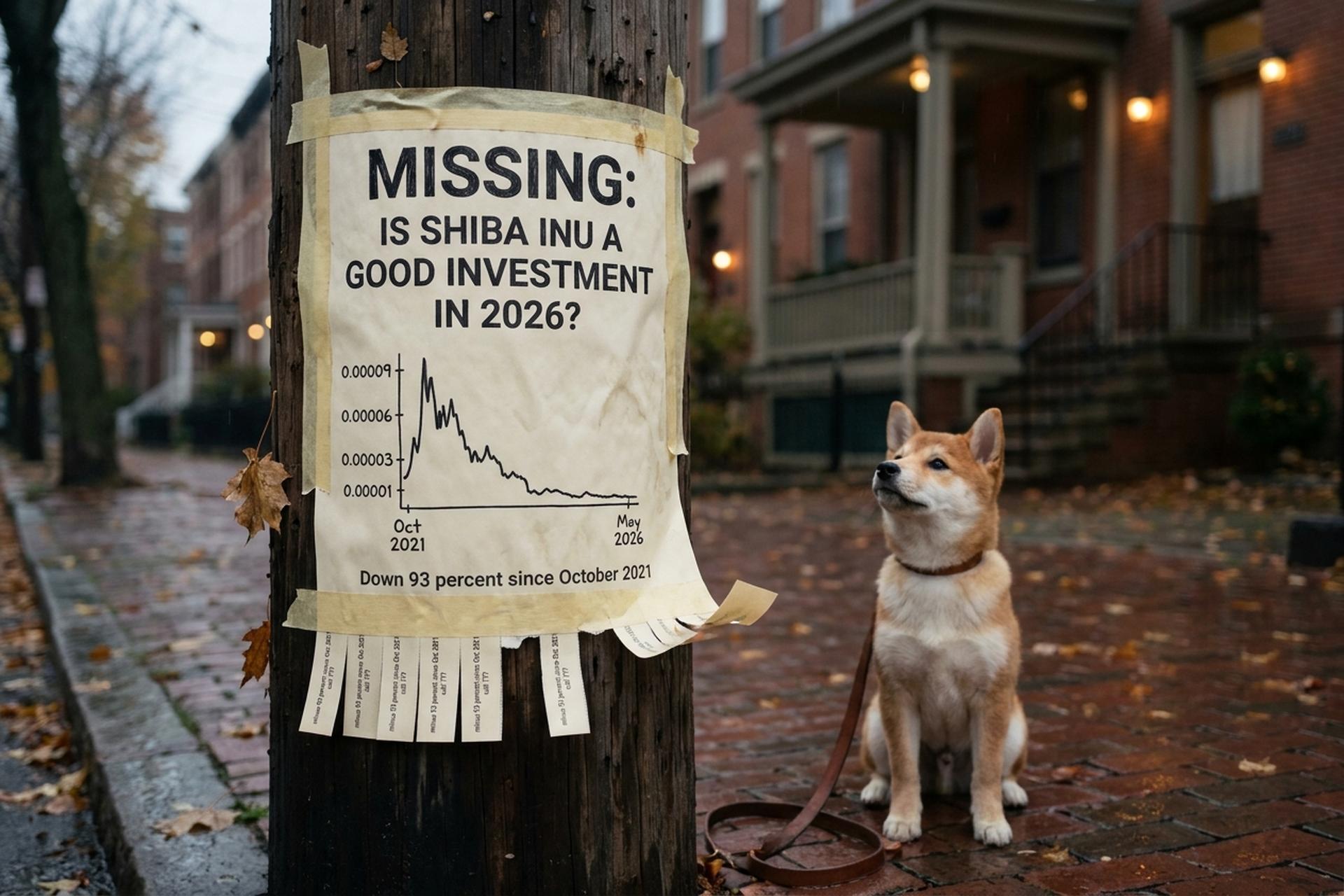
Is the Shiba Inu coin a good investment in 2026? Whether the inu is a good investment in 2026 depends on numbers most coverage avoids. Shiba Inu was created in August 2020 as a Dogecoin-inspired meme coin. Shiba Inu is a cryptocurrency among the major cryptocurrencies, and the cryptocurrency market has spent five years pricing it. A $10,000 stake placed at SHIB's October 28, 2021 all-time high of $0.00008616 is worth about $700 today — a 93 percent loss that five years of crypto markets have not repaired. The "burn rate" headlines obscure the fact that roughly 41 percent of the original one quadrillion supply went up in smoke from a single Vitalik Buterin transaction in May 2021, and almost nothing since. Shibarium, the Layer-2 from the Shiba Inu team that was supposed to change SHIB fundamentals through lower transaction costs and a deflationary burn loop, holds $488,000 of total value and earned about twelve dollars in annualized fees as of May 2026. The honest, risk-first answer is below — information, not investment advice.
The 2026 verdict on Shiba Inu, briefly
Trade the SHIB token small if you must. Do not treat it as a long-term holding. Compared to Bitcoin, the price of Shiba Inu has lagged badly: SHIB has outperformed Dogecoin on a five-year annualized basis (roughly minus 16.5 percent per year against DOGE's minus 28.1 percent) but lost catastrophically to Bitcoin (plus 121.6 percent over five years) and the S&P 500 (plus 81.7 percent). The SEC and CFTC jointly classified SHIB as a digital commodity on March 17, 2026, which is real news and unambiguously good news, but the trading price did not move on the announcement. No standalone spot SHIB ETF has been filed. The Shiba Inu coin is a less-bad memecoin in a brutal meme coin market, not an investment in any conservative sense of the word.
Where Shiba Inu sits in May 2026, by the numbers
The Shiba Inu overview below uses CoinMarketCap and Shibburn data as of May 18, 2026. The most useful frame is opportunity cost. A $10,000 buyer at the October 2021 ATH of $0.00008616 is sitting on roughly $700 today. The same $10,000 placed in Bitcoin in May 2021 became about $22,000. The same in the S&P 500, with dividends reinvested, became about $18,000. That is the comparison most "should I buy SHIB" articles refuse to make, and it is the one a serious investor has to start with.
Below Shiba Inu's price chart and the average trading price line, the structural picture is more interesting than the day-to-day candle. According to CoinMarketCap and CoinGecko, on May 18, 2026 Shiba Inu had a circulating supply of roughly 589.24 trillion tokens against a market cap of about $3.5 billion, ranking it 29th by market capitalization. SHIB's price has spent five consecutive months trading under $0.00001 and remains inside a descending channel that began in September 2025, with persistent high volatility and small daily price movements rarely breaking 5 percent. Holders on Etherscan crossed 1.55 million in late March 2026 and grew to over 1.58 million by late April, the latter an on-chain all-time high. The crypto market more broadly has rotated away from memecoin speculation toward Bitcoin spot ETFs over the same window. A strong community keeps headlines flowing, but on-chain digital assets activity has softened.
The concentration data is where things get uncomfortable. The top ten SHIB wallets hold roughly 62 to 63 percent of total supply, according to on-chain analytics aggregators Santiment and CoinCodex. Vitalik Buterin's burn address alone holds 41.04 percent. Upbit's hot wallet holds 5.93 percent, with Robinhood, Binance, Crypto.com, Bithumb, and OKX filling most of the remaining top-ten slots. None of these are individual whales hoarding to dump, but exchange-custody concentration on this scale means real free float lives in a small handful of CEX wallets. If one exchange delists, restructures custody, or gets compromised, SHIB's tradeable supply reorganizes overnight.
The snapshot below pulls the headline numbers into one place.
| Metric | Value | Source |
|---|---|---|
| Spot price | ~$0.0000059 | CoinMarketCap, May 18, 2026 |
| Market cap | ~$3.5B | CoinMarketCap |
| Market cap rank | 29 | CoinMarketCap |
| Circulating supply | 589.24T SHIB | CoinGecko |
| Cumulative burn (since launch) | 410.75T (41.05% of original 1Q) | Shibburn |
| Total holders | 1.58M | The Crypto Basic / on-chain |
| Top-10 wallet concentration | 62–63% | Santiment / CoinCodex |
| Vitalik burn address share | 41.04% | Shibburn |
| Upbit hot wallet share | 5.93% | CoinCodex |
| Drawdown from ATH | -93% | Derived from CMC |
| Months below $0.00001 | 5 consecutive | AInvest |
None of these numbers are catastrophic in isolation. Taken together, they describe an asset that is liquid enough to trade, dominated by exchange custody, and unable to recapture its 2021 peak even during a Bitcoin bull market.
Why SHIB's supply won't shrink: a fundamental problem
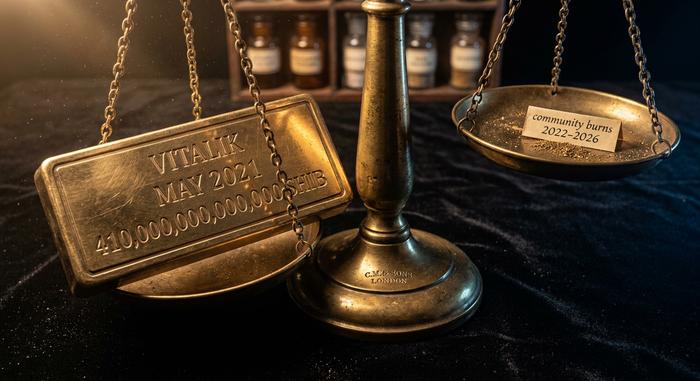
The most cited bull statistic about Shiba Inu is the 41 percent burn, a number that, on its face, suggests aggressive supply destruction. Shibburn's data confirms that 410.75 trillion SHIB has indeed been destroyed since launch, sometimes described in the press as a deflationary mechanism baked into the SHIB token model. The catch is that virtually all of it came from a single Vitalik Buterin transaction in May 2021, when the Ethereum co-founder burned roughly 410 trillion of the 505 trillion SHIB he had been gifted — one of the most consequential celebrity endorsements (in reverse) the meme coin market has ever seen — a quieter counterpart to the Elon-driven hype cycles that pump and dump SHIB and DOGE alike. Everything community burns have managed since then is a rounding error against the 589 trillion still in circulation. The supply of Shiba Inu has functionally been flat for four years.
On January 1, 2026, a widely-reported burn spike of 10,728 percent destroyed 173 million SHIB. That sounds dramatic; it is 0.00003 percent of the float. The fundamental problem is the math. For SHIB to reclaim its October 2021 ATH, market cap has to grow from roughly $3.5 billion to over $50 billion, which requires either a fifteen-fold price increase or supply destruction orders of magnitude beyond what the community has actually managed.
Shibarium: huge tx count, near-zero economic activity
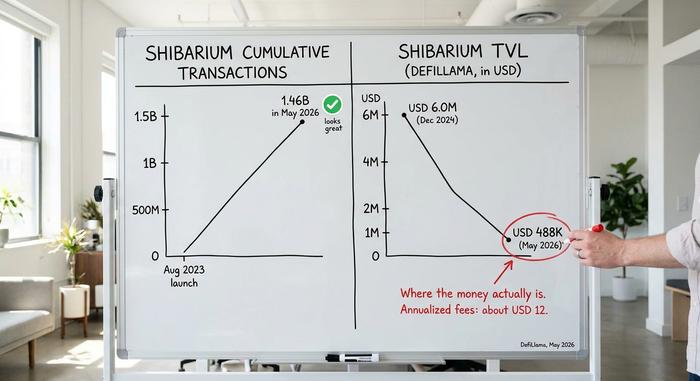
Shibarium, the Ethereum Layer-2 blockchain built by the SHIB team, launched its mainnet on August 16, 2023 and has been the centerpiece of every bull thesis since. The headline numbers look respectable on paper. ShibariumScan shows cumulative 1.46 billion transactions, 14.5 million blocks, and roughly 268 million wallet addresses ever interacted with the network. Daily transactions peaked at 3.82 million in August 2025.
The economic reality is different. According to DefiLlama, Shibarium's total value locked stood at approximately $487,800 in May 2026 — down from roughly $6 million at the end of 2024, a 93 percent collapse in 14 months. Annualized chain fees are about twelve dollars. Not twelve million. Twelve. For a Layer-2 that is supposed to host decentralized finance applications, gaming, and the SHIB metaverse economy, that is a near-zero rate of paid economic activity. Cumulative transaction counts on Layer-2s can be inflated cheaply through automated micro-transactions; what matters for an L2 thesis is fee revenue, and Shibarium has effectively none.
Then there was the bridge hack. On September 12, 2025, an attacker exploited a flash-loan vulnerability in Shibarium's bridge contract, briefly acquiring 4.6 million BONE tokens, taking more than two-thirds of validator voting power, and draining roughly $4.1 million by injecting three fake checkpoints into the Ethereum mainnet contracts that secure the chain. SHIB fell 11.5 percent that day; BONE fell 43.5 percent. The Shiba Inu Foundation rolled the chain back and offered the attacker a bounty in exchange for returning funds. The attacker declined. The chain has since hardened bridge security, but the security story is now a documented part of Shibarium's record.
For an investor asked to price the Shibarium upside into SHIB, the question is no longer "will it scale" but "how much of the bull thesis is left after $488,000 of TVL, a published roadmap that has slipped repeatedly, and a successful flash-loan attack on the bridge." ShibaSwap, the ecosystem's DEX, has seen volume erode alongside TVL across 2025-2026.
Whale concentration and the top 10 wallets
Holder concentration in SHIB is structurally high. The burn address holds 41.04 percent. The next largest wallets are exchange custody addresses, led by Upbit at 5.93 percent and followed by Robinhood, Binance, Crypto.com, Bithumb, and OKX, with the top ten in aggregate at roughly 62 to 63 percent.
The standard counterargument is that these are not single whales but custodians holding fragmented retail balances, which is technically true and partially comforting. The uncomfortable part is what happens at the protocol level if any of these custodians shifts custody, gets sanctioned, or experiences an outflow event. Bitcoin and Ethereum have similar exchange-custody patterns, but the single-address share for either is well below ten percent. SHIB's 41 percent in a burn address (frozen by design) plus 6 percent in one Korean exchange is unusual, and it means liquidity sensitivity to a single counterparty move is materially higher than for top-cap coins. For a tradable asset that already trades on social momentum, layered concentration of this kind is a second-order risk worth pricing in.
What 2026 changed for SHIB: regulation, ETFs, and what didn't
Two pieces of genuinely new 2026 information matter for an investor weighing SHIB today.
The first is regulatory clarity. On March 17, 2026, the SEC and CFTC issued joint guidance — the first of its kind — explicitly classifying thirteen named crypto assets as digital commodities under U.S. law. The list named SHIB by ticker alongside BTC, ETH, SOL, ADA, AVAX, LINK, DOGE, LTC, DOT, XLM, XTZ, and XRP. The CFTC press release (9198-26) and follow-up memos from four major law firms confirmed the classification. For SHIB this is unambiguously positive. The long-running risk that the SEC might one day declare the token an unregistered security is now formally retired, and the path to U.S. spot ETF listings is procedurally clearer.
The second is what the ETF market has actually done with that clarity. T. Rowe Price, a $1.7 trillion asset manager, filed an S-1 on October 22, 2025 for an active crypto ETF that lists SHIB among five to fifteen eligible holdings. Grayscale separately flagged SHIB as eligible for spot ETF listing under the new generic standards in November 2025. But as of mid-May 2026, no U.S. fund manager has filed for a standalone spot SHIB ETF. DOGE, meanwhile, has had two spot products to market since January 2026 (21Shares TDOG launched and Bitwise BWOW pending). The Motley Fool and other mainstream outlets covering the basket route note the same pattern: SHIB has the same regulatory standing as DOGE but considerably less institutional appetite for a single-name wrapper, and the basket route dilutes whatever incremental flow SHIB might have attracted. Future price forecasts have softened accordingly.
These are the inputs a SHIB investor in 2026 has to work with: legal clarity, no standalone wrapper, weaker ETF demand than DOGE, and a Layer-2 in commercial decline.
Shiba Inu vs DOGE, Bitcoin, S&P 500: the 5-year scorecard
Five-year returns are the cleanest way to score any speculative asset, because the window is long enough to wash out short-term noise. According to PortfoliosLab and Curvo, the annualized return on SHIB over the past five years is roughly minus 16.5 percent per year. DOGE returned minus 28.1 percent annualized over the same window. Bitcoin returned plus 121.6 percent total over the five years to February 2026, or about 17.3 percent annualized. The S&P 500 with dividends returned 81.7 percent total, about 12.7 percent annualized.
Phrased differently, SHIB lost an investor about 16 percent per year while the S&P paid them about 13 percent. The opportunity cost over five years is roughly 30 percentage points per year, compounded.
The table below shows what $10,000 placed at SHIB's October 2021 ATH became across each asset, the worst plausible SHIB entry point but a fair like-for-like.
| Asset | $10,000 in late Oct 2021 | $10,000 in May 2026 | 5-year change |
|---|---|---|---|
| Shiba Inu (at $0.00008616 ATH) | $10,000 | ~$700 | -93% |
| Dogecoin (near peak ~$0.30) | $10,000 | ~$3,500 | -65% |
| Bitcoin (~$61,000 in Oct 2021) | $10,000 | ~$12,600 | +26% |
| Ethereum (~$4,200 in Oct 2021) | $10,000 | ~$5,000 | -50% |
| S&P 500 (incl. dividends) | $10,000 | ~$14,000 | +40% |
SHIB's "5-year return" is sometimes quoted as plus 17 million percent. That number measures the move from SHIB's launch price of $0.000000000056, when the token did not trade on any exchange and almost nobody could buy it. The honest comparison is the table above, using the Oct 2021 ATH as a real-world entry. The conclusion is uncomfortable and consistent across every memecoin benchmark.
Investing in Shiba Inu: who it fits, who should pass
For most readers asking whether to buy Shiba Inu, the honest answer is short. Shiba Inu is a good speculative position for some — the inu token can play a small role in a risk-aware portfolio — and Shiba Inu coin is a good fit for traders who treat it as a sentiment bet, never as the core of a portfolio. Shiba Inu will never be a substitute for owning Bitcoin; if you have to choose between adding SHIB and choosing to buy Bitcoin, buy Bitcoin first. If you have a diversified core in indexes and Bitcoin, a long-term plan, and an emergency fund, a small SHIB allocation can sit on top of that as a speculative investment. If you do not have those things in place first, Shiba Inu is not suitable for all investors as a starting point — even one share of an S&P 500 ETF is a better first crypto-and-finance decision than your first SHIB position.
The position-sizing ceiling is approximately zero to three percent of an investable portfolio, never higher, never on leverage, dollar-cost averaged in if at all. The high risks here are not abstract — the risk of losing 90 percent or more is documented in every prior cycle, and SHIB's daily price fluctuations and weekly price swings still routinely break 10 percent in either direction. None of this is financial advice; the math just says what it says. Conservative investors should hold zero. Anyone whose risk tolerance cannot stomach a 95 percent drawdown should also hold zero, because that is the historical worst case for SHIB and it remains close to the current quote.
The base rates are unforgiving. Binance Research found that 97 percent of memecoins fail or go inactive shortly after launch. A December 2025 arXiv paper, Measuring Memecoin Fragility, found that fewer than 8 percent of new memecoin launches survive 60 days and the majority lose more than 97 percent of peak value. SHIB has survived more than five years, which puts it in the surviving sliver and makes it a meaningfully different bet from a launch-day Solana memecoin. Survival is not the same as recovery, and a SHIB allocation should be sized as if the base rate still applies to the next five years, not the last.