JasmyCoin (JASMY): IoT, Data Democracy and the Japan Bet
Five former Sony executives walked into a Tokyo office in April 2016. They started a company around one proposition: the data your smart devices generate should belong to you, not to the platforms that vacuum it up for free. Almost a decade later, that company's token is the only cryptocurrency Japan's FSA has cleared as compliant. JasmyCoin trades on every major centralized exchange from Coinbase to Binance to Bitbank. Its layer-2 mainnet on the Arbitrum Orbit stack went live in January 2026. The price chart tells one story. The regulatory story tells another. The technology sits in between.
This piece walks through what JasmyCoin actually is. We cover how the Personal Data Locker and JASMY token fit together, who the ex-Sony founders are, the price history including the misunderstood 2021 spike, the live JasmyCoin markets and statistics, the JasmyChain L2 and JASMY 2.0 roadmap, why FSA registration matters, which corporate partners are real, and where to buy JasmyCoin alongside the risks worth weighing.
What JasmyCoin Is and Why It Exists
JasmyCoin is the native settlement token of Jasmy Corporation. The Tokyo-based internet of things and personal data company was built by former Sony executives. The crypto project pitches itself as a "Data Democracy" play. Instead of letting Alphabet, Meta, and Amazon harvest your behavioural data for free, you keep ownership and control of that data in an encrypted Personal Data Locker. Anyone who wants access has to pay you in JASMY, settling data exchange on-chain via the Jasmy platform. The token therefore behaves less like an L1 ICO bet and more like a metered API key for an emerging personal data economy. Whether that economy materialises at scale is the open question.
Jasmy Corporation was founded in April 2016 in Tokyo (April 5, 2016, in Kita-Aoyama, Minato-ku). The company holds ISO/IEC 27001:2022 certification and a Japanese PrivacyMark. It banks with Sumitomo Mitsui Banking Corporation and operates as a private entity. A common piece of misreporting says Jasmy is listed on the Tokyo Stock Exchange or the old JASDAQ market. It is not. Only the cryptocurrency trades publicly. The pitch deck leans on the founders' Sony, Panasonic and Toyota pedigrees, which is why outlets often shorthand JasmyCoin as "Japan's Bitcoin" or the "Sony of crypto." Useful headline labels, but the underlying product is more specific than either tag suggests.

Inside the Jasmy Token and ERC-20 Architecture
Under the hood JasmyCoin operates as an ERC-20 token deployed on the Ethereum blockchain (contract 0x7420b4b9a0110cdc71fb720908340c03f9bc03ec). The supporting blockchain technology around the token is what makes Jasmy interesting. Three components matter.
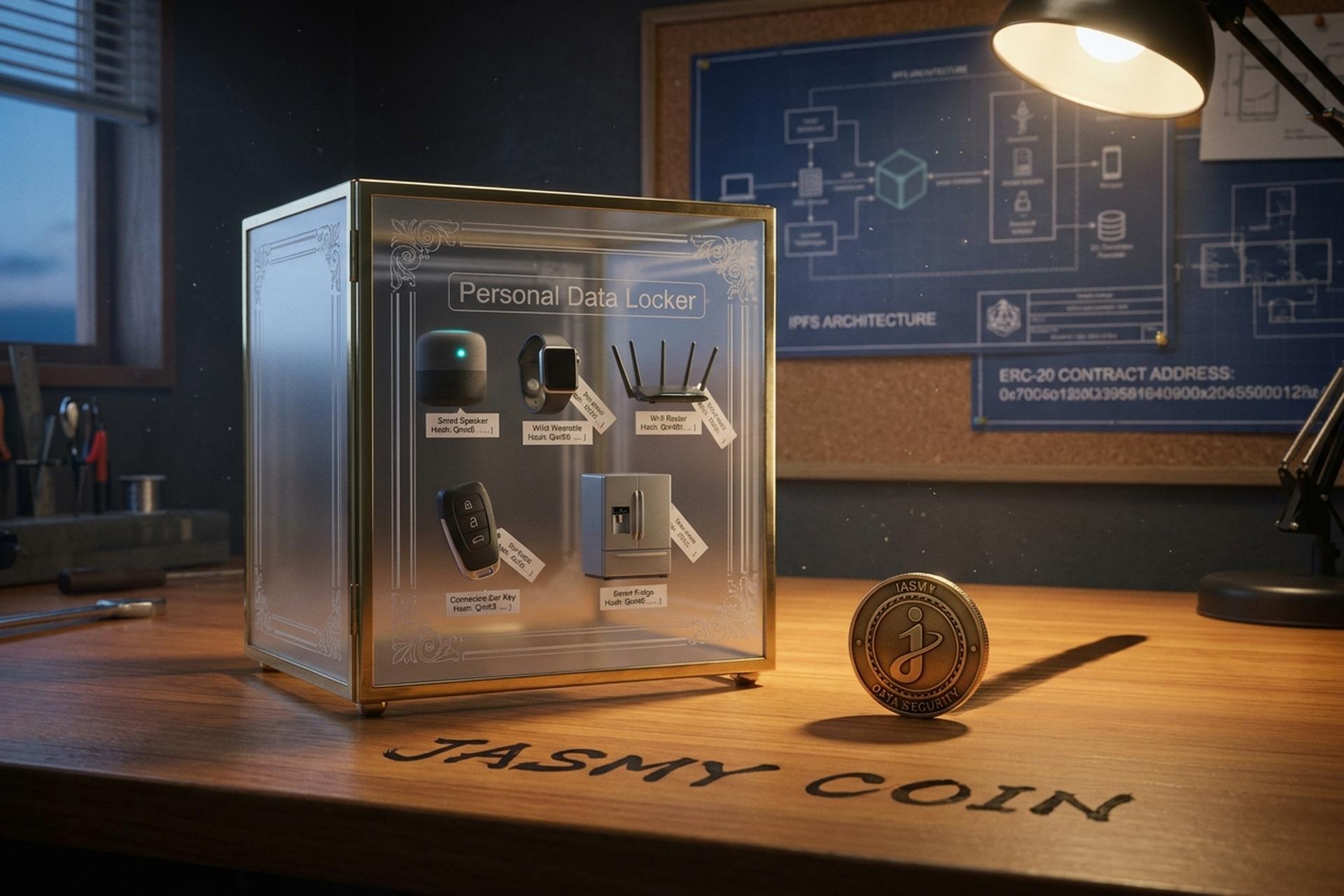
First, the Personal Data Locker. A user's IoT devices generate streams of personal data via edge computing. Smart appliances, wearables, PCs all feed the locker. Jasmy encrypts that data on-device. The encrypted payload is stored off-chain on the InterPlanetary File System (IPFS), the decentralized storage network that has been around since 2014. Storing data on IPFS keeps the data securely user-permissioned. Only cryptographic hashes of each file are committed to Ethereum. That gives tamper-evidence without parking the data itself on-chain. By 2026 Jasmy is repositioning the PDL as a decentralized-identity layer, not just a vault.
Second, the Security Knowledge Communicator (SKC). Older materials call it the Smart Key Container. This middleware handles KYC, registration and identity verification. It also ledgers every access transaction. When a third party wants to query a user's data, the SKC is the smart contract layer that brokers consent. It sets the market price, records the access, and charges the requester in JASMY. The user keeps full control and can securely share data on demand.
Third, the Smart Guardian. The edge-side hardware security module sits on the device itself: the router, the smart fridge, the laptop. It protects against the data privacy weak point in consumer IoT. Cheap unpatched devices are trivial to hijack. The Jasmy ecosystem markets SG as the way to decentralize that risk.
The utility token does several jobs inside this stack. Inside the data marketplace it is the settlement currency. It is the unit a merchant pays to retrieve personal data from IoT devices. As of January 2026 JASMY is also the gas token on JasmyChain. That makes it the token that powers the entire Jasmy network. Since March 2025 the JASMY ERC-20 token can move freely between Ethereum and the Base network. The bridge runs on Chainlink CCIP under the Cross-Chain Token (CCT) standard. That opens up DeFi-style use of JASMY outside the Japanese walled garden.
Founders, Ex-Sony DNA, and the Tokyo Origin Story
The Sony connection is not marketing decoration. The names check out. Kunitake Ando, Jasmy's Representative Director, was previously the seventh President and COO of Sony Corporation. Kazumasa Sato is the current President and COO. He joined Sony in 1980 on IBM mainframes. He later became CEO of Sony Style.com Japan Inc., served as Managing Director of Sony Style Japan, and was an Operating Officer at Sony Marketing Inc. He left Sony in 2010 and co-founded Jasmy six years later. Masanobu Yoshida co-founded the company and served as Deputy President and CTO until December 2021. Hiroshi Harada, the current CFO, came from KPMG.
The rest of the senior bench includes Takashi Hagiwara on the board running software development. Tadashi Morita serves as Chief Strategy Officer. Sheng Guo is Chief Information Officer of the Softech subsidiary. The Sony, Panasonic and Toyota DNA running through leadership matters. It is the structural reason incumbent Japanese industrial corporates have been willing to sit across the table from a crypto company at all. Japan has historically been resistant to anything that smells like wild-west Silicon Valley.
JasmyCoin Price History, Coinbase Listing and ATH
JasmyCoin price history has two acts that get confused. The first listing was on Bitbank in early 2021. It was the JMY/JPY pair, billed as Japan's first legally compliant cryptocurrency. That same February, JASMY also appeared on Upbit in Korea. Most data sources record an all-time high around $4.79 on CoinGecko and $4.99 on Coinbase. Both prints are stamped February 16, 2021. That was almost certainly a thin-book listing spike on Upbit, not organic discovery. Anyone trying to buy at $4 found nothing to fill against.
The credible secondary peak came three years later. In early 2024 a Japan-crypto narrative rally pushed JASMY higher. The rally was driven by Yen weakness and a broader DePIN bid. JASMY hit roughly $0.049 in mid-February 2024 — the real tradable cycle high most market participants treat as the reference top.
| Event | Date | Pair / Note |
|---|---|---|
| Bitbank (Japan, JPY) | Early 2021 | First Japan-compliant listing |
| BITPoint Japan | October 26, 2021 | JMY/JPY, FSA milestone |
| Binance.com | November 22, 2021, 12:00 UTC | JASMY/BTC, BNB, BUSD, USDT |
| Coinbase | February 17, 2022, 9 AM PT | JASMY/USD, USDT, EUR |
| Binance.US | Listed 2022, delisted March 21, 2023 | Alongside HNT |
| 2024 cycle high | ~February 16, 2024 | ~$0.049 (tradable peak) |
From that 2021 wash-traded $4.79, JASMY is now down roughly 99.9 percent. From the 2024 cycle high near $0.049, the drawdown is closer to 88 percent. Neither number flatters the project, but the 99.9 percent figure misleads if cited without context.
JasmyCoin Markets and Price Today
Here is the JasmyCoin price today and a broader JasmyCoin markets snapshot of the live price of jasmycoin, as of mid-May 2026:
| JasmyCoin metric | Value (May 17, 2026) |
|---|---|
| JASMY current price | $0.00589 to $0.00592 USD |
| Market capitalization | $292.6 million |
| Rank by market cap | #155 to #168 (varies by source) |
| 24-hour trading volume | ~$8.3 million |
| Markets / exchanges | 103 markets across 79 venues |
| 2026 intra-month high | $0.00778 (early May 2026) |
| Fully diluted valuation | ~$295.9 million |
The JasmyCoin price chart shows the recent price changes against the USD price. The token bounced roughly 62 percent off its 2026 low into early May, then drifted back. The JASMY price chart pattern is typical for mid-cap cryptocurrencies. Volume sits on Binance, Bybit, KuCoin and GroveX for the offshore book. Bitbank and BITPoint carry the regulated JPY book.
JasmyCoin Statistics: Supply, Holders, FDV
The JasmyCoin statistics that matter most for any new holder concern dilution and concentration. The total supply of jasmy is fixed at 50 billion JASMY tokens. Circulating supply has reached about 49.44 billion. That is roughly 98.89 percent of the cap already in the market. The market-cap-to-FDV ratio sits at 0.99. There is almost no overhead from unlocking future tokens. Supply pressure comes from ecosystem-incentive distributions, not from locked-investor cliffs. The trade-off is concentration. A Capital.com holder analysis from November 2025 found that the top ten wallet addresses control a meaningful share of float. Moves by one large holder can shift the price chart on a thin trading day.
JasmyChain L2 Mainnet and the JASMY 2.0 Roadmap
The most important change to JasmyCoin in 2026 has nothing to do with price. It is about utility. On January 19, 2026, Jasmy put JasmyChain into production. The new layer-2 was built on Arbitrum Orbit using the Nitro stack. It runs Chain ID 680 and uses Proof-of-Stake. A common misreporting insists JasmyChain runs on the OP Stack from Optimism. It does not. The Arbitrum choice matters. Orbit chains inherit Ethereum security via Arbitrum's fraud-proof system, not via a separate set of sequencer assumptions.
JASMY is the native gas token on JasmyChain — the single most material change to JASMY tokenomics since launch. Every transaction on the new chain consumes JASMY. What had been an almost purely speculative ERC-20 now has measurable utility demand, assuming the chain attracts real applications. The published roadmap targets 20,000 nodes and 30 validators. At launch, JasmyChain hosts Jasmy Swap (a third-party DEX) and MemePad (a memecoin launchpad).
"JASMY 2.0" is the umbrella label Jasmy uses for the whole upgrade. It bundles JasmyChain L2 with the JANCTION incubation. There is no separate ticker. No token swap. No contract migration. Holders of the ERC-20 JASMY simply bridge their balances onto JasmyChain. Coverage implying a token swap is wrong.
JANCTION is the second pillar. Jasmy frames it as "the first incubation project of Jasmy Incorporated." It is a GPU-backed L2 oriented at AI workloads. The brand is the JANCTION GPU Pool, and it has its own JCT token. A public testnet launched across 2024 and 2025. Limited GPU node sales opened in December 2024. General sales followed in February 2025. Mainnet is not yet publicly fixed as of May 2026. If JANCTION ships and attracts AI inference demand, JASMY benefits indirectly via shared security and ecosystem alignment.
Japan's Crypto Regulation: The JasmyCoin Moat
Japan runs the strictest cryptocurrency-listing regime among major economies. The Financial Services Agency co-supervises two self-regulatory bodies. The JVCEA covers spot. The JSTOA covers security tokens. The JVCEA maintains a per-token whitelist. No Japan-domiciled exchange may list a token unless the JVCEA has approved it. Global Legal Insights' "Blockchain and Cryptocurrency Laws and Regulations 2026" confirms this regime is intact. The FSA has enforced the FATF Travel Rule on Japanese virtual-asset service providers since 2023.
Jasmy is widely cited as the first cryptocurrency registered as compliant with the FSA-supervised JVCEA framework. It was the first non-major to clear a JPY trading pair on a Japanese exchange. JasmyCoin trades against the Yen on BITPoint Japan since October 26, 2021. It also trades on Bitbank, BitTrade and Coincheck. Japanese institutional capital is structurally barred from most altcoins. For those investors, the JVCEA whitelist effectively defines the addressable market.
The caveat: the "first and only" framing no longer holds in 2026. Several other tokens have since been JVCEA-approved for JPY pairs, eroding the unique-status moat. Jasmy's first-mover advantage in Japan remains real but is no longer monopolistic.
Named Partners: Panasonic, Toyota, VAIO, Transcosmos
Several Japanese industrial names get associated with Jasmy. Some are verifiable. Others are repeated without a source. The verifiable list as of May 2026 looks like this. Panasonic Advanced Technology is the Osaka-based research arm of Panasonic. It announced a joint Web3 IoT data-control platform with Jasmy on March 26, 2024. First-phase use cases sit in health and sports-fan engagement. The collaboration began in February 2024. Toyota appears as a reference partnership within the Woven City smart-mobility project in Susono, Shizuoka. No on-chain metrics have been released. VAIO Corporation embeds Smart Guardian and SKC into its "Secure PC" laptop line. It is a multi-year reference relationship. Transcosmos — Japan's largest BPO operator — joined the "Jasmy Initiative" in 2019 for customer-data management.
Two associations that circulate in social posts but have no verified partnership in mid-2026 are MUFG and NTT Docomo. The Aichi-prefecture smart-city MOU is also unverified.
Buying JasmyCoin and Risks to Watch
Buying JasmyCoin in 2026 is straightforward. The largest offshore venues by JASMY volume are Binance, Bybit, KuCoin, MEXC, Bitget and GroveX. Japan-domestic JPY pairs run on Bitbank, BITPoint, Coincheck and BitTrade. On the decentralised side, Uniswap and DeGate carry JASMY pools. The token also bridges to Base via Chainlink CCIP for DeFi use. Every major wallet that handles ERC-20 assets supports it.
The risks to weigh before any buying jasmy decision are clear. One: roughly 99 percent of supply already circulates. Ecosystem-incentive distributions remain a slow drip of selling pressure even without large investor unlocks. Two: JASMY's price action has historically been driven by Japan and Yen narratives. It is not driven by published adoption metrics. The project has consistently declined to publish PDL user counts or on-chain TVL prior to JasmyChain. Three: JasmyChain has been live only since January 2026. The actual usage data that would justify a utility re-rating is still very early. Four: mid-cap tokens around the rank-150 band routinely see drawdowns of 70 to 80 percent inside a single cycle.
The Japan Bet: What JasmyCoin Has to Prove
JasmyCoin is one of the few crypto projects where the regulatory story, the technical story and the brand story all line up on the same axis: a Japan-domiciled, FSA-compliant token built by an ex-Sony team trying to commercialise personal data sovereignty. What it has not yet shown is the operating metric that would close the loop, namely a published Personal Data Locker user count, a measurable JasmyChain transaction baseline, and a Panasonic phase-two deliverable beyond press release. The 2026 catalyst calendar makes those provable inside the next twelve months.