What Is Optimism (OP)? The Layer 2 That Bet Everything on a Superchain
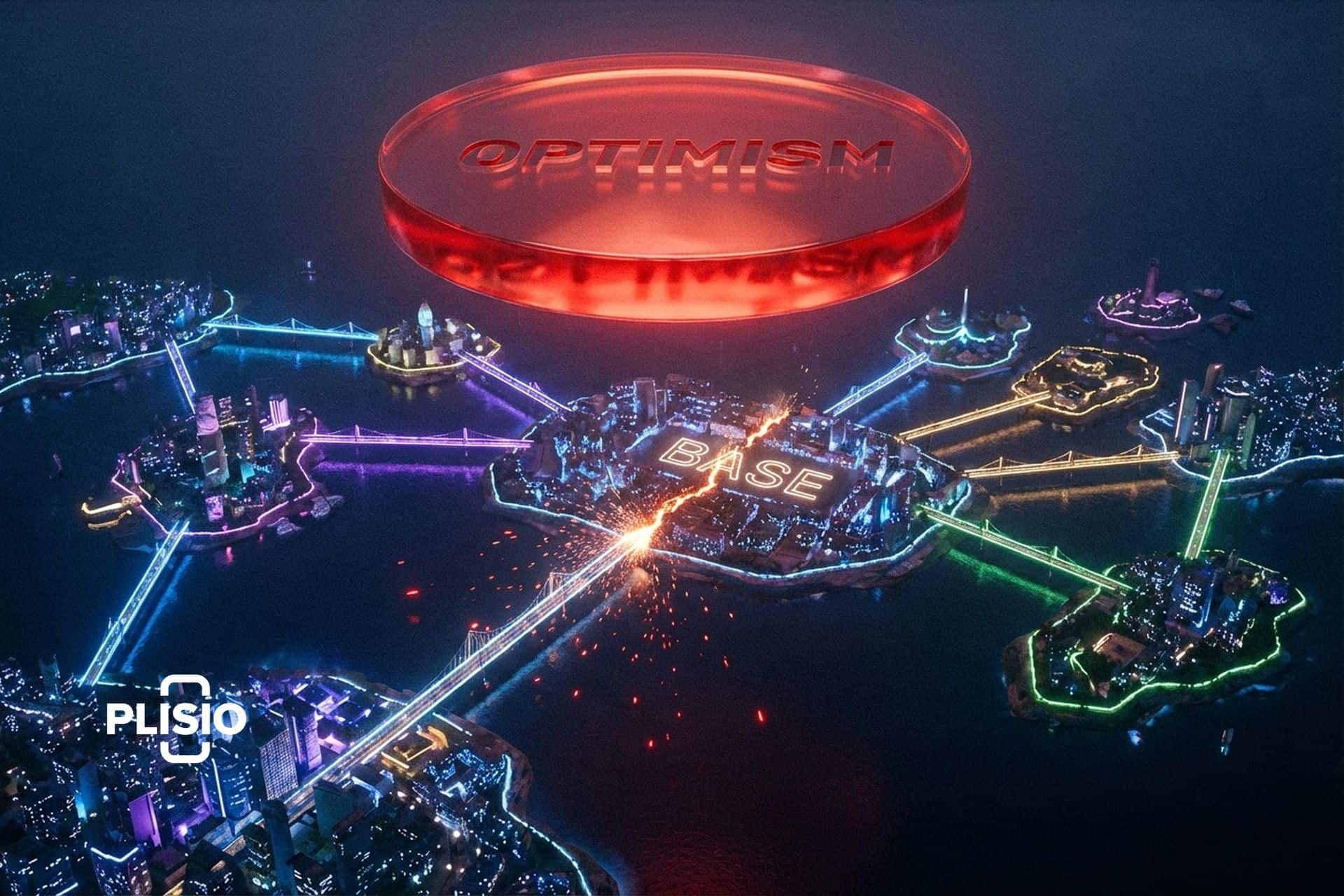
On February 18, 2026, Coinbase told Optimism it was leaving. Base -- the biggest chain on the OP Stack, the one driving 87% of Superchain sequencer revenue -- announced it would fork away and build its own infrastructure. The OP token dropped 20% in a day.
That single event captures everything you need to know about where Optimism stands right now. It built the most widely used Layer 2 framework in crypto. Over 50 chains run on its code. But the chain's own token sits at $0.11 -- down 97.7% from its all-time high of $4.84. The TVL on OP Mainnet hovers around $700-800 million, while Arbitrum, its main rival, holds nearly triple that.
So what is Optimism, and why does it matter if the token price says otherwise?
Optimism is an Ethereum Layer 2 that uses optimistic rollups
Optimism is a Layer 2 network built on top of Ethereum. It takes transactions off the main Ethereum chain, processes them faster and cheaper, and posts the results back to Ethereum for final settlement. The security still comes from Ethereum. The speed comes from doing less work on L1.
The tech behind it is called optimistic rollups. The name says it: the system is optimistic about transactions. It assumes every batch is valid unless someone proves otherwise. If you submit a bad transaction, there is a seven-day window where anyone can challenge it with a fraud proof. If the challenge holds up, the batch gets thrown out. If nobody challenges, the batch goes through.
This is different from ZK-rollups (used by zkSync and StarkNet), which generate a math proof that the batch is correct before posting it. Optimistic rollups are simpler and cheaper to run, but the trade-off is that withdrawal to Ethereum takes about a week because of the challenge window.
After the Bedrock upgrade in June 2023, transaction costs dropped 47-56%. Then Ecotone (March 2024) plugged into Ethereum's EIP-4844 blob transactions and cut fees by another 90%+. A swap on Optimism today costs a few cents. The Fjord upgrade in July 2024 added compression improvements on top of that.
For context: a token swap on Ethereum L1 might cost $1-5 in gas. On Optimism, the same swap runs $0.05-0.20. Still not as cheap as Solana ($0.00025), but if you want Ethereum-level security without Ethereum-level fees, Layer 2 is the answer. Optimism is one of the most straightforward ways to get there.
The fraud proof system has had a bumpy ride. Permissionless fault proofs went live in June 2024, got disabled in August due to bugs, and came back after the Granite hard fork. In February 2026, Optimism announced a partnership with Succinct to add ZK validity proofs alongside the existing fraud proof system -- a move toward Stage 2 decentralization. Right now the chain is still at Stage 1, meaning the Optimism Foundation has some override capabilities for security purposes.
The Superchain vision: one stack, many chains
Optimism's big idea is not one chain. It is many chains, all running the same code.
The OP Stack is the open-source software that powers Optimism. Any team can take it and launch their own rollup. Coinbase used it to build Base. Sony used it for Soneium. Worldcoin built World Chain on it. Uniswap launched Unichain. Frax, Lisk, Zora, Mode -- 50+ chains total run on OP Stack code.
The ones that join the official network form the Superchain. As of early 2026, there are 34 Superchain chains. Together they handle over 50% of all Layer 2 transactions across the entire Ethereum ecosystem. The aggregate Superchain TVL hit $6.3 billion in late 2025, accounting for 42.8% of all L2 value.
The logic behind this is straightforward. Instead of trying to get every user and every protocol onto one chain, Optimism lets a hundred chains bloom. Each one serves a different niche. Base handles general DeFi. World Chain does identity. Zora does NFTs. They all share a common bridge, a common message-passing system, and -- in theory -- a common fee structure that sends revenue back to the Optimism Collective.
| Superchain chain | Operator | Focus |
|---|---|---|
| OP Mainnet | Optimism Foundation | General purpose |
| Base | Coinbase (departing) | DeFi, consumer apps |
| World Chain | Worldcoin | Digital identity |
| Soneium | Sony | Entertainment, gaming |
| Unichain | Uniswap Labs | DEX-native chain |
| Zora | Zora Labs | NFTs, social |
| Fraxtal | Frax Finance | DeFi, stablecoins |
| Mode | Mode Network | DeFi-focused |
| Lisk | Lisk Foundation | Legacy chain migrated to L2 |
Base leaving: what it means and what it does not
The Base departure is the elephant in the room. Coinbase's chain was the Superchain's revenue engine. In the first half of 2025, Base generated $42.4 million in sequencer revenue -- 87.2% of the Superchain total. When Base announced it was building its own stack (called "base/base"), the market read it as a vote of no confidence.
The OP token tanked. Narrative collapsed. Twitter declared the Superchain dead.
Reality is more nuanced. Base is not vanishing overnight. The fork needs three hard forks to complete. Coinbase still has to maintain compatibility with the Ethereum ecosystem. And Optimism still has 33 other Superchain chains, plus dozens of OP Stack forks outside the official registry.
But the financial blow is real. The governance just approved a buyback program using 50% of net sequencer revenue -- about 2,700 ETH per year ($8 million). With Base gone, that revenue drops off a cliff. The buyback math only works if other Superchain chains grow fast enough to fill the gap.
The OP token: governance, airdrops, and a 97% drawdown
OP launched in May 2022 with an airdrop to 231,000 addresses. Total supply: 4.29 billion. Current circulation: about 2.12 billion (49%). There is a 2% annual inflation rate built in.
The token's purpose is governance. Holders vote on protocol upgrades, treasury spending, and incentive programs through the Token House. A parallel structure called the Citizens' House uses one-person-one-vote (not token-weighted) to decide on public goods funding through RetroPGF -- Retroactive Public Goods Funding.
RetroPGF is genuinely interesting. The idea: fund projects after they have proven their value, not before. Six rounds have been completed, distributing over 60 million OP to hundreds of projects building on the OP Stack and ecosystem. Total allocation for RetroPGF: 850 million OP (20% of supply). But the program is currently paused through the end of 2026.
Five airdrop rounds have gone out so far, putting about 242 million OP into 650,000+ wallets. Another 550 million OP remains allocated for future airdrops. At current prices, the remaining airdrop pool is worth about $61 million -- not nothing, but not the kind of money that moves markets.
| Category | Allocation | OP amount |
|---|---|---|
| Ecosystem Fund | 25% | ~1.07B |
| RetroPGF | 20% | ~859M |
| Airdrops | 19% | ~816M |
| Core Contributors | 19% | ~816M |
| Investors | 17% | ~730M |
The price tells the harshest story. ATH of $4.84 in March 2024, during the Bitcoin ETF mania. Then a grinding decline to $0.10 by late March 2026. A 97.7% drop. Even among L2 tokens, that is brutal. Arbitrum's ARB fell 96% from its ATH. Both tokens are in the same trench.
Optimism vs Arbitrum: the L2 rivalry
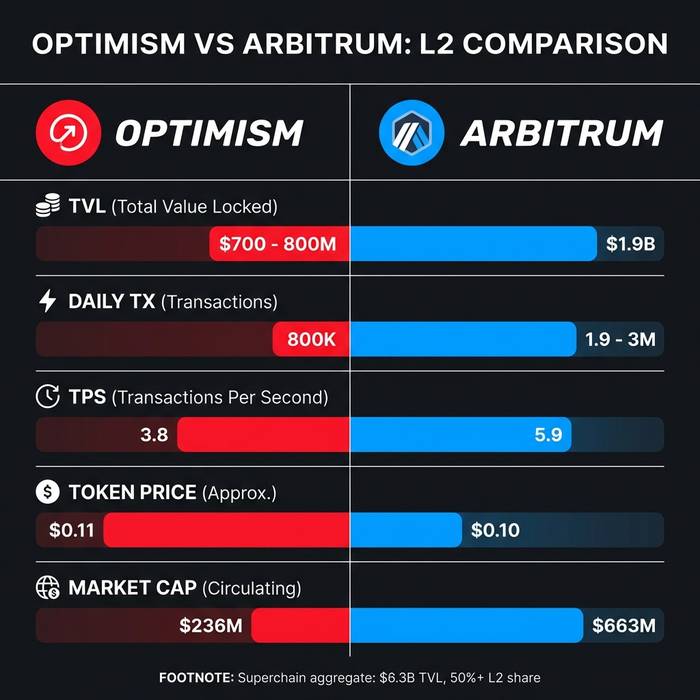
Arbitrum and Optimism are the two biggest optimistic rollup chains on Ethereum. They compete for developers, users, and liquidity. Here is where they stand:
| Metric | Optimism (OP Mainnet) | Arbitrum One |
|---|---|---|
| DeFi TVL | ~$700-800M | ~$1.9-2.0B |
| Daily transactions | ~800K | ~1.9-3M |
| TPS | ~3.8 | ~5.9 |
| Total historical tx | ~224M | ~565M |
| Token price | $0.111 | $0.096 |
| Token market cap | $236M | $663M |
Arbitrum wins on raw numbers. More TVL, more transactions, more activity on a single chain. But Optimism's play is not one chain. It is the Superchain aggregate. Count all 34 chains and the numbers flip: $6.3 billion in combined TVL, 50%+ of L2 transaction share.
The question is whether the Superchain holds together without Base. If it does, Optimism's strategy of being the infrastructure layer for dozens of chains is validated. If the other chains do not grow fast enough, Optimism becomes an open-source framework that everyone uses but nobody pays for.
Key protocols on Optimism
Optimism's DeFi ecosystem is not as deep as Arbitrum's, but it has real players.
Aave V3 leads with about $186 million in TVL. Synthetix, which was born on Optimism, holds $134 million. Velodrome, the chain's native DEX, sits at $91 million. The ecosystem skews toward established protocols that deployed on Optimism for cheaper gas, rather than Optimism-native innovation.
The biggest applications on OP Mainnet also benefit from the Optimism Foundation's incentive programs, which have distributed millions of OP tokens to protocols that attract users and liquidity.
One thing Optimism does differently from most chains: the emphasis on public goods funding. The idea that part of the network's revenue should go back to the developers who build open-source tools and infrastructure is baked into the governance, not bolted on as an afterthought. Whether that survives the revenue crunch from Base leaving is one of the most important questions for 2026.
How to use Optimism
Getting on Optimism is straightforward if you have used Ethereum before. Add the Optimism network to MetaMask (Chain ID: 10), bridge some ETH from mainnet, and you are good. The official Optimism bridge takes about 20 minutes for deposits. Third-party bridges like Hop, Stargate, and Across are faster but carry their own smart contract risks.
Once you are on the chain, it works just like Ethereum. Same addresses, same tools, same wallet. Aave, Uniswap, Velodrome, Synthetix -- they all run here. Gas is paid in ETH (bridged to Optimism). If you hold OP tokens, you can delegate your voting power in the Token House to participate in governance.
For builders: deploying a Solidity contract on Optimism requires minimal changes from an Ethereum deployment. The chain is EVM-equivalent after Bedrock, meaning most Ethereum tooling (Hardhat, Foundry, Remix) works out of the box. The OP Stack is MIT-licensed and fully open source -- any team can fork it and spin up their own L2.
What comes next
Optimism is at a crossroads. The Superchain idea is elegant, and the OP Stack is genuinely the most used L2 framework in crypto. But the economics are shaky. The biggest revenue source just left. The token is at all-time lows. RetroPGF is paused. And the competition -- Arbitrum, Base (now independent), zkSync, StarkNet -- is not standing still.
The bright side: the OP Stack codebase is everywhere. Fifty chains and counting. The governance experiment with Token House and Citizens' House is one of the most ambitious in crypto. And if the Superchain can attract new high-activity chains to replace Base's revenue, the buyback program starts to matter.
Honest take: Optimism has great tech and terrible token economics right now. Price follows narrative and revenue, not code quality. The OP Stack is everywhere, but the token captures almost none of that value. Whether OP at $0.11 is a steal or a trap depends on one thing: can the Superchain generate enough revenue without Base to make the buyback program meaningful?
Nobody has the answer yet. The infra is real. The usage is real. The revenue hole is also real. If Optimism can sign up three or four new high-volume chains to the Superchain by end of 2026 -- Sony's Soneium, Uniswap's Unichain, and whatever else comes through -- this story looks very different 12 months from now.