Stonks Meme: From GameStop Surge to Memecoin Stock Price
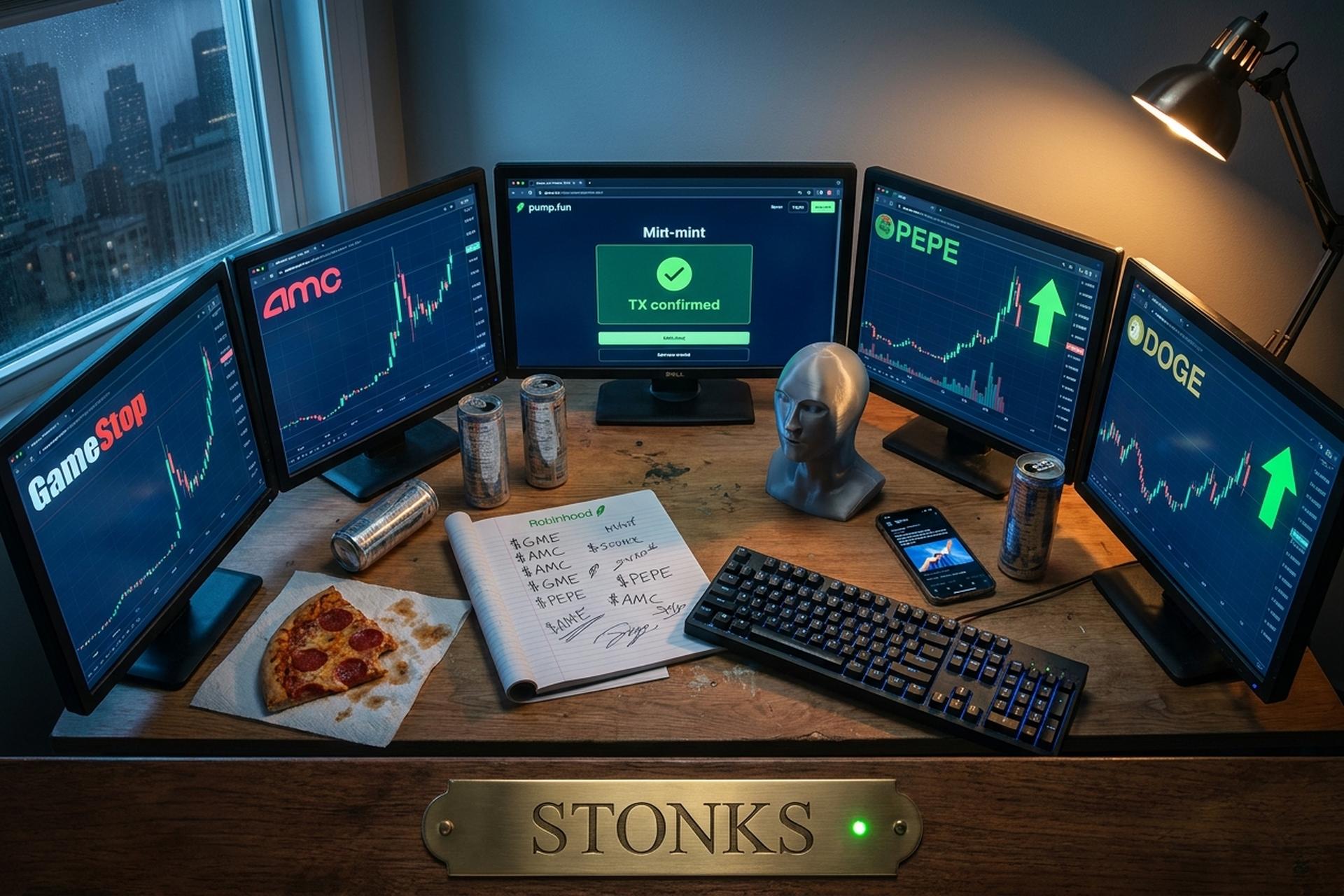
Retail traders accounted for 36% of US equity trading volume on April 29, 2025, an all-time record according to J.P. Morgan data cited by Cboe Global Markets. The number was under 10% before 2020. Somewhere in that five-year jump, a deliberately misspelled word from a Facebook page in 2017 stopped being a joke about money and became the working dialect of a generation that invests through Robinhood, pump.fun and group chats. The word is stonks. This article walks through where it came from, how GameStop made it serious, why it now describes the entire memecoin sector, and what it tells you about how people actually make financial decisions in 2026.
What Stonks Means: The Misspelled Stock Slang
The standard definition is that "stonks" is a deliberate misspelling of "stocks." That is correct and almost beside the point. The misspelling is the joke, not the carrier of the joke. It signals that the speaker knows they are pretending to understand markets. Adam Downer, an editor at Know Your Meme, put it tightly in 2021: stonks became "an ironic way to pair images with captions where you are actually bad with money but you think you are good with money." Merriam-Webster eventually added the term to its slang glossary, with a note that it functions as a hedge: you can post a stonks chart without committing to whether you mean it. That ambiguity is exactly what made the meme survive a financial cycle most slang does not.
Origin of the Stonks Meme: Meme Man and 2017
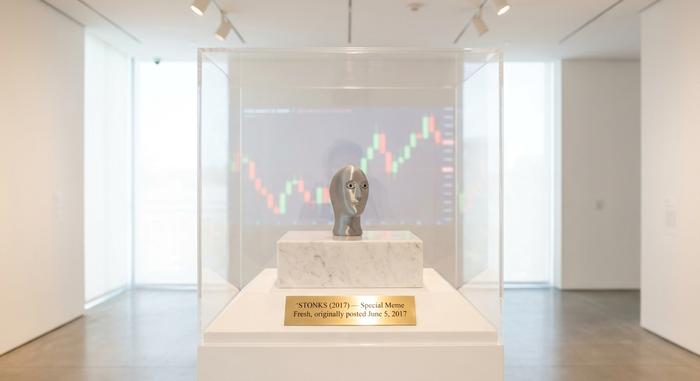
The first appearance of the stonks meme has a precise date. On June 5, 2017, the Facebook page "Special Meme Fresh" posted an image of Meme Man, a low-resolution 3D head rendered in shiny grey, standing in front of a generic stock-market chart with red and green arrows. The single-word caption was "STONKS." The post gathered around 3,600 reactions in its first weeks. None of those reactions had anything to do with finance. Meme Man belonged to the surreal-meme genre that flourished on 4chan and small Reddit communities between 2016 and 2018, defined by minimalist design, off-key spelling and intentional ugliness. Its earliest spread was tracked through three measurable hops: r/Ooer reposted the image on July 3, 2017 and accumulated around 400 points; on February 9, 2018 the YouTuber HallucinatoryMenu uploaded a clip of the word pronounced with heavy reverb, reaching 19,000 views; and on March 15, 2018 an edited version turned up in an Imgur photo dump that crossed 131,000 views. Meme Man, often drawn wearing a poorly fitted business suit in later edits, emerged as a reusable reaction image whenever a chart moved fast in either direction. Its popularity grew because the image existed to mock the speaker as much as the market. By the end of 2018 the template had spawned a small family of Meme Man variations using the same misspelling trick on other professions: Shef for chef, Tehc for tech, Helth for health. None of those variants had legs. Stonks did, partly because finance is the one field where the misspelling reads as commentary rather than nonsense. Two years later, a global pandemic and a brokerage app would do the rest. But for almost three years, "stonks" was an obscure surreal joke about a 3D bald man and a fake stock chart. The financial meaning was retrofitted.
How GameStop Made Stonks a Financial Meme
The first time most people outside meme circles encountered the word, it was being tweeted by Elon Musk. On January 26, 2021 he posted the single word "Gamestonk!!" with a link to the WallStreetBets subreddit. The episode pitted internet day traders organising on a reddit forum and a sprawling reddit group against the established hedge funds that had shorted GameStop heavily, with social media coordination doing most of the work. GameStop shares jumped 31% in the after-hours session, according to CNN Business reporting that night. The structural set-up handed early movers an obvious profit window on the way up before institutions could exit. Two days later GameStop printed an intraday high of $483, against a price under $20 less than a month earlier. Short interest in the stock had reached 140% of its float, a structurally unsustainable level documented in Wikipedia's detailed squeeze account. WallStreetBets gained two million subscribers in a single day around the peak, according to Newsweek, and the community grew from roughly 2 million members on January 25 to over 6 million by month-end. Robinhood, the brokerage where most of the retail trading flowed, halted buy orders on GameStop on January 28, an event that triggered a $70 million FINRA penalty in June 2021, at the time the largest in FINRA history, for outages and misleading customers. By July 2021 Robinhood had 18 million accounts holding around $80 billion in assets. AMC Entertainment underwent a parallel squeeze in the same window, peaking above $72 in June. The word "stonks" travelled through every layer of that story. Bloomberg headlines used it. Congressional hearings on the GameStop episode acknowledged it. CNBC anchors started saying it on air, ironically at first and then with progressively less irony. What had been a surreal-meme inside joke became the brand name of a retail revolt against perceived institutional gatekeeping. The St. Louis Fed later published a 2024 explainer titled "Who Buys Meme Stocks?" that treated meme-stock traders as a legitimate demographic to study, with surveys on age, income and brokerage use. That paper is the cleanest sign that "stonks" had crossed the line from joke to category. After January 2021 you could not use the word ironically without also using it descriptively.
Stonks Growth Into Memecoin Culture
Pump.fun, a Solana-based launchpad that lets any user create a memecoin from a wallet in under a minute and route it straight to a Raydium exchange listing, generated more than $1 billion in cumulative protocol revenue by December 2025, according to DeFiLlama data summarised in CoinDesk's year-end coverage. The platform alone has handled over $150 billion in trading volume across hundreds of thousands of tokens. Bloomberg counted more than 13 million memecoins in existence as of October 22, 2025, in a piece arguing the supply now demands regulatory attention. That is the natural ending of the GameStop story. The same psychological loop, where a retail trader sees a meme, posts a chart, pumps the price, exits or holds and repeats, moved from US equities to cryptocurrency because crypto offered something the stock market could not. There is no settlement cycle, no broker who can halt trading, and no short-interest data to anchor a thesis on. The trade and the meme have collapsed into a single object.
The sector data shows how large the move became.
| Metric | 2021 peak | 2024 peak | Source |
|---|---|---|---|
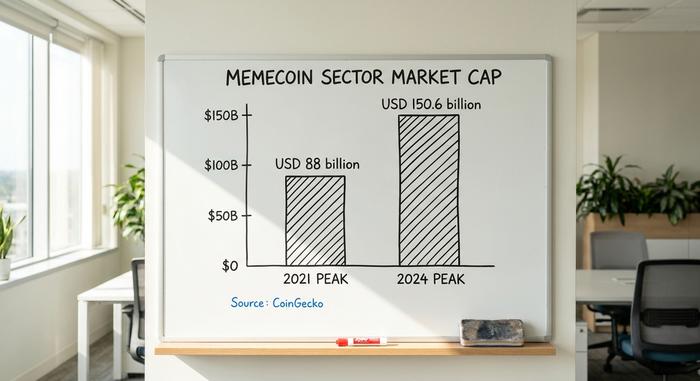
| Total memecoin market cap | $88 billion (Oct 2021) | $150.6 billion (Dec 2024) | CoinGecko State of Memecoins 2025 |
| Daily memecoin volume (avg) | $1.1 billion (2023) | $9.7 billion (2024) | CoinGecko |
| PEPE market cap | — | $11 billion (Dec 9, 2024) | FXStreet |
| Pump.fun cumulative revenue | — | >$1 billion (Dec 2025) | DeFiLlama / CoinDesk |
| Memecoins in circulation | thousands | 13 million+ (Oct 2025) | Bloomberg |
DOGE, launched in 2013 as a parody of Bitcoin, set the template when Musk-driven tweets pushed it to a peak market cap near $90 billion in May 2021 (GlobalData). SHIB launched in August 2020 and peaked in October 2021. PEPE arrived in April 2023 and rode 2024's cycle to its $11 billion print. By 2026 the Solana memecoin share of total Solana DEX volume had dropped from roughly 70% to around 10%, according to SolanaFloor, which the publication framed as the sector maturing rather than dying. Memecoin volume now sits inside a more diversified DeFi mix on Solana, but the daily token-creation rate on pump.fun is still measured in tens of thousands. That is what "stonks" looks like at scale.
Variation: From Stonks to Not Stonks and Stonks on ETH
The cleanest measure of how far a meme has travelled is the number of derivatives it spawns. Not Stonks appeared as the inverse: Meme Man with a downward arrow and red numbers, used whenever a trade went the wrong way. The surreal-meme family kept generating cousins, with Shef, Tehc and Helth taking the misspelling pattern into adjacent fields. None reached escape velocity. The financial variants did. A token called Stonks on ETH currently trades on Uniswap V2 and Solana with a market cap of roughly $306,000 (CoinGecko rank #4335) and a deliberately absurd circulating supply of 420.69 billion units, a supply choice that is itself a meme reference combining 4/20 and 69 into a single number. The token reached an all-time high of $0.000097 in June 2024. It is, in every sense, a 2017 Facebook image with a price chart, a market cap and a 24-hour trading volume of a few thousand dollars. A separate text-based game STONKS-9800, marketed as a 16-bit stock market simulator on Steam, even built a small audience around the meme name; players calculate trades inside a deliberately janky interface that channels the same joke. That is the meme reading the meme back to itself.
Stonks ETFs: The Meme Hits a Real Stock Price
The most visible sign that mainstream finance has accepted the stonks meme is the existence of regulated investment products built around it. Roundhill Investments launched the MEME ETF on October 8, 2025, packaging a basket of meme-stock and meme-adjacent equities into a single ticker. Canary Capital filed an S-1 registration for a spot PEPE ETF on April 8, 2026, the first formal attempt to bring a memecoin into the same regulatory wrapper that Bitcoin and Ether occupy. Bitwise had already filed for a spot DOGE ETF in January 2025, with Bloomberg ETF analysts assigning roughly 75% odds of eventual approval. The list keeps growing because retail flow has shifted hard enough to justify the structuring cost.
| Product | Filed / launched | Issuer | Status |
|---|---|---|---|
| Roundhill MEME ETF | Launched Oct 8, 2025 | Roundhill Investments | Trading |
| Bitwise DOGE ETF | Filed Jan 2025 | Bitwise | Pending |
| Canary spot PEPE ETF | Filed Apr 8, 2026 | Canary Capital | Pending |
The retail share number sits behind all of it, alongside a broader trend of memecoin market value drifting up year-over-year. When 36% of daily US equity volume comes from individual traders, ignoring the language those traders use is bad product design. ETF issuers learned this lesson the slow way through 2024 and 2025, watching memecoin daily turnover overtake several mid-cap altcoins they had been considering as separate products. The MEME ticker on Roundhill was, in that sense, a defensive move by traditional finance as much as an opportunistic one. The product had to exist because the underlying behaviour was already there.
What Stonks Says About Financial Decisions
The honest answer to why "stonks" persisted while most internet slang did not is that it tells the truth. Most retail investors do not know what they are doing in the precise sense that a CFA would mean. They know it. They make the bet anyway, sometimes with strong returns and often with terrible ones. The meme builds that admission directly into the word, which is why it survived the embarrassment of GME holders down 80% from peak, the embarrassment of LUNA wipeouts, the embarrassment of pump.fun tokens that went to zero in the same minute they launched. I keep coming back to Downer's framing: the word works because it admits the gap between feeling competent and being competent. The St. Louis Fed paper documented something similar in numbers — meme-stock traders skew younger, more male, and more concentrated than market averages would predict, with portfolios that would make a fiduciary visibly wince. The financial decisions made under the stonks register are not all wrong. They are made with a self-awareness that the language itself underwrites. The vocabulary of poor financial decisions, admitted upfront, captures more of the actual retail-trading zeitgeist than any quarterly outlook from a Wall Street strategist. That is rare. Traditional investing vocabulary tends to flatter the user with phrases like "long-term conviction" and "thesis-driven allocation." The stonks vocabulary does the opposite. It assumes the user is half-guessing and prices that guess into the joke.
Conclusion: When the Stonks Joke Becomes the Default
Once a meme has a $150 billion sector behind it, an ETF wrapper on top, an academic literature underneath, and 13 million token variants circulating, the question of whether it is still a meme stops being interesting. The interesting question is what the next layer of irony does when the joke becomes the default. Surreal-meme culture worked because it was a small inside language. Stonks broke out of that frame in 2021 and has been broadening ever since. If retail keeps gaining share through the late 2020s, and the J.P. Morgan data suggests that is the base case rather than a one-off spike, the value of any new financial product will partly depend on whether it can hold a conversation in the same register the user is already trading in. Watch where the next surreal-meme image lands. It tells you where the money is going six months out.