Stock Market Terminology 2026: A Vocabulary by Trader Style
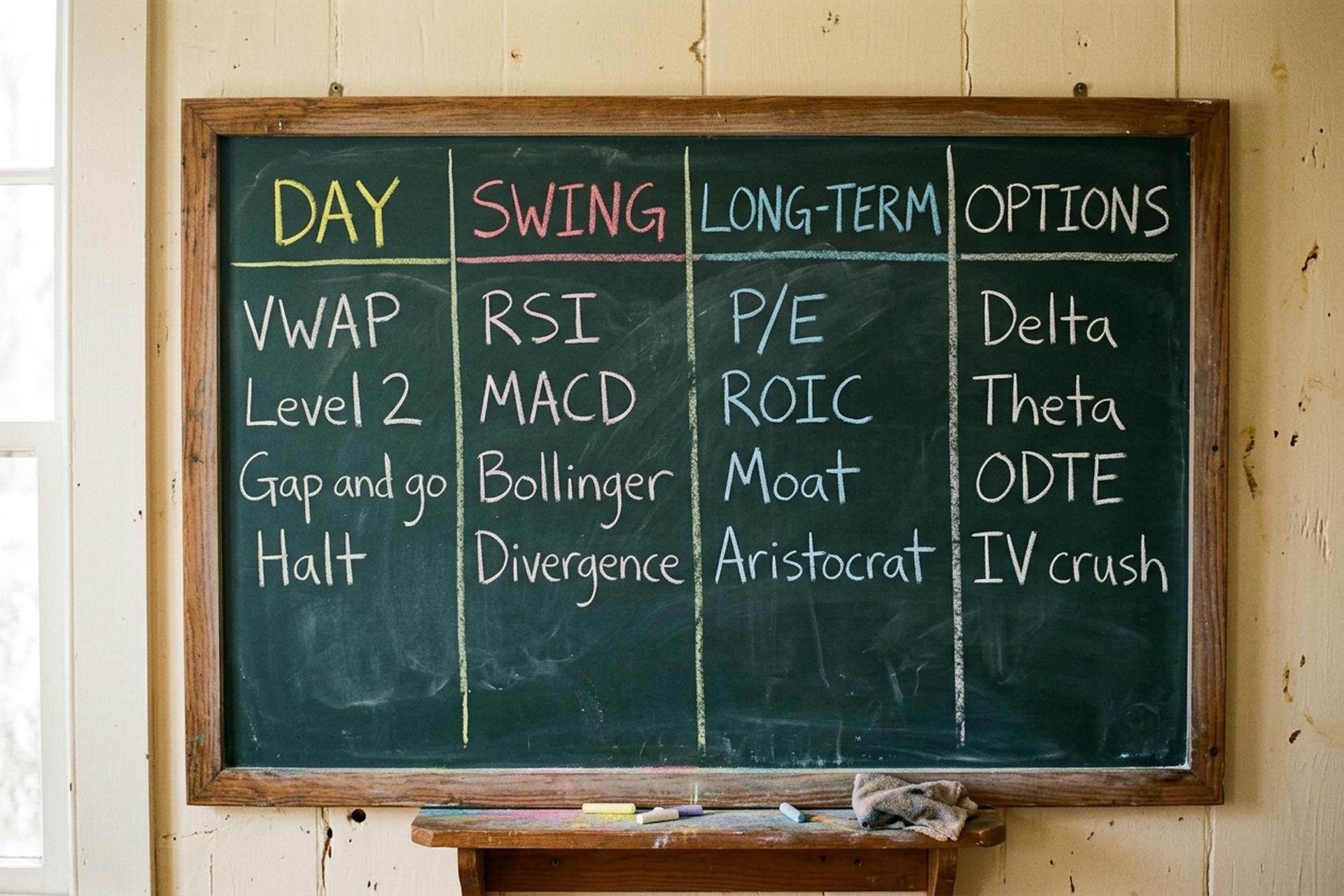
Every glossary article on the first page of Google does the same thing: a flat alphabetical list of 25 to 95 terms. That format flatters nobody. A day trader and a long-term dividend investor share maybe a fifth of their working vocabulary; options traders speak a four-letter alphabet the other two camps can ignore. This article fixes that by sorting stock market terminology the way trading desks actually use it — by what kind of trader you are.
Why Stock Market Terminology Splits by Trader Style
The Pattern Day Trader rule used to be the first thing every new equity trader learned: $25,000 in your account or three day trades a week, full stop. That threshold had been unchanged since 2001. As of June 4, 2026, it is gone. FINRA's Regulatory Notice 26-10 replaced the static minimum with an intraday real-time margin calculation, and brokerages have until October 20, 2027 to implement it fully. Single largest structural change to US day-trading access in 25 years, and most glossaries still describe the old rule.
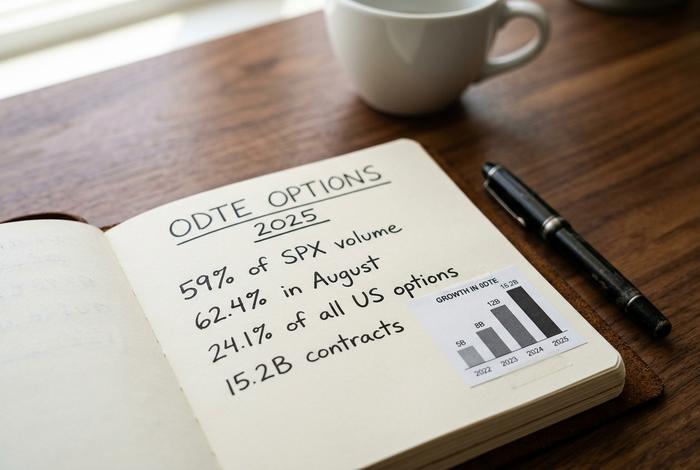
The same drift shows up everywhere. Zero-days-to-expiration options were a niche product at the start of this decade; in 2025 they accounted for 59% of all S&P 500 index option volume on average, and 62.4% in August 2025 alone, per the CBOE's annual review. Total US listed options volume hit 15.2 billion contracts in 2025, up 26% year over year. Same-day settlement on stocks (T+1) became standard on May 28, 2024. None of these terms appear in a typical stock-market-terms-for-beginners list, yet they describe how the market actually moved in the past year.
The structural point is simple. A glossary organized alphabetically treats every term as equally important to every reader. A glossary organized by trader style admits the obvious: the working vocabulary of a long-term investor focused on Coca-Cola's dividend (P/E ratio, free cash flow, dividend aristocrat, moat) barely overlaps with what a day trader watches at the open (VWAP, Level 2, gap-and-go, T1 halt). The right way to learn the material is to pick a style, learn its core terms, then borrow from the others.
Day Trading Vocabulary: VWAP, Level 2 and Trade Halts
Day traders mostly care about what the order book is doing in the next sixty seconds. Analysis comes a distant second to mechanics, and the working vocabulary follows that priority.
Open any decent intraday chart and the first line you see is the volume-weighted average price for the session — VWAP. Institutional desks fill big orders against it; retail traders use it as moving support and resistance that the whole room watches at once. Just above it sits the Level 2 quote, the depth-of-book view showing the ladder of bids and offers with size attached to each price.
A handful of words describe what to do with all that. Scalpers grab one or two ticks and hold for seconds. A trader who fades a sudden spike is betting the move reverses; one chasing momo is doing the opposite, riding strength on volume. The gap-and-go setup is more specific: a stock opens with a price gap, breaks the high or low of the opening range in the gap's direction, and runs from there.
Halt codes are worth knowing because misreading one can be expensive. T1 means trading is paused pending a routine news release; it usually resolves cleanly. T12 is the one to watch out for, signalling a regulatory inquiry into an unusual price move. The LULD (Limit Up–Limit Down) system halts individual stocks automatically when price runs outside fixed percentage bands: ±5% for S&P 500 names above $3, ±20% for stocks priced between $0.75 and $3.
Two recent shifts also belong here. T+1 settlement, since May 28, 2024, means the cash from a sale arrives the next business day rather than two. And the PDT rule was retired on June 4, 2026 in favour of dynamic intraday margin that recalculates in real time.
Swing Trading Stock Terms Built on Technical Charts
Swing traders hold positions for days or weeks, so their vocabulary leans on the technical analysis menu plus a few survival phrases learned the hard way.
The Relative Strength Index, RSI, runs on a 0-to-100 scale and tells you the speed of recent moves. Readings above 70 are usually flagged as overbought; below 30, oversold. Neither is a buy or sell signal on its own — a lesson most swing traders learn after one or two overbought-and-still-running rallies. MACD, the Moving Average Convergence Divergence indicator, subtracts a slower exponential moving average (26-period) from a faster one (12-period) and tracks the result against a 9-period EMA signal line; the crossovers are the trading signals.
Bollinger Bands give a quick read of volatility regime — a 20-period SMA in the middle, with outer bands set two standard deviations above and below. Wide bands mean trouble or opportunity depending on the breakout direction; the squeeze, when bands tighten, often precedes a sharp move.
Support and resistance need no introduction, but divergence does: that's the term for when price makes a new high or low and the indicator refuses to confirm it. Missing one is one of the more expensive ways to learn the rest of the vocabulary. The catch-phrases are easier — buy the dip assumes the trend resumes; catching a falling knife warns against doing it too early.
Long-Term Investor Vocabulary: Moats and Aristocrats
Patient investors speak something close to Buffett-Munger. Five or six terms carry most of the freight, and they apply roughly the same whether rates are at 2% or 6%.
Every stock screen leads with price-to-earnings: share price divided by earnings per share. What the number means depends on context — the S&P 500 was trading near 29× trailing earnings in February 2026, against a long-run historical average closer to 19 or 20. By that measure the index has been expensive for a while. EBITDA (earnings before interest, taxes, depreciation, and amortization) shows up as the denominator in the enterprise-value-over-EBITDA multiple, a way to compare companies with different debt loads. Free cash flow does the same job more honestly, netting out what the business had to spend on equipment.
Then there is ROIC, return on invested capital, which is really a quality score: 10% is strong, 15% means something genuinely durable is going on. That durable thing has a name. Buffett's moat — the competitive advantage from brand, network effects, switching costs, or patents — is what lets a company hold high ROIC for a decade or longer. Compounder is the investor's word for a business that keeps reinvesting at that high ROIC; value trap is the cautionary opposite, a stock that looks cheap on the multiples for a structural reason no buyer's enthusiasm can fix.
Dividend Aristocrats are the practical roll-call. The S&P keeps the list, requiring 25 consecutive years of dividend increases for membership. The count hit 69 in 2025 and held at 69 in 2026, the first year on record with no changes at the January rebalancing. Every name on that list is a blue-chip stock by any usable definition: large market cap, steady earnings, and a payment record that makes them the default anchor for shareholder income portfolios.
Options Trading Has Its Own Stock Market Language
Options have done to stock vocabulary what crypto did to mainstream finance — invented a parallel language inside five years. The terms split into three layers: contract mechanics, the Greeks, and the new 0DTE ecosystem.
Contract mechanics first. A call is the right to buy 100 shares at the strike price before expiration; a put is the symmetric right to sell. The contract is in the money if exercising today would profit (call above strike, put below), at the money if stock and strike are roughly equal, out of the money otherwise. The premium is what a trader pays for that right, made up of intrinsic value plus extrinsic (time plus implied volatility, both decaying toward zero at expiration). When the buyer exercises, the seller is assigned.
Then the Greeks, the four sensitivities every options trader eventually memorizes. Delta tracks how much the option's price moves for a $1 move in the underlying. Gamma is the rate of change of delta itself; it accelerates near expiration and is the reason short-dated options can move so violently. Theta is the daily time decay — bad for buyers, good for sellers, and the engine of every premium-collection strategy. Vega measures sensitivity to a one-percentage-point change in implied volatility.
The 0DTE story is the loudest single shift in equity options of this decade. Zero-days-to-expiration contracts expire on the business day they are traded, and SPX now has daily expirations, so there is always at least one contract dying today. IV crush is the related hazard: implied volatility collapses the moment a scheduled catalyst — an earnings release, an FOMC announcement, an FDA decision — resolves, gutting extrinsic value faster than a directional bet can build intrinsic. A trader can be right on the move and still lose money.
| Year | 0DTE as % of SPX volume | 0DTE as % of all US options |
|---|---|---|
| 2022 | ~25-30% (est.) | ~15% |
| 2023 | ~45% | ~18% |
| 2024 | n/a | 21.5% |
| 2025 (full year) | 59% | 24.1% |
| Aug 2025 (record month) | 62.4% | — |
Source: CBOE Insights, State of the Options Industry 2025; SPX 0DTE August 2025 release.
Three income strategies fill out the modern options vocabulary, all built on selling theta to someone else. A covered call sells a call against shares already owned. A cash-secured put sells a put while holding enough cash to actually buy at the strike if assigned. The wheel cycles between the two — sell puts until assigned, sell calls until called away, repeat.
Wall Street Stock Slang: From Tendies to Whales
Slang is not an optional layer. Reading a market-moving Reddit thread requires it, and a handful of the terms describe regulated conduct that can put traders or brokers in front of the SEC.
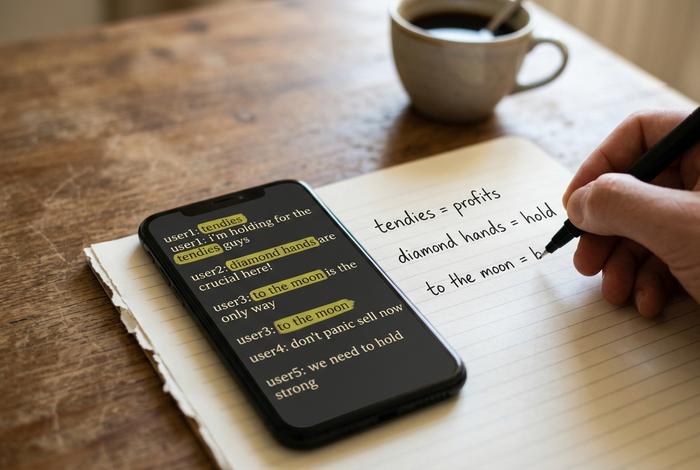
Start with the meme dictionary. Tendies are profits — the phrase migrated from 4Chan to WallStreetBets around 2019. Diamond hands means holding through volatility; paper hands means selling under pressure. Apes are retail traders piling into the same heavily shorted name, a positive label inside WSB. Stonks is the deliberately misspelled meme version of "stocks." To the moon was once a prediction and is now closer to a verb. Whale is the older pro slang for any account whose trades visibly move price, and smart money versus dumb money roughly maps to institutional versus retail flow.
The terms that describe regulated conduct matter more than the meme set. Painting the tape is illegal — coordinated trades designed to create the illusion of volume or price, prosecutable under the 1934 Act. Pump and dump is the same crime done in slower motion. Rugpull came from crypto (a project developer abandoning a token) and now applies to small-cap equities. Dead cat bounce is the short-term rally inside an ongoing downtrend; Nvidia's Q1 2025 chart was a clean example, falling from $139.30 in mid-February to $106.98 by March 10, bouncing back to $121.41 on March 24, then sliding to $94.31 by April 4. Quad witching falls on the third Friday of March, June, September, and December, when stock options, stock-index futures, stock-index options, and single-stock futures all expire together. March 2025's quad witching saw roughly $4.7 trillion in derivatives expire.
| Slang | Plain English | Origin |
|---|---|---|
| Tendies | Profits | 4Chan → WSB |
| Diamond hands | Holding through volatility | WSB, 2020 |
| Paper hands | Selling under pressure | WSB, 2020 |
| Apes | Retail piling into a meme name | Planet of the Apes meme |
| Stonks | Stocks (ironic) | Internet meme |
| Whale | Position large enough to move price | Wall Street, pre-internet |
| Painting the tape | Illegal fake-volume creation | SEC, 1934 Act |
| Quad witching | Quarterly quadruple expiration | Derivatives calendar |
| Dead cat bounce | Temporary rally in a downtrend | Financial Times, 1985 |
| Rugpull | Coordinated abandonment/dump | Crypto, now stocks too |
May 2024 GameStop was the cleanest recent demonstration that meme-driven moves can be real. Keith Gill's ("Roaring Kitty") return to social media triggered a roughly 400% spike over two weeks; GameStop raised $933.4 million in a share sale at the peak and AMC raised $250 million in a single day. Reading the slang correctly was the difference between watching that move and trading it.
Market Structure Words That Trip Up New Investors
This is where new investors lose money fastest — the mechanics doing the work do not pause for the trader to understand them.
The bid is the highest price any buyer is currently willing to pay; the ask is the lowest a seller will accept; the gap between them is the bid-ask spread. A market order fills immediately at whatever price is available, which on a thin book means slippage. A limit order only executes at your set price or better, though it may not execute at all. A stop sits dormant and turns into a market order the moment price crosses a threshold.
Dark pools are private trading venues where orders are not displayed before they execute. They handle roughly 15-20% of US equity volume directly. The broader off-exchange share — single-dealer platforms and other non-displayed venues — crossed 50% for three consecutive months starting late 2024, hitting 51.8% in January 2025 per Bloomberg's compilation of FINRA data. The contrast is with the lit exchanges (NYSE, Nasdaq), where every quote is on the consolidated tape in real time. Institutional desks often prefer dark venues for large block trades precisely because the lit tape would let others front-run them.
The market-wide circuit breakers — MWCB — trigger off the S&P 500's decline from the prior close. A 7% drop is Level 1, a 13% drop Level 2; either halts the whole market for fifteen minutes if it lands before 3:25 p.m. Eastern. A 20% drop is Level 3 and closes the market for the rest of the session. Outside regular hours, pre-market runs 4:00-9:30 a.m. and after-hours 4:00-8:00 p.m., both thin and wide.
New Stock Market Terms Added Since 2020
Six terms that did not exist or did not matter in 2019 glossaries: spot Bitcoin ETF (the SEC approved 11 issuers on January 10, 2024; collective AUM exceeded $110 billion by late 2025, with BlackRock's IBIT alone peaking above $100 billion in October 2025 — an initial public offering of access to a new asset class that drew more inflows in its first year than any exchange-traded fund launch in history). 0DTE options, defined above. T+1 settlement, effective May 28, 2024. Magnificent Seven, coined in 2023 for Alphabet, Amazon, Apple, Meta, Microsoft, Nvidia, and Tesla — roughly one-third of S&P 500 market cap and more than 40% of index total return at the end of 2024; combined AI capex projected at about $725 billion in 2026. AI capex play as Wall Street shorthand for any stock benefiting from data-center, chip, or networking infrastructure spending. PDT-rule sunset, June 4, 2026.
How to Build Your Stock Market Trading Vocabulary
Build in layers. Pick whichever style matches what you plan to do this year. Get the fifteen core terms for that style down cold; the lists above are a reasonable starting point. Borrow another ten from the nearest neighbouring style. Save the slang for last, only when the threads you read make you reach for it.
For fact-checking, two anchors: Schwab and Fidelity's learning centres for definitional clarity, FINRA and SEC for anything regulatory. Stock market terminology is not static — the words that matter move with market structure, and any common stock, mutual fund, or securities-markets rule that reads as settled in a 2019 article may have moved since.