Linea Crypto Explained: Ethereum L2 and Tokenomics
Few crypto projects carry a pedigree like Linea's. It comes from Consensys, the company behind MetaMask and Infura, the plumbing that a huge share of Ethereum users touch every day. And yet the LINEA token trades around 95% below the price it hit on launch day. That contradiction, serious engineering on one side and a brutal chart on the other, is exactly why Linea crypto is worth understanding properly.
This guide walks through all of it: what Linea actually is, how its zkEVM works, what the LINEA token does, how it stacks up against rival Layer 2s, and where the real risks sit. No hype, no price predictions dressed up as facts.
What Is Linea in the Crypto World
Linea is an Ethereum Layer 2 network, a zkEVM rollup built by Consensys. In plain terms, it is a separate chain that handles transactions cheaply and quickly, then posts cryptographic proof of those transactions back to Ethereum, which acts as the final judge. You get lower fees and faster confirmations while still leaning on Ethereum's security. Think of it as an express lane bolted onto the main highway rather than a separate road that goes its own way.
The pitch from the team is unusually blunt about its loyalties. Linea brands itself as "the best chain for ETH capital," meaning it is designed to strengthen Ethereum rather than compete with it. The network went live in a mainnet alpha at EthCC in Paris in July 2023, according to Consensys. Since then it has grown into one of the larger zk-based rollups, though as we will see, "larger" is relative in a market two giants dominate.
How Linea Works: Rollups and ZK Proofs
If you have never thought about how a rollup works, the concept is simpler than the jargon suggests.
What a rollup actually does
Imagine Ethereum as a busy courthouse where every case is heard one at a time. That is slow and expensive. A rollup is like a clerk who handles hundreds of cases off-site, then walks into the courthouse with a single sealed document proving every verdict was reached fairly. Linea processes transactions on its own chain, compresses them into batches, and submits that batched data to Ethereum. The heavy lifting happens off-chain. The trust still comes from Ethereum.
Why zero-knowledge proofs matter
Here is where Linea differs from optimistic rollups like Arbitrum. Optimistic rollups assume transactions are valid and leave a challenge window, often around seven days, during which someone can dispute them. Linea instead generates a zero-knowledge validity proof: a piece of math that proves the batch is correct without revealing every detail. No waiting for a fraud window, no trust assumptions. The proof either checks out or it does not. That design also keeps fees low. Transacting on Linea is meaningfully cheaper than doing the same thing on Ethereum mainnet, which is the whole reason these networks exist.
Inside Linea's Type 2 zkEVM Prover
Not all zkEVMs are built the same. Vitalik Buterin once sorted them into types, running from Type 1, which is fully identical to Ethereum, down to Type 4, which speaks the same high-level language but works very differently underneath. Linea sits at Type 2. In plain terms, it matches Ethereum at the bytecode level.
Why does that matter? Because developers can lift an existing Ethereum smart contract and drop it onto Linea without rewriting a line. Same tools. Same code. Same wallet flow. Under the hood, Linea proves all of this with a prover built on the gnark library, and it aims for several thousand transactions per second where Ethereum mainnet manages a couple of hundred. Fees land roughly ten times cheaper than doing the same thing on L1. That equivalence is the quiet advantage. Migration is friction, and friction kills adoption. Linea made the move almost trivial, and for the thousands of teams already on Ethereum, that is the entire pitch.
The LINEA Token: Supply and Allocation
The LINEA token launched in September 2025, and its design breaks from almost every other major token you have seen. There is no allocation to the team. None to venture investors. That alone makes it worth a closer look.
The total supply is roughly 72.01 billion tokens. The split is heavily tilted toward the community and the ecosystem rather than insiders, according to Linea's tokenomics docs. For a token from a company as established as Consensys, handing zero supply to the team is a genuine outlier.
| LINEA allocation | Share | Notes |
|---|---|---|
| Ecosystem (incl. long-term fund) | 85% | 10-year ecosystem fund, builders, public goods |
| Consensys treasury | 15% | 5-year lock |
| User + builder airdrop | 10% (within ecosystem) | 9% users, 1% builders, unlocked at TGE |
| Team / investors | 0% | No insider allocation |
The 2025 airdrop
The token generation event landed on September 10, 2025, distributing roughly 9.4 billion tokens to eligible users and builders, as The Block reported, after a brief network outage on launch day. The airdrop was fully unlocked immediately, with no vesting cliff for recipients.
Where the price went
This is the uncomfortable part. LINEA peaked near $0.0467 on its launch day and then fell hard. As of June 2026 it trades around $0.0024, a drawdown of roughly 95%, sitting close to its all-time low with a market cap near $74 million on a circulating supply of about 31 billion tokens, per CoinGecko. A fully unlocked airdrop tends to produce exactly this: heavy selling and a spike in trading volume once everyone can move at once.
The Dual-Burn: How Linea Burns ETH and LINEA
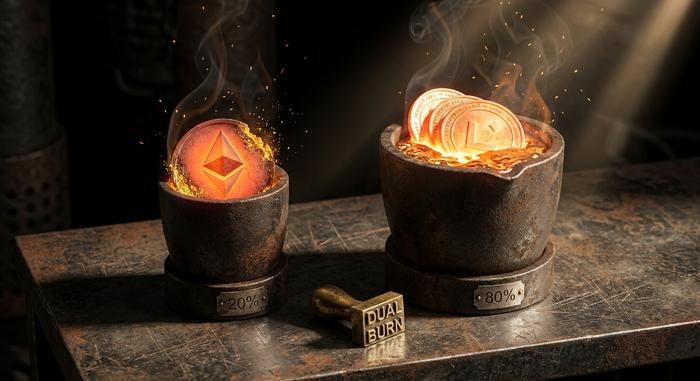
To give the token a reason to exist, Linea added a dual-burn mechanism. Here is the split. The network takes its net profit from transaction fees and destroys it two ways. About 20% buys and burns ETH. The other 80% buys LINEA on the open market and burns that too. It went live in November 2025, applied retroactively to September, so every transaction since launch already counts.
It is a two-sided bet, and a smart one. Torching ETH backs up Linea's "good for Ethereum" branding, since less ETH floating around helps the whole network. Torching LINEA ties the token's scarcity straight to usage. More transactions, less supply. That is a cleaner value story than most L2 tokens can tell. The catch is obvious, though. A burn on thin volume removes almost nothing, so the mechanism is only ever as strong as the traffic feeding it.
Linea vs Other Ethereum Layer 2s
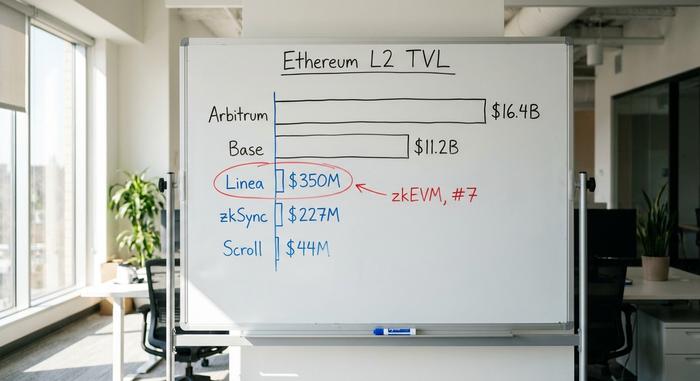
Linea does not operate in a vacuum. The Layer 2 race is crowded, and the honest picture is that Linea is a mid-tier player by size, not a leader. The table below uses total value secured from L2BEAT.
| L2 | Proof type | EVM type | TVS (as of Jun 2026) | Native token |
|---|---|---|---|---|
| Arbitrum | Optimistic | EVM-equivalent | ~$16.4B | ARB |
| Base | Optimistic | EVM-equivalent | ~$11.2B | None |
| Linea | ZK (zkEVM) | Type 2 | ~$350M | LINEA |
| Scroll | ZK (zkEVM) | Type 2/3 | ~$44M | SCR |
| zkSync Era | ZK (zkEVM) | Type 4 | ~$227M | ZK |
Arbitrum and Base together hold the lion's share of the roughly $39 billion locked across all rollups, based on L2BEAT data. Linea ranks around #7 with about $350 million. Its edge is not raw size. It is the zk technology, the EVM-equivalence, and the deep Consensys integration through MetaMask. Whether that translates into catching the optimistic leaders is still an open bet.
What Stage 0 Means for Linea Security
Here is something the price pages never explain. L2BEAT grades rollups on a decentralization scale from Stage 0 to Stage 2. Stage 0 means training wheels are firmly on: the operators can still upgrade the system and intervene, and users rely heavily on a trusted setup. Stage 2 means the chain runs trustlessly, with users protected even if the team turns hostile.
Linea is currently Stage 0. The main blocker to reaching Stage 1 is its zero-second upgrade delay, which would need to become a multi-day window so users have time to exit before any change takes effect. In practice this means Consensys and a security council still hold meaningful control over the network today. That is normal for a young L2, but it is a real consideration. You are trusting a company, not just code, for now.
Native Yield and the Linea Ecosystem
One feature genuinely sets Linea apart. Through a system called Native Yield, announced in 2025, ETH that users bridge to Linea gets automatically staked on Ethereum's mainnet, and the staking rewards, roughly in the 3 to 5% range, flow back to liquidity providers on Linea. Your bridged ETH is not sitting idle. It earns while it works.
That feeds a broader ecosystem of DeFi apps, bridges, and tools, all tied tightly to the MetaMask and Infura stack that millions already use. Total value locked on Linea sits around $350 million as of mid-2026. It is not Arbitrum-scale, but the native-yield angle gives ETH holders a reason to park capital there that pure transaction speed cannot. Consensys has also leaned on incentive programs to pull builders and liquidity in, the kind of campaigns that can spike activity quickly but rarely tell you much about what sticks once the rewards dry up.
Risks: LINEA Token and Centralization
I am not convinced the token thesis is proven yet, and it would be dishonest to pretend otherwise. The roughly 95% drawdown since launch is the obvious red flag, but the deeper issue is supply. With a 10-year ecosystem fund holding the bulk of tokens, there is a large overhang waiting to enter circulation over time. Demand has to outrun that steady unlock, and so far it has not.
The second risk is centralization. As a Stage 0 rollup, Linea's sequencer and prover are not yet decentralized, so the network depends on Consensys to keep running and to behave. The dual-burn helps the value story, and the tech is genuinely strong, but none of that removes the structural pressure of a heavy supply schedule meeting a token still searching for its floor.
How to Use Linea and Get LINEA
Using Linea is straightforward if you already use Ethereum. Bridge ETH to the network through MetaMask or the official Linea bridge, then interact with dApps the same way you would on mainnet, paying gas fees in ETH rather than in LINEA. The LINEA token itself is optional for everyday use; you only need it if you want exposure to the asset or plan to take part in governance and ecosystem incentives. To get it, you buy LINEA on major centralized exchanges or swap for it on a Linea-based DEX. Bridging takes a few minutes, and once your funds arrive the experience feels almost identical to using Ethereum itself.
Is Linea Crypto Worth Watching?
Strip away the noise and Linea is a paradox. The technology is real, the Ethereum alignment is sincere, and the no-insider tokenomics are refreshingly fair. At the same time, the token has been punished, the supply overhang is heavy, and the network is still centralized in the ways that matter. So the question is not whether Linea is good tech. It clearly is. The question is whether the dual-burn and ecosystem growth can absorb years of unlocking supply faster than that supply weighs the token down. Watch the burn rate and the TVL, not the price predictions.