Desjardins Group 2026: Banking, Insurance, Crypto, App Review
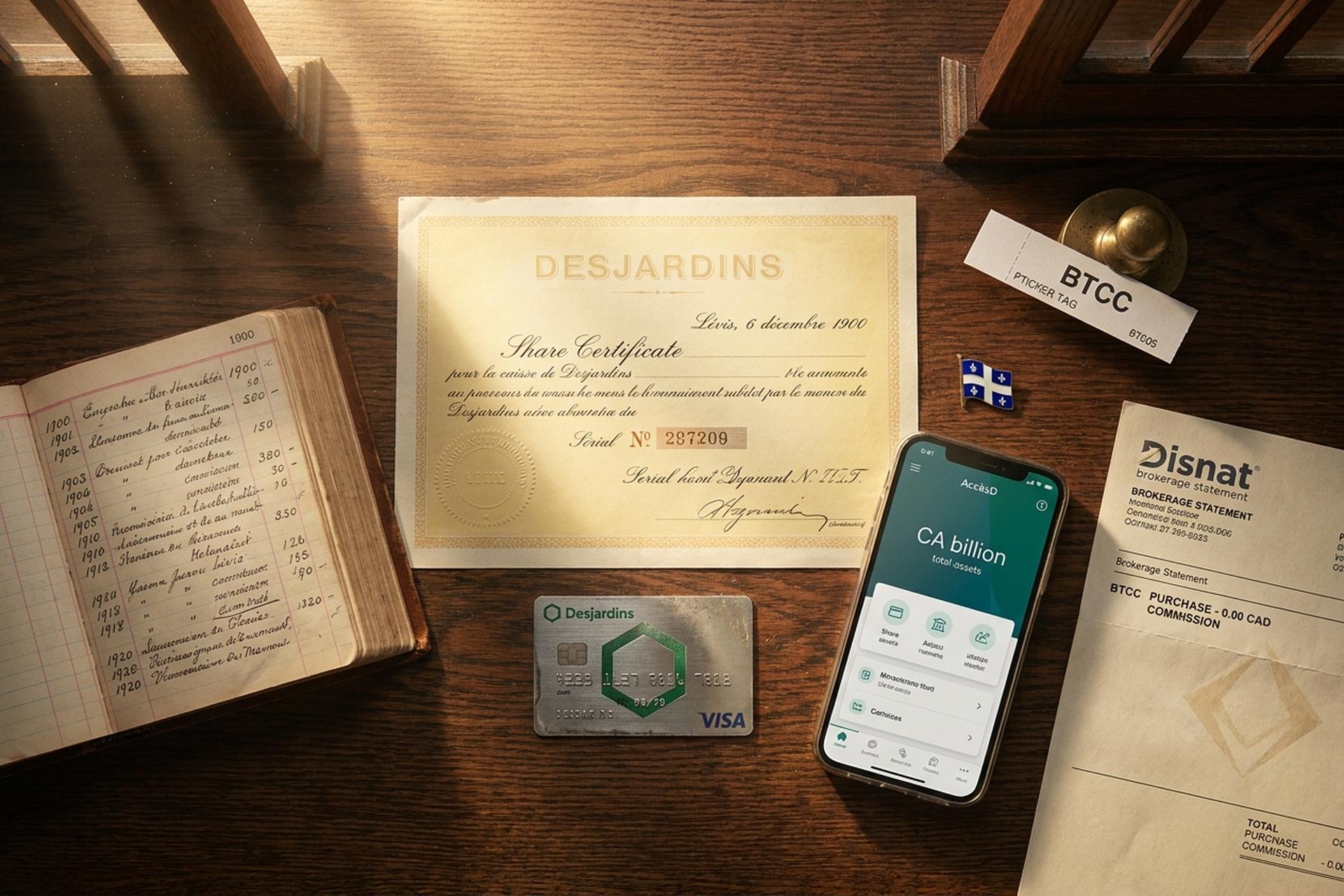
North America's largest credit-union federation is older than the Bank of Canada itself. It is still owned by its 7.5 million members rather than by public shareholders, runs 196 local caisses across Quebec and Ontario, manages over CA$510 billion in assets, and every year sends a ristourne (a patronage dividend) back to those members. That structure is the whole story.
The group covers personal finance end-to-end. It does the everyday work of a bank. It sells more home insurance in Quebec than any other firm. It runs Disnat, one of the oldest online brokerages in the country. And it lets members buy Canadian-listed Bitcoin and Ether ETFs from that same brokerage account. No spot crypto, though.
This Desjardins review walks through what the group does in 2026: banking and AccèsD, the insurance arm, the Disnat investing platform, the crypto angle without direct custody, the 2019 data breach, and how it stacks up against RBC, TD, BMO, Scotiabank, and CIBC.
What Desjardins Is: A 1900-Founded Quebec Cooperative
Alphonse Desjardins was a court reporter, not a banker. He had spent years watching working-class Quebecois being denied credit by Montreal-headquartered banks, and on 6 December 1900 he opened the first caisse populaire (literally, "people's credit union") in his hometown of Lévis. That little caisse is the root of everything you see today.
More than 125 years on, the Fédération des caisses Desjardins du Québec sits on top of 196 local caisses, over a thousand points of service, roughly 52,500 staff, and around 7.5 million members and clients. Total assets hit CA$510.2 billion at the end of 2025. Surplus for the year came in at CA$3.81 billion. Denis Dubois took over from Guy Cormier as president and CEO on 2 September 2025.
One more point matters for the rest of this review. Desjardins is regulated by Quebec's AMF, not by the federal Office of the Superintendent of Financial Institutions. That single line of rule-making explains a lot of what you will see below.
Banking with Desjardins: Caisses, AccèsD, Cards, Accounts
Day-to-day banking with Desjardins now feels broadly equivalent to what a TD or RBC customer gets, with one structural twist. Each member belongs to a specific local caisse — there is no single "Desjardins" account, only an account at, say, the Caisse populaire de Lévis or the Caisse Desjardins de Montréal-Est. AccèsD is the digital layer that hides that legal structure: one login, one app, one online portal, regardless of which caisse holds your money.
The Desjardins mobile services app, AccèsD, covers what the Big Five apps now cover. Fingerprint and facial recognition login. Apple Pay and Google Pay. InstaBalance, which lets you peek at the balance without logging in. Mobile cheque deposit by photo. Interac e-Transfer. Card lock, replacement, and rewards redemption inside the app. An AI assistant called Alvie provides financial insights and budgeting nudges. The platform also supports an unusually broad set of registered account types — Chequing, Savings, RRSP, TFSA, RRIF, RESP, FHSA, LIRA, LIF, non-registered — which matters because the average Canadian household holds three or four of these at once.
Credit and debit cards are issued under the cooperative's own Visa programme (Cash Back, Odyssey, Élégance, Bonus, Étudiante). The youth and student plans are aggressively priced: 14- to 17-year-olds get a free monthly plan with unlimited transactions, which is something most Big Five offerings still do not match.
Where Desjardins is still visibly different, in 2026, is the in-branch network in Quebec. Members can still walk into a caisse and talk to a human about a mortgage. The cooperative has closed branches over the past decade — 293 caisses became 196 — but the remaining footprint is denser in regional Quebec than any chartered bank's.
Desjardins Insurance: Auto, Home, Life, and Health
Most Ontarians don't realise they are Desjardins customers. They opened a State Farm policy years ago, kept paying the same premium, and one day a letter arrived telling them the brand on their wallet card had quietly changed. That whole story happened in 2014 and 2015, when Desjardins paid about CA$1.6 billion for State Farm's Canadian book and absorbed roughly 1.2 million customers in a single shot.
The deal made Desjardins the second-largest property and casualty insurer in Canada. The cooperative now holds roughly 14.2% of the national auto market and around 28% of Quebec home insurance. Desjardins General Insurance Group is the resulting P&C arm. A separate subsidiary, Desjardins Financial Security, handles life, disability, group benefits, and individual health insurance. I find the insurance story the most underdiscussed part of the cooperative's modern profile — most Quebecois know about the caisses, very few outside the industry remember that the State Farm logo on a million-plus Canadian driveways was replaced with a green diamond a decade ago.
Desjardins Investments and the Disnat Online Brokerage
Disnat is older than most Canadian brokerages. Formally Desjardins Online Brokerage. Founded in 1983. The platform has two tiers today: Disnat Direct for retail and Disnat Classic for active traders.
Pricing was rebuilt in mid-2022. Every Canadian and US-listed stock and ETF now trades for CA$0 commission. Options cost CA$1.25 a contract with an CA$8.75 minimum. Mutual funds trade free, including the Desjardins Funds family and the Capital régional et coopératif Desjardins, a Quebec-specific tax-credit vehicle that an Ontario investor will probably never touch. Registered account types cover the full Canadian alphabet: TFSA, RRSP, FHSA, RESP, LIRA, RRIF, margin, cash. J.D. Power ranked Disnat second in its 2025 Canadian self-directed investor satisfaction study, behind Wealthsimple, ahead of Questrade, and ahead of every Big Five direct-investing brand.
There are two other arms worth knowing about. Aviso Wealth is a joint venture between Desjardins and the Canadian Credit Union Association; it runs the robo-advisor service for members who would rather not pick ETFs themselves. Desjardins Securities, the IIROC-regulated full-service arm, is where higher-net-worth members go for an advisor relationship. Put all of that next to the banking and insurance arms, and the Quebec-based investment side is unusually full-stack for an institution of Desjardins' size. Part of that is the lack of public shareholders pushing for a higher brokerage margin. The mix of financial services under one membership card is genuinely rare in Canadian practice.
Crypto on Desjardins: Bitcoin and Ether ETF Access
Desjardins has been one of the more vocal Canadian groups about not touching spot crypto. The public stance, last restated by senior leaders in 2024, is that "Bitcoin is not an accepted form of payment" and that direct crypto trading is not on the roadmap. The staff trading policy also blocks direct crypto for those in advisory roles.
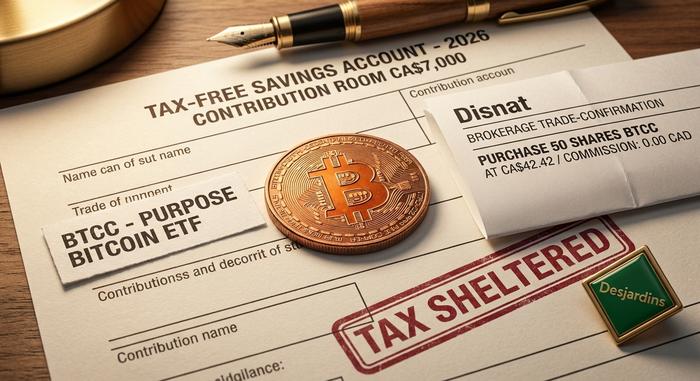
The practical path is ETFs. Canada was the first country in the world to approve a spot Bitcoin ETF — the Purpose Bitcoin ETF (ticker BTCC), in February 2021. A Desjardins member can buy that ticker, and most of the rest of the Canadian crypto ETF lineup, inside any Disnat account for CA$0 commission. Hold it in a TFSA, RRSP, or FHSA, and the whole gain is sheltered from tax.
| ETF | Ticker | Issuer | Asset |
|---|---|---|---|
| Purpose Bitcoin ETF | BTCC | Purpose | Bitcoin (physically settled) |
| CI Galaxy Bitcoin ETF | BTCX | CI / Galaxy | Bitcoin |
| 3iQ Bitcoin ETF | BTCQ | 3iQ | Bitcoin |
| Fidelity Advantage Bitcoin ETF | FBTC | Fidelity | Bitcoin |
| Evolve Bitcoin ETF | EBIT | Evolve | Bitcoin |
| Purpose Ether ETF | ETHH | Purpose | Ether |
| CI Galaxy Ethereum ETF | ETHX | CI / Galaxy | Ether |
| 3iQ Ether Staking ETF | ETHQ | 3iQ | Ether (with staking) |
| Scotia / 3iQ Multi-Crypto ETF | MCRP | Scotia / 3iQ | BTC + ETH basket |
The tax math is where this gets interesting. A retail Canadian buying a Canadian-listed Bitcoin ETF inside a TFSA pays zero tax on the gain, up to the yearly room cap. That outcome is cleaner than what a US investor can get inside a Roth IRA, which still needs a self-directed custodian to hold a spot Bitcoin ETF. For a long-term Canadian crypto holder who is also a Desjardins member, the path is not exciting. But it is genuinely tax-efficient.
Desjardins vs the Big Five: RBC, TD, BMO, Scotia, CIBC
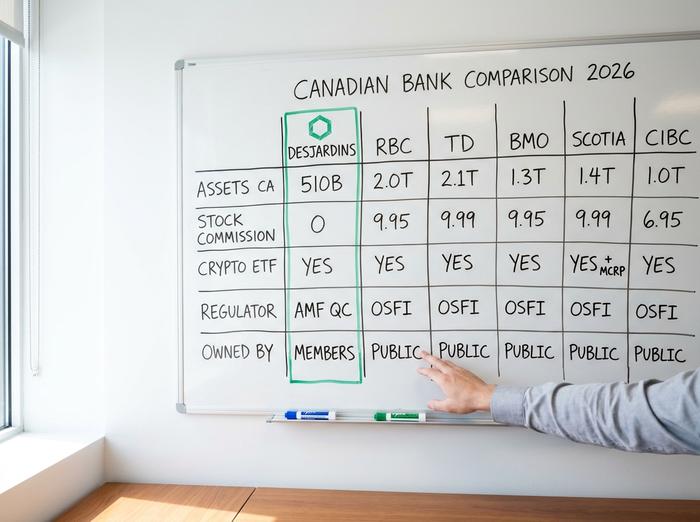
Scale first, because the difference is real. RBC sits around CA$2.0 trillion in assets and TD around CA$2.1 trillion. BMO, Scotiabank, and CIBC are each somewhere in the CA$1.0 to 1.4 trillion range. Desjardins at CA$510 billion is the sixth-largest deposit-taking institution in the country, and the largest one that does not call itself a chartered bank.
On pricing, the story flips. Disnat went commission-free on stocks and ETFs back in 2022. RBC Direct Investing only caught up on commission-free ETFs in June 2025, and even then only on ETFs and not on the underlying stocks. TD Direct, BMO InvestorLine, Scotia iTRADE, and CIBC Investor's Edge still post real per-trade commissions across most of their retail tiers. For Canadian-listed Bitcoin ETFs the gap closes — every Big Five brokerage will sell you one, and Scotiabank even put its own name on a multi-crypto ETF with 3iQ during 2025. Spot Bitcoin inside the main banking app? Not at any of them. And not at Desjardins either, for what it's worth.
| Item | Desjardins | RBC | TD | BMO | Scotiabank | CIBC |
|---|---|---|---|---|---|---|
| Total assets (CA$) | 510B | ~2.0T | ~2.1T | ~1.3T | ~1.4T | ~1.0T |
| Stock/ETF commission | CA$0 | CA$0 ETF / $9.95 stock | $9.99 | $9.95 | $9.99 | $6.95 |
| Crypto ETFs supported | Yes | Yes | Yes | Yes | Yes (incl. own MCRP) | Yes |
| Spot crypto | No | No | No | No | No | No |
| Primary regulator | AMF (QC) | OSFI | OSFI | OSFI | OSFI | OSFI |
| Deposit insurance | Fonds d'assurance-dépôts du Mouvement Desjardins (CA$100k per category) | CDIC | CDIC | CDIC | CDIC | CDIC |
| Ownership | Members | Public shareholders | Public | Public | Public | Public |
The honest take is that for a Quebec resident, the cooperative wins on day-to-day banking fees, ristournes, and the in-branch network. For a national investor, the Big Five win on global reach and US-dollar account flexibility. For a self-directed crypto-curious investor, Disnat is genuinely competitive — and considerably cheaper than RBC Direct Investing on the equity side.
Credit Ratings, Costs, and the 2019 Data Breach Legacy
Desjardins still carries credit ratings broadly equivalent to the Big Five: Moody's Aa2, S&P A+, DBRS AA, Fitch AA−. Those were reconfirmed during the most recent rating cycle.
The cost of solvency, in the cooperative's modern history, was the 2019 data breach. A now-former employee in the marketing analytics team copied personal data on roughly 9.7 million individuals and businesses and sold the file outside the firm. The breach was caught in December 2018 and made public in June 2019. It is still the largest leak in Canadian financial history. The Office of the Privacy Commissioner ruled in 2020 that Desjardins had violated PIPEDA. A national class action settlement worth about CA$200.9 million was approved in June 2022. Every affected member was offered lifetime credit monitoring through Equifax. Inside the building, the breach forced a rebuild of identity-management systems and tighter access-control rules. Outside, it did not change the cooperative's credit ratings.
I keep coming back to the breach when I think about Desjardins. The financial picture is clean, the ratings are intact, and the cooperative has done the unglamorous work of patching the hole. But "we lost 9.7 million identity records" is the kind of historical fact that should weigh into any serious member's decision.
How to Open a Desjardins Account and Log Into AccèsD
You need to be a Canadian resident, 18 or older (the youth plans cover ages 14 to 17 with a parent). ID checks happen online or in person at a caisse. A single CA$5 share buy makes you a full member with a vote at your local caisse. Your first debit card arrives in five to seven days. AccèsD log-in uses a username, a password, and a second-factor code; the link to the AccèsD mobile services app on iOS and Android takes the same details.
Ristournes: How the Cooperative Returns Profit to Members
The ristourne is the mechanic that genuinely separates Desjardins from any chartered bank. Each year, a share of the cooperative's surplus is returned to members in proportion to the business each member did with their caisse (deposits held, loans serviced, products used), and a separate share funds community sponsorship and the Desjardins Foundation. In fiscal 2025, the cooperative paid out roughly CA$505 million in ristournes and community contributions, up 15.6% from CA$437 million the previous year. The vote on the annual amount is taken at each caisse's general meeting; tax treatment is as a patronage dividend, not as bank interest.
Verdict on Desjardins for Canadians in 2026
For a Quebec local the group is the clear default in 2026: full banking, cheap brokerage, a strong ristourne, a solid insurance arm, and a still-dense branch network. For an Ontario member with a caisse nearby, it is fair on costs even if in-branch help is thinner. For someone outside Quebec and Ontario the thin branch map hurts, and a Big Five account plus Disnat for investing is a fair hybrid. For the crypto-curious, Disnat plus TFSA-sheltered Bitcoin or Ether ETFs is one of the best tax outcomes any North American retail investor can get.