Bitcoin ETF Canada: Purpose, iShares & Fidelity Compared

Canada beat the world to a spot Bitcoin ETF, and not by a polite margin. Almost three years. The Purpose Bitcoin ETF — ticker BTCC, on the Toronto Stock Exchange — opened for trading on February 18, 2021, after the Ontario Securities Commission quietly cleared it the week before. Thirty days later, BTCC had pulled more than C$1 billion in assets. Meanwhile in the United States: the SEC kept rejecting spot Bitcoin ETF applications until January 11, 2024, and even then only because a federal appeals court told the agency it had to. That three-year head start built the Canadian Bitcoin ETF landscape into the longest live track record on Earth. The current lineup: Purpose, Evolve, CI Galaxy, 3iQ, Ninepoint, Fidelity Advantage, plus the iShares Bitcoin ETF run by BlackRock Canada. Seven serious products, each with a different fee, custodian, and currency story. This guide walks through how the history came together, what the products look like in 2026, and how to actually buy one.
The world's first spot Bitcoin ETF: how Canada moved first
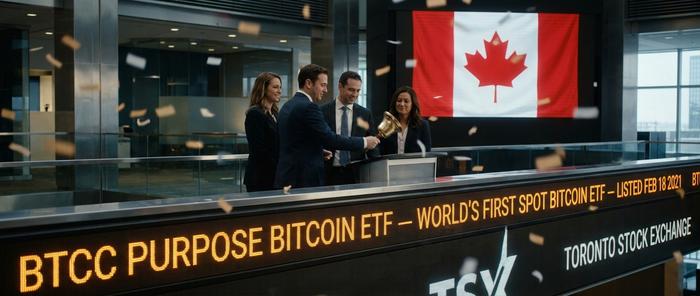
The story starts at the Ontario Securities Commission. In early February 2021, OSC staff had been reviewing Purpose Investments' prospectus for a Bitcoin ETF that would hold physical Bitcoin rather than futures contracts. On February 11 and 12, the OSC granted clearance — a quiet regulatory step that would turn out to be one of the most consequential decisions in modern crypto finance. OSC chair Grant Vingoe later said the regulator concluded it was the "right time" to greenlight the product, given that institutional custody had matured and Canadian investors were already buying Bitcoin through riskier channels. BTCC opened trading on February 18, 2021, marketed as the first physically settled Bitcoin ETF in the world.
The reception was extraordinary. By the one-month anniversary on March 18, 2021, Purpose had crossed C$1 billion in net asset value. That was an early signal — institutional and retail demand had been bottled up by years of regulatory uncertainty, and the OSC's principles-based framework let Canadian funds move while the SEC was still drafting questions.
A wave of competitors followed within months. Evolve Funds launched its Bitcoin ETF (EBIT) on February 17, 2021 — one day before Purpose, depending on how you count the listing process, although BTCC is still widely credited as the regulator-cleared first. CI Galaxy Bitcoin ETF (BTCX.B) followed on March 9, 2021. 3iQ converted its closed-end fund into the 3iQ Bitcoin ETF (BTCQ) in late March. Ninepoint Bitcoin ETF (BITC) listed on May 6 with a carbon-offset overlay. Fidelity Advantage Bitcoin ETF (FBTC) arrived November 30 of the same year, marking the entry of a US fund giant into Canadian crypto-ETF distribution.
| 2021 launch | Ticker | Sponsor | Notable |
|---|---|---|---|
| Feb 17 | EBIT | Evolve Funds | Spot physical; multiple currency share classes |
| Feb 18 | BTCC | Purpose Investments | World's first spot Bitcoin ETF |
| Mar 9 | BTCX.B | CI Global Asset Management | Sub-advised by Galaxy Digital |
| Mar 31 | BTCQ | 3iQ Corp | Converted from closed-end fund |
| May 6 | BITC | Ninepoint Partners | Carbon-offset structure |
| Nov 30 | FBTC | Fidelity Investments Canada | First US fund manager entry; in-house custody |
The Securities and Exchange Commission in Washington watched all of this. SEC chair Gary Gensler kept rejecting spot Bitcoin ETF applications throughout 2021 to 2023, citing market manipulation concerns. A federal court told him in August 2023 that the position was arbitrary. The first eleven US spot Bitcoin ETFs finally launched January 11, 2024 — three years and one month after the Canadian product set the template.
The Canadian Bitcoin ETF landscape today
The market shifted, hard, the moment the US opened. Money is mobile. A meaningful slice of Canadian Bitcoin ETF assets sailed south to chase the deeper liquidity of the US listings. The 2024 numbers came in ugly — Canadian crypto ETFs together bled roughly C$1.1 billion in net redemptions across the year. Looked dramatic. Felt worse. But that pain set up the fee war that arrived next.
Fidelity blinked first. January 2025: Fidelity Investments Canada chopped FBTC's management fee down to 0.32%, pricing the fund directly against the new US products. Purpose Investments answered four months later, in May 2025, by launching the Purpose Core Bitcoin ETF, ticker BTCO — same physical-Bitcoin exposure, lower fees, deliberately positioned against the new competitive pressure. Then Global X Investments Canada zigged instead of zagged. The Global X Enhanced Bitcoin Covered Call ETF, ticker BCCL, listed in April 2025 with 125% light leverage and a dynamic covered-call income overlay. A niche aimed at investors who care about yield-overlay returns more than clean spot tracking.
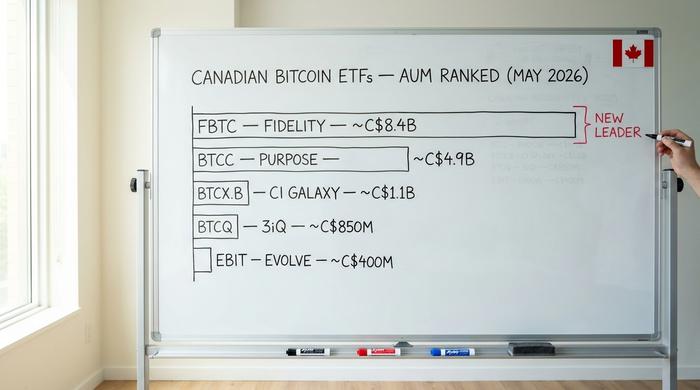
Then the flows came back. By the end of 2025, Canadian Bitcoin ETFs had collected somewhere around C$933 million in net creations, recovering most of the prior year's outflows. As of May 2026 the AUM leaderboard reads: Fidelity FBTC, roughly C$1.3 to 1.5 billion, the new leader. Purpose BTCC, between C$0.7 and 1.0 billion, still a heavyweight. CI Galaxy BTCX.B, about C$839 million. 3iQ BTCQ, around C$246 million. Evolve EBIT, roughly C$200 million. No consolidations, no fund closures, no headlines about a Canadian ETF folding under the US weight. Canadians ended up with more choice than they had in 2023. Not less.
Purpose Bitcoin ETF (BTCC): the original
Purpose remains the symbolic anchor of the category. The fund invests directly in physical Bitcoin on a one-to-one basis, with each ETF unit backed by a stated fraction of a coin published daily on Purpose's transparency page. The investment objective is straightforward: replicate the price of Bitcoin in Canadian dollars, net of fees, with the fund's net asset value calculated daily against a Bitcoin index benchmark. Three share classes trade: BTCC (Canadian dollars, unhedged), BTCC.B (Canadian dollars, currency-hedged), and BTCC.U (US dollars). The unhedged share gives Canadian investors direct USD-BTC exposure plus FX exposure; the hedged share isolates the Bitcoin price move from the loonie. BTCC.U is for investors who already think in dollars.
Custody is split across three institutions. Cidel Trust Company acts as the regulated Canadian trustee; Gemini Trust Company and Coinbase Custody Trust Company hold the actual Bitcoin in cold storage. That arrangement is conservative — Purpose can rotate between custodians if any single institution has security issues, and the trust structure puts the Bitcoin outside the asset manager's balance sheet, giving unitholders an additional layer of insolvency protection.
The management fee on the original BTCC is 1.00%, plus applicable sales taxes, which once looked expensive but became typical for the category. Purpose's launch of BTCO at a lower fee in 2025 acknowledged the post-US pressure. The fund is TFSA, RRSP, RESP, and FHSA eligible like every other TSX-listed Bitcoin ETF, so Canadian investors can shelter the gains across any of those four registered accounts.
Som Seif, the founder and CEO of Purpose Investments, has used the fund to make a wider point: that Canadian regulators got the structural call right in 2021. I tend to agree with him on the framework. The fee story has aged less well, but the Canadian Bitcoin ETF was the proof-of-concept the whole global ETF industry needed.
iShares, Fidelity Advantage, and the US giants in Canada
When the SEC finally let US spot Bitcoin ETFs trade in 2024, the conventional wisdom was that big US managers would let their Canadian listings wither. That is not what happened.
Fidelity doubled down. The Fidelity Advantage Bitcoin ETF, ticker FBTC, lists on the TSX and has been managed since 2021 with custody from Fidelity Digital Assets — the in-house institutional custody arm Fidelity built for its own US clients. The January 2025 fee cut to 0.32% was the loudest signal. Combined with Fidelity's brand and the structural advantage of a Canadian-domiciled fund for TFSA and RRSP holders, FBTC vacuumed up enough flows to become the largest Bitcoin ETF in Canada by AUM in 2026.
BlackRock made a different choice. Rather than rebuild a parallel structure, it partnered with RBC Global Asset Management Inc. to bring the iShares Bitcoin ETF Canada to the TSX through the existing iShares-RBC alliance. BlackRock Asset Management Canada Limited is the named investment adviser. For Canadian retail investors who already hold iShares core ETFs through RBC Direct Investing or other brokerages, the addition of a Canadian iShares Bitcoin ETF was a clean fit.
| Fund | Ticker | Sponsor | Mgmt fee | AUM (May 2026) | Custodian |
|---|---|---|---|---|---|
| Fidelity Advantage Bitcoin | FBTC | Fidelity Investments Canada | 0.32% | ~C$1.3-1.5B | Fidelity Digital Assets |
| Purpose Bitcoin ETF | BTCC | Purpose Investments | 1.00% | ~C$0.7-1.0B | Cidel + Gemini + Coinbase |
| CI Galaxy Bitcoin | BTCX.B | CI Global Asset Management | 0.40% | ~C$839M | Galaxy Digital (sub-advisor) |
| 3iQ Bitcoin ETF | BTCQ | 3iQ Corp | 1.00% | ~C$246M | Tetra Trust + Coinbase |
| Evolve Bitcoin ETF | EBIT | Evolve Funds | 0.75% | ~C$200M | Gemini + Cidel |
| Purpose Core Bitcoin | BTCO | Purpose Investments | Lower than BTCC | New (2025) | Same as BTCC |
| iShares Bitcoin ETF Canada | — | RBC GAM / BlackRock Canada | Not disclosed | Newer entrant | BlackRock-managed |
These products differ in fee, custodian preference, and share class structure, but they all hold physical Bitcoin on a one-to-one basis. None of the major Canadian Bitcoin ETFs are futures-based. None have publicly disclosed operational outages tied to custody. That uniformity is, on its own, a quiet vote of confidence in the framework the OSC built five years ago.
How to buy a Bitcoin ETF in Canada
Three steps. Open a Canadian brokerage account that trades the Toronto Stock Exchange or Cboe Canada. Fund the account. Type a ticker — BTCC, FBTC, BTCX.B, BTCQ, or EBIT — and place a market or limit order. Trades settle T+1. The brokers that handle this well include Questrade, Wealthsimple Trade, RBC Direct Investing, TD Direct Investing, BMO InvestorLine, CIBC Investor's Edge, and Interactive Brokers Canada. Most offer commission-free or low-commission ETF trades on these tickers. The platform matters less than the ETF choice.
The registered-account piece is where Canada really shines. Every major Canadian Bitcoin ETF — all the exchange-traded funds on this list — is TFSA-eligible. Same with RRSP, RESP, and FHSA. Inside a TFSA, the gains are tax-free for Canadian residents. Inside an RRSP or FHSA, the gains are tax-deferred. Capital-gains rules only kick in on disposition outside a registered account. That tax wrapper, more than any single product feature, is the reason a Canadian Bitcoin ETF beats holding the coin directly for most retail allocations. It can also help diversify a portfolio concentrated in Canadian equities, though investors should read the simplified prospectus before investing.
Currency is the next decision. Hedged share classes such as BTCC.B, BTCX, and EBIT strip out the USD-CAD exchange rate. The result is pure Bitcoin-price exposure measured in loonies. Unhedged classes — BTCC and EBIT unhedged, for example — leave the FX move in. Returns get amplified or dampened by whichever direction the Canadian dollar runs. Then the USD-denominated classes — BTCC.U, BTCX, EBIT.U, BTCQ.U — settle directly in US dollars. Pick the currency class that matches whichever one you already think in.
One real catch. US citizens resident in Canada should not buy these products without reading the IRS rules first. Canadian Bitcoin ETFs are classified as passive foreign investment companies under US tax law. PFIC treatment brings Form 8621 filings, mark-to-market elections, and heavy tax on gains. For Americans living north of the border, the cleaner option is usually a US-based spot Bitcoin ETF held in a US brokerage account.
What every Canadian Bitcoin ETF investor should remember
Canada has the longest live track record of any spot Bitcoin ETF jurisdiction on earth. Five years of trading data, multiple market cycles, custodian rotations, and a regulator that has not stepped back from the original 2021 decision. The fee structure has compressed sharply since the US opened, and the choice for a Canadian investor in 2026 is genuinely about three things: the management fee you are willing to pay, the currency class that fits your accounts, and the custodian you trust. Read the simplified prospectus, watch the management expense ratio more than the headline fee, and use the registered accounts. The infrastructure is mature; the work is yours.