Best Crypto Exchanges in Canada for 2026: Fees, Features, and How to Start Your Crypto Journey

Binance? Gone. Bybit? Gone. KuCoin, OKX, Gate.io? All gone. Canada kicked out eight major crypto exchanges between 2023 and 2026. The ones that survived are the ones that registered, filed paperwork, and played by CSA rules.
Good news: 16 platforms still hold active CSA registration in April 2026. You can buy bitcoin, trade bitcoin and ethereum, buy and sell cryptocurrencies through a mobile app, and build a crypto portfolio without leaving the country's regulatory perimeter. The hard part is figuring out which best crypto exchange in Canada actually fits your situation. That is what this guide covers, starting with a fee comparison table, then individual reviews, and finally the regulatory and tax context that every crypto investor in Canada needs to understand before starting their crypto journey.
Best crypto exchanges in Canada: comparison table
Before getting into the details, here is how the top Canadian crypto exchanges compare on the numbers that matter most:
| Exchange | Trading fee | Coins | Deposit (CAD) | Withdrawal | Best for |
|---|---|---|---|---|---|
| NDAX | 0.2% flat | 30+ | Free (Interac) | $25 flat | Low fees |
| Bitbuy | 0.1-0.2% (Pro) | 60+ | Free (Interac) | 1.5% | Beginners |
| Newton | Spread (~1.1-1.6%) | 70+ | Free (Interac) | Free | Zero-fee deposits/withdrawals |
| Kraken | 0.1-0.4% | 175+ | Wire only | Varies | Advanced trade tools |
| Coinbase Canada | 0.05-0.60% | 200+ | 3.99% (card) | Free (crypto) | Coin selection |
| Wealthsimple Crypto | 1.5-2% (spread) | 100+ | Free (linked bank) | Free | Stock+crypto in one app |
| Shakepay | Spread (~1.5-2.5%) | BTC + ETH | Free (Interac) | Free | Shaking sats, simplicity |
| Coinsquare | 0.50% | 40+ | Free (Interac) | 1.5% | CAD pairs |
| VirgoCX | 0.095-1.6% | 90+ | Free (Interac) | Free | OTC trades |
| Crypto.com | 0-0.5% | 400+ | Card fees apply | Varies | Card cashback, huge selection |
All fees listed above are for the exchange's standard or pro trade platform tier. Instant buy and express features often charge more. Each cryptocurrency exchange offers different spreads on top of the listed fees.
How to choose the best crypto exchange in Canada
Not every exchange works for every trader. Before signing up for anything, think about what you actually need:
If you trade often and care about fees: NDAX at 0.2% flat or Kraken at 0.1% (maker) will save you real money over time. A $10,000 monthly volume on Coinbase's 0.6% tier costs $60 in fees. The same volume on NDAX costs $20. Over a year, that gap is $480.
If you are buying crypto for the first time: Bitbuy or Shakepay. Both accept Interac e-Transfer (most Canadian exchanges do), both have clean interfaces, and both are registered with Canadian regulators. Shakepay only does BTC and ETH, which is limiting but also keeps things simple.
If you want the biggest coin selection: Coinbase Canada lists 200+ popular crypto coins. Crypto.com lists 400+. Kraken has 175+. The best Canadian crypto exchange options top out around 60-90 coins, which covers every major digital asset but might miss smaller altcoins. You can buy cryptocurrency, sell crypto, and hold crypto all on the same app in Canada.
If security is your top priority: Kraken has never been hacked in over a decade of operation and runs proof of reserves audits. Bitbuy keeps 90% of crypto assets in cold storage with insurance. Both are strong picks. Best cryptocurrency exchange for security? Either one. And if you want true control, move your crypto holdings to a hardware crypto wallet after buying.
If you already use Wealthsimple for stocks: Wealthsimple Crypto lets you hold crypto in the same app as your stock portfolio. The 1.5-2% spread is steep compared to dedicated exchanges, but the convenience of a single platform appeals to traditional investors dipping into crypto.
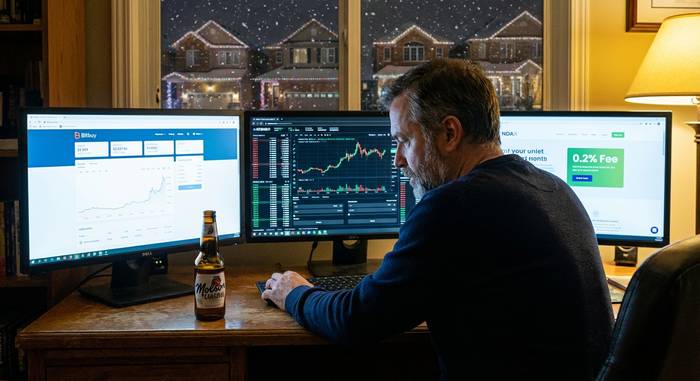
NDAX: best for low fees
Calgary-based, founded in 2018. NDAX charges a flat 0.2% on every trade, which undercuts most Canadian competitors by more than half. For active traders moving any kind of volume, that fee advantage adds up fast.
NDAX supports about 30 cryptocurrencies, which covers bitcoin, ethereum, and the major altcoins but leaves out the long tail. Staking is available on select coins. The interface is clean enough for beginners but also offers order books and charting for crypto traders who want more control. Registered with FINTRAC. Interac e-Transfer deposits are free. The main drawback: a $25 flat withdrawal fee for CAD, which stings on small amounts.
Bitbuy: best for beginners in Canada
Toronto-based, originally launched as Instabit in 2013. Bitbuy has built its entire brand around being the easy, Canadian, safe choice. The interface is deliberately simple. Customer support is available via email and live chat, which sounds basic until you compare it to exchanges where the only support channel is a bot.
Bitbuy lists 60+ cryptocurrencies. The Pro tier charges 0.1% maker / 0.2% taker per trade, putting it among the cheapest in Canada. The Express tier is easier to use but costs up to 3.85% in spread. Ninety percent of assets sit in cold storage with insurance coverage. Registered as a Money Services Business with FINTRAC and CSA-approved.
Big news in 2025: Robinhood acquired WonderFi, the parent company of Bitbuy and Coinsquare, for C$250 million. WonderFi had over C$2.1 billion in assets under custody at the time. What this means for Bitbuy users is still unfolding, but the backing of a NASDAQ-listed company adds another layer of credibility.
The limitation: fees on the Express tier. If you trade frequently without switching to Pro, the costs add up fast. But for someone buying bitcoin monthly and holding, Bitbuy's security track record and support quality justify the premium.
Kraken Canada: best for advanced trade features
Founded in San Francisco in 2011, Kraken is one of the oldest crypto exchanges still running. It has never suffered a major hack. Proof of reserves audits are published regularly. Ninety-five percent of digital assets go into cold storage.
For Canadians, Kraken offers 175+ cryptocurrencies with maker fees as low as 0.1% and taker fees at 0.4%. The Kraken Pro interface has advanced charting, multiple order types, and API access for algorithmic traders. The catch: margin trading and futures are restricted for Canadian users, which limits what experienced traders can do.
Funding in CAD requires a wire transfer. No Interac e-Transfer. That alone is a dealbreaker for many Canadians who are used to moving money in minutes for free. If you can live with wires, the low withdrawal fees and security record make Kraken hard to beat as the best bitcoin and crypto trade platform for serious crypto users.
Coinbase Canada: best coin selection among regulated platforms
Coinbase is publicly traded on the NASDAQ, CSA-registered in Canada, and offers 200+ cryptocurrencies. The Learn and Earn program pays you small amounts of crypto for watching short educational videos, which is a genuinely useful onboarding feature.
Fees range from 0.05% to 0.60% on Advanced Trade, but the simple buy interface can charge up to 3.99% for card purchases. Staking yields up to 14% on certain assets. Customer support has been a weak point historically, with slow response times reported across multiple review platforms.
For Canadians who want access to a large number of coins on a platform that is publicly audited and regulated, Coinbase is the obvious pick. Just avoid the instant buy feature and use Advanced Trade to keep fees reasonable.
Newton: best for zero deposit and withdrawal fees
Toronto-based, founded in 2018. Newton charges no trading fees, no deposit fees, and no withdrawal fees. The business model relies on spreads built into the price, typically 1.1% to 1.6%. That means you pay more than the market price when buying and receive less when selling, but the total cost often works out similar to exchanges that charge explicit fees.
Newton supports 70+ coins, accepts Interac e-Transfer, and has FINTRAC and CSA registration. The app is straightforward enough for beginners. The main complaint: those spreads can widen during volatile periods, effectively increasing your cost at the worst possible moment.
Wealthsimple Crypto: best for traditional investors
If you already hold stocks and ETFs on Wealthsimple, adding crypto to the same account takes about 30 seconds. No new KYC. No new app. The crypto trading platform in Canada lives right next to your stock portfolio.
Wealthsimple lists 100+ coins and is regulated by IIROC in addition to FINTRAC. The downside is cost: spreads run 1.5% to 2%, which is among the highest on this list. There is no advanced trade interface, no API, and no way to withdraw your crypto to an external wallet. Your coins stay on the platform.
For crypto investors who want a small crypto portfolio alongside their stocks and do not care about self-custody, Wealthsimple is convenient and easy to use. For anyone serious about the best crypto trading experience specifically, the high fees and lack of withdrawal options make it hard to justify as your primary cryptocurrency exchange in Canada.
Exchanges that left or were banned from Canada
Not every global exchange stuck around after Canadian regulators tightened the rules. Knowing who left and why tells you something about how seriously Canada takes crypto regulation:
| Exchange | What happened | Year |
|---|---|---|
| Binance | Pulled out of Ontario, then all of Canada | 2023 |
| KuCoin | Banned by OSC, cease-and-desist order | 2023 |
| Bybit | Phased exit, fully restricted | 2023-2026 |
| OKX | Exited, cited "new regulations" | Early 2025 |
| Gate.io | Banned, unregistered | 2023 |
| Huobi Global | Banned, non-compliant | 2023 |
| Paxos | Stopped Canadian operations | 2023 |
| dYdX | Restricted Canadian users | 2023 |
The common thread: the Canadian Securities Administrators (CSA) began requiring all crypto trading platforms to register as restricted dealers. Exchanges that did not want to comply left. The ones that stayed, Bitbuy, Kraken, Coinbase, Newton, and others, went through the registration process.
For users, this is actually good news. Every exchange operating legally in Canada has been vetted by regulators. The wild-west era is over.
Crypto taxes in Canada: what you owe the CRA
Legal to buy. Legal to hold. Not free from the taxman. The CRA calls crypto a commodity, so every time you sell, swap, or spend it, you owe them a cut.
Here is how it works. You buy ETH at $2,000. Sell it at $3,000. That $1,000 profit is a capital gain. Half of it ($500) gets added to your taxable income. You pay your normal marginal rate on that $500. In Ontario, someone earning $100K already pays a combined rate around 43%. So the tax on that $500 gain comes to roughly $215. Scale that up to a $100,000 gain and the bill hits about $21,500.
One catch for 2026: gains above $250,000 now have a higher inclusion rate of 66.67% instead of 50%. That kicked in January 1. The government also turned on CARF, the Crypto-Asset Reporting Framework. Your exchange now reports your trades directly to the CRA. CRA then shares that data with tax authorities in other countries. The era of unreported crypto income in Canada is over.
Swapping BTC for ETH? Taxable. Staking rewards? Income when you receive them. Airdrops? Same thing. Koinly, CoinLedger, and Wealthsimple Tax all pull transaction history from Canadian exchanges and spit out CRA-ready reports.

How Canadian crypto regulation works in 2026
Two layers of regulation. You need to understand both.
Layer one: FINTRAC. Every crypto exchange in Canada registers as a Money Services Business. That means KYC checks, anti-money laundering procedures, and suspicious transaction reporting. This has been the baseline requirement for years.
Layer two: the CSA. Since 2022, the Canadian Securities Administrators treat crypto trading platforms like securities dealers. They must register as restricted dealers under provincial securities law. This is the requirement that drove Binance out and forced eight other exchanges to leave. Not every country goes this far. Canada does.
What you do not get: CIPF coverage. If your stock broker goes bankrupt, the Canadian Investor Protection Fund reimburses you up to $1 million. If your crypto exchange goes bankrupt, CIPF does not apply. Your coins are gone. That is the single biggest reason to use a hardware wallet for anything you are not actively trading.
Ontario's OSC tends to be the strictest provincial regulator. They have banned certain crypto derivatives and futures products even on platforms that are registered elsewhere in Canada.
Newer developments: Parliament tabled the Stablecoin Act (Bill C-15) in November 2025. If it passes, fiat-backed stablecoins will fall under Bank of Canada supervision with mandatory reserve backing. Implementation expected around 2027. On the adoption side, roughly 31% of Canadians hold some crypto according to Statista, and the market is on track to reach US$1.09 billion in revenue by 2033.
As of April 2026, 16 platforms hold CSA registration. That is the list. If an exchange is not on it, it is either operating illegally or has left the country.
Why exchange security matters: the QuadrigaCX lesson
In 2019, QuadrigaCX collapsed. It was Canada's biggest crypto exchange at the time. The founder, Gerald Cotten, died during a trip to India. He was apparently the only person who knew the passwords to the cold wallets. $215 million in customer money became permanently inaccessible. Over 76,000 people lost funds.
The OSC investigation that followed uncovered something worse than incompetence: Cotten had been trading with customer deposits on outside exchanges and losing money. He fabricated account balances to cover the gaps. QuadrigaCX was not a poorly managed exchange. It was a fraud. That same year, Einstein Exchange went down too, leaving C$16 million in customer losses behind.
Those two disasters are the reason Canadian crypto regulation looks the way it does today. FINTRAC tightened AML enforcement. The CSA built the restricted dealer framework. Every platform on this list went through that registration process because of what happened at QuadrigaCX.
Still: registration does not make an exchange bulletproof. CIPF does not cover crypto. If a registered exchange collapses tomorrow, your coins are gone. Buy on a regulated platform, then move what you are not trading to a hardware wallet. That lesson cost 76,000 Canadians their savings. Do not relearn it.
Decentralized crypto exchanges for Canadians
Want to skip the centralized exchange entirely? You can. Decentralized exchanges let you plug in your own crypto wallet, trade peer to peer through smart contracts, and keep custody of your coins the whole time. No KYC. No account.
Uniswap handles Ethereum tokens. Curve specializes in stablecoins with low slippage. 1inch scrapes liquidity from a dozen DEXs to find the best price. All three work fine from a Canadian IP.
The problem: you cannot buy cryptocurrency with Canadian dollars on any of them. You need to already own crypto. If a trade goes sideways, there is no one to call. And the interfaces are not built for people who just opened their first wallet last week. Use a DEX alongside a centralized exchange, not instead of one.
Interac e-Transfer: the Canadian advantage
One feature that makes the Canadian crypto experience different from most countries is Interac e-Transfer. Nearly every Canadian crypto exchange accepts it for deposits, and most do not charge a fee. The transfer settles in minutes, not days. Compare that to wire transfers (which Kraken requires for CAD) or credit card purchases (which Coinbase charges 3.99% for), and the value becomes obvious.
Exchanges that accept Interac e-Transfer with no deposit fee: NDAX, Bitbuy, Newton, Shakepay, Coinsquare, and VirgoCX. Wealthsimple uses linked bank accounts instead, which is similarly free but takes longer to settle. Kraken Canada is the notable exception, requiring wire transfers that most retail banks charge $15-30 to send.
If you are choosing between two similar exchanges, check whether they support Interac. The convenience difference between funding your account in 5 minutes for free versus waiting 2-3 business days and paying a wire fee is not trivial.