What is BlackRock? The Silent Overlord of Global Finance
BlackRock manages $14 trillion. Fourteen trillion dollars in assets under management, parked in stocks, bonds, real estate, private equity, and -- since 2024 -- Bitcoin and Ethereum. BlackRock is the world's largest asset manager by a mile. Vanguard, number two, trails by $2 trillion.
For years BlackRock was a name most people outside finance had never heard. Then conspiracy threads turned it into a meme villain. Then BlackRock CEO Larry Fink went from calling Bitcoin "a money laundering index" to running the fastest-growing exchange traded fund in history -- a spot Bitcoin ETF that sucked in $54 billion in two years flat.
So what is BlackRock? How did an investment management firm started by eight people in a single room end up holding more money than the GDP of every country except the US and China? And why should you care about what the world's largest investment company does with crypto?
BlackRock was founded in 1988 with $5 million and a spreadsheet
BlackRock started as a division of the Blackstone Group. Larry Fink and seven co-founders -- Robert Kapito, Susan Wagner, Barbara Novick, Ben Golub, Hugh Frater, Ralph Schlosstein, and Keith Anderson -- launched the investment company in August 1988 with $5 million in starting capital and a focus on fixed-income securities: government bonds, corporate debt, mortgage-backed instruments.
What set BlackRock apart was not what it bought but how it measured risk. Fink had been burned by a $100 million trading loss at First Boston, and he was obsessed with risk management. The team built proprietary analytics tools to assess portfolio risk, and those tools eventually became Aladdin -- the platform that now manages risk and operations for $25 trillion in assets across hundreds of institutional clients.
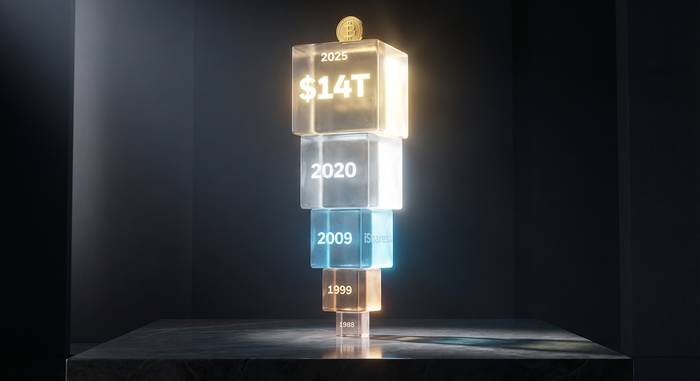
The growth came in waves. PNC Financial took a stake in 1994, pushing assets under management to $53 billion. BlackRock went public on the New York Stock Exchange in 1999 at $14 per share -- a holding company that would eventually become the largest in its field. In 2006 it merged with Merrill Lynch Investment Managers, adding new fund lineups and a huge distribution network. But the move that changed everything came in 2009: BlackRock acquired Barclays Global Investors, which brought iShares -- the world's largest ETF platform -- under its roof.
That one deal turned BlackRock from a big investment manager into the global asset manager. BlackRock and iShares together gave the firm direct access to retail investors through exchange traded funds. The ETF boom of the 2010s did the rest. Asset management at scale had a new king. By 2020, assets under management crossed $8 trillion. By the end of 2025, they hit $14.042 trillion -- a 21.6% increase from the year before, powered by a record $698 billion in net inflows.
| Year | Milestone | AUM |
|---|---|---|
| 1988 | Founded as Blackstone division | $5M starting capital |
| 1992 | Rebranded to BlackRock | $17B |
| 1999 | IPO on NYSE at $14/share | $165B |
| 2006 | Merged with Merrill Lynch IM | ~$1T |
| 2009 | BlackRock acquired BGI + iShares | ~$3.3T |
| 2020 | Crossed $8T milestone | $8.68T |
| 2024 | Launched IBIT, ETHA, BUIDL | $11.55T |
| 2025 | Record inflows, Preqin + GIP acquisitions | $14.04T |
How BlackRock actually makes money
BlackRock is an investment management firm. It does not make things. It does not sell software (well, sort of -- more on that). It manages other people's money and charges fees for doing it.
Investment management and advisory fees -- from iShares ETFs, mutual funds, index funds, actively managed strategies, and alternative investments -- account for over 70% of revenue. You buy an iShares ETF, BlackRock takes a small percentage as an expense ratio. When you manage $14 trillion in investment portfolios, even tiny percentages add up fast.
The company also sells technology and management services. Aladdin, BlackRock's risk management and investment advisory platform, is used by banks, pension funds, insurers, and sovereign wealth funds to manage their own investment portfolios. Japan's largest asset manager runs on Aladdin. Korea's National Pension Service runs on Aladdin. The platform handles about $25 trillion in total assets and pulls in roughly $1.7 billion a year -- about 8% of BlackRock's revenue. In October 2025, Aladdin launched an AI-powered commentary feature with Morgan Stanley as first client.
The financial services company also earns from distribution fees, performance fees on BlackRock funds, and management services for institutional clients. Total revenue for fiscal year 2025 hit $24.22 billion, up 19% from the year before. Net income dipped to $5.55 billion (down 13%) because of noncash charges tied to the $12.5 billion Global Infrastructure Partners acquisition and the $12 billion HPS Investment Partners deal.
The stock (BLK) trades around $962 on the New York Stock Exchange with a market cap of about $166 billion. BlackRock returned $5 billion to shareholders in 2025 through dividends and buybacks and raised the 2026 dividend by 10%.
The crypto pivot nobody saw coming
In 2017, BlackRock CEO Larry Fink called Bitcoin "an index for money laundering." By 2024, his firm was running the biggest Bitcoin fund on the planet.
What changed? The market did. Institutional demand for crypto exposure grew so fast that ignoring it became a bigger risk than participating. Fink admitted as much publicly: he said he had been "wrong" about Bitcoin and now sees it as "digital gold" and "an asset of fear" -- a safe haven for people worried about currency debasement and political instability.
BlackRock launched the iShares Bitcoin Trust (IBIT) on January 11, 2024. It became the fastest-growing exchange-traded product in history. By March 2026, IBIT held roughly $54 billion in assets -- about 771,000 BTC -- and commanded 45%+ market share among US spot Bitcoin ETFs. In 2025 alone, IBIT drew $25 billion in net inflows, making it the 6th largest ETF by inflows across all asset classes. Not just crypto. All of them.
The iShares Ethereum Trust (ETHA) followed in mid-2024, sitting at about $6 billion in assets by early 2026. Smaller than IBIT, but the largest spot Ethereum ETF by a wide margin.
Then there is BUIDL -- the BlackRock USD Institutional Digital Liquidity fund, tokenized by Securitize on Ethereum and now live on 8+ blockchains including Arbitrum, Solana, Avalanche, and BNB Chain. BUIDL holds US Treasury bills and cash, offering institutional investors a tokenized money market product. It peaked at around $2.9 billion in mid-2025, roughly 40% of the total tokenized Treasury market. As of early 2026 it sits at about $1.7 billion after some outflows, with Circle's USYC fund emerging as a competitor.
BlackRock also purchased blockchain-issued municipal bonds in December 2024 -- a quiet but telling move. BlackRock launched this effort because it sees tokenized securities as the future of fixed-income markets. The firm is not just buying crypto. It is rebuilding how financial markets work under the hood.
| Product | Type | AUM (Mar 2026) | Launch | Market position |
|---|---|---|---|---|
| IBIT | Spot Bitcoin ETF | ~$54B | Jan 2024 | #1, 45%+ market share |
| ETHA | Spot Ethereum ETF | ~$6B | Jul 2024 | #1 spot ETH ETF |
| BUIDL | Tokenized Treasury fund | ~$1.7B | Mar 2024 | Top 2 tokenized Treasury product |
In his 2026 annual shareholder letter, Fink projected that BlackRock's crypto business could generate $500 million per year in revenue within five years. He called tokenization "where the internet was in 1996." He also floated a path where global Bitcoin adoption could drive the price toward $700,000 -- while warning that Bitcoin's rise could undermine the dollar's reserve status if America does not get its fiscal house in order.
The conspiracy theories and the real concerns
BlackRock shows up in every conspiracy thread you have ever scrolled past. Secret world government. Owns everything. Controls politicians. Buys up every house in your neighborhood.
Most of this is noise. BlackRock is an investment company that manages money for clients. It and Vanguard show up as top holders in most large companies because they run massive index funds. When you own an S&P 500 ETF, your money buys shares in all 500 companies. The fund manager -- BlackRock, Vanguard, State Street -- ends up listed as a major shareholder. But they are not buying those companies for themselves. They are buying them for you, the iShares or index fund investor. They are fiduciary to their clients, not the owners of America Inc.
The housing thing? That is mostly Blackstone (different company, confusing name). BlackRock itself has clarified this repeatedly. Institutional investors own a small fraction of US homes.
But real concerns exist. The "Big Three" -- BlackRock, Vanguard, and State Street -- collectively own roughly 25% of S&P 500 companies through their index products. That level of concentration raises questions about market power, voting influence, and systemic risk. Texas and 15 Republican states filed an antitrust lawsuit alleging that BlackRock used its investment strategies to pressure companies into limiting coal production. The DOJ and FTC joined the action.
BlackRock withdrew from the UN Net Zero Asset Managers initiative in January 2025, right before Trump took office. It lost European pension fund business for not being green enough and got blacklisted in Texas for being too green. The firm still runs 305+ ESG-labeled BlackRock funds, 81% of which exclude some fossil fuel companies. Financial conduct authorities in multiple countries are watching how BlackRock handles these conflicts. Fink's 2026 letter quietly de-emphasized green energy and pivoted the narrative toward AI infrastructure. The political tightrope is real.
BlackRock vs the competition
BlackRock is not the only giant. But its investment strategies in crypto and tokenization have opened a gap.
| Firm | AUM | Crypto products | Crypto stance |
|---|---|---|---|
| BlackRock | $14.04T | IBIT ($54B), ETHA ($6B), BUIDL | All in. Largest crypto ETF issuer |
| Vanguard | ~$12T | None proprietary | Reversed anti-crypto stance Dec 2025, now allows 3rd-party crypto ETF trades. Will not launch own products |
| Fidelity | ~$5.8T | FBTC ($12.7B) | Early adopter, #2 Bitcoin ETF, encourages retirement crypto allocations |
| State Street | ~$4.7T | None yet | Planning crypto custody for 2026 |
Fidelity's FBTC is the only real competitor to IBIT, and it is less than a quarter of the size. Vanguard spent years refusing to let clients touch crypto, then reversed course in December 2025 under competitive pressure -- it now allows trading third-party crypto ETFs but will not launch its own. State Street is still building out a crypto custody service. BlackRock has a two-year head start and keeps adding new fund products and investment services. The gap is getting wider, not narrower.
It is worth noting that none of these products constitute investment advice. They are investment vehicles that provide liquidity and market access. BlackRock does not tell you to buy Bitcoin. It gives you a cheap, regulated way to do it yourself. The distinction matters for how regulators see these products.
What BlackRock's crypto bet means for you
BlackRock is not a crypto company. It is a $14 trillion asset management machine that decided crypto was too big to sit out. When the largest asset manager on the planet puts its name on Bitcoin ETFs, tokenized Treasuries, and blockchain securities, every institution still on the fence takes notice. Financial markets move when BlackRock moves.
IBIT holds more Bitcoin than all but a handful of entities on earth. BUIDL is dragging tokenization from lab experiment into the real financial markets. Investing involves risks -- Fink writes that in every single letter -- but the direction of travel is clear. BlackRock sees crypto and tokenized assets as permanent parts of the global financial system. Not a trade. Not a fad. Infrastructure.
The tension is obvious. Having the world's largest investment company sitting on the biggest pile of Bitcoin ETF shares puts power right back into the hands of the kind of institution crypto was built to make useless. Bitcoiners point this out constantly. They are right. But the money keeps coming in. $54 billion in IBIT is hard to argue with.
There is a weird split happening in how people think about BlackRock and crypto. If you care about security of your investment, having BlackRock custody your Bitcoin through a regulated ETF feels safer than running your own wallet. If you care about the original point of Bitcoin -- financial self-sovereignty -- then the biggest fund manager in the world owning 771,000 BTC is exactly the problem.
Both views make sense. Neither is going away.
BlackRock will keep building products for the financial markets because that is what BlackRock does. It does not build for ideological reasons. It builds for asset management fees. And right now, crypto fees are growing faster than anything else in the portfolio. Fink's $500 million annual crypto revenue target was not a dream. It was a business plan.
If you want to learn more about BlackRock, the simplest way is through their products. Buy an iShares ETF. Look at the prospectus. Read Fink's annual letter. The company hides in plain sight -- every shareholder report, every fund page, every SEC filing is public. The purpose at BlackRock, as they repeat in every document, is to help people invest for the long term. Whether you trust that mission or see it as corporate PR is up to you. The $14 trillion speaks for itself.