
Orbiter Finance: Cross-Rollup Bridge Guide & OBT Review 2026

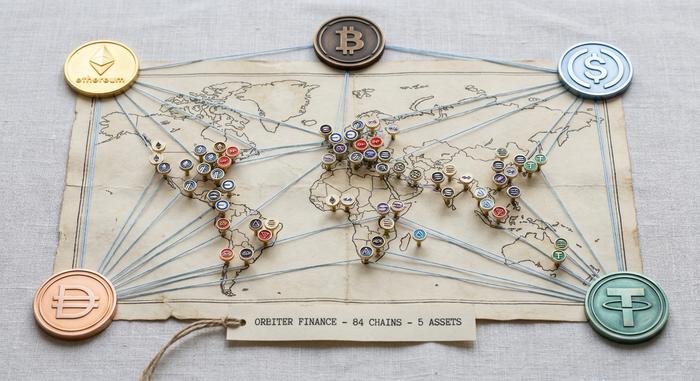
Most cross-chain blockchain bridges work the same way: lock your tokens on chain A, mint a wrapped version on chain B, then unwind the lock when the user goes back. Orbiter Finance does not do that. The Orbiter Finance bridge runs a Maker-EOA model where a liquidity provider (the Maker) posts margin, sees a deposit on the source chain, and delivers funds from their own wallet on the destination chain — typically inside ten to twenty seconds. By May 2026 the protocol has moved roughly $28 billion across 35 million transactions for more than 4.7 million users, with 84 mainnet chains supported per the official documentation. The OBT governance token launched on Donald Trump's inauguration day in January 2025 and has since lost about 97% of its all-time-high price. This guide covers what the protocol actually does, how to bridge through it, how it compares to Across and Stargate, and whether the post-airdrop token still matters.
What Orbiter Finance is and who built the protocol
Orbiter Finance was founded in Singapore in 2021. Its only confirmed funding round is a $3.2 million seed at a $40 million valuation, closed in March 2022, with Tiger Global, StarkWare, Matrixport Ventures, Mirana Ventures, Lemniscap, Amber Group, Mask Network, Loopring, imToken Ventures, A&T Capital, and Cobo Ventures among the backers. A second round closed in January 2024 with OKX participating, but the amount has not been disclosed. Pantera Capital is frequently listed as an investor in third-party write-ups — that is incorrect. Pantera invested in StarkWare, which in turn invested in Orbiter, and the chain of associations has gotten compressed in retelling.
The team also has an academic tie to the Ethereum Foundation: a 2024 joint research paper with Kyle Charbonnet at EF and UC Santa Barbara on bridge-security models. That is collaboration, not employment, and it is worth keeping the distinction clean.
How the Orbiter Finance bridge protocol works
Three contracts and one role do most of the work. The Maker is an externally owned account (an EOA, the same kind of wallet you use to hold ETH) that has posted margin into the Maker Deposit Contract on every chain it serves. When a Sender wants to bridge, the Sender transfers funds to the Maker's EOA on the source chain with a small amount-encoding suffix that flags the destination chain. The Maker watches the source chain, sees the deposit, and sends matching funds out of its own EOA on the destination chain. Settlement window: ten to twenty seconds for most routes.
If the Maker fails to deliver, the Sender invokes the Event-Bound Contract, which uses a Simple Payment Verification proof against the source-chain block to confirm the deposit really happened. The EBC then slashes the Maker's margin in the MDC and reimburses the Sender with compensation on top of the original amount. The security code shown during a bridge transaction is the Sender's claim ticket if this arbitration is ever needed.
The trade-offs are honest. The model is fast because there is no consensus to wait on and no lock-and-mint round-trip. It is also liquidity-bounded, because every transfer comes out of a Maker's pre-funded wallet. Large transfers can hit a Maker's instantaneous capacity. Maker availability across all 84 chains varies, and at the long-tail end you may see slower fills or routing through a chain hop. Lock-and-mint vulnerabilities — the kind that produced the Wormhole and Ronin disasters — do not apply here because there is nothing being minted.
Supported chains, assets, and bridge fees
The 84 mainnet chains is the headline number, and it is genuinely the broadest count among non-aggregator bridges as of May 2026. Orbiter Finance coverage spans EVM Layer 2 rollups (Arbitrum, Optimism, Base, zkSync, Linea, Scroll, Polygon zkEVM), BNB Chain, plus non-EVM virtual machines: SolanaVM, SuiVM, CairoVM (Starknet), TronVM, FuelVM, AptosVM, ImmutableX, Hyperliquid, and Eclipse. The breadth is a real interoperability advantage for users routing across blockchain ecosystems. Five core assets are routed natively: ETH, USDC, USDT, DAI, and WBTC. Custom tokens are supported through an API-routing pathway documented in the official docs.
Fees are a flat trading rate from 0.03% to 0.30%, plus a dynamic withholding component that covers destination-chain gas. The withholding rate updates with network conditions on the receiving end, which is why a quote on Skrumble in early 2026 came back at around $4.85 to bridge 0.5 ETH from Optimism to Arbitrum — most of that is destination gas, not the trading fee.
| Component | What it is | Typical 2026 range |
|---|---|---|
| Trading fee | Orbiter's protocol fee | 0.03%–0.30% of amount |
| Withholding fee | Destination gas reimbursement | Dynamic, ~$0.50–$5+ per tx |
| Time | Most routes | 10–20 seconds |
How to bridge crypto with Orbiter Finance step by step
Seven steps cover almost every bridging case. First, open orbiter.finance in your browser; there is no native mobile app, so beware of fake clones on app stores. Second, connect MetaMask (or any WalletConnect-compatible wallet) and confirm the network. Third, pick the asset from the supported list. Fourth, choose source and destination chains. Fifth, enter the amount and read the auto-quoted total fee. Sixth, copy or screenshot the security code that appears in the confirmation step — this is your arbitration ticket. Seventh, approve the transaction in the wallet and wait the ten to twenty seconds for the Maker to deliver on the destination chain.
Two practical notes from regular users. Set the wallet network to the source chain before clicking "bridge" or MetaMask will prompt a switch and slow you down. And on the long-tail chains (CairoVM, smaller EVMs), the route may execute via an intermediate hop, so confirm the route preview before signing.
Orbiter Finance vs Across, Stargate, Hop, and Synapse
The comparison is more nuanced than a single ranking. Each bridge optimizes for a different axis.
| Bridge | Architecture | Chains | Speed | Typical fee | 2026 strength |
|---|---|---|---|---|---|
| Orbiter Finance | Maker-EOA liquidity network | 84 mainnet | 10–20 sec | 0.03–0.30% + gas | Chain count, speed |
| Across | Optimistic oracle (UMA) | ~20 EVM | 1–4 min | 0.01–0.25% | $650M TVL, lowest typical fee |
| Stargate | LayerZero unified liquidity | ~70 incl. non-EVM | 1–3 min | 0.06% + gas | $465M 30-day volume |
| Hop Protocol | AMM + canonical messengers | ~10 EVM | 30 sec–10 min | 0.04% + gas | $3B+ lifetime, mature |
| Synapse | Cross-chain stableswap | ~20 EVM | 1–5 min | Variable, 80% cheaper on 45/60 routes (Synapse-published) | Niche routing |
Orbiter wins on raw chain count and speed. Across has the best fee profile in the L2-to-L2 lane and inherits UMA's well-tested optimistic-oracle security. Stargate's LayerZero base layer makes it the strongest for cross-virtual-machine moves. Hop has the longest unbroken operating record. Synapse plays niche routes well but a lot of its "cheaper than competitors" data is its own research, so weight accordingly.
The practical rule for picking a bridge in 2026 has not changed: route the actual amount you want to move through three bridges, compare quotes including time, and use the cheapest-plus-fastest. For the L2-to-L2 lanes where speed matters, Orbiter is usually the answer.
OBT token, the Orbiter Finance airdrop, and price action
OBT launched on January 20, 2025 — Trump's inauguration day, deliberately chosen as a high-attention date. Total supply is 10 billion. The initial circulating supply at TGE was 2.8 billion or 28% of total. Allocation: 40% community, 20% ecosystem, 15% team, 15% foundation, 10% investors. The initial airdrop was 22% of supply, distributed at TGE, followed by an additional 3% per month for six months. Snapshot was taken on January 16, 2025.
Eligibility rewarded protocol usage. The two thresholds were at least two months of activity since December 2021 and a minimum of 40 OPoints accumulated through the platform. Maximum per user was 5,600 OBT, with Ace Pilot NFT holders receiving 17,000 OBT and Expert Pilot NFT holders 2,300 OBT. Launch chains were Ethereum, Arbitrum, and Base, with listings on Bybit (a launchpool covering 0.8% of supply), Gate, MEXC, and Bithumb (March 2025).
Price tells the rest of the story. Bithumb listing pushed the all-time high to roughly $0.033 in March 2025. By May 2026 OBT trades around $0.00095 — a drawdown near 97%. Token-economics on this kind of curve is usually a combination of large airdrop dump pressure, low buy-side demand outside of farming, and the absence of a clear staking or fee-capture mechanism to sink supply. None of that invalidates the underlying protocol; it just means the token and the product should be valued separately for now.
Orbiter Finance security, audits, and the 2023 Discord hit
Audit coverage of the Orbiter Finance smart contracts is partial and partly misreported elsewhere. The official Orbiter docs list SlowMist as an auditor. Third-party reviews mention CertiK and PeckShield, but the corresponding public audit reports could not be located through primary sources. Halborn is sometimes cited; that one is wrong. Halborn audited the Orbit Bridge / Orbit Chain protocol — a separate project with a similar name that lost roughly $82 million in a December 2023 exploit. The two are routinely confused.
Orbiter's own 2023 incident was social, not on-chain. On June 1, 2023, the Pink Drainer phishing operation compromised the Orbiter Discord and posted a fake ORB airdrop link. Roughly $213,000 in user funds were lost through the malicious approvals that followed. Orbiter ran a compensation program starting July 5, 2023, with full refunds for losses up to $1,000 and tiered payouts above. In October 2023 a wave of users reported missing or stuck transactions on social media; no exploit was ever confirmed, and the issue resolved without core contract changes.
The honest summary: more than three years of operation, $28 billion in throughput, no breach of the core bridge contracts. That is a meaningful track record, with the caveat that audit transparency is below what a protocol of this scale should publish.
Vizing zkEVM and the road ahead in 2026
Orbiter is no longer just a bridge. In April 2024 the team announced Vizing, an OKX-backed ZK omnichain rollup that aims to make Orbiter the L2 itself, not only the routing layer between other L2s. The strategic logic is plain: aggregating cross-rollup volume into a single rollup of your own captures the value that today flows through to the destination chains. 2025 partnerships extended the surface area further: Rootstock for RIF-token bridge rebates (ending December 15, 2025), Nano Labs for the NBNB.io stablecoin route added in Q4 2025, Hyperliquid USDC routing live since July 25 2025, JuChain ZK integration since November 19 2025, and a KyberSwap routing partnership across DEX aggregators. Whether Vizing actually ships on the announced timeline is the bet to watch in 2026.
Is Orbiter Finance safe to use today
The Orbiter Finance maker-EOA architecture removes a major class of smart contract bridge risk: there is nothing being minted, so the Wormhole and Ronin failure modes do not apply. What replaces them is Maker-liveness risk, mitigated by the SPV-arbitration mechanism and the on-chain margin every Maker has posted. Use the canonical URL orbiter.finance only. The 2023 Discord incident shows that the soft-target risk is real even when the contracts are clean.
The verdict on Orbiter Finance in 2026
A modestly funded Singapore team has built one of the fastest and broadest cross-chain blockchain bridges in DeFi, with 84 mainnet networks and a multi-billion-dollar throughput record. The Orbiter Finance maker-EOA model was the right architectural call. The OBT token launch, by contrast, looks like a price-of-attention bet that did not pay back for holders. Use Orbiter Finance for L2-to-L2 transfers across rollups, evaluate the token on its own terms, and watch what Vizing actually ships in 2026.



